MBOSE Class 11 Question Paper 2018 for Geology
Finished viewing? Save it for later —
Download MBOSE Class 11 Question Paper 2018 for Geology (PDF · 4 pages)About MBOSE Class 11 Question Paper 2018 for Geology
MBOSE Class 11 Question Paper 2018 for Geology is available here for free download. Published by Meghalaya Board for Class 11, this question paper can be viewed online or downloaded as a PDF (4 pages). Candidates preparing for Class 11 can use MBOSE Class 11 Question Paper 2018 for Geology to understand the exam pattern, the type of questions asked, and the overall difficulty level.
Frequently Asked Questions
How can I download MBOSE Class 11 Question Paper 2018 for Geology?
Open this page and click the Download button to save MBOSE Class 11 Question Paper 2018 for Geology as a PDF. It is completely free on AglaSem Docs.
Is MBOSE Class 11 Question Paper 2018 for Geology free to download?
Yes. MBOSE Class 11 Question Paper 2018 for Geology can be viewed online and downloaded as a PDF free of cost on AglaSem Docs.
How many pages does MBOSE Class 11 Question Paper 2018 for Geology have?
MBOSE Class 11 Question Paper 2018 for Geology contains 4 pages, which you can read online or download together as a single PDF.
Where can I find more Class 11 study material?
You can find more Class 11 question papers, sample papers, syllabus, and answer keys on AglaSem Docs.
MBOSE Class 11 Question Paper 2018 for Geology – Text
Read the full text of this question paper below — useful to quickly search, copy and reference the content online without downloading the PDF.
📄 View text version (4 pages)
Page 1
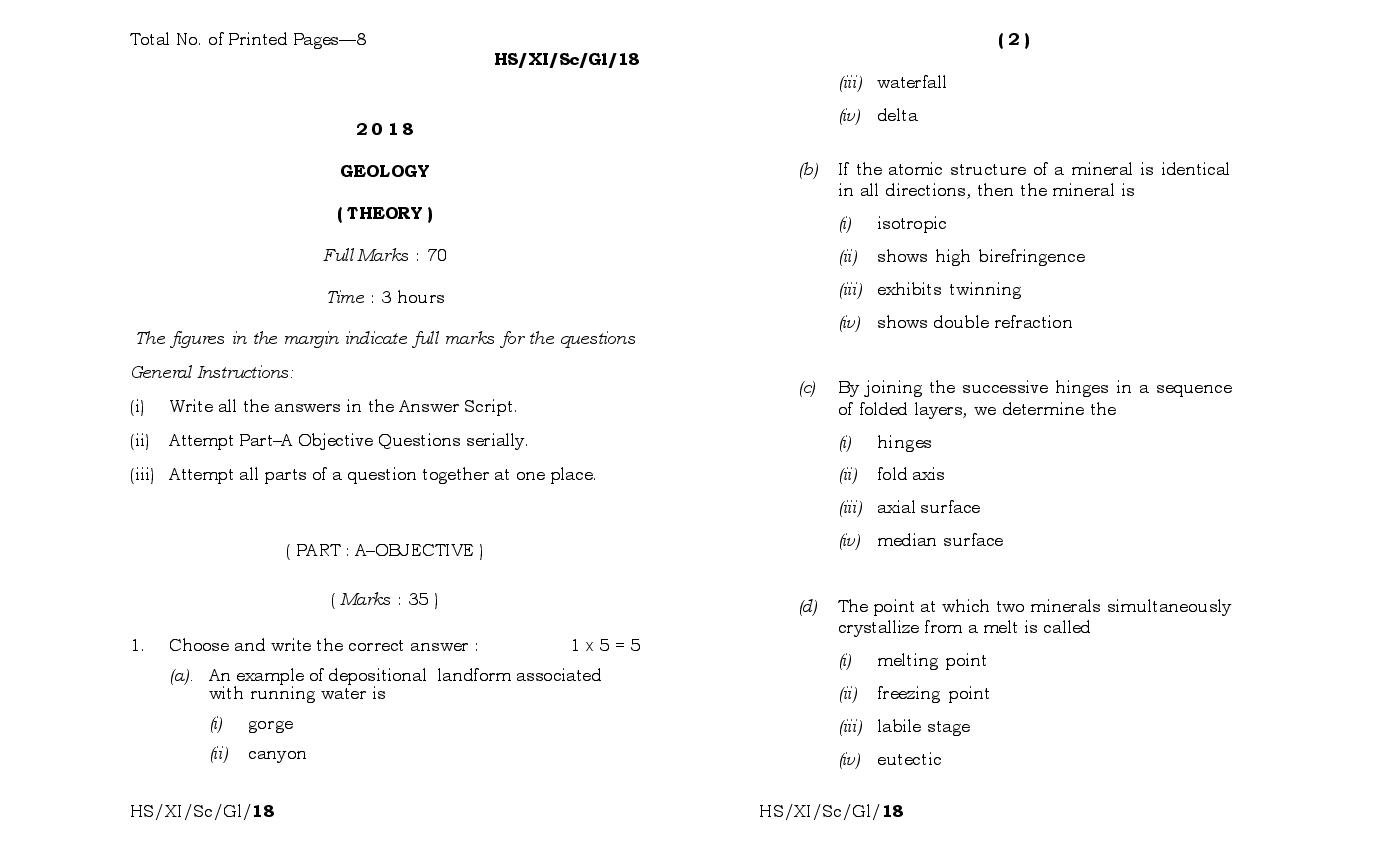
HS/XI/Sc/Gl/18
(iii) waterfall
(iv) delta
2018
GEOLOGY (b) If the atomic structure of a mineral is identical
in all directions, then the mineral is
( THEORY )
(i) isotropic
Full Marks : 70 (ii) shows high birefringence
Time : 3 hours (iii) exhibits twinning
(iv) shows double refraction
The figures in the margin indicate full marks for the questions
General Instructions:
(c) By joining the successive hinges in a sequence
(i) Write all the answers in the Answer Script. of folded layers, we determine the
(ii) Attempt Part–A Objective Questions serially. (i) hinges
(iii) Attempt all parts of a question together at one place. (ii) fold axis
(iii) axial surface
(iv) median surface
( PART : A–OBJECTIVE )
( Marks : 35 ) (d) The point at which two minerals simultaneously
crystallize from a melt is called
1. Choose and write the correct answer : 1x5=5
(i) melting point
(a). An example of depositional landform associated
with running water is (ii) freezing point
(i) gorge (iii) labile stage
(ii) canyon (iv) eutectic
Page 2
(e) Alignment of platy or flaky minerals in parallel (c) The clinographic relationship a1 = a2 = a3 c is
layers give rise to the metamorphic rock related to the system.
(i) slate
(d) are the finest products of a volcano.
(ii) schist
(e) Tabular igneous rocks parallel to bedding are
(iii) gneiss called .
(iv) hornfels
(f) Generally, the last mineral to crystallize from an
igneous melt is .
2. State ‘ True’ or ‘False’ : 1x5=5
(g) Strike of rocks is perpendicular to .
(a) Earthquakes are recorded by seismograms.
(b) Minerals break along smooth parallel surfaces (h) An example of low grade metamorphic rock is
called fractures. .
(c) Crust and uppermost mantle make up tectonic (i) The term is used to denote metamorphic
plates. rock fabric.
(d) It is possible to give rise to diverse rocks from
one single parental magma. (j) Folds with almost horizontal axial surface are
called folds.
(e) The presence of muscovite and biotite indicates
high metamorphic grade.
4. Express in one word :
1x3=3
3. Fill in the blanks : 1 x 10 = 10 (a) Hot igneous melt on the earth’s surface.
(a) When sediments are laid down as layers, they
are deposited in a manner. (b) Crystals joined along common crystallographic
planes.
(b) The change in color of a mineral under polarized
light is called .
(c) Physical and chemical breakdown of rocks.
Page 3
5. Match Column A with Column B and write the ( PART : B–DESCRIPTIVE )
corresponding numbers : 1x6=6
( Marks : 35 )
Column A Column B
Answer five questions selecting one from each Group
(a) Denudation (i) inclination of line
(ii) gravity settling GROUP – A
(b) Plunge
(iii) cataclasis ( General Geology )
(iv) small crystals 1. Elucidate the nature of the earth’s interior. Draw a
(c) Differentiation
neat sketch. 7
(v) erosion
(d) Stress (vi) large crystals
2. Answer any two of the following : 3½ x 2 = 7
(vii) inclination of plane (a) Processess of weathering
(e) Palimpsest
(viii) weathering and erosion (b) Geological Time Scale
(ix) remnant fabric. (c) Origin of the solar system
(f) Phenocrysts
6. Write briefly within three sentences on: 1x6=6 GROUP – B
(a) Agents of weathering ( Crystallography and Mineralogy )
(b) Plane of symmetry
3. List the symmetry elements of the Normal Class of
(c) Plastic deformation the Tetragonal system. List the forms developed in
the Normal Class of the Tetragonal system. Distinguish
(d) Concept of crystallization a Tetragonal prism from a pyramid. Draw a
clinographic sketch of the Tetragonal system. Name
(e) Concept of metamorphism two minerals crystallizing in the Tetragonal system.
(f) Batholith 1½ + 2 + 2 + ½ + 1 = 7
HS/XI/Sc/Gl/18 HS/XI/Sc/Gl/18
Page 4
4. Answer any two of the following: 3½ x 2 = 7 8. Answer any two of the following: 3½ x 2 = 7
(a) Concept of metamorphic differentiation
(a) Polarization of light
(b) Double refraction (b) Magma
(c) Common physical properties of minerals. (c) Assimilation
GROUP – E
GROUP – C
( Metamorphic Petrology )
( Structural Geology and Geotectonics )
9. Write short notes on any three metamorphic rock
5. Define a fault. What is footwall and hanging wall and textures and any three metamorphic rock structures.
slip of faults? Write brief notes on the various types of Draw neat diagrams. 6+1=7
faults with sketches. 1+2+4=7
10. Answer any two of the following: 3½ x 2 = 7
6. Answer any two of the following: 3½ x 2 = 7
(a) Anticline and syncline (a) Agents of metamorphism
(b) Joints (b) Regional metamorphism
(c) Concept of plate tectonics. (c) Riecke’s Principle.
GROUP – D
( Igneous Petrology )
7. Write notes on any seven common textures seen in
volcanic and plutonic igneous rocks. Draw suitable
diagrams. 7
HS/XI/Sc/Gl/18 HS/XI/Sc/Gl/18
Document Details
| Board / Org | Meghalaya Board |
| Exam | Class 11 |
| Type | Question Paper |
| Pages | 4 |
| Updated | 30 Apr 2026 |