MBOSE Class 12 Question Paper 2021 for Anthropology
Finished viewing? Save it for later —
Download MBOSE Class 12 Question Paper 2021 for Anthropology (PDF · 8 pages)About MBOSE Class 12 Question Paper 2021 for Anthropology
MBOSE Class 12 Question Paper 2021 for Anthropology is available here for free download. Published by Meghalaya Board for Class 12, this question paper can be viewed online or downloaded as a PDF (8 pages). Candidates preparing for Class 12 can use MBOSE Class 12 Question Paper 2021 for Anthropology to understand the exam pattern, the type of questions asked, and the overall difficulty level.
Frequently Asked Questions
How can I download MBOSE Class 12 Question Paper 2021 for Anthropology?
Open this page and click the Download button to save MBOSE Class 12 Question Paper 2021 for Anthropology as a PDF. It is completely free on AglaSem Docs.
Is MBOSE Class 12 Question Paper 2021 for Anthropology free to download?
Yes. MBOSE Class 12 Question Paper 2021 for Anthropology can be viewed online and downloaded as a PDF free of cost on AglaSem Docs.
How many pages does MBOSE Class 12 Question Paper 2021 for Anthropology have?
MBOSE Class 12 Question Paper 2021 for Anthropology contains 8 pages, which you can read online or download together as a single PDF.
Where can I find more Class 12 study material?
You can find more Class 12 question papers, sample papers, syllabus, and answer keys on AglaSem Docs.
MBOSE Class 12 Question Paper 2021 for Anthropology – Text
Read the full text of this question paper below — useful to quickly search, copy and reference the content online without downloading the PDF.
📄 View text version (8 pages)
Page 1
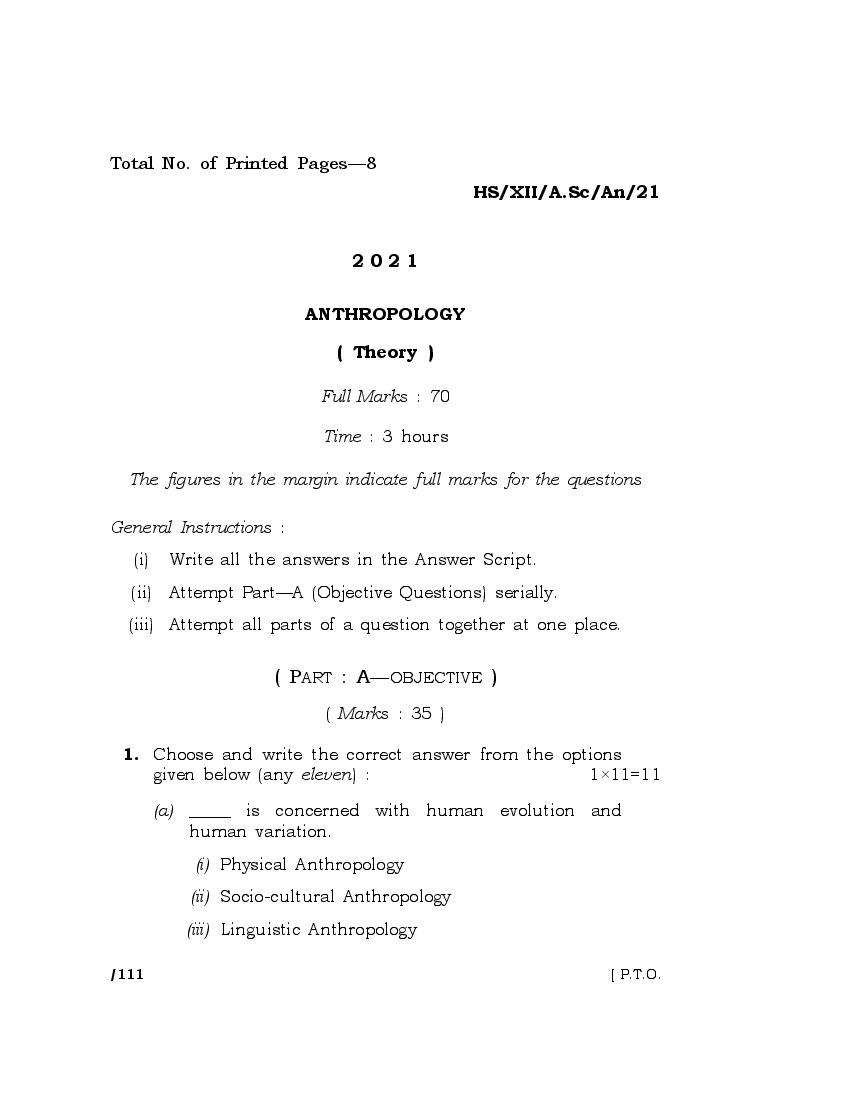
HS/XII/A.Sc/An/21
2021
ANTHROPOLOGY
( Theory )
Full Marks : 70
Time : 3 hours
The figures in the margin indicate full marks for the questions
General Instructions :
(i) Write all the answers in the Answer Script.
(ii) Attempt Part—A (Objective Questions) serially.
(iii) Attempt all parts of a question together at one place.
( PART : A—OBJECTIVE )
( Marks : 35 )
1. Choose and write the correct answer from the options
given below (any eleven) : 1×11=11
(a) _____ is concerned with human evolution and
human variation.
(i) Physical Anthropology
(ii) Socio-cultural Anthropology
(iii) Linguistic Anthropology
/111 [ P.T.O.
Page 2
(b) The stages of human growth have been classified by
(i) R. L. Scammon
(ii) Thomas Huxley
(iii) Adam Smith
(c) After the prime period of adulthood, _____ starts.
(i) puberty
(ii) adolescence
(iii) senescence
(d) Growth of an individual is affected by _____ factors.
(i) intrinsic
(ii) extrinsic
(iii) Both (i) and (ii)
(e) The facial prognathism is prominent among
(i) Caucasoid
(ii) Negroid
(iii) Mongoloid
(f) The Scytho-Dravidian was classified by
(i) H. H. Risley
(ii) B. S. Guha
(iii) S. S. Sarkar
HS/XII/A.Sc/An/21/111 [ Contd.
Page 3
(g) The human ovum at conception is about
(i) 0·1 mm
(ii) 0·5 mm
(iii) 0·8 mm
(h) Broad flat face with prominent cheek bones are
common among the
(i) Caucasoid
(ii) Negroid
(iii) Mongoloid
(i) Man can regulate his internal body temperature
around
(i) 36 ºC
(ii) 37 ºC
(iii) 38 ºC
(j) The first discovery of primitive art was from a large
cave named
(i) Altamira
(ii) Bhimbetka
(iii) Lascaux
HS/XII/A.Sc/An/21/111 [ P.T.O.
Page 4
(k) Blade tool belongs to
(i) Lower Palaeolithic Culture
(ii) Upper Palaeolithic Culture
(iii) Mesolithic Culture
(l) The first Backward Class Commission was
appointed on
(i) 26th November, 1949
(ii) 29th November, 1953
(iii) 31st March, 1955
(m) Domestication of plants took place in the
(i) Palaeolithic Period
(ii) Mesolithic Period
(iii) Neolithic Period
(n) The process which gives definite shape to different
parts of the body is called
(i) Morphogenesis
(ii) Growth spurt
(iii) Orthogenesis
HS/XII/A.Sc/An/21/111 [ Contd.
Page 5
(o) Endogamy is one of the characteristics of the Indian
(i) OBC
(ii) Tribe
(iii) Caste
2. State whether the following statements are True or
False (any ten) : 1×10=10
(a) Growth and development are the same.
(b) Temperature is uniform throughout the world.
(c) The main pigmentation of the skin of man is melanin.
(d) Home arts were found at the entrance of caves or
rock-shelters.
(e) The process of growing old is scientifically studied in
osteology.
(f) A tribe is a heterogeneous ethnic group.
(g) Clactonian is the first flake-tool culture.
(h) M. C. Burkitt classified the Palaeolithic art tradition
in Europe.
(i) Levalloisian Culture belongs to the flake-tool
tradition.
HS/XII/A.Sc/An/21/111 [ P.T.O.
Page 6
(j) Man is a social animal possessing culture.
(k) Patrilocal is the characteristic feature of the Khasi
society.
(l) The untouchables who constitute the lowest segment
of Hindu Social Hierarchy have been grouped as
Scheduled Caste.
(m) Race is a biological concept.
(n) Body size and proportion of man are influenced by
natural selection.
(o) The Negrito is one of the racial elements classified by
H. H. Risley.
3. Answer in brief any seven of the following : 2×7=14
(a) Define adaptation.
(b) What do you mean by growth?
(c) Define race.
(d) Name the major races of the world.
(e) What is gender?
(f) What is cave-art?
(g) What are handaxes?
HS/XII/A.Sc/An/21/111 [ Contd.
Page 7
(h) List (in order) the prehistoric stages of cultural
development.
(i) What is caste system?
(j) Who appointed the first Backward Class Commission
in India?
(k) What is prehistory?
(l) Name the four environmental conditions of human
adaptation.
(m) Amongst which race is the epicanthic fold common?
(n) Who classified the Aryo-Dravidian?
(o) Name any two Palaeolithic tools.
( PART : B—DESCRIPTIVE )
( Marks : 35 )
Answer Question No. 4 and any three from the rest
4. Write short notes on any two of the following : 5½×2=11
(a) Human adaptation in the mountain
(b) Sanskritization
(c) Culture contact
(d) Grinding and polishing technique
(e) Microliths
HS/XII/A.Sc/An/21/111 [ P.T.O.
Page 8
5. Describe the post-natal stages of human growth. 8
6. What are the major identified problems of tribes in
India? 8
7. Give the characteristic features of any two major races of
the world. 8
8. Describe the important characteristics of the caste
system in India. 8
9. Write on the special status of women in a matrilineal
society. 8
10. Write on the classification of Indian population according
to H. H. Risley or B. S. Guha. 8
11. Describe any two methods of tool-making in Palaeolithic
Period. 4+4=8
12. Write on the main features of Neolithic Cultures. 8
HS/XII/A.Sc/An/21/111 11–21—360
Document Details
| Board / Org | Meghalaya Board |
| Exam | Class 12 |
| Type | Question Paper |
| Pages | 8 |
| Updated | 30 Apr 2026 |