Goa Board Class 12 Question Paper 2022 Geology
Finished viewing? Save it for later —
Download Goa Board Class 12 Question Paper 2022 Geology (PDF · 12 pages)About Goa Board Class 12 Question Paper 2022 Geology
Goa Board Class 12 Question Paper 2022 Geology is available here for free download. Published by Goa Board for Class 12, this question paper can be viewed online or downloaded as a PDF (12 pages). Candidates preparing for Class 12 can use Goa Board Class 12 Question Paper 2022 Geology to understand the exam pattern, the type of questions asked, and the overall difficulty level.
Frequently Asked Questions
How can I download Goa Board Class 12 Question Paper 2022 Geology?
Open this page and click the Download button to save Goa Board Class 12 Question Paper 2022 Geology as a PDF. It is completely free on AglaSem Docs.
Is Goa Board Class 12 Question Paper 2022 Geology free to download?
Yes. Goa Board Class 12 Question Paper 2022 Geology can be viewed online and downloaded as a PDF free of cost on AglaSem Docs.
How many pages does Goa Board Class 12 Question Paper 2022 Geology have?
Goa Board Class 12 Question Paper 2022 Geology contains 12 pages, which you can read online or download together as a single PDF.
Where can I find more Class 12 study material?
You can find more Class 12 question papers, sample papers, syllabus, and answer keys on AglaSem Docs.
Goa Board Class 12 Question Paper 2022 Geology – Text
Read the full text of this question paper below — useful to quickly search, copy and reference the content online without downloading the PDF.
📄 View text version (12 pages)
Page 1
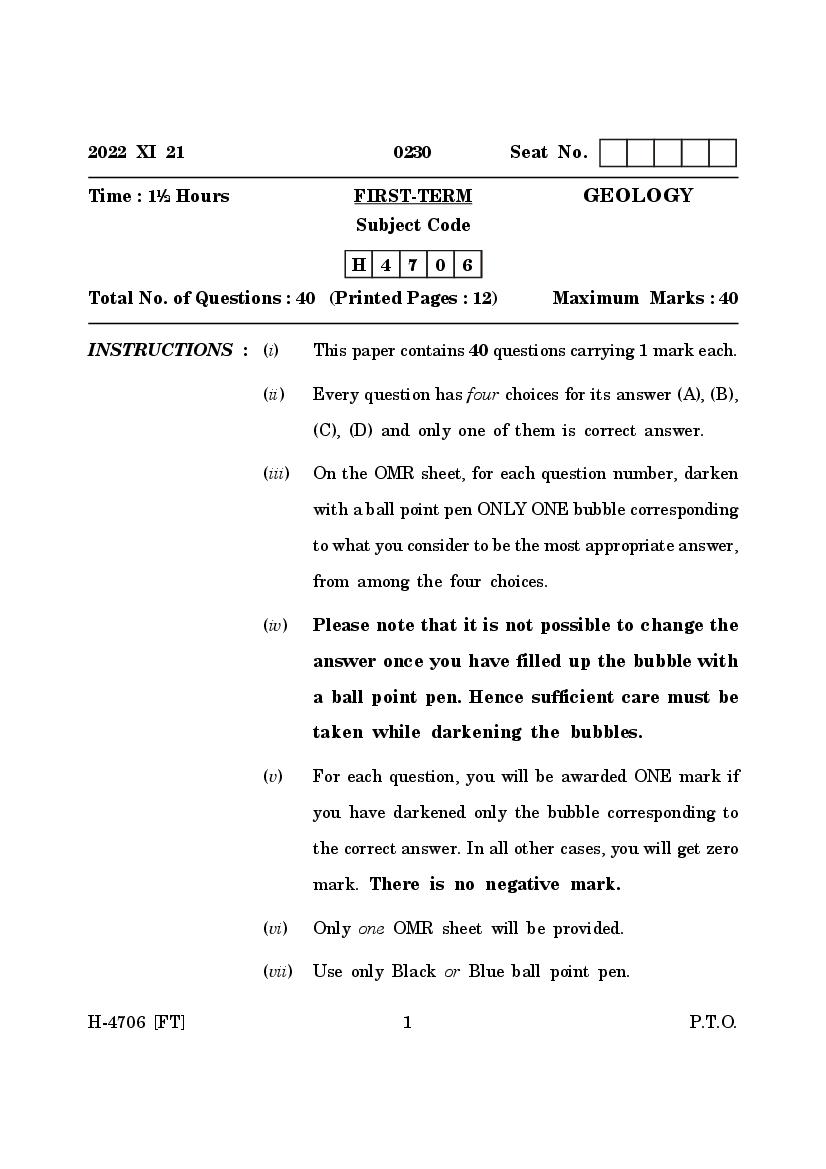
Time : 1½ Hours FIRST-TERM GEOLOGY
Subject Code
H 4 7 0 6
Total No. of Questions : 40 (Printed Pages : 12) Maximum Marks : 40
INSTRUCTIONS : (i) This paper contains 40 questions carrying 1 mark each.
(ii) Every question has four choices for its answer (A), (B),
(C), (D) and only one of them is correct answer.
(iii) On the OMR sheet, for each question number, darken
with a ball point pen ONLY ONE bubble corresponding
to what you consider to be the most appropriate answer,
from among the four choices.
(iv) Please note that it is not possible to change the
answer once you have filled up the bubble with
a ball point pen. Hence sufficient care must be
taken while darkening the bubbles.
(v) For each question, you will be awarded ONE mark if
you have darkened only the bubble corresponding to
the correct answer. In all other cases, you will get zero
mark. There is no negative mark.
(vi) Only one OMR sheet will be provided.
(vii) Use only Black or Blue ball point pen.
H-4706 [FT] 1 P.T.O.
Page 2
(A) Vertical
(B) Horizontal
(C) Inclined at 60º to the horizontal
(D) Inclined at 60º to its normal
2. Folds characterized by well-defined, sharp hinge points are called .......... 1
(A) Conjugate folds
(B) Chevron folds
(C) Cuspate folds
(D) Cylindrical folds
3. Match list I with list II and select the correct answer using the codes given
below the lists : 1
List I List II
(a) Axis of fold (1) Angle which axis makes with the
horizontal plane
(b) Plunge of fold (2) Line drawn parallel to the hinge
line of fold
(c) Crest (3) Lowest point in a down arched fold
(d) Trough (4) Highest point in a up arched fold
Codes :
(A) (a)-(2), (b)-(1), (c)-(4), (d)-(3)
(B) (a)-(1), (b)-(4), (c)-(2), (d)-(3)
(C) (a)-(3), (b)-(2), (c)-(1), (d)-(4)
(D) (a)-(4), (b)-(1), (c)-(2), (d)-(3)
H-4706 [FT] 2
Page 3
.................................. 1
(A) Normal fault
(B) Strike-slip fault
(C) Dip-slip fault
(D) Thrust fault
5. Which of the following is complimentary to the dip ? 1
(A) Strike
(B) Hade
(C) Rake
(D) Pitch
6. Shortening of the Earth’s crust is accommodated by ................................. 1
(A) Folds and Joints
(B) Normal and Reverse fault
(C) Folds and Reverse fault
(D) Folds and Normal fault
7. The main varieties of coal in correct order from low to high carbon content
are .......................................... 1
(A) Peat, Anthracite, Bituminous, Lignite
(B) Anthracite, Bituminous, Lignite, Peat
(C) Peat, Lignite, Bituminous, Anthracite
(D) Bituminous, Peat, Lignite, Anthracite
H-4706 [FT] 3 P.T.O.
Page 4
(A) CuFeS2
(B) Cu2Co3(OH)2
(C) CaSO4 – 2H2O
(D) Al2O32H2O
9. The plunge of a fold means ................................... 1
(A) Inclination of hinge line with horizontal
(B) Average inclination of both limbs and horizontal
(C) Inclination of fold crest line with horizontal
(D) Inclination of fold axis with horizontal
10. If the heave of the fault is zero, then the fault is ..................... 1
(A) High angle fault
(B) Low angle fault
(C) Horizontal fault
(D) Vertical fault
11. Joints which run in a direction that lies between the strike and dip direction
of the rock beds, are called .................................. 1
(A) Strike joint
(B) Dip joint
(C) Oblique joint
(D) Bedding joint
H-4706 [FT] 4
Page 5
Clay
(A) Reverse fault
(B) Angular unconformity
(C) Non-conformity
(D) Disconformity
13. The true dip of a bed is N25ºW, the strike direction of that will be ..... 1
(A) N65ºE
(B) S55ºE
(C) S65ºE
(D) N70ºW
14. Which of the following indicates an unconformity ? 1
(A) Sandstone
(B) Conglomerate
(C) Shale
(D) Grit
H-4706 [FT] 5 P.T.O.
Page 6
(A) Psilomelane
(B) Magnetite
(C) Bauxite
(D) Galena
16. When gravity is the agency involved in placing economic deposits, the deposit
is called ................................ 1
(A) Beach placers
(B) Alluvial placers
(C) Aeolian placers
(D) Deluvial placers
17. In Orissa iron ore are located in ............................. 1
(A) Mayurbhanj district
(B) Keonjhar district
(C) Both (A) and (B)
(D) Koraput district
18. Which state has the only diamond mine in the country ? 1
(A) Kerala
(B) Madhya Pradesh
(C) Karnataka
(D) Bihar
H-4706 [FT] 6
Page 7
(A) Placer deposit
(B) Epigenetic deposit
(C) Metamorphic deposit
(D) Syngenetic deposit
20. Which among the following is not the essential condition for hydrothermal
deposits ? 1
(A) Highly active fluid
(B) Suitable pathways
(C) Highly enriched fluid
(D) Highly inactive fluids
21. The ore mineral which shows non-metallic lustre is ........................... 1
(A) Hematite
(B) Galena
(C) Bauxite
(D) Magnetite
22. The streak exhibited by a mineral Hematite is ............................... 1
(A) Black
(B) Green
(C) Cherry red
(D) Blue
H-4706 [FT] 7 P.T.O.
Page 8
(A) Vageri formation
(B) Sanvordem formation
(C) Barcem formation
(D) Bicholim formation
24. An ore mineral in oxide form is ............................... 1
(A) Galena
(B) Chalcopyrite
(C) Psilomelane
(D) Pyrite
25. Which of the following would act as a cap rock in case of oil trap ? 1
(A) Sandstone
(B) Laterite
(C) Limestone
(D) Shale
26. Gash veins are typically seen in ............................... 1
(A) Limestone
(B) Laterite
(C) Sandstone
(D) Granite
H-4706 [FT] 8
Page 9
(A) Chromium
(B) Titanium
(C) Aluminium
(D) Laterite
28. Best example of a crystallized ore mineral is .............................. 1
(A) Fluorite
(B) Zircon
(C) Calcite
(D) Galena
29. If an igneous rock consists of quartz in large quantity, the rock could be
.......................................... 1
(A) Basalt
(B) Rhyolite
(C) Gabbro
(D) Dunite
30. Pearly lustre in phyllite is attributed to the presence of ......................... 1
(A) Orthoclase
(B) Muscovite
(C) Quartz
(D) Olivine
H-4706 [FT] 9 P.T.O.
Page 10
(A) Marble
(B) Gneiss
(C) Chlorite schist
(D) State
32. A very coarse grained clastic sedimentary rock of varied composition is termed
as ................................... 1
(A) Arenaceous rock
(B) Argillaceous rock
(C) Calcareous rock
(D) Rudaceous rock
33. In porphyritic texture the large crystal is termed as ............................. 1
(A) Oikocryst
(B) Phenocryst
(C) Xenolith
(D) Chadocryst
34. Volcanic equivalent of rock gabbro is .............................. 1
(A) Basalt
(B) Granite
(C) Rhyolite
(D) Trachyte
35. Which among the following is not a mafic minearl ? 1
(A) Amphibole
(B) Mica
(C) Pyroxene
(D) Plagioclase
H-4706 [FT] 10
Page 11
(A) Conglomerate
(B) Sandstone
(C) Granite
(D) Breccia
37. Sedimentary rock likely to be associated with Bauxite is ......................... 1
(A) Shale
(B) Laterite
(C) Limestone
(D) Sandstone
38. When granite undergoes contact metamorphism the net result may be ......... 1
(A) Marble
(B) Schist
(C) Gneiss
(D) Phyllite
39. Which of the following best shows the increasing grade of metamorphism ? 1
(A) Shale-schist-slate-phyllite
(B) Schist-slate-phyllite-shale
(C) Shale-slate-phyllite-schist
(D) Phyllite-slate-schist-phyllite
40. If a rock consists of clast of quartz welded together by calcite, the rock would
be called as ................................... 1
(A) Ferruginous sandstone
(B) Calcareous sandstone
(C) Siliceous sandstone
(D) Shelly limestone
H-4706 [FT] 11 P.T.O.
Page 12
Document Details
| Board / Org | Goa Board |
| Exam | Class 12 |
| Type | Question Paper |
| Pages | 12 |
| Updated | 24 Sep 2026 |