MBOSE Class 12 Question Paper 2021 for Biology
Finished viewing? Save it for later —
Download MBOSE Class 12 Question Paper 2021 for Biology (PDF · 16 pages)About MBOSE Class 12 Question Paper 2021 for Biology
MBOSE Class 12 Question Paper 2021 for Biology is available here for free download. Published by Meghalaya Board for Class 12, this question paper can be viewed online or downloaded as a PDF (16 pages). Candidates preparing for Class 12 can use MBOSE Class 12 Question Paper 2021 for Biology to understand the exam pattern, the type of questions asked, and the overall difficulty level.
Frequently Asked Questions
How can I download MBOSE Class 12 Question Paper 2021 for Biology?
Open this page and click the Download button to save MBOSE Class 12 Question Paper 2021 for Biology as a PDF. It is completely free on AglaSem Docs.
Is MBOSE Class 12 Question Paper 2021 for Biology free to download?
Yes. MBOSE Class 12 Question Paper 2021 for Biology can be viewed online and downloaded as a PDF free of cost on AglaSem Docs.
How many pages does MBOSE Class 12 Question Paper 2021 for Biology have?
MBOSE Class 12 Question Paper 2021 for Biology contains 16 pages, which you can read online or download together as a single PDF.
Where can I find more Class 12 study material?
You can find more Class 12 question papers, sample papers, syllabus, and answer keys on AglaSem Docs.
MBOSE Class 12 Question Paper 2021 for Biology – Text
Read the full text of this question paper below — useful to quickly search, copy and reference the content online without downloading the PDF.
📄 View text version (16 pages)
Page 1
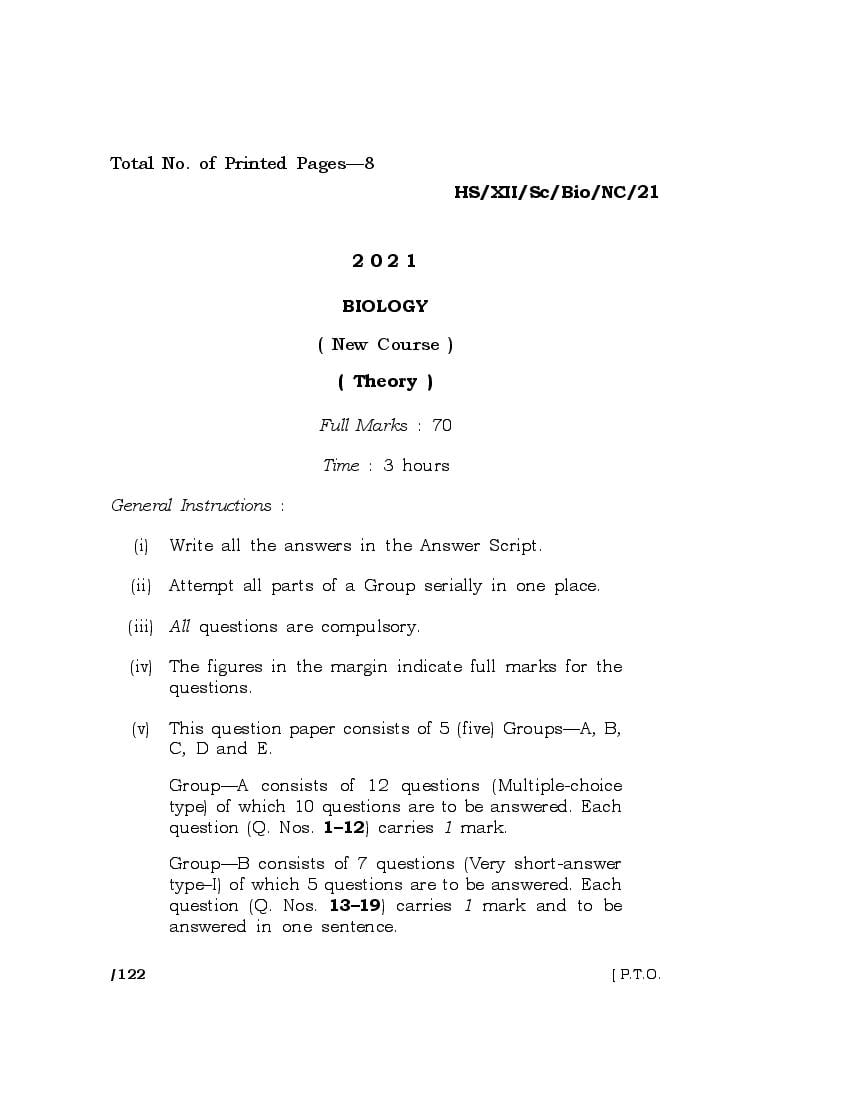
HS/XII/Sc/Bio/NC/21
2021
BIOLOGY
( New Course )
( Theory )
Full Marks : 70
Time : 3 hours
General Instructions :
(i) Write all the answers in the Answer Script.
(ii) Attempt all parts of a Group serially in one place.
(iii) All questions are compulsory.
(iv) The figures in the margin indicate full marks for the
questions.
(v) This question paper consists of 5 (five) Groups—A, B,
C, D and E.
Group—A consists of 12 questions (Multiple-choice
type) of which 10 questions are to be answered. Each
question (Q. Nos. 1–12) carries 1 mark.
Group—B consists of 7 questions (Very short-answer
type–I) of which 5 questions are to be answered. Each
question (Q. Nos. 13–19) carries 1 mark and to be
answered in one sentence.
/122 [ P.T.O.
Page 2
Group—C consists of 5 questions (Short-answer
type–I). Each question (Q. Nos. 20–24) carries 2 marks
with alternatives to be answered in 20–30 words.
Group—D consists of 12 questions (Short-answer
type–II) of which 10 questions are to be answered.
Each question (Q. Nos. 25–36) carries 3 marks and to
be answered in 30–40 words.
Group—E consists of 3 questions (Long-answer type).
Each question (Q. Nos. 37–39) carries 5 marks with
alternatives to be answered in 60–80 words.
GROUP—A
Choose and write the correct answer of the following
(any ten) : 1×10=10
1. In angiosperm triple fusion is required for the formation
of
(a) embryo
(b) endosperm
(c) fruit
(d) seed
2. The hormone relaxin is secreted by
(a) ovary
(b) placenta
(c) scrotum
(d) uterus
HS/XII/Sc/Bio/NC/21/122 [ Contd.
Page 3
3. The hard outer layer of pollen grains is called
(a) intine
(b) exine
(c) germ pore
(d) tapetum
4. Which of the following is a Mendelian disorder?
(a) Down syndrome
(b) Klinefelter syndrome
(c) Haemophilia
(d) Genital herpes
5. In incomplete dominance, the genotypic ratio is
(a) 3 : 1
(b) 9 : 3 : 3 : 1
(c) 9:7
(d) 1 : 2 : 1
6. A transgenic plant which may help in solving the
problem of night blindness is
(a) Bt soybean
(b) FlavrSavr tomato
(c) StarLink maize
(d) Golden rice
HS/XII/Sc/Bio/NC/21/122 [ P.T.O.
Page 4
7. The organism which causes diseases in plants and
animals is called
(a) vector
(b) pathogen
(c) insect
(d) worm
8. The function of restriction endonuclease is
(a) to join DNA fragments
(b) to cleave DNA at specific point
(c) to produce complementary strands
(d) unwinding of DNA double helix
9. The substance produced by a cell in viral infection that
can protect other cells from further infection is
(a) serotonin
(b) colostrum
(c) interferon
(d) histamine
10. Emigration is the
(a) number of individuals that have come into the
habitat
(b) number of births in a given period
(c) number of deaths in a given period
(d) number of individuals that have left the habitat
HS/XII/Sc/Bio/NC/21/122 [ Contd.
Page 5
11. Fungal association of roots of higher plants in
mycorrhiza is
(a) mutualism
(b) commensalism
(c) parasitism
(d) predation
12. Which of the following is an in situ conservation of
biodiversity?
(a) National Park
(b) Botanical Garden
(c) Zoological Park
(d) Cryopreservation
GROUP—B
Answer the following questions in one sentence each
(any five) : 1×5=5
13. Define polyembryony.
14. Who proposed the chromosomal theory of inheritance?
15. What is a plasmid?
16. What is a retrovirus?
17. Expand IUCN.
HS/XII/Sc/Bio/NC/21/122 [ P.T.O.
Page 6
18. Define biotechnology.
19. Name two primary lymphoid organs.
GROUP—C
20. Write four characteristic features of a flower pollinated
by wind. ½×4=2
21. What is codominance? Give an example. 1+1=2
Or
Explain the law of dominance by a monohybrid cross. 2
22. What are antibiotics? From which microorganism the
antibiotic Penicillin was extracted? 1+1=2
Or
Draw a labelled diagram of a human sperm. 2
23. Explain biopiracy with a suitable example. 1+1=2
24. Draw a well-labelled diagram of an antibody molecule. 2
GROUP—D
Answer the following questions (any ten) :
25. Describe the process of fertilization in angiospermic
plants. Give suitable diagram. 2+1=3
26. How is sex determined in human beings? 3
HS/XII/Sc/Bio/NC/21/122 [ Contd.
Page 7
27. A child has blood group O. If the father has blood group
A and mother has blood group B, work out the
genotypes of the parents and the possible genotypes of
the other offsprings. 3
28. What are the goals of the Human Genome Project? 3
29. What is Bt cotton plant? Explain how this cotton plant
is able to resist the infestation by bollworms. 1+2=3
30. Mention the steps involved in recombinant DNA
technology. 3
31. What is immunity? Distinguish between active and
passive immunity. 1+2=3
32. How is a cancerous cell different from a normal cell? 3
33. Write the ecological adaptations in xerophytes. 3
34. What is biogas? Explain the role of microbes in biogas
production. 1+2=3
35. The immune system of a person is suppressed. In the
ELISA test, he was found positive to a pathogen.
(a) Name the disease the patient is suffering from.
(b) What is the causative organism?
(c) Which cells of the body are affected by the
pathogen? 1+1+1=3
36. What is a biosphere reserve? What are the different
zones of a biosphere reserve? 1+2=3
HS/XII/Sc/Bio/NC/21/122 [ P.T.O.
Page 8
GROUP—E
37. Define linkage and crossing over. Give their significance.
When does crossing over take place? 2+2+1=5
Or
Explain briefly the process of oogenesis in humans. 5
38. What is Mendel’s law of segregation? Explain with the
help of a suitable cross. 1+4=5
Or
Explain the mechanism of DNA replication with suitable
diagram. 4+1=5
39. What is biodiversity? Describe the strategies involved
in biodiversity conservation. 1+4=5
Or
What is population? Explain the different types of
negative interactions in a population. 1+4=5
HS/XII/Sc/Bio/NC/21/122 11-21—5090
Page 9
HS/XII/Sc/Bio-Bot/OC/21
2021
BIO-BOTANY
( Old Course )
( Theory )
Full Marks : 35
Time : 1 12 hours
General Instructions :
(i) Write all the answers in the Answer Script.
(ii) All questions are compulsory.
(iii) Attempts all parts of a Group serially in one place.
(iv) The figures in the margin indicate full marks for the
questions.
(v) The question paper consists of 5(five) Groups—A, B, C, D
and E.
Group—A consists of 4 questions (Q. Nos. 1–4) of 1 mark
each and is multiple-choice type.
Group—B consists of 4 questions (Q. Nos. 5–8) of 1 mark
each, very short-answer type, to be answered in 1 sentence
each.
Group—C consists of 4 questions (Q. Nos. 9–12) of 2 marks
each, short-answer type–I, to be answered in 20–30
words each.
Group—D consists of 3 questions (Q. Nos. 13–15) of 3
marks each, with one alternative from the same unit, short-
answer type-II, to be answered in 30–40 words each.
/123 [ P.T.O.
Page 10
Group—E consists of 2 questions (Q. Nos. 16 and 17) of
5 marks each, with one alternative for each question, long-
answer type, to be answered in 70–80 words each.
GROUP—A
Choose and write the correct answer for the following : 1×4=4
1. Transfer of pollen to the stigma of another flower of the
same plant is
(a) autogamy
(b) allogamy
(c) xenogamy
(d) geitonogamy
2. Which of the following is a process in protein synthesis?
(a) Transversion
(b) Transformation
(c) Translation
(d) Translocation
3. Penicillin—an antibiotic is obtained from
(a) algae
(b) fungus
(c) bacteria
(d) yeast
HS/XII/Sc/Bio-Bot/OC/21/123 [ Contd.
Page 11
4. Green plants constitute
(a) first trophic level
(b) second trophic level
(c) third trophic level
(d) fourth trophic level
GROUP—B
5. Define parthenocarpy. 1
6. What is multiple allelism? 1
7. Name the bacterium responsible for converting milk
into curd. 1
8. Define biotechnology. 1
GROUP—C
9. What are transgenic plants? Give two examples. 1+1=2
10. Write four objectives of plant breeding. 2
11. What are ecological pyramids? Name the types of
ecological pyramids. 1+1=2
12. Give the importance of cyclosporin A and statins. 1+1=2
HS/XII/Sc/Bio-Bot/OC/21/123 [ P.T.O.
Page 12
GROUP—D
13. Draw a labelled diagram of longitudinal section of an
ovule of angiosperms. 3
14. Explain complementary gene interaction with the help
of an example. 3
Or
What is the inducer in the lac operon? How does it
ensure ‘switching on’ of genes? 1+2=3
15. Write the techniques of plant tissue culture. 3
GROUP—E
16. Define succession. Explain the process of succession in
the newly formed pond or lake. 1+4=5
Or
Explain briefly the biotic components of an ecosystem. 5
17. Define transcription. Explain the process of
transcription in bacteria with suitable diagram. 1+3+1=5
Or
Explain the chromosomal theory of inheritance. 5
HS/XII/Sc/Bio-Bot/OC/21/123 11-21—1020
Page 13
HS/XII/SC/Bio-Zoo/OC/21
2021
BIO-ZOOLOGY
( Old Course )
( Theory )
Full Marks : 35
Time : 1½ hours
The figures in the margin indicate full marks for the questions
General Instructions :
(i) Write all the answers in the Answer Script.
(ii) Attempt all parts of a Group serially in one place.
(iii) All questions are compulsory.
(iv) This question paper consists of 5 (five) Groups—A, B, C,
D and E.
Group—A consists of 4 questions (multiple-choice
type). Each question (Q. Nos. 1–4) carries 1 mark.
Group—B consists of 4 questions (very short-answer
type). Each question (Q. Nos. 5–8) carries 1 mark and
to be answered in one sentence.
Group—C consists of 4 questions (short-answer
type—I). Each question (Q. Nos. 9–12) carries 2 marks
and to be answered in 20-30 words.
Group—D consists of 3 questions (short-answer
type—II). Each question (Q. Nos. 13–15) carries
3 marks and to be answered in 30-40 words.
Group—E consists of 2 questions (long-answer type).
Each question (Q. Nos. 16 and 17) carries 5 marks
with alternatives to be answered in 60-80 words.
/124 [ P.T.O.
Page 14
GROUP—A
Choose and write the correct answer of the following :
1. Which one of the following is released from the ovary
during ovulation? 1
(a) Primary oocyte
(b) Secondary oocyte
(c) Oogonium
(d) Embryo
2. Malaria is caused by 1
(a) Entamoeba sp.
(b) Ascaris sp.
(c) Plasmodium sp.
(d) Wuchereria sp.
3. Molecular scissor which cuts DNA at specific site is 1
(a) pectinase
(b) polymerase
(c) restriction endonuclease
(d) ligase
HS/XII/SC/Bio-Zoo/OC/21/124 [ Contd.
Page 15
4. Kaziranga National Park is located in 1
(a) West Bengal
(b) Assam
(c) Meghalaya
(d) Odisha
GROUP—B
5. Name the hormone produced by corpus luteum. 1
6. Define vaccine. 1
7. Give the full form of VNTR. 1
8. Name the gas that contributes mainly to global
warming. 1
GROUP—C
9. Draw a labelled diagram of a mammalian sperm. 2
10. Why did Mendel select garden pea for his experiment? 2
11. What is the full form of AIDS? Name its causative
agent. 1+1
12. What is a biosphere reserve? Name one biosphere
reserve in India. 1+1
HS/XII/SC/Bio-Zoo/OC/21/124 [ P.T.O.
Page 16
GROUP—D
13. What are the different characteristics of cancer cells? 3
14. Give the salient features of human genome project. 3
15. State Mendel’s law of segregation. Explain it with the
help of a monohybrid cross. 1+2
GROUP—E
16. With suitable diagrams, describe the process of
oogenesis in human female. 2+3
Or
What is menstrual cycle? Briefly describe the various
phases of this cycle. 1+4
17. List the four postulates of Lamarckism. Give one
example given by Lamarck in support of his theory. 4+1
Or
What is haemophilia? With the help of a cross, explain
why this genetic disorder occurs more in male
individuals than females. 1+4
HS/XII/SC/Bio-Zoo/OC/21/124 11-21—1020
Document Details
| Board / Org | Meghalaya Board |
| Exam | Class 12 |
| Type | Question Paper |
| Pages | 16 |
| Updated | 30 Apr 2026 |