Goa Board Class 12 Question Paper 2024 Biology
Finished viewing? Save it for later —
Download Goa Board Class 12 Question Paper 2024 Biology (PDF · 8 pages)About Goa Board Class 12 Question Paper 2024 Biology
Goa Board Class 12 Question Paper 2024 Biology is available here for free download. Published by Goa Board for Class 12, this question paper can be viewed online or downloaded as a PDF (8 pages). Candidates preparing for Class 12 can use Goa Board Class 12 Question Paper 2024 Biology to understand the exam pattern, the type of questions asked, and the overall difficulty level.
Frequently Asked Questions
How can I download Goa Board Class 12 Question Paper 2024 Biology?
Open this page and click the Download button to save Goa Board Class 12 Question Paper 2024 Biology as a PDF. It is completely free on AglaSem Docs.
Is Goa Board Class 12 Question Paper 2024 Biology free to download?
Yes. Goa Board Class 12 Question Paper 2024 Biology can be viewed online and downloaded as a PDF free of cost on AglaSem Docs.
How many pages does Goa Board Class 12 Question Paper 2024 Biology have?
Goa Board Class 12 Question Paper 2024 Biology contains 8 pages, which you can read online or download together as a single PDF.
Where can I find more Class 12 study material?
You can find more Class 12 question papers, sample papers, syllabus, and answer keys on AglaSem Docs.
Goa Board Class 12 Question Paper 2024 Biology – Text
Read the full text of this question paper below — useful to quickly search, copy and reference the content online without downloading the PDF.
📄 View text version (8 pages)
Page 1
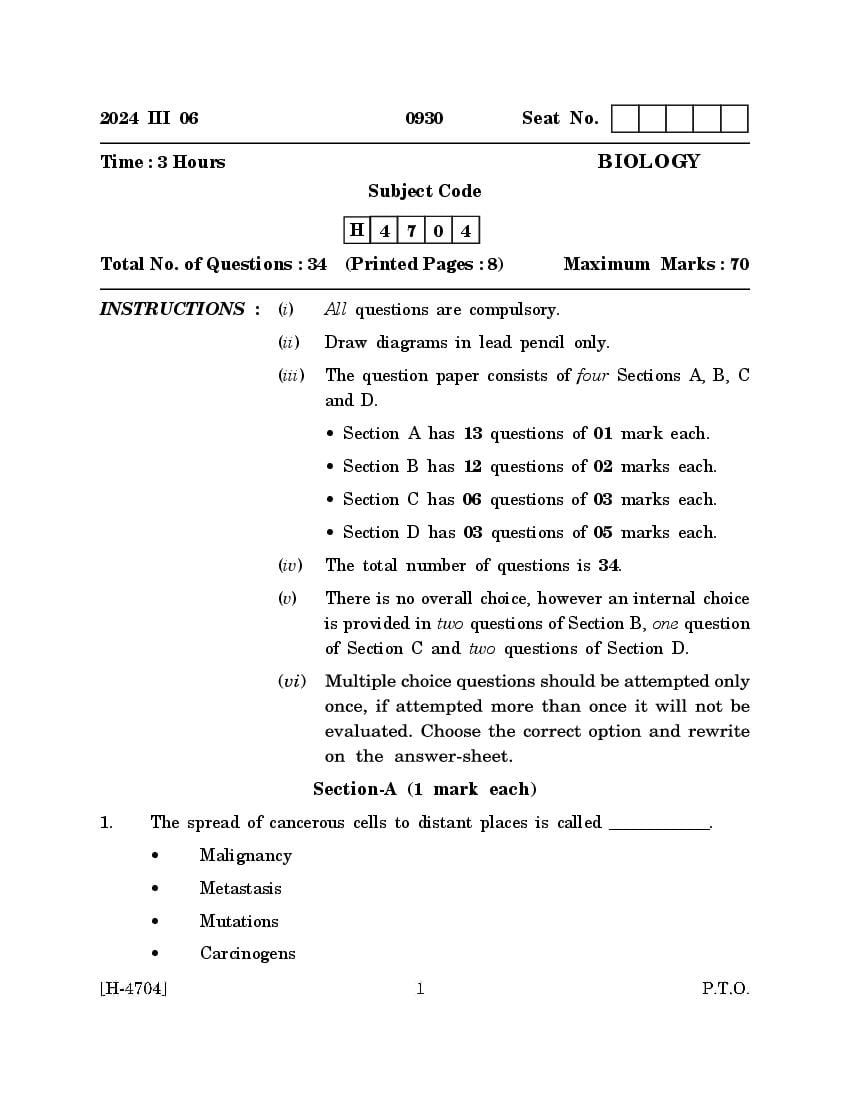
Time : 3 Hours BIOLOGY
Subject Code
H 4 7 0 4
Total No. of Questions : 34 (Printed Pages : 8) Maximum Marks : 70
INSTRUCTIONS : (i) All questions are compulsory.
(ii) Draw diagrams in lead pencil only.
(iii) The question paper consists of four Sections A, B, C
and D.
• Section A has 13 questions of 01 mark each.
• Section B has 12 questions of 02 marks each.
• Section C has 06 questions of 03 marks each.
• Section D has 03 questions of 05 marks each.
(iv) The total number of questions is 34.
(v) There is no overall choice, however an internal choice
is provided in two questions of Section B, one question
of Section C and two questions of Section D.
Section-A (1 mark each)
1. The spread of cancerous cells to distant places is called ____________.
• Malignancy
• Metastasis
• Mutations
• Carcinogens
Page 2
• Ringworm, AIDS
• Common Cold, AIDS
• Dysentery, Common Cold
• Typhoid, Tuberculosis
3. During gel electrophoresis, you are asked to examine a gel on which DNA
fragments have been separated.
Where would you find the smallest fragments of DNA ?
• Near the positive electrode, farthest away from the wells.
• Near the negative electrode, farthest away from the wells.
• Near the negative electrode, close to wells.
• In the middle, since fragments tend to slow down.
4. The process by which inorganic nutrients go down into the soil horizon and
gets precipitated as unavailable salts is called ..............
• Fragmentation
• Leaching
• Catabolism
• Fermentation
5. RNA interference helps in developing resistance in tobacco plant against
nematode infection by .................
• Silencing of specific mRNA due to complementary dsRNA molecule
• Silencing of t-RNA due to complementary RNA molecule
• Interference of DNA in RNA synthesis
• Interference of rRNA in RNA synthesis
Page 3
from primary spermatocytes.
The total number of meiotic divisions required to produce 400 spermatozoa
will be :
• 200
• 300
• 100
• 50
7. The following ecological pyramid represents :
Trophic level Dry weight (kg m–2)
TC 1.5
SC 11
PC 37
PP 809
• Pyramid of Number
• Pyramid of Biomass
• Inverted Pyramid of number
• Inverted Pyramid of energy
Page 4
plates with chromogenic substrate.
With reference to the above observation, choose the correct option from the
following :
• A recombinant DNA was inserted in the coding sequence of ampicillin
resistance gene.
• A recombinant DNA was inserted in the coding sequence of
ß-galactosidase gene.
• A recombinant DNA was inserted in the coding sequence of penicillin
resistance gene.
• A recombinant DNA was inserted in the coding sequence of kannamycin
resistance gene.
9. What is amniocentesis ?
10. Bacillus thuringiensis produce a toxic protein that kills insects but not the
bacteria. After consuming the toxic proteins, which changes will occur in the
gut of the insect.
11. Human insulin when synthesized in the body needs to be processed before
it can act. Give reason.
12. State the examples of physical barriers in innate immunity
13. How GM plants have been useful to humankind (Any 2 points)
Page 5
14. Describe the process of microsporogenesis in Angiosperms.
OR
Describe the process of megasporogenesis in Angiosperms.
15. Write a note on Parturition.
OR
Write a note on the events occurring after fertilisation upto implantation of
the blastocyst in the uterus.
16. Explain the role of anaerobic bacteria in secondary treatment of sewage water
in sewage treatment plant.
17. Describe any two causes of biodiversity loss.
18. Distinguish between primary and secondary succession.
19. Explain how in biodiversity conservation, threatened animals and plants are
taken out from their natural habitat and placed in special settings.
20. Draw a neat labelled diagram of DNA double Helix.
21. On a field trip, students observed an inflorescence with colourless flowers,
well exposed stamens and large feathery stigma.
On the basis of your knowledge, mention the pollinating agent and give two
characteristics of the pollen grains produced by such flowers.
22. During an agricultural training programme for farmers in organic farming,
the expert advised the use of Nucleopolyhedrovirus for pest management.
Is the expert advice correct ?
Support your answer with reasons.
Page 6
5' AUG GGG CCG GAG CUG AAU GGU UAG 3'
Assuming that codons containing 'C' are introns :
(a) Derive the processed mRNA that would be formed from the above
sequence.
(b) Write down the number of amino acids in the protein molecule formed
after translation.
24. Draw a neat diagram of an Anatropous ovule in Angiosperms.
25. A molecular scissor in biotechnology cleaves DNA sequence as shown in the
figure below :
5' — A C T A G T — 3'
3' — T G A T C A — 5'
(a) Mention the term used for such type of sequences.
(b) What would be the result of the cleaving by the enzyme ?
Section-C (3 marks each)
26. Describe Haemophilia as a Mendelian disorder.
OR
Describe Thalessemia as Mendelian disorder.
Page 7
(a) Colour of the stem in F1 progency [Work out the Cross]
(b) Percentage of brown stemmed plants in F2 progeny if plants of
F1 generation are self pollinated [Support with Punnett Square].
(c) Ratio of GG and Gg in F2 progeny.
28. In eukaryotes, the packaging of DNA helix is much more complex than in
prokaryotes. Give reasons.
29. Draw a neat diagram of female reproductive system in humans.
30. Enlist the various steps involved in the Isolation of the Genetic material (DNA)
in recombinant DNA technology.
31. In a family planning camp, couple with complete families were advised for
permanent methods of contraception.
Explain the methods which they can adopt. Also comment on the principle
involved.
Section-D (5 marks each)
32. Give a detailed account of the origin and evolution of man. Add a note on
Miller's experiment.
OR
Give a detailed account of paleontological and anatomical and morphological
evidences of evolution.
Add a note on the example supporting evolution by natural selection observed
in England.
Page 8
example of organisms for coping with extreme in their environment.
34. Discuss the various methods of detection and treatment of cancer.
OR
Discuss the causative agent, mode of transmission and symptoms of typhoid,
amoebiasis and filariasis.
Document Details
| Board / Org | Goa Board |
| Exam | Class 12 |
| Type | Question Paper |
| Pages | 8 |
| Updated | 30 Apr 2026 |