AMU Entrance Exam Syllabus for M.A. in English
Finished viewing? Save it for later —
Download AMU Entrance Exam Syllabus for M.A. in English (PDF · 4 pages)About AMU Entrance Exam Syllabus for M.A. in English
AMU Entrance Exam Syllabus for M.A. in English is available here for free download. Published by Default for Admission Tests, this syllabus can be viewed online or downloaded as a PDF (4 pages). Candidates preparing for Admission Tests can use AMU Entrance Exam Syllabus for M.A. in English to understand the exam pattern, the type of questions asked, and the overall difficulty level.
Frequently Asked Questions
How can I download AMU Entrance Exam Syllabus for M.A. in English?
Open this page and click the Download button to save AMU Entrance Exam Syllabus for M.A. in English as a PDF. It is completely free on AglaSem Docs.
Is AMU Entrance Exam Syllabus for M.A. in English free to download?
Yes. AMU Entrance Exam Syllabus for M.A. in English can be viewed online and downloaded as a PDF free of cost on AglaSem Docs.
How many pages does AMU Entrance Exam Syllabus for M.A. in English have?
AMU Entrance Exam Syllabus for M.A. in English contains 4 pages, which you can read online or download together as a single PDF.
Where can I find more Admission Tests study material?
You can find more Admission Tests question papers, sample papers, syllabus, and answer keys on AglaSem Docs.
AMU Entrance Exam Syllabus for M.A. in English – Text
Read the full text of this syllabus below — useful to quickly search, copy and reference the content online without downloading the PDF.
📄 View text version (3 pages)
Page 1
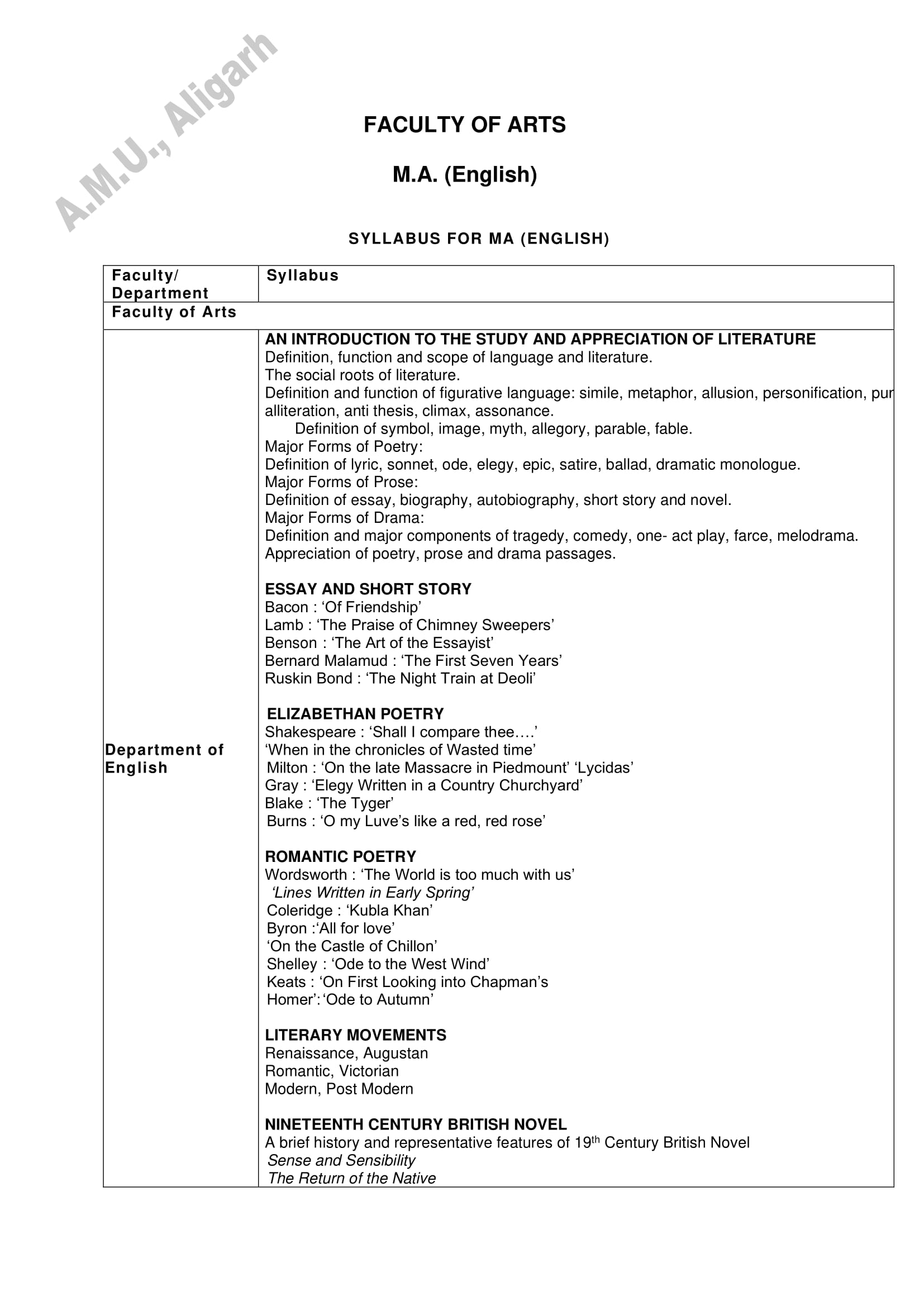
M.A. (English)
SYLLABUS FOR MA (ENGLISH)
Faculty/ Syllabus
Department
Faculty of Arts
AN INTRODUCTION TO THE STUDY AND APPRECIATION OF LITERATURE
Definition, function and scope of language and literature.
The social roots of literature.
Definition and function of figurative language: simile, metaphor, allusion, personification, pun,
alliteration, anti thesis, climax, assonance.
(iii) Definition of symbol, image, myth, allegory, parable, fable.
Major Forms of Poetry:
Definition of lyric, sonnet, ode, elegy, epic, satire, ballad, dramatic monologue.
Major Forms of Prose:
Definition of essay, biography, autobiography, short story and novel.
Major Forms of Drama:
Definition and major components of tragedy, comedy, one- act play, farce, melodrama.
Appreciation of poetry, prose and drama passages.
ESSAY AND SHORT STORY
Bacon : ‘Of Friendship’
Lamb : ‘The Praise of Chimney Sweepers’
Benson : ‘The Art of the Essayist’
Bernard Malamud : ‘The First Seven Years’
Ruskin Bond : ‘The Night Train at Deoli’
ELIZABETHAN POETRY
Shakespeare : ‘Shall I compare thee….’
Department of ‘When in the chronicles of Wasted time’
English Milton : ‘On the late Massacre in Piedmount’ ‘Lycidas’
Gray : ‘Elegy Written in a Country Churchyard’
Blake : ‘The Tyger’
Burns : ‘O my Luve’s like a red, red rose’
ROMANTIC POETRY
Wordsworth : ‘The World is too much with us’
‘Lines Written in Early Spring’
Coleridge : ‘Kubla Khan’
Unit III: Byron :‘All for love’
‘On the Castle of Chillon’
Shelley : ‘Ode to the West Wind’
Keats : ‘On First Looking into Chapman’s
Homer’: ‘Ode to Autumn’
LITERARY MOVEMENTS
Renaissance, Augustan
Romantic, Victorian
Modern, Post Modern
NINETEENTH CENTURY BRITISH NOVEL
A brief history and representative features of 19th Century British Novel
Sense and Sensibility
Unit III The Return of the Native
Page 2
Unit I: Tennyson : ‘Ulysses’
Browning : ‘My Last Duchess’
Arnold : ‘Thyrsis’
‘Dover Beach’
Unit III: Yeats :‘The Lake Isle of Innisfree’
‘Among School Children’
Auden : ‘Seascape’
‘The Shield of Achilles’
Eliot: ‘Landscapes - New Hampshire’
‘Journey of the Magi’
SHAKESPEAREAN DRAMA
Macbeth
As You Like It
POST- SHAKESPEAREAN DRAMA
She Stoops to Conquer
Look Back in Anger
Arms and the Man
All My Sons
APPROACHES TO LITERATURE
Unit I Biographical, Historical and Formalist Approaches to Literature
(a) Concepts
(b) Practice texts
(i) Excerpts from Charles Dickens by Jane Smiley
(ii) Excerpts from Delhi by Khushwant Singh
(iii) Understanding Elizabeth Bishop through ‘One Art ’
Unit II Mythological and Archetypal Approaches to Literature
(a) Concepts.
(i) Excerpts from The Golden Bough by Frazer
(ii) Excerpts from Haroun and Sea of Stories by Salman Rushdie
Unit III Psychological, Sociological and Gender Criticism Approaches to Literature
(a) Concepts
(i) Excerpts from Death of Salesman by Arthur Miller
(ii) The Great Gatsby by F. Scott. Fitzgerald
(iii) ‘To be or not to be’, Hamlets’ Soliloquy
INDIAN AND AFRICAN NOVEL
Representative Features of Indian and African Novel in English
Unit II: The Voice
Unit III: Kanthapura
TWENTIETH CENTURY BRITISH AND AMERICAN NOVEL
Representative Features of Twentieth Century British and American Novel
A Passage to India
A Farewell to Arms
History of English Studies
OLD ENGLISH
(i) History
(ii) Excerpts from Beowulf
MIDDLE ENGLISH
History
Excerpts from Piers Plowman by William Langland and Everyman
MODERN ENGLISH (Upto 17th Century and Early 18th Century)
A: History
B: Excerpts from Hamlet by William Shakespeare
Page 3
Donne: ‘The Sun Rising’
Milton: ‘On His Blindness’
Addison and Steele: ‘A Silent Man's Advantages in Society’ (Excerpts)
Swift: Gulliver's Travels
Defoe: Robinson Crusoe
MODERN ENGLISH (Upto 19th Century)
A: History: (18th & 19th Century)
b. Excerpts:
Pope: ‘Rape of The Lock’ (Excerpts)
Swift: Gulliver's Travels
Defoe: Robinson Crusoe
Jane Austen: Pride and Prejudice
Coleridge: ‘The Rime of Ancient Mariner’
Wordsworth: ‘Lucy Poems’
Thackery: Vanity Fair
Browning: ‘My Last Duchess’
Modern English (20th Century)
A. History
B. Excerpts:
Walter Raleigh: Wishes of an Elderly Man, Wished at a Garden Party, June 1914"
Hemingway: ‘The Snows of Kilimanjaro’
Tennesse Williams: A Streetcar Named Desire (Excerpt)
Virginia Woolf: To The Light House (Excerpt)
T. S. Eliot: The Wasteland (Excerpt)
Beckett: Waiting for Godot (Excerpt)
Alice Walker: The Color Purple (Excerpt)
World Englishes
A: Background
B: Excerpts:
Amos Tutuola: The Palm-Wine Drinkard (Excerpt)
Amitav Ghosh: The Sea of Poppies (Excerpt)
Aravind Adiga: The White Tiger
Pablo Neruda: ‘I Do Not Love You Except Because I Love You’
English Studies in Translation
Excerpts:
Ghalib: Excerpts from translated ghazals
Manto: ‘Toba Tek Singh’
Premchand: ‘Sadgati’
Mahasweta Devi: ‘Dopadi’
Introduction to Critical Theory
(a) Defining Theory; Theory and Criticism; From Liberal Humanist Criticism to Theory.
(b) Reader-Response Criticism: The Narratee; Affective Stylistics; Reception Theory;
(c) Literary Competence.
Marxist Criticism: Basic Concepts; Soviet Socialist Realism; The Frankfurt School; Ideology.
(a) Postcolonial Theory and Criticism: From Commonwealth to Postcolonial; Theories of
Colonial Discourses; Postcolonialsim and Nationalism; Diaspora Identities.
Unit III:Cultural Studies: Approaches to Culture; The Development of Cultural Studies; Theoretical bases of
Cultural Studies; Impact of Cultural Studies.
(a) Dialogic Criticism: Polyphony, Dialogism, Heteroglossia, Carnivalesque.
(b)
Document Details
| Board / Org | Default |
| Exam | Admission Tests |
| Type | Syllabus |
| Pages | 4 |
| Updated | 30 Apr 2026 |