AMU Entrance Exam Syllabus for M.A. in English Language Teaching
Finished viewing? Save it for later —
Download AMU Entrance Exam Syllabus for M.A. in English Language Teaching (PDF · 4 pages)About AMU Entrance Exam Syllabus for M.A. in English Language Teaching
AMU Entrance Exam Syllabus for M.A. in English Language Teaching is available here for free download. Published by Default for Admission Tests, this syllabus can be viewed online or downloaded as a PDF (4 pages). Candidates preparing for Admission Tests can use AMU Entrance Exam Syllabus for M.A. in English Language Teaching to understand the exam pattern, the type of questions asked, and the overall difficulty level.
Frequently Asked Questions
How can I download AMU Entrance Exam Syllabus for M.A. in English Language Teaching?
Open this page and click the Download button to save AMU Entrance Exam Syllabus for M.A. in English Language Teaching as a PDF. It is completely free on AglaSem Docs.
Is AMU Entrance Exam Syllabus for M.A. in English Language Teaching free to download?
Yes. AMU Entrance Exam Syllabus for M.A. in English Language Teaching can be viewed online and downloaded as a PDF free of cost on AglaSem Docs.
How many pages does AMU Entrance Exam Syllabus for M.A. in English Language Teaching have?
AMU Entrance Exam Syllabus for M.A. in English Language Teaching contains 4 pages, which you can read online or download together as a single PDF.
Where can I find more Admission Tests study material?
You can find more Admission Tests question papers, sample papers, syllabus, and answer keys on AglaSem Docs.
AMU Entrance Exam Syllabus for M.A. in English Language Teaching – Text
Read the full text of this syllabus below — useful to quickly search, copy and reference the content online without downloading the PDF.
📄 View text version (4 pages)
Page 1
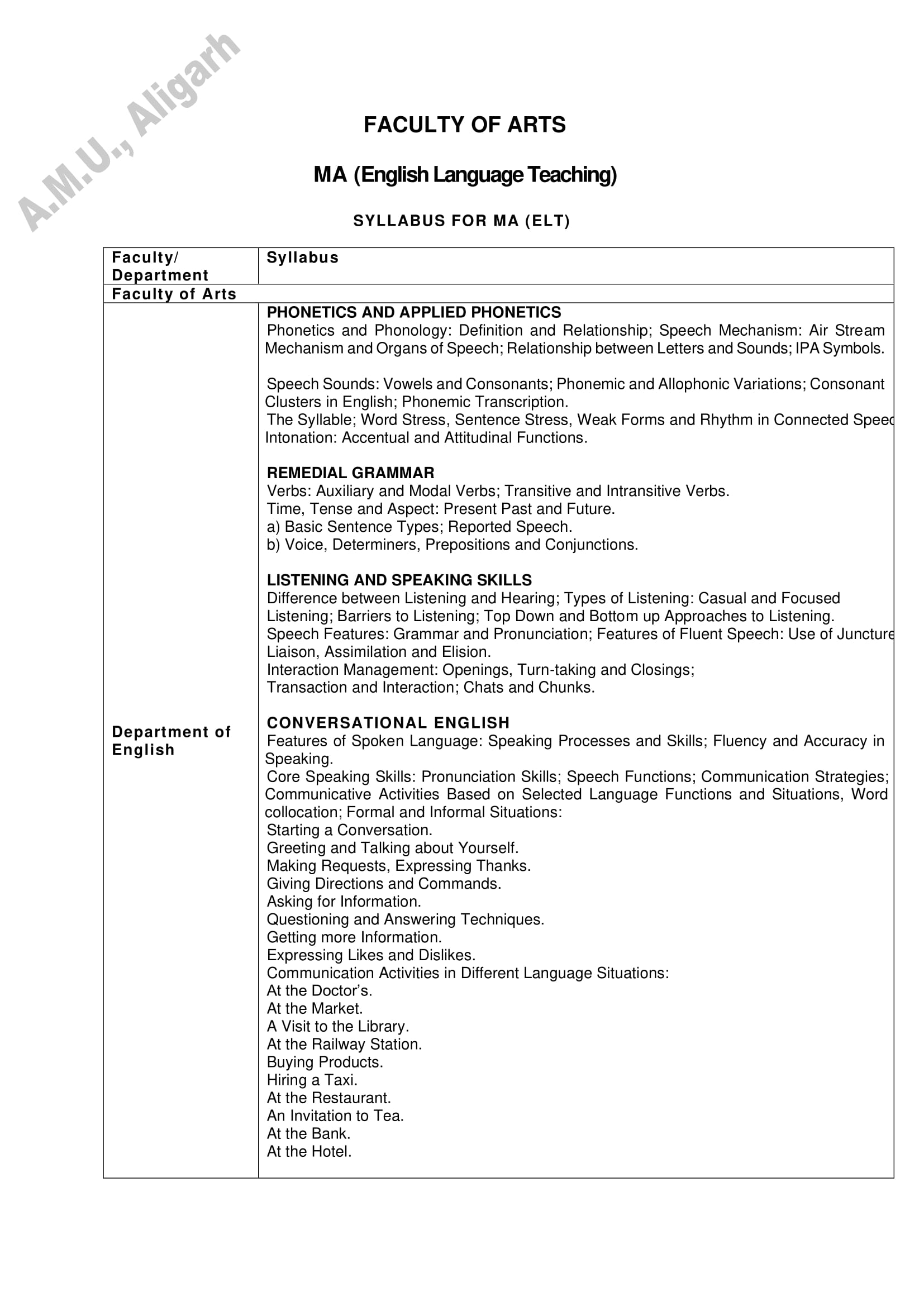
MA (English Language Teaching)
SYLLABUS FOR MA (ELT)
Faculty/ Syllabus
Department
Faculty of Arts
PHONETICS AND APPLIED PHONETICS
Phonetics and Phonology: Definition and Relationship; Speech Mechanism: Air Stream
Mechanism and Organs of Speech; Relationship between Letters and Sounds; IPA Symbols.
Speech Sounds: Vowels and Consonants; Phonemic and Allophonic Variations; Consonant
Clusters in English; Phonemic Transcription.
The Syllable; Word Stress, Sentence Stress, Weak Forms and Rhythm in Connected Speech;
Intonation: Accentual and Attitudinal Functions.
REMEDIAL GRAMMAR
Verbs: Auxiliary and Modal Verbs; Transitive and Intransitive Verbs.
Time, Tense and Aspect: Present Past and Future.
a) Basic Sentence Types; Reported Speech.
b) Voice, Determiners, Prepositions and Conjunctions.
LISTENING AND SPEAKING SKILLS
Difference between Listening and Hearing; Types of Listening: Casual and Focused
Listening; Barriers to Listening; Top Down and Bottom up Approaches to Listening.
Speech Features: Grammar and Pronunciation; Features of Fluent Speech: Use of Juncture,
Liaison, Assimilation and Elision.
Interaction Management: Openings, Turn-taking and Closings;
Transaction and Interaction; Chats and Chunks.
CONVERSATIONAL ENGLISH
Department of
Features of Spoken Language: Speaking Processes and Skills; Fluency and Accuracy in
English
Speaking.
Core Speaking Skills: Pronunciation Skills; Speech Functions; Communication Strategies;
Communicative Activities Based on Selected Language Functions and Situations, Word
collocation; Formal and Informal Situations:
Starting a Conversation.
Greeting and Talking about Yourself.
Making Requests, Expressing Thanks.
Giving Directions and Commands.
Asking for Information.
Questioning and Answering Techniques.
Getting more Information.
Expressing Likes and Dislikes.
Communication Activities in Different Language Situations:
At the Doctor’s.
At the Market.
A Visit to the Library.
At the Railway Station.
Buying Products.
Hiring a Taxi.
At the Restaurant.
An Invitation to Tea.
At the Bank.
At the Hotel.
Page 2
Processes in Reading: Lower level Processes- Word recognition, Orthographic, Phonological,
Morphological, Semantic and Syntactic Processing: Higher level Processes-Text Model and
Situation Model
Reading and Vocabulary: Components of Word Knowledge, Word Learning Strategies: Direct
Instruction, Learning from Context
Developing Reading Ability: Strategic reading; Multiple strategy Instruction, Directed Reading
and Thinking Activities, Collaborative Strategic Reading, Transactional Strategies Instruction
READING SKILLS
Nature, Purpose and Types of Reading; Methods of Reading: Phonic Method & Word
Method.
Approaches to Reading: Bottom-Up, Top-Down and Interactive; Sub skills of Reading;
Reading Strategies
Comprehension Training: Comprehending different kinds of texts: Political, Scientific, Legal,
WRITING SKILL
Essentials of Writing; Graphic Structure; Graphic Conventions (Mechanics & Usage);
Effective techniques and process of writing, Difference between speech and writing.
Writing in the Early Stages.
Sentence Building Activities.
Sentence Linking Activities.
Paragraph Writing: Guided and Free (Communication activities).
Developing Skills in Writings:
Writing Notes: Developing content from Notes
Revision and Editing.
Summary Writing & Paraphrasing.
Letter-Writing: Formal Letters.
Writing Notices & Advertisements.
Writing Short Reports for Journals and Newspapers.
BASIC CONCEPTS OF GRAMMAR
Definition of Grammar; Types of Grammar: Traditional and Modern Grammar;
Approaches to the teaching of Grammar: Descriptive and Prescriptive Grammar.
(Exercises to be practised on the basis of the above approaches)
Spoken Vs Written Grammar: Grammaticality vs. Appropriateness; Use and Usage;
Spoken Intelligibility. (Spoken/Written grammar to be practiced)
Introduction to the Discourse Markers: Cohesive Devices: Conjunctions, Referencing,
Anaphora, Cataphora; Ellipsis; Substitution; Grammatical& Lexical Cohesion;
Punctuations
ADVANCED WRITING
Nature and Purpose of Writing; Writing as Communication.
Approaches to Writing; Stages in Writing.
Modes of Writing: Narrative, Descriptive, Expository, Argumentative.
Figurative Language and Literary Devices.
Creative Writing; Short Story, Newspaper Article.
FUNCTIONS AND SITUATIONS
Form and Function; Language Functions as enumerated by Firth, Halliday and Jacobson;
Communication Activities based on Selected Language Functions and Situations.
Language Functions in Written Communication Skills: Arguing, Description and Narration.
Functions and Situations in Oral Communication Skills:
Functions: Greeting and Introducing; Making Requests; Asking for and Giving Permissions;
Offering Help; Giving Instructions or Directions.
Situations: At the Doctor’s; At the Market; A Visit to the Library; At the Railway Station;
Buying Products; Hiring a Taxi; At the Restaurant; An Invitation to Tea; At the Bank; At the
Hotel.
Telephoning Skills: Handling Calls; Leaving a Message; Making Requests; Asking for and
Page 3
Presentation Skills: Debates, Interview and Discussion Skills.
ENGLISH FOR ACADEMIC PURPOSES
Definition and Scope of English for Academic Purposes/ Study Skills; Characteristics of
Academic English; Changing Formal and Academic Language into Informal and Non-
Academic Language and vice-versa.
Reading Academic Texts; Surveying a Textbook; Surveying a Chapter; Signposts;
Inferencing; Critical Reading; Using Reference Sources.
Academic Writing Skills: Note-Taking and Note-Making; Abstracting and Summarizing;
Paraphrasing; Writing Examination Answers; Writing Long Papers and Academic Reports;
Preparing a Bibliography.
ENGLISH FOR BUSINESS
Business Communication: Language of Business: Tone, Style, Jargon, Clichés, Ambiguity
(Use of Extracts), Glossary of Business Terms.
Business Correspondence: Basic Principles, Format and Types; Employment Letters; Placing
Orders; Enquiry and Response Letters; Letters of Complaint and Apology; Persuasive
Letters; Curriculum Vitae.
Report Writing: Periodic Reports and Market Survey Reports.
External Communication: Press Releases; Notice Inviting Tenders; E-mails.
Oral Communication: Telephonic Conversation; Reception of Visitors; Holding Meetings;
Attending Job Interviews; Organizing Business; Conferences; Seminars; Presentation and
Workshops.
LANGUAGE AND SOCIETY
Sociolinguistics: Language in Relation to Society
Language and Culture
Sociology of Language
Speech Community
Language and Dialect
Varieties of Language
Language Contact: Bilingualism and Multilingualism
Borrowing: Types of Borrowing
Code Switching and Code-Mixing; Types of Code Switching
ENGLISH IN PRINT MEDIA
Definition of News; Difference Between News and Information; News and Ideas; Types of
News; Hard/Soft News. Reporting: Techniques; Chronological Order/Logical Order; Inverted
Pyramid; Components of a News Story; Language and Style; Suppliers of News.
Types and Trends in Reporting: Objective Reporting, Interpretative Reporting; Investigative
Reporting; Entertainment Reporting; Development Reporting.
Writing News; Writing Interviews; Writing Features (Cartoons, Photo Features, etc.); Writing
Headlines; Writing Leads; Writing Editorials. Make-up of the Newspaper: Types and
Procedures; Language and Style used in Print Media.
ENGLISH IN ELECTRONIC MEDIA
Introduction to Mass Communication and Broadcasting / Telecasting;
Difference between Radio and Television as Modes of Mass Communication.
Writing for the Broadcast Media: News Writing and Editing; Radio/TV: News Reading,
Announcing.
P.S.A. (Public Services Announcements), Advertisements
Language for Media and Style; Qualities of Good Speech: Stress, Rhythm, Tone and Body Langua
Careers in Radio / TV, News Reading; Announcing; Interviewing.
Contexts; Elements of Redundancy; Barriers to Communication.
Documentaries; Features and Interview.
Practical Work: Evaluation of the English Language used in the Indian
Broadcast Media Writing / Editing Exercises.
Comparison, Contrast and Critique of Select Broadcast Items.
Page 4
SOFT SKILLS
Interpersonal and affective skills: Types, elements and constituents of communication,
interpersonal skills, body language, management of stress and conflict, time management,
motivation, negotiation skills, corporate etiquette.
Listening and Speaking: Enhancing listening skills, effective presentation skills, effective
group discussion, interview skills.
Effective writing skills: Stages in writing, writing proposals, statement of purpose, writing a
resume, job application
Introducing the Use of Multimedia
Multimedia and its categories; Characteristics of Multimedia; Application of Multimedia in
Education
Developing Language skills through technology: Radio, Audio -Video, Language
Laboratory, Computer Assisted Language Learning, Blogs
Use of Audio-Visual aids in English pronunciation; Activities like story completion,
Comprehension exercises.
Learning Outcomes:
At the completion of the course, students will be able to use multimedia aids in completing
their assignments and making use of e-resources. Besides they will be able to improve
their language skills in and outside the classroom setting.
Note: Students have to submit one assignment from each unit.
Document Details
| Board / Org | Default |
| Exam | Admission Tests |
| Type | Syllabus |
| Pages | 4 |
| Updated | 30 Apr 2026 |