NSTSE Sample Paper Solutions Class 12 PCM
Finished viewing? Save it for later —
Download NSTSE Sample Paper Solutions Class 12 PCM (PDF · 3 pages)About NSTSE Sample Paper Solutions Class 12 PCM
NSTSE Sample Paper Solutions Class 12 PCM is available here for free download. Published by Unified Council for National Level Science Talent Search Examination, this solution can be viewed online or downloaded as a PDF (3 pages). Candidates preparing for National Level Science Talent Search Examination can use NSTSE Sample Paper Solutions Class 12 PCM to understand the exam pattern, the type of questions asked, and the overall difficulty level.
Frequently Asked Questions
How can I download NSTSE Sample Paper Solutions Class 12 PCM?
Open this page and click the Download button to save NSTSE Sample Paper Solutions Class 12 PCM as a PDF. It is completely free on AglaSem Docs.
Is NSTSE Sample Paper Solutions Class 12 PCM free to download?
Yes. NSTSE Sample Paper Solutions Class 12 PCM can be viewed online and downloaded as a PDF free of cost on AglaSem Docs.
How many pages does NSTSE Sample Paper Solutions Class 12 PCM have?
NSTSE Sample Paper Solutions Class 12 PCM contains 3 pages, which you can read online or download together as a single PDF.
Where can I find more National Level Science Talent Search Examination study material?
You can find more National Level Science Talent Search Examination question papers, sample papers, syllabus, and answer keys on AglaSem Docs.
NSTSE Sample Paper Solutions Class 12 PCM – Text
Read the full text of this solution below — useful to quickly search, copy and reference the content online without downloading the PDF.
📄 View text version (3 pages)
Page 1
A n I S O 9 0 0 1 : 2008 C e r t i f i e d O r g a n i s a t i o n
Test Assess Achieve
NATIONAL LEVEL SCIENCE TALENT SEARCH EXAMINATION
Solutions for Class : 12_PCM
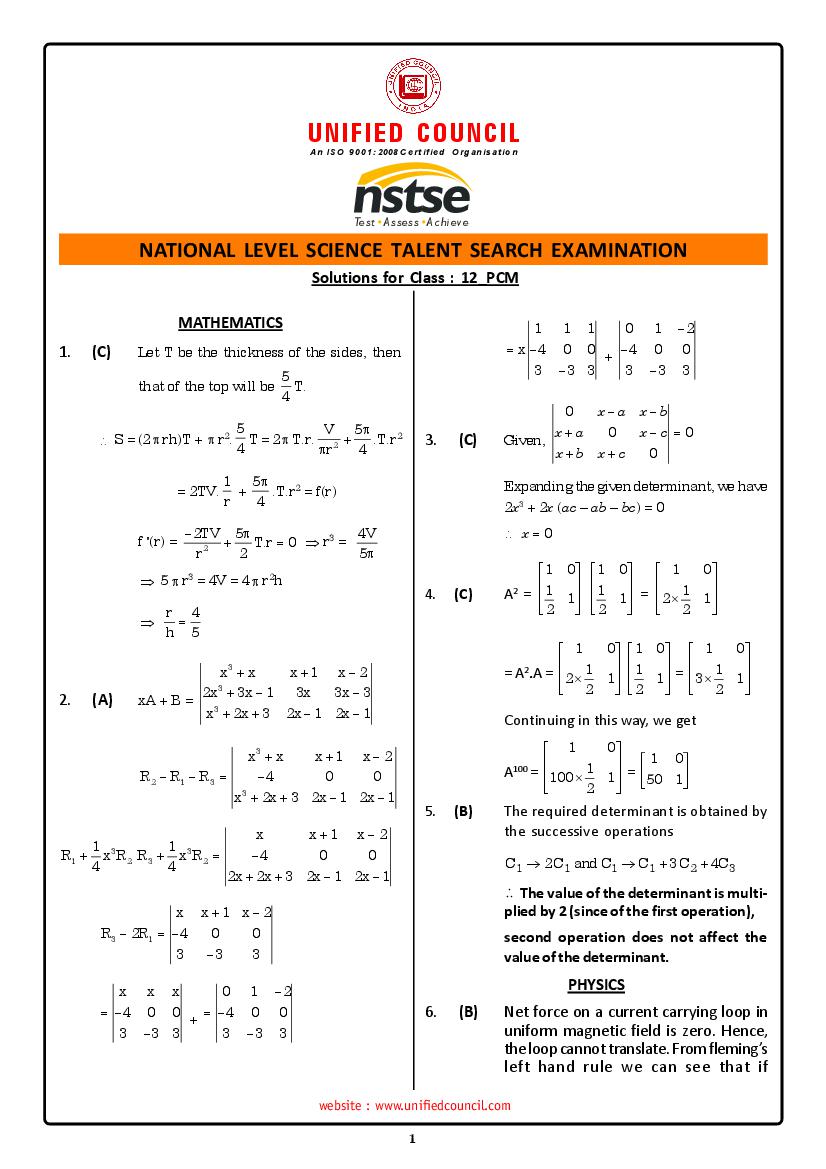
MATHEMATICS 1 1 1 0 1 2
1. (C) Let T be the thickness of the sides, then x 4 0 0 4 0 0
+
5 3 3 3 3 3 3
that of the top will be T.
4
0 xa xb
5 V 5 xa 0 xc 0
S = (2 rh)T + r2. T = 2 T.r. 2 + .T.r2 3. (C) Given,
4 r 4 xb xc 0
1 5 Expanding the given determinant, we have
= 2TV. + .T.r2 = f(r)
r 4 2x3 + 2x (ac – ab – bc) = 0
2TV 5 4V x0
f '(r) = 2
T.r 0 r3 =
r 2 5
1 0 1 0 1 0
5 r3 = 4V = 4 r2h 1 1
4. (C) A = 1 1 = 2 1 1
2
r 4 2 2 2
h 5
1 0 1 0 1 0
= A2.A = 2 1 1 1 1 = 3 1 1
3
x x x 1 x 2
3
2x 3x 1 3x 3x 3 2 2 2
2. (A) xA + B = 3
x 2x 3 2x 1 2x 1 Continuing in this way, we get
1 0
x3 x x 1 x 2 1 0
R 2 R1 R 3 4 0 0 A100 = 100 1 1 = 50 1
3 2
x 2x 3 2x 1 2x 1
5. (B) The required determinant is obtained by
x x 1 x 2 the successive operations
1 3 1
R1 x R2 R3 x 3R2 4 0 0
4 4 C1 2 C1 and C1 C1 + 3 C2 + 4C3
2x 2x 3 2x 1 2x 1
The value of the determinant is multi-
x x 1 x 2 plied by 2 (since of the first operation),
R 3 2R1 4 0 0 second operation does not affect the
3 3 3 value of the determinant.
x x x 0 1 2 PHYSICS
4 0 0
+
4 0 0 6. (B) Net force on a current carrying loop in
3 3 3 3 3 3 uniform magnetic field is zero. Hence,
the loop cannot translate. From fleming’s
left hand rule we can see that if
1
Page 2
inwards and current in the loop is Again, m = 4=
f 20
clockwise (as shown) the magnetic force
or v = 20 – 80 = – 60 cm
Fm on each element of the loop is radially
outwards, or the loops will have a 10. (A) Four charges q1, q2, q3 and q4 are placed
tendency to expand. at the four corners of the square PQRS
y
as shown below.
i Fm × Here,
q1 2m q2
x P Q
r r
2m 2m
r O r
7. (D) According to the given information
substance ‘X’ is ferromagnetic in nature
S R
which is gadolinium. q4 2m q3
A paramagnetic substance is feebly q1 = 2 μ C = 2 10–6 C;
attracted by a magnet. When a rod of
q2 = – 2 μ C = – 2 10–6 C;
paramagnetic substance is suspended
in a magnetic field, it slowly sets itself q3 = – 3 μ C = – 3 10–6 C;
parallel to the direction of the magnetic q4 = 6 μ C = 6 10–6 C;
field. It also moves from a weaker part
of the magnetic field to its stronger part, and PQ = QR = RS = PS = 2 m
but it is feebly attracted by the magnet. Let r be the distance of each charge from
When a rod of diamagnetic substance the centre O of the square.
is suspended in a magnetic field, it Then,
slowly sets itself at right angles to the r2 + r2 2 or r = 1 m
direction of field. It moves from stronger Potential at point O due to charges at the
part of the magnetic field to its weaker four corners,
part i.e., it is feebly repelled by the
magnet. 1 q1 q2 q3 q4
V= + + +
4πε0 r r r r
Aluminium and oxygen are paramagnetic.
Gold is diamagnetic. Gadolinium is 1 1
ferromagnetic. So, substance X is q +q +q +q
.
4πε0 r 1 2 3 4
gadolinium.
Given I = 20 A, n = 9×1030 m–3 ; A = 10–4 m2 9 × 10⁹
8. (A) 2 × 10 6 + 2 × 10 6 + 3× 10 6 + 6 × 10 6
1
and e = 1.6×10⁻¹⁹ C
= 2.7 104 V
I 20
Vd = neA = 9 1030 1.6 1019 104 CHEMISTRY
= 0.138 × 10⁻⁶ m s-1 11. (A) Addition of HCl to acetylene in the
presence of mercuric salt leads to
9. (B) As the image formed is erect and hence formation of vinyl chloride which in the
virtual, the magnification produced by monomer for poly vinyl chloride.
the lens is positive i.e. m = + 4.
12. (A) The ideal conditions for the manufacture
Also, f = + 20 cm of H2SO4 by contact process are low
f temperature, high pressure and high
Now, m = concentration of reactants.
u+ f
20 13. (B) The process of heating the quenched
4= or u + 20 = 5 steel to a temperature much below
u + 20
redness and cooling it slowly.
or u = –15 cm
2
Page 3
They simply soften on heating, and
gradually begin to flow on further
heating. These solids are, therefore
considered as super cooled liquids.
15. (D) [Fe(CN)6]3- is an octahedral complex ion
and is paramagnetic in nature. Secondly
it is an inner orbital complex ion with
the presence of only one unpaired
electron in it.
CRITICAL THINKING
16. (D)
17. (D)
18. (C)
19. (D)
20. (B)
3