DUET 2021 Question Paper Ph.D in Biochemistry
Finished viewing? Save it for later —
Download DUET 2021 Question Paper Ph.D in Biochemistry (PDF · 9 pages)About DUET 2021 Question Paper Ph.D in Biochemistry
DUET 2021 Question Paper Ph.D in Biochemistry is available here for free download. Published by NTA for DUET, this question paper can be viewed online or downloaded as a PDF (9 pages). Candidates preparing for DUET can use DUET 2021 Question Paper Ph.D in Biochemistry to understand the exam pattern, the type of questions asked, and the overall difficulty level.
Frequently Asked Questions
How can I download DUET 2021 Question Paper Ph.D in Biochemistry?
Open this page and click the Download button to save DUET 2021 Question Paper Ph.D in Biochemistry as a PDF. It is completely free on AglaSem Docs.
Is DUET 2021 Question Paper Ph.D in Biochemistry free to download?
Yes. DUET 2021 Question Paper Ph.D in Biochemistry can be viewed online and downloaded as a PDF free of cost on AglaSem Docs.
How many pages does DUET 2021 Question Paper Ph.D in Biochemistry have?
DUET 2021 Question Paper Ph.D in Biochemistry contains 9 pages, which you can read online or download together as a single PDF.
Where can I find more DUET study material?
You can find more DUET question papers, sample papers, syllabus, and answer keys on AglaSem Docs.
DUET 2021 Question Paper Ph.D in Biochemistry – Text
Read the full text of this question paper below — useful to quickly search, copy and reference the content online without downloading the PDF.
📄 View text version (9 pages)
Page 1
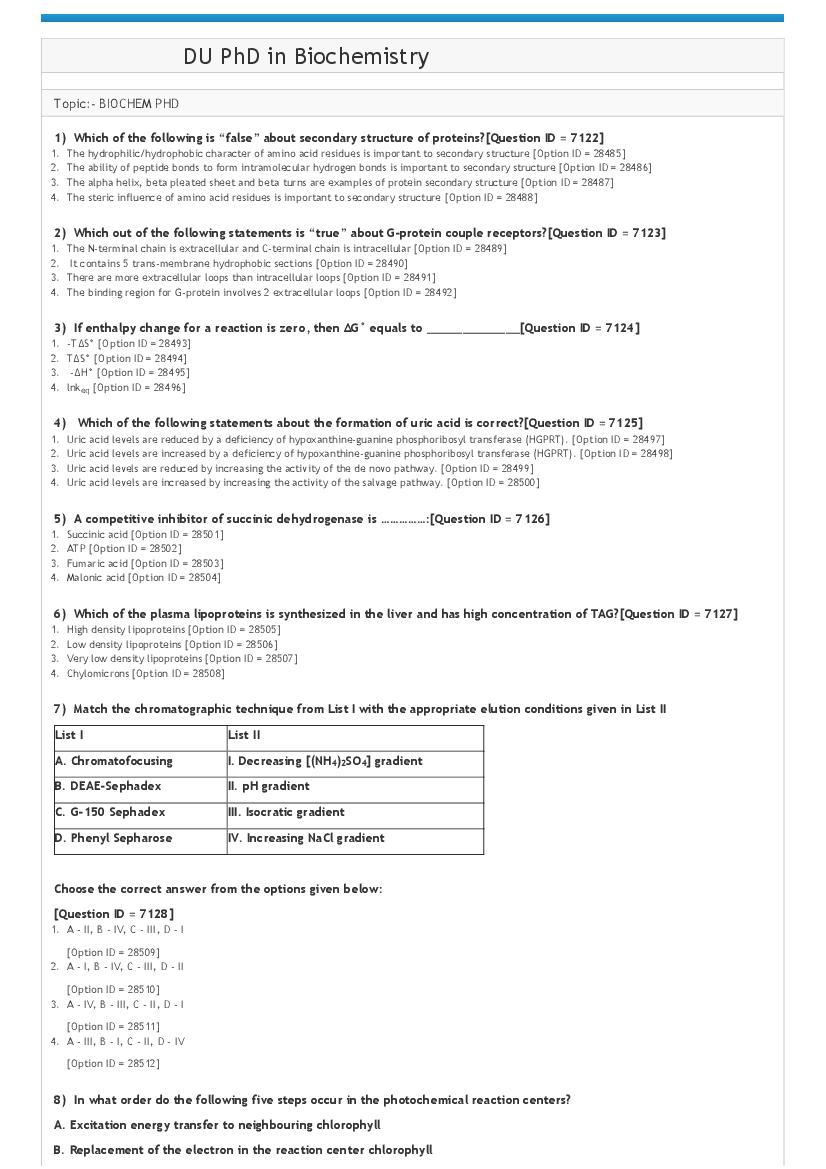
Topic:‐ BIOCHEM PHD
1) Which of the following is “false” about secondary structure of proteins?[Question ID = 7122]
1. The hydrophilic/hydrophobic character of amino acid residues is important to secondary structure [Option ID = 28485]
2. The ability of peptide bonds to form intramolecular hydrogen bonds is important to secondary structure [Option ID = 28486]
3. The alpha helix, beta pleated sheet and beta turns are examples of protein secondary structure [Option ID = 28487]
4. The steric influence of amino acid residues is important to secondary structure [Option ID = 28488]
2) Which out of the following statements is “true” about G‐protein couple receptors?[Question ID = 7123]
1. The N‐terminal chain is extracellular and C‐terminal chain is intracellular [Option ID = 28489]
2. It contains 5 trans‐membrane hydrophobic sections [Option ID = 28490]
3. There are more extracellular loops than intracellular loops [Option ID = 28491]
4. The binding region for G‐protein involves 2 extracellular loops [Option ID = 28492]
3) If enthalpy change for a reaction is zero, then ∆G° equals to _____________[Question ID = 7124]
1. ‐T∆S° [Option ID = 28493]
2. T∆S° [Option ID = 28494]
3. ‐∆H° [Option ID = 28495]
4. lnkeq [Option ID = 28496]
4) Which of the following statements about the formation of uric acid is correct?[Question ID = 7125]
1. Uric acid levels are reduced by a deficiency of hypoxanthine‐guanine phosphoribosyl transferase (HGPRT). [Option ID = 28497]
2. Uric acid levels are increased by a deficiency of hypoxanthine‐guanine phosphoribosyl transferase (HGPRT). [Option ID = 28498]
3. Uric acid levels are reduced by increasing the activity of the de novo pathway. [Option ID = 28499]
4. Uric acid levels are increased by increasing the activity of the salvage pathway. [Option ID = 28500]
5) A competitive inhibitor of succinic dehydrogenase is ……………:[Question ID = 7126]
1. Succinic acid [Option ID = 28501]
2. ATP [Option ID = 28502]
3. Fumaric acid [Option ID = 28503]
4. Malonic acid [Option ID = 28504]
6) Which of the plasma lipoproteins is synthesized in the liver and has high concentration of TAG?[Question ID = 7127]
1. High density lipoproteins [Option ID = 28505]
2. Low density lipoproteins [Option ID = 28506]
3. Very low density lipoproteins [Option ID = 28507]
4. Chylomicrons [Option ID = 28508]
7) Match the chromatographic technique from List I with the appropriate elution conditions given in List II
List I List II
A. Chromatofocusing I. Decreasing [(NH4) 2SO4] gradient
B. DEAE‐Sephadex II. pH gradient
C. G‐150 Sephadex III. Isocratic gradient
D. Phenyl Sepharose IV. Increasing NaCl gradient
[Question ID = 7128]
1. A ‐ II, B ‐ IV, C ‐ III, D ‐ I
[Option ID = 28509]
2. A ‐ I, B ‐ IV, C ‐ III, D ‐ II
[Option ID = 28510]
3. A ‐ IV, B ‐ III, C ‐ II, D ‐ I
[Option ID = 28511]
4. A ‐ III, B ‐ I, C ‐ II, D ‐ IV
[Option ID = 28512]
8) In what order do the following five steps occur in the photochemical reaction centers?
A. Excitation energy transfer to neighbouring chlorophyll
B. Replacement of the electron in the reaction center chlorophyll
Page 2
D. Passage of excited electron to electron‐transfer chain
E. Excitation energy transfer to neighbouring chlorophyll
Choose the correct answer from the options given below
[Question ID = 7129]
1. A, B, C, D, E
[Option ID = 28513]
2. C, B, E, D, A
[Option ID = 28514]
3. C, E, A, D, B
[Option ID = 28515]
4. D, B, C, E, A
[Option ID = 28516]
9) The computational method whereby the mutual orientation and conformational position of a protein molecule in complex
with another protein or a small protein is predicted is known as:[Question ID = 7130]
1. Molecular Dynamics Simulation [Option ID = 28517]
2. Homology modeling [Option ID = 28518]
3. Structure superposition [Option ID = 28519]
4. Docking [Option ID = 28520]
10) Plagiarism software checks plagiarism by inspecting:[Question ID = 7131]
1. Citation index [Option ID = 28521]
2. Similarity index [Option ID = 28522]
3. H‐index [Option ID = 28523]
4. Content index [Option ID = 28524]
11) Toll like receptors (TLR), present in the mammalian macrophages, are recognized by the types of macromolecules that
are not present in the vertebrates but are present in certain microbial pathogens. When these pathogens infect
macrophages, TLR signaling is stimulated. Following are the list of macrophages in List I and types of TLR in List II
List I List II
A. Lipopolysaccharides (LPS I. TLR3
B. Flagellin II. TLR4
C. Double stranded RNA III. TLR5
D. Unmethylated CpG dinucleotide IV. TLR9
[Question ID = 7132]
1. A ‐ I, B ‐ II, C ‐ III, D ‐ IV [Option ID = 28525]
2. A ‐ II, B ‐ I, C ‐ IV, D ‐ III [Option ID = 28526]
3. A ‐ II, B ‐ III, C ‐ I, D ‐ IV [Option ID = 28527]
4. A ‐ III, B ‐ IV, C ‐ II, D ‐ I [Option ID = 28528]
12) Following are some statements about biomolecules:
A. In all L‐amino acids, only the C alpha carbon atom is chiral \
B. Deoxyribose is optically inactive
C. The specific rotation of sucrose will be the sum of the specific rotations of D‐glucose and D‐fructose
D. Phosphatidyl choline isolated from biological membranes is optically active
E. Glycine is optically inactive
[Question ID = 7133]
1. A, C and D
[Option ID = 28529]
2. B, C and E
[Option ID = 28530]
3. D and E
[Option ID = 28531]
4. A and E
[Option ID = 28532]
13) Match List I with List II
List I List II
Page 3
B. 5‐BU II. intercalating agent
C. Ethyl methane sulfonate III. deaminating agent
D. HNO2 IV. alkylating agent
[Question ID = 7134]
1. A ‐ II, B ‐ IV, C ‐ I, D ‐ III
[Option ID = 28533]
2. A ‐ II, B ‐ I, C ‐ IV, D ‐ III
[Option ID = 28534]
3. A ‐ I, B ‐ IV, C ‐ II, D ‐ III
[Option ID = 28535]
4. A ‐ I, B ‐ II, C ‐ III, D ‐ IV
[Option ID = 28536]
14) The following events that occur in rods in response to light are listed in random sequence:
A. activation of transduction
B. decreased release of synaptic transmitter
C. structural changes in rhodopsin
D. closure of Na+ channels
E. decrease in intracellular cGMP
What is the sequence in which they normally occur?
[Question ID = 7135]
1. B, A, C, E, D
[Option ID = 28537]
2. A, B, C, E, D
[Option ID = 28538]
3. E, C, A, D, B
[Option ID = 28539]
4. C, A, E, D, B
[Option ID = 28540]
15) In DNA, mutations at G‐C sequences occur quite frequently since 5‐methyl cytosine easily deaminates to form:
[Question ID = 7136]
1. Adenine [Option ID = 28541]
2. Thymine [Option ID = 28542]
3. Guanine [Option ID = 28543]
4. Cytosine [Option ID = 28544]
16) A patient has a genetic defect resulting in deficiency of lipoprotein lipase. After eating a meal containing a large
amount of fat, one would expect to see a plasma elevation of [Question ID = 7137]
1. Chylomicrons [Option ID = 28545]
2. VLDLs [Option ID = 28546]
3. LDLs [Option ID = 28547]
4. HDLs [Option ID = 28548]
17) Which of the following mechanism is NOT likely to trigger apoptosis:[Question ID = 7138]
1. Binding of Fas/FasL proteins on the surface [Option ID = 28549]
2. Mitochondrial protein release into the cytosol [Option ID = 28550]
3. Irreparable DNA damage [Option ID = 28551]
4. Mutations that inhibit p53 activity [Option ID = 28552]
18) Minisatellites are used as marker for identifying individuals by DNA fingerprinting as the alleles may differ in the
number of repeats. Based on the Southern blot data provided below for the given parents (M= mother, F= father) identify
the progeny (A, B, C and D).
Page 4
1. B, C and D [Option ID = 28553]
2. A, B, C and D [Option ID = 28554]
3. A and D only [Option ID = 28555]
4. A, B and D [Option ID = 28556]
19) Aspartate amino transferase uses the following for transamination:[Question ID = 7140]
1. Glutamic acid and Pyruvic acid [Option ID = 28557]
2. Glutamic acid and Oxaloacetic acid [Option ID = 28558]
3. Aspartic acid and Pyruvic acid [Option ID = 28559]
4. Aspartic acid and Keto adipic acid [Option ID = 28560]
20) SARS‐CoV‐2 targets which of the following receptors in human body:[Question ID = 7141]
1. ACE I [Option ID = 28561]
2. ACE II [Option ID = 28562]
3. Angiotensin [Option ID = 28563]
4. S‐protein [Option ID = 28564]
21) Human papilloma virus (HPV) causes cervical cancer by employing two oncoproteins, E6 and E7. These proteins are
responsible for:[Question ID = 7142]
1. Activating p53 and Inhibiting pRB [Option ID = 28565]
2. Inhibiting p53 and Activating pRB [Option ID = 28566]
3. Inhibiting p53 and Inhibiting pRB [Option ID = 28567]
4. Activating p53 and Activating pRB [Option ID = 28568]
22) Which of the following pair correctly represent the sugar and protein components of milk?[Question ID = 7143]
1. Glucose and Galactose [Option ID = 28569]
2. Glucose and Lactose [Option ID = 28570]
3. Lactose and Casein [Option ID = 28571]
4. Glucose and Casein [Option ID = 28572]
23) The oligopeptide, F‐A‐R‐P‐M‐T‐S‐R‐P‐G‐F, is treated with trypsin, chymotrypsin and carboxypeptidase‐B. Apart from
the original peptide, the number of fragments obtained will be:[Question ID = 7144]
1. 4 [Option ID = 28573]
2. 3 [Option ID = 28574]
3. 2 [Option ID = 28575]
4. 0 [Option ID = 28576]
24) The migration of a protein on an SDS‐PAGE gel is best described as inversely proportional to the:[Question ID = 7145]
1. Negative charge [Option ID = 28577]
2. Isoelectric point [Option ID = 28578]
3. Log of molecular weight [Option ID = 28579]
4. Native volume [Option ID = 28580]
25) Eukaryotic cells and their organelles are disrupted by sonication. A centrifuge is used to separate the soluble from
insoluble components. Following centrifugation, protein “x” is found in the insoluble fraction. The insoluble fraction is
treated with 0.5 (M) NaCl and centrifuged again. Now, protein “x” is found in the soluble fraction. Therefore, protein “x”
can be best described as:[Question ID = 7146]
1. An integral plasma membrane protein [Option ID = 28581]
2. A peripheral membrane protein [Option ID = 28582]
3. A soluble cytoplasmic protein [Option ID = 28583]
4. A soluble nuclear protein [Option ID = 28584]
26) You are inserting a gene of 2kb length into a vector of 3kb to make a GST fusion protein. The gene is being inserted at
the EcoRI site and the insert has a HindIII site 500bp downstream of the first codon. You are screening for the clone with
the correct orientation by restriction digestion of the plasmid using HindIII plus BamHI (H+B) and HindIII plus PstI (H+P). The
map of the relevant region of the vector is shown below:
Page 5
[Question ID = 7147]
1. A
[Option ID = 28585]
2. B
[Option ID = 28586]
3. C
[Option ID = 28587]
4. D
[Option ID = 28588]
27) The sequence of the peptide KGLITRTGLIKR can be unequivocally determined by[Question ID = 7148]
1. Only Edman degradation. [Option ID = 28589]
2. Amino acid analysis and MALDI MS/MS mass spectrometry. . [Option ID = 28590]
3. MALDI MS/MS mass spectrometry. [Option ID = 28591]
4. MALDI mass spectrometry after treatment of the peptide with trypsin [Option ID = 28592]
28) The mismatch repair activity of E. coli repairs mis‐incorporated bases which are not removed by the proofreading
activity of DNA polymerase. However, while doing so, it has to decide which strand of the DNA is newly synthesized and
which one is parental. Mismatch repair system does it by which one of the following ways?[Question ID = 7149]
1. It recognizes nearby GATC sequence. [Option ID = 28593]
2. It recognizes any nearby palindromic sequence. [Option ID = 28594]
3. It recognises a specific repetitive sequence. [Option ID = 28595]
4. It recognises the hemi‐methylated GATC sequence nearby. [Option ID = 28596]
29) The listed below statements may or may not be correct:
A. Fructose 2,6 bisphosphate is an allosteric inhibitor of phosphofructokinase 1.
B. The TCA cycle intermediates, succinate and oxaloacetate can both be derived from amino acids.
C. A diet rich in cysteine can compensate for a methionine deficit diet in humans
D. dTTP for DNA synthesis can be obtained from UTP.
E. In the fatty acid biosynthesis pathway, the carbon atom from HCO3 in the synthesis of malonyl CoA is not incorporated
into the palmitic acid.
Select the correct statements from the options given below:
[Question ID = 7150]
1. A, B, C and E only
[Option ID = 28597]
2. B, D and E only
[Option ID = 28598]
3. A, D and E only
[Option ID = 28599]
4. B and C only
[Option ID = 28600]
30) The native structure of a protein, whose formation from its denatured state is favored at a temperature below T =
∆H/∆S. For what values of ∆H and ∆S this condition is satisfied?[Question ID = 7151]
1. ∆H is – ve ∆S is +ve [Option ID = 28601]
Page 6
3. ∆H is + ve ∆S is + ve [Option ID = 28603]
4. ∆H is + ve ∆S is –ve [Option ID = 28604]
31) Following are some statements about β‐turns:
A. All the 20 amino acids have equal propensity to form β‐turn
B. Proline cannot occur in the β‐turn
C. Pro‐Gly sequence strongly favors β‐turn
D. In Asn‐Gly β‐turn, Asn can have positive values.
[Question ID = 7152]
1. B and D only
[Option ID = 28605]
2. A and C only
[Option ID = 28606]
3. A and D only
[Option ID = 28607]
4. C and D only
[Option ID = 28608]
32) Match List I with List II
List I List II
A. Cyanide I. K+ ionophore
B. Antimycin A II. Electron transfer from cytochrome b to cytochrome C1
C. Valinomycin III. F1 subunit of ATP synthase
D. Aurovertin IV. Cytochrome oxidase
V. Adenine nucleotide translocase
[Question ID = 7153]
1. A ‐ V, B ‐ II, C ‐ III, D ‐ I [Option ID = 28609]
2. A ‐ V, B ‐ II, C ‐ I, D ‐ III [Option ID = 28610]
3. A ‐ IV, B ‐ II, C ‐ I, D ‐ III [Option ID = 28611]
4. A ‐ IV, B ‐ V, C ‐ III, D ‐ I [Option ID = 28612]
33) Name the structures given below in the order of their appearance and identify corresponding glycosidic linkages:
[Question ID = 7154]
1. Amylose, Cellulose; (α1→4),(β1→6) [Option ID = 28613]
2. Amylopectin, amylase; (α1→6),(α1→4) [Option ID = 28614]
3. Starch, Cellulose; (α1→6),(α1→4) [Option ID = 28615]
4. Cellulose, Dextran; (β2→4),(α3→6) [Option ID = 28616]
34) In eukaryotic cells, circular mRNA reflects a rapid rate of synthesis of the specific Protein.Following mechanisms are
suggested:
A. eIF‐4G and PABP promotes this process through 5’‐3’ interaction of mRNA
B. Ribosomes are less reactive in recognizing circular mRNA
C. PABP and eIF‐4A promotes this process
D. Ribosomes can reinitiate translation without being dissembled
Page 7
1. A and C only
[Option ID = 28617]
2. B and C only
[Option ID = 28618]
3. A and D only
[Option ID = 28619]
4. B and D only
[Option ID = 28620]
35) Select the technique which can be used to determine the structure of 15 kDa globular proteins at atomic resolution?
[Question ID = 7156]
1. Raman spectroscopy [Option ID = 28621]
2. NMR spectroscopy [Option ID = 28622]
3. UV spectroscopy [Option ID = 28623]
4. IR spectroscopy [Option ID = 28624]
36) In B‐form DNA helix, one of strands is replaced by another strand with identical nucleotide sequences but with a
backbone made up of all ribose sugars, the new duplex structure would be[Question ID = 7157]
1. B‐form [Option ID = 28625]
2. A‐form [Option ID = 28626]
3. C‐form [Option ID = 28627]
4. D‐form [Option ID = 28628]
37) A gene encoding tRNA undergoes mutational event in its anticodon region that enables it to recognize a mutant
nonsense codon and permit completion of translation. Such a mutation is known as[Question ID = 7158]
1. Silent mutation [Option ID = 28629]
2. Neutral mutation [Option ID = 28630]
3. Reversion [Option ID = 28631]
4. Nonsense suppressor [Option ID = 28632]
38) Match List I with List II
List I List II
A. Isotype switching I. VH domain
B. Clonal allergy II. Non‐responsive to self‐antigens
C. Class II MHC III. Non –responsive to TH cells
D. Self‐tolerance IV. β2 ‐microglobulin
[Question ID = 7159]
1. A ‐ I, B ‐ III, C ‐ IV, D ‐ II [Option ID = 28633]
2. A ‐ II, B ‐ IV, C ‐ I, D ‐ III [Option ID = 28634]
3. A ‐ I, B ‐ IV, C ‐ III, D ‐ II [Option ID = 28635]
4. A ‐ II, B ‐ I, C ‐ III, D ‐ IV [Option ID = 28636]
39) Actin binding proteins (ABPs) are primarily important for regulating:[Question ID = 7160]
1. Glycosylation of membrane proteins [Option ID = 28637]
2. Membrane asymmetry [Option ID = 28638]
3. Cytoskeletal organization [Option ID = 28639]
4. Passive diffusion of solutes across phospholipid bilayer [Option ID = 28640]
40) Hemophilia A is manifested because of the absence or malfunction of:[Question ID = 7161]
1. Factor VIII [Option ID = 28641]
2. Factor XI [Option ID = 28642]
3. Hemoglobin [Option ID = 28643]
4. Factor IX [Option ID = 28644]
41) The φ and ψ values of a β‐strand composed of all D‐ amino acids will mainly occupy which quadrant in the
Ramachandran plot?[Question ID = 7162]
1. Upper left [Option ID = 28645]
2. Upper right [Option ID = 28646]
3. Lower left [Option ID = 28647]
4. Lower right [Option ID = 28648]
42) Band3 transmembrane protein of RBCs is a:[Question ID = 7163]
1. Sodium transporter [Option ID = 28649]
2. Calcium antiporter [Option ID = 28650]
3. Chloride transporter [Option ID = 28651]
Page 8
43) The dolichol pyro phosphoryl oligosaccharide is formed on:[Question ID = 7164]
1. The ER membrane [Option ID = 28653]
2. The trans‐Golgi membrane [Option ID = 28654]
3. The cis‐Golgi membrane [Option ID = 28655]
4. Secretory vesicle membrane [Option ID = 28656]
44) Epi Fluorescence microscopy is based on the ability of certain molecules to:[Question ID = 7165]
1. Continuously emit light of a constant wavelength [Option ID = 28657]
2. Absorb light of many different wavelengths [Option ID = 28658]
3. Absorb light of a given wavelength and then emit light of a longer wavelength [Option ID = 28659]
4. Absorb light of a given wavelength and then emit light of a shorter wavelength [Option ID = 28660]
45) A lectin can preferentially bind to plasma membrane vesicles if it is:[Question ID = 7166]
1. Right side out [Option ID = 28661]
2. Inside out [Option ID = 28662]
3. Both right‐side‐out and inside‐out [Option ID = 28663]
4. Digested with protease [Option ID = 28664]
46) One of the key processes in the entry of influenza viruses (that is different from their non‐enveloped counterparts)
into its host cell is:[Question ID = 7167]
1. Binding to host cells surface [Option ID = 28665]
2. Receptor mediated endocytosis leading to membrane fusion [Option ID = 28666]
3. Integration of its genome to host cells chromosome [Option ID = 28667]
4. Super active action of its RNA dependent RNA polymerase [Option ID = 28668]
47) In the small intestine, cholera toxin acts by:[Question ID = 7168]
1. ADP – ribosylation of the G regulatory protein [Option ID = 28669]
2. inhibition of adenyl cyclase [Option ID = 28670]
3. activation of GTPase [Option ID = 28671]
4. active absorption of NaCl [Option ID = 28672]
48) In a mixture of the proteins consisting of i) Serum albumin, Mw – 68,500 Da, ii) Carbonic Anhydrase, Mw – 30,000 Da,
iii) Immunoglobulin, Mw – 145,000 Da and iv) Lysozyme, Mw – 14,000 Da, the elution profile obtained after gel filtration
chromatography will have
A. The first peak of Immunoglobulin and second peak of lysozyme
B. The first peak of Immunoglobulin and second peak of serum albumin
C. The third peak of Carbonic Anhydrase and fourth peak of Lysozyme
D. The third peak of serum albumin and fourth peak of carbonic anhydrase
E. The third peak will have both carbonic anhydrase and lysozyme
F. The first peak will have both Immunoglobulin and serum albumin
[Question ID = 7169]
1. A and D only
[Option ID = 28673]
2. B and C only
[Option ID = 28674]
3. A and E only
[Option ID = 28675]
4. C and F only
[Option ID = 28676]
49) Bibliography given in a research report[Question ID = 7170]
1. Helps those interested in further research and studying the problem from another angle [Option ID = 28677]
2. Shows the vast knowledge of the researcher [Option ID = 28678]
3. Makes the report authentic [Option ID = 28679]
4. Helps understand the methodology employed [Option ID = 28680]
50) Match List I with List II of the following components of various signaling pathways.
List I List ofII
Ligand Receptor/pathway
A. Fas I. Notch protein
B. Delta II. cAMP pathway
C. Wnt III. Apoptosis
Page 9
[Question ID = 7171]
1. A ‐ IV, B ‐ I, C ‐ III, D ‐ II [Option ID = 28681]
2. A ‐ III, B ‐ I, C ‐ IV, D ‐ II [Option ID = 28682]
3. A ‐ IV, B ‐ II, C ‐ I, D ‐ III [Option ID = 28683]
4. A ‐ II, B ‐ I, C ‐ IV, D ‐ III [Option ID = 28684]
Document Details
| Board / Org | NTA |
| Exam | DUET |
| Type | Question Paper |
| Pages | 9 |
| Language | english |
| Updated | 30 Apr 2026 |