DUET 2021 Question Paper Ph.D in Computer Science
Finished viewing? Save it for later —
Download DUET 2021 Question Paper Ph.D in Computer Science (PDF · 13 pages)About DUET 2021 Question Paper Ph.D in Computer Science
DUET 2021 Question Paper Ph.D in Computer Science is available here for free download. Published by NTA for DUET, this question paper can be viewed online or downloaded as a PDF (13 pages). Candidates preparing for DUET can use DUET 2021 Question Paper Ph.D in Computer Science to understand the exam pattern, the type of questions asked, and the overall difficulty level.
Frequently Asked Questions
How can I download DUET 2021 Question Paper Ph.D in Computer Science?
Open this page and click the Download button to save DUET 2021 Question Paper Ph.D in Computer Science as a PDF. It is completely free on AglaSem Docs.
Is DUET 2021 Question Paper Ph.D in Computer Science free to download?
Yes. DUET 2021 Question Paper Ph.D in Computer Science can be viewed online and downloaded as a PDF free of cost on AglaSem Docs.
How many pages does DUET 2021 Question Paper Ph.D in Computer Science have?
DUET 2021 Question Paper Ph.D in Computer Science contains 13 pages, which you can read online or download together as a single PDF.
Where can I find more DUET study material?
You can find more DUET question papers, sample papers, syllabus, and answer keys on AglaSem Docs.
DUET 2021 Question Paper Ph.D in Computer Science – Text
Read the full text of this question paper below — useful to quickly search, copy and reference the content online without downloading the PDF.
📄 View text version (13 pages)
Page 1
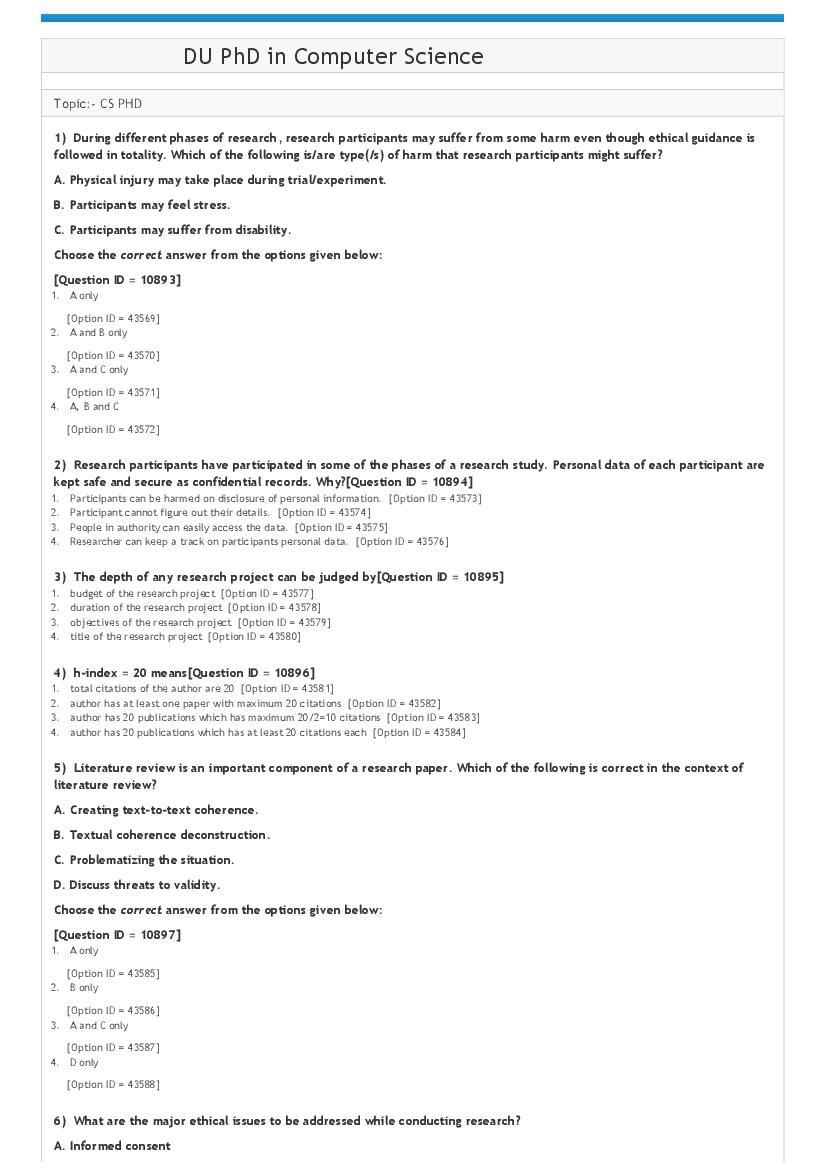
Topic:‐ CS PHD
1) During different phases of research, research participants may suffer from some harm even though ethical guidance is
followed in totality. Which of the following is/are type(/s) of harm that research participants might suffer?
A. Physical injury may take place during trial/experiment.
B. Participants may feel stress.
C. Participants may suffer from disability.
Choose the correct answer from the options given below:
[Question ID = 10893]
1. A only
[Option ID = 43569]
2. A and B only
[Option ID = 43570]
3. A and C only
[Option ID = 43571]
4. A, B and C
[Option ID = 43572]
2) Research participants have participated in some of the phases of a research study. Personal data of each participant are
kept safe and secure as confidential records. Why?[Question ID = 10894]
1. Participants can be harmed on disclosure of personal information. [Option ID = 43573]
2. Participant cannot figure out their details. [Option ID = 43574]
3. People in authority can easily access the data. [Option ID = 43575]
4. Researcher can keep a track on participants personal data. [Option ID = 43576]
3) The depth of any research project can be judged by[Question ID = 10895]
1. budget of the research project [Option ID = 43577]
2. duration of the research project [Option ID = 43578]
3. objectives of the research project [Option ID = 43579]
4. title of the research project [Option ID = 43580]
4) h‐index = 20 means[Question ID = 10896]
1. total citations of the author are 20 [Option ID = 43581]
2. author has at least one paper with maximum 20 citations [Option ID = 43582]
3. author has 20 publications which has maximum 20/2=10 citations [Option ID = 43583]
4. author has 20 publications which has at least 20 citations each [Option ID = 43584]
5) Literature review is an important component of a research paper. Which of the following is correct in the context of
literature review?
A. Creating text‐to‐text coherence.
B. Textual coherence deconstruction.
C. Problematizing the situation.
D. Discuss threats to validity.
Choose the correct answer from the options given below:
[Question ID = 10897]
1. A only
[Option ID = 43585]
2. B only
[Option ID = 43586]
3. A and C only
[Option ID = 43587]
4. D only
[Option ID = 43588]
6) What are the major ethical issues to be addressed while conducting research?
A. Informed consent
Page 2
C. Respect for secrecy and confidentiality
D. Respect for privacy
Choose the correct answer from the options given below:
[Question ID = 10898]
1. A only
[Option ID = 43589]
2. A and B only
[Option ID = 43590]
3. A and C only
[Option ID = 43591]
4. A, B, C and D
[Option ID = 43592]
7) Which of the following term is not related to indexing of a journal?[Question ID = 10899]
1. Emerging Source Citation Index (ESCI) [Option ID = 43593]
2. Social Sciences Citation Index (SSCI) [Option ID = 43594]
3. Science Citation Index Expanded (SCIE) [Option ID = 43595]
4. Book Citation Index (BKCI) [Option ID = 43596]
8) A laboratory blood test is 95 percent effective in detecting a particular disease when it is, in fact, present. However,
the test also yields a “false positive” result for 1 percent of the healthy person tested. If 0.5 percent of the population
actually has the disease. What is the probability a person has the disease given that his test result is positive?[Question ID =
10900]
1. 0.532 [Option ID = 43597]
2. 0.432 [Option ID = 43598]
3. 0.323 [Option ID = 43599]
4. 0.223 [Option ID = 43600]
9) Let X be a random variable with probability density function
The value of c is
[Question ID = 10901]
1. 1/4
[Option ID = 43601]
2. 3/4
[Option ID = 43602]
3. 1/5
[Option ID = 43603]
4. 3/5
[Option ID = 43604]
10) An examination paper has 100 multiple‐choice questions of three marks each, with each question having four choices.
Each incorrect answer fetches ‐1 mark. Suppose 1000 students choose all their answers randomly with uniform probability.
The sum total of the expected marks obtained by all these students is[Question ID = 10902]
1. 0 [Option ID = 43605]
2. 2550 [Option ID = 43606]
3. 7525 [Option ID = 43607]
4. 9375 [Option ID = 43608]
11) Which of the following is a ‘non‐parametric’ test?
[Question ID = 10903]
1. chi‐square test
[Option ID = 43609]
2. t‐test
[Option ID = 43610]
3. z‐test
[Option ID = 43611]
4. none of these
[Option ID = 43612]
12) If the trace and the determinant of a 2×2 matrix are known to be ‐2 and ‐35 respectively then the eigenvalues of the
matrix are
Page 3
1. ‐30 and ‐5
[Option ID = 43613]
2. ‐37 and ‐1
[Option ID = 43614]
3. ‐7 and 5
[Option ID = 43615]
4. 17.5 and ‐2
[Option ID = 43616]
13)
[Question ID = 10905]
1.
[Option ID = 43617]
2.
[Option ID = 43618]
3.
[Option ID = 43619]
4.
[Option ID = 43620]
14)
[Question ID = 10906]
1.
[Option ID = 43621]
2.
[Option ID = 43622]
3.
[Option ID = 43623]
4.
[Option ID = 43624]
15)
Page 4
1. Any real number
[Option ID = 43625]
2. 0
[Option ID = 43626]
3. 1
[Option ID = 43627]
4. There is no such value
[Option ID = 43628]
16)
[Question ID = 10908]
1.
[Option ID = 43629]
2.
[Option ID = 43630]
3.
[Option ID = 43631]
4.
[Option ID = 43632]
17)
[Question ID = 10909]
1. 0 [Option ID = 43633]
2. 1 [Option ID = 43634]
3. 3 [Option ID = 43635]
4. not defined [Option ID = 43636]
18) Let . The maximum value of the function in the interval (0, ∞) is
[Question ID = 10910]
1.
[Option ID = 43637]
2.
[Option ID = 43638]
3.
[Option ID = 43639]
4.
[Option ID = 43640]
19)
[Question ID = 10911]
1. 2 [Option ID = 43641]
2. 3 [Option ID = 43642]
3. 4 [Option ID = 43643]
4. 1 [Option ID = 43644]
20) The use of the motor car is becoming more and more widespread in the world. As an increasing number of countries
develop both technically and economically, so a large proportion of the world is able to buy and use a car. Possessing a car
gives a much greater degree of mobility, enabling the driver to move around freely. The owner of a car is no longer forced
to rely on public transport and is, therefore, not compelled to work locally. He can choose from a greater variety of jobs as
he is not restricted to a choice within a small radius. Travelling to work by car is also more comfortable than having to use
public transport. There is no irritation caused by waiting for trains or buses, standing in long patient queues in scorching sun
Page 5
enjoy their leisure time to the full making trips to the hills or riverside resorts at weekends, instead of being confined to
their immediate neighbourhood. This feeling of independence, and the freedom to go where you please is, perhaps, the
greatest advantage of the car.
When considering the drawbacks, perhaps pollution is of prime importance. As more and more cars are produced and used,
so the emission from their exhaust pipes contains an ever larger volume of poisonous gas. Most of the important cities of the
world suffer from traffic congestion. The soaring cost of petrol further adds to the driver’s worries. In fact, he must
sometimes wonder if the motor car is such a boon, and not just a menace.
What in the opinion of the author is the greatest advantage of possessing a car?
[Question ID = 10912]
1. You are no longer compelled to work within a small area
[Option ID = 43645]
2. You are sure to reach your workplace in time now
[Option ID = 43646]
3. The car gives you a greater degree of mobility
[Option ID = 43647]
4. You can easily make trips to the hills or riverside resorts at weekends
[Option ID = 43648]
21) The use of the motor car is becoming more and more widespread in the world. As an increasing number of countries
develop both technically and economically, so a large proportion of the world is able to buy and use a car. Possessing a car
gives a much greater degree of mobility, enabling the driver to move around freely. The owner of a car is no longer forced
to rely on public transport and is, therefore, not compelled to work locally. He can choose from a greater variety of jobs as
he is not restricted to a choice within a small radius. Travelling to work by car is also more comfortable than having to use
public transport. There is no irritation caused by waiting for trains or buses, standing in long patient queues in scorching sun
or blinding rain for as long as half an hour sometimes. For the first time in this century also, many people are now able to
enjoy their leisure time to the full making trips to the hills or riverside resorts at weekends, instead of being confined to
their immediate neighbourhood. This feeling of independence, and the freedom to go where you please is, perhaps, the
greatest advantage of the car.
When considering the drawbacks, perhaps pollution is of prime importance. As more and more cars are produced and used,
so the emission from their exhaust pipes contains an ever larger volume of poisonous gas. Most of the important cities of the
world suffer from traffic congestion. The soaring cost of petrol further adds to the driver’s worries. In fact, he must
sometimes wonder if the motor car is such a boon, and not just a menace.
What does the statement ‘he must sometimes wonder if the motor car is such a boon, and not just a menace’ mean?
[Question ID = 10913]
1. The car user can’t believe the car is such an indispensable part of his life
[Option ID = 43649]
2. It has fewer advantages and more disadvantages
[Option ID = 43650]
3. Sometimes he feels the car is more of a curse than a blessing
[Option ID = 43651]
4. The traffic congestions and rising cost of petrol have dimmed his sense of pleasure in driving
[Option ID = 43652]
22) The Great White Shark is the largest predatory shark, and is probably the most well‐known and feared shark. The Great
White Shark is gray or bluish above and white below. The largest Great White can reach length of 22 feet and weigh up to
5,000 pounds. The Great White has massive teeth, which are positioned in rows and serrated. When the Great White
attacks, it bites its prey and shakes its head back and forth. The serrated teeth act as a saw and literally tear the victim
apart. The Great White Shark often swallows many of its own teeth in an attack. The Great White Shark normally feeds on
fish, seals, dolphins, porpoises, otters, and turtles. It is thought to locate its prey by electrosense and by smell. Like all
sharks, Great Whites have special pores called Ampullae of Lorenzini, which enable them to detect the electromagnetic
fields radiated by moving organisms. Great Whites can detect voltage as small as one half billionth of a volt.
Great Whites employ several hunting techniques depending on the prey. Most of the time, the shark will remain still
underwater before ambushing its prey from underneath. In the case of hunting some kinds of seals, the impact of the shark
is so powerful that it knocks both the shark and the seal clear out of the water. With larger prey such as elephant seals, the
shark will simply take a huge bite out of it and wait for it to bleed to death. When hunting dolphins, the shark will attack
from above, presumably to avoid detection from the dolphin's echolocation.
Mark the statement that is NOT true
[Question ID = 10914]
1. The white shark senses its prey through its auditory sense
[Option ID = 43653]
2. It swallows many of its own teeth in an attack
Page 6
3. It has different techniques to attack different kinds of sea creatures
[Option ID = 43655]
4. The great white shark is perhaps the most fearsome of all sharks
[Option ID = 43656]
23) The Great White Shark is the largest predatory shark, and is probably the most well‐known and feared shark. The Great
White Shark is gray or bluish above and white below. The largest Great White can reach length of 22 feet and weigh up to
5,000 pounds. The Great White has massive teeth, which are positioned in rows and serrated. When the Great White
attacks, it bites its prey and shakes its head back and forth. The serrated teeth act as a saw and literally tear the victim
apart. The Great White Shark often swallows many of its own teeth in an attack. The Great White Shark normally feeds on
fish, seals, dolphins, porpoises, otters, and turtles. It is thought to locate its prey by electrosense and by smell. Like all
sharks, Great Whites have special pores called Ampullae of Lorenzini, which enable them to detect the electromagnetic
fields radiated by moving organisms.
Great Whites can detect voltage as small as one half billionth of a volt. Great Whites employ several hunting techniques
depending on the prey. Most of the time, the shark will remain still underwater before ambushing its prey from
underneath. In the case of hunting some kinds of seals, the impact of the shark is so powerful that it knocks both the shark
and the seal clear out of the water. With larger prey such as elephant seals, the shark will simply take a huge bite out of it
and wait for it to bleed to death. When hunting dolphins, the shark will attack from above, presumably to avoid detection
from the dolphin's echolocation.
The White Shark uses its serrated teeth?
[Question ID = 10915]
1. Eat up big animals like elephant seals
[Option ID = 43657]
2. Ambush its prey from below
[Option ID = 43658]
3. Saw and tear apart its prey
[Option ID = 43659]
4. Feed on small animals like dolphins, seals, turtles
[Option ID = 43660]
24) Natural resources are things that are useful to people and come from the earth. Materials for building shelter are
natural resources. So are food sources such as fruits and vegetables, animals that could be caught or hunted, and water.
A region’s climate and landforms let certain things grow in different areas. They also determine what kind of life will be
able to survive there. Regions with very rich soil make good farming communities. However, areas with poor soil may attract
those who have other purposes for the land. For example, you can build a factory here. Each area attracts people based on
their interests and purposes. Areas that support many different interests will naturally have larger populations. Mountains,
lakes, or oceans are natural resources. Villages and cities built near water sources have been the most successful. People
who want to catch fish for a living can do that by the ocean, but cannot do so in the desert. Water can also be used to
transport goods to other areas to be sold. Places that are difficult to reach will naturally have fewer people living in them.
Places that are high on mountain tops are not very desirable to some people. Neither are places that are in the middle of
hot, dry deserts. For too long, humans have destroyed resources. We have been using up those that cannot be easily
replaced. Renewable resources are those that can be replaced easily. We are fortunate to have many resources that are
renewable, such as sun, wind, water and trees. We need to focus more on using renewable resources. This will protect our
planet from further harm.
The statement ‘They also determine what kind of life will be able to survive there’ means:
[Question ID = 10916]
1. What kind of communities will continue to live here
[Option ID = 43661]
2. What vegetation will grow here
[Option ID = 43662]
3. What kind of animals will be found here
[Option ID = 43663]
4. What occupations will flourish here
[Option ID = 43664]
25) Natural resources are things that are useful to people and come from the earth. Materials for building shelter are
natural resources. So are food sources such as fruits and vegetables, animals that could be caught or hunted, and water.
A region’s climate and landforms let certain things grow in different areas. They also determine what kind of life will be
able to survive there. Regions with very rich soil make good farming communities. However, areas with poor soil may attract
those who have other purposes for the land. For example, you can build a factory here. Each area attracts people based on
their interests and purposes. Areas that support many different interests will naturally have larger populations. Mountains,
lakes, or oceans are natural resources. Villages and cities built near water sources have been the most successful. People
Page 7
transport goods to other areas to be sold. Places that are difficult to reach will naturally have fewer people living in them.
Places that are high on mountain tops are not very desirable to some people. Neither are places that are in the middle of
hot, dry deserts. For too long, humans have destroyed resources. We have been using up those that cannot be easily
replaced. Renewable resources are those that can be replaced easily. We are fortunate to have many resources that are
renewable, such as sun, wind, water and trees. We need to focus more on using renewable resources. .This will protect our
planet from further harm.
Mark the statement that is NOT true
[Question ID = 10917]
1. Natural resources come from the earth
[Option ID = 43665]
2. Areas with poor soil hardly attract anyone
[Option ID = 43666]
3. Natural resources include things that come from the earth as also water, air, hills, etc
[Option ID = 43667]
4. Areas that support many different interests naturally have larger populations
[Option ID = 43668]
26)
[Question ID = 10918]
1. A: True, B: False, C: False
[Option ID = 43669]
2. A: True, B: True, C: True
[Option ID = 43670]
3. A: True, B: True, C: False
[Option ID = 43671]
4. A: False, B: True, C: False
[Option ID = 43672]
27)
[Question ID = 10919]
1.
[Option ID = 43673]
2.
[Option ID = 43674]
3.
[Option ID = 43675]
4.
[Option ID = 43676]
28) The number of minimum spanning tree in the following graph is:
Page 8
1. 1 [Option ID = 43677]
2. 8 [Option ID = 43678]
3. 18 [Option ID = 43679]
4. 9 [Option ID = 43680]
29)
[Question ID = 10921]
1. 56, 52, 44, 62, 33, 43 [Option ID = 43681]
2. 44, 52, 33, 62, 43, 56 [Option ID = 43682]
3. 56, 44, 52, 33, 62, 43 [Option ID = 43683]
4. 52, 56, 43, 33, 44, 62 [Option ID = 43684]
30) What does the following function do when called for a linked list with head as the first node?
void traverse(struct node* head)
{
if(head == NULL)
return;
traverse(head→next);
printf ("%d", head→data);
}
[Question ID = 10922]
1. It prints the data of all the nodes of the linked list
[Option ID = 43685]
2. It prints the data of all the nodes of linked list in reverse order
[Option ID = 43686]
3. It prints the data of alternate nodes of linked list
[Option ID = 43687]
4. It prints the data of alternate nodes in reverse order
[Option ID = 43688]
31) Suppose we push n numbers on a stack and then perform n pop operations. Assuming each operation takes T units of
time, what is the average time for which an element stays in the stack? Note that the last element that was pushed stays
for 0 time in the stack.
[Question ID = 10923]
1.
[Option ID = 43689]
2.
[Option ID = 43690]
3.
[Option ID = 43691]
4.
[Option ID = 43692]
32) The time taken by merge‐sort on elements, in the worst case, is
Page 9
1.
[Option ID = 43693]
2.
[Option ID = 43694]
3.
[Option ID = 43695]
4. None of the above
[Option ID = 43696]
33) Suppose we have integers in the range {1 … 1000} stored in a binary search tree. Which of the following cannot be the
sequence of nodes examined while searching for the key 365?[Question ID = 10925]
1. 5, 255, 405, 400, 335, 350, 395, 365 [Option ID = 43697]
2. 925, 220, 910, 215, 900, 260, 360, 365 [Option ID = 43698]
3. 925, 200, 915, 240, 910, 245, 365 [Option ID = 43699]
4. 5, 400, 390, 220, 270, 385, 380, 280, 365 [Option ID = 43700]
34) Suppose the split at every level of Quick sort happens in the ratio of 1/3 to 2/3. The maximum height of the recursion
tree is
[Question ID = 10926]
1.
[Option ID = 43701]
2.
[Option ID = 43702]
3.
[Option ID = 43703]
4.
[Option ID = 43704]
35) Consider the following functions Which of the following is not true?
[Question ID = 10927]
1. f(n) = O(g(n))
[Option ID = 43705]
2. f(n) = θ(g(n))
[Option ID = 43706]
3. f(n) = Ω(g(n))
[Option ID = 43707]
4. none of the above
[Option ID = 43708]
36) Consider an undirected graph with positive edge weights. Which of the following is not true?[Question ID = 10928]
1. Shortest path between any pair of vertices remains the same if the edge weights are incremented by 1 [Option ID = 43709]
2. Minimum spanning tree remains the same if the edge weights are incremented by 1 [Option ID = 43710]
3. Shortest path between any pair of vertices remains the same if the edge weights are multiplied by a positive constant k [Option ID = 43711]
4. Minimum spanning tree remains the same if the edge weights are multiplied by a positive constant k [Option ID = 43712]
37) is the the output of the following program?
#include<stdio.h>
void test(int n, int sum)
{
int k = 0, j = 0;
if (n == 0) return;
k = n % 10; j = n / 10;
sum = sum + k;
test(j, sum);
printf ("%d,", k);
Page 10
void main ()
What
{
int a = 3032, sum = 0;
test(a, sum);
printf ("%d\n", sum);
}
[Question ID = 10929]
1. 3, 0, 3, 2, 8
[Option ID = 43713]
2. 3, 0, 3, 2, 0
[Option ID = 43714]
3. 2, 3, 0, 3, 8
[Option ID = 43715]
4. 2, 3, 0, 3, 0
[Option ID = 43716]
38) What is the time complexity of the following piece of code.
for(i=1; i<=n; i=2*i)
sum = sum + i; //Initially, sum=0
[Question ID = 10930]
1.
[Option ID = 43717]
2.
[Option ID = 43718]
3.
[Option ID = 43719]
4.
[Option ID = 43720]
39) Consider the following logic
for (i=0;i< NO_STUDENTS;i++)
{
count = 0;
for (j=0; j< NO_SUBJECTS; j++)
{
if(marks[i][j] > PASS_MARK)
{
count++;
}
else
{
break;
}
}
if(count == NO_SUBJECTS)
{
for (j=0;j< NO_SUBJECTS;j++)
{
total[i] = total[i] + marks[i][j];
}
}
if(total[i] == 0)
{
printf("Student %d ‐ failed\n", I);
}
else
{
Page 11
}
}
What does this logic do
[Question ID = 10931]
1. It computes the total marks of each student and displays whether the student failed or passed, along with the total marks
[Option ID = 43721]
2. It computes the total marks of each student and displays whether the student passed or failed. It also displays the total marks of only passed
students
[Option ID = 43722]
3. It computes the total marks of only the passed students and for every student it displays whether the student passed or failed by displaying the
total marks of only passed students
[Option ID = 43723]
4. It prints total marks of all the students
[Option ID = 43724]
40) What is the output of the following program in C/C++?
void main()
{
int x = 28;
printf ("%d ", x‐‐ ‐ 1);
}
[Question ID = 10932]
1. 27
[Option ID = 43725]
2. 28
[Option ID = 43726]
3. 26
[Option ID = 43727]
4. 25
[Option ID = 43728]
41) What is the output of the following program?
int main()
{
int a = ‐7;
printf("%d", 0 < !a);
return 0;
}
[Question ID = 10933]
1. Prints a non‐zero value
[Option ID = 43729]
2. Prints 0
[Option ID = 43730]
3. Garbage
[Option ID = 43731]
4. Compilation error
[Option ID = 43732]
42) In digital communication, if the available channel is a _____________ channel, we cannot send a digital signal directly
on the channel.
[Question ID = 10934]
1. low‐pass
[Option ID = 43733]
2. bandpass
[Option ID = 43734]
3. low rate
[Option ID = 43735]
4. high rate
Page 12
43) Which of the following field in IPv4 datagram is not related to fragmentation?[Question ID = 10935]
1. Flags [Option ID = 43737]
2. Offset [Option ID = 43738]
3. TOS [Option ID = 43739]
4. Identifier [Option ID = 43740]
44) Which of the following testing checks whether or not individual modules of a software are functioning as desired?
[Question ID = 10936]
1. Unit testing [Option ID = 43741]
2. Integration testing [Option ID = 43742]
3. Alpha testing [Option ID = 43743]
4. Beta testing [Option ID = 43744]
45) Which of the following commands is used to delete a particular column of a relation in a relational database?[Question
ID = 10937]
1. UPDATE [Option ID = 43745]
2. POP [Option ID = 43746]
3. DELETE [Option ID = 43747]
4. ALTER [Option ID = 43748]
46) How many two input NOR gates are required to make two input inclusive OR gate?[Question ID = 10938]
1. 3 [Option ID = 43749]
2. 2 [Option ID = 43750]
3. 1 [Option ID = 43751]
4. 4 [Option ID = 43752]
47) The simplified form of the expression X'Z + X'Y + XY'Z + YZ is:
[Question ID = 10939]
1. XY'+Z
[Option ID = 43753]
2. XZ+Y'
[Option ID = 43754]
3. X'Z+Y
[Option ID = 43755]
4. X'Y+Z
[Option ID = 43756]
48) In a multi‐threading operating system architecture, which of the following areas cannot be shared by two threads
within a process?[Question ID = 10940]
1. Code area [Option ID = 43757]
2. Data area [Option ID = 43758]
3. Stack area [Option ID = 43759]
4. PCB area [Option ID = 43760]
49) A user process makes a read system call as follows:
While True
Do
read (fd, *m , 4);
The Operating System buffer size is 1024 bytes, and a physical disk sector size is also same. The physical DMA data transfer
time is 32 milliseconds. What will be the average Disk I/O time for the above read system call?
[Question ID = 10941]
1. 1/2 milliseconds
[Option ID = 43761]
2. 1/4 milliseconds
[Option ID = 43762]
3. 1/8 milliseconds
[Option ID = 43763]
4. 1/16 milliseconds
[Option ID = 43764]
50) In Round robin CPU scheduling, the time‐slice is 4 milliseconds. The average execution time of Timer Interrupt service
Routine is 1 millisecond. The efficiency of the aforesaid scheduling is:
[Question ID = 10942]
Page 13
[Option ID = 43765]
2. 40%
[Option ID = 43766]
3. 60%
[Option ID = 43767]
4. 80%
[Option ID = 43768]
Document Details
| Board / Org | NTA |
| Exam | DUET |
| Type | Question Paper |
| Pages | 13 |
| Language | english |
| Updated | 30 Apr 2026 |