DUET 2021 Question Paper Ph.D in Chemistry
Finished viewing? Save it for later —
Download DUET 2021 Question Paper Ph.D in Chemistry (PDF · 13 pages)About DUET 2021 Question Paper Ph.D in Chemistry
DUET 2021 Question Paper Ph.D in Chemistry is available here for free download. Published by NTA for DUET, this question paper can be viewed online or downloaded as a PDF (13 pages). Candidates preparing for DUET can use DUET 2021 Question Paper Ph.D in Chemistry to understand the exam pattern, the type of questions asked, and the overall difficulty level.
Frequently Asked Questions
How can I download DUET 2021 Question Paper Ph.D in Chemistry?
Open this page and click the Download button to save DUET 2021 Question Paper Ph.D in Chemistry as a PDF. It is completely free on AglaSem Docs.
Is DUET 2021 Question Paper Ph.D in Chemistry free to download?
Yes. DUET 2021 Question Paper Ph.D in Chemistry can be viewed online and downloaded as a PDF free of cost on AglaSem Docs.
How many pages does DUET 2021 Question Paper Ph.D in Chemistry have?
DUET 2021 Question Paper Ph.D in Chemistry contains 13 pages, which you can read online or download together as a single PDF.
Where can I find more DUET study material?
You can find more DUET question papers, sample papers, syllabus, and answer keys on AglaSem Docs.
DUET 2021 Question Paper Ph.D in Chemistry – Text
Read the full text of this question paper below — useful to quickly search, copy and reference the content online without downloading the PDF.
📄 View text version (13 pages)
Page 1
Topic:‐ CHEM PHD
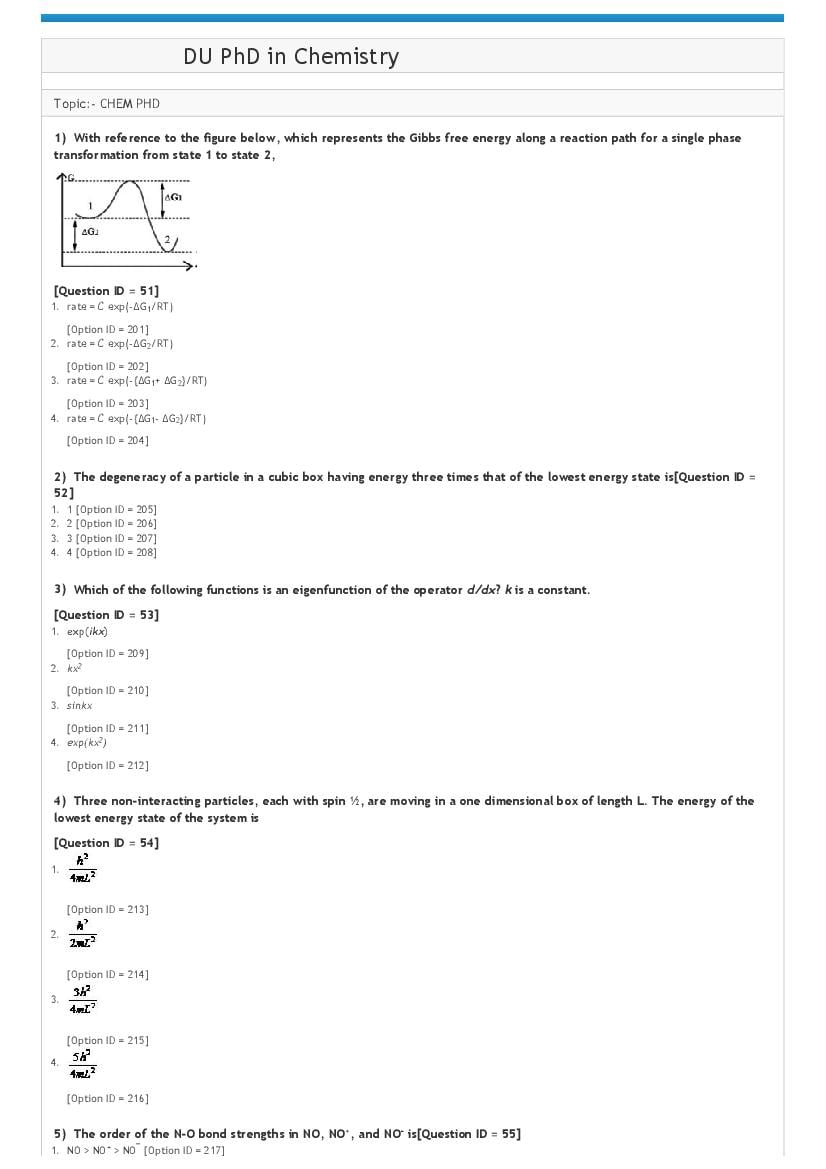
1) With reference to the figure below, which represents the Gibbs free energy along a reaction path for a single phase
transformation from state 1 to state 2,
[Question ID = 51]
1. rate = C exp(‐ΔG1/RT)
[Option ID = 201]
2. rate = C exp(‐ΔG2/RT)
[Option ID = 202]
3. rate = C exp(‐{ΔG1+ ΔG2}/RT)
[Option ID = 203]
4. rate = C exp(‐{ΔG1‐ ΔG2}/RT)
[Option ID = 204]
2) The degeneracy of a particle in a cubic box having energy three times that of the lowest energy state is[Question ID =
52]
1. 1 [Option ID = 205]
2. 2 [Option ID = 206]
3. 3 [Option ID = 207]
4. 4 [Option ID = 208]
3) Which of the following functions is an eigenfunction of the operator d/dx? k is a constant.
[Question ID = 53]
1. exp(ikx)
[Option ID = 209]
2. kx2
[Option ID = 210]
3. sinkx
[Option ID = 211]
4. exp(kx2)
[Option ID = 212]
4) Three non‐interacting particles, each with spin ½, are moving in a one dimensional box of length L. The energy of the
lowest energy state of the system is
[Question ID = 54]
1.
[Option ID = 213]
2.
[Option ID = 214]
3.
[Option ID = 215]
4.
[Option ID = 216]
5) The order of the N‐O bond strengths in NO, NO+, and NO‐ is[Question ID = 55]
1. NO > NO+ > NO¯ [Option ID = 217]
Page 2
3. NO+ > NO¯ > NO [Option ID = 219]
4. NO¯ > NO > NO+ [Option ID = 220]
6) If the energy of a particle can be either 1, 2, 3, 4 or 5 units with probability 1/15, 2/15, 3/15/ 4/15 and 5/15,
respectively, the average energy of the particle is[Question ID = 56]
1. 0.5 [Option ID = 221]
2. 3.0 [Option ID = 222]
3. 3.7 [Option ID = 223]
4. 4.3 [Option ID = 224]
7) In terms of the partition function Z of a system of particles, the average energy <E> is expressed as
[Question ID = 57]
1.
[Option ID = 225]
2.
[Option ID = 226]
3.
[Option ID = 227]
4.
[Option ID = 228]
8) State which of the following statements about Bose‐Einstein (BE) statistics is FALSE[Question ID = 58]
1. BE statistics is for particles with integral spin. [Option ID = 229]
2. BE statistics can be applied to photons. [Option ID = 230]
3. Bosons obey Pauli’s Exclusion Principle. [Option ID = 231]
4. The wave function of bosons is symmetric. [Option ID = 232]
9) The equation for the evaluation of β in the Maxwell‐Boltzmann distribution law is
[Question ID = 59]
1. β = 1/kT.
[Option ID = 233]
2. β = ‐1/kT.
[Option ID = 234]
3. β = kT.
[Option ID = 235]
4. β = 2/kT.
[Option ID = 236]
10) According to the Debye‐Hückel limiting law, if the concentration of a dilute aqueous solution of KCl is increased 4‐fold,
the value of logγ ± will
[Question ID = 60]
1. decrease by a factor of 2
[Option ID = 237]
2. increase by a factor of 2
[Option ID = 238]
3. decrease by a factor of 4
[Option ID = 239]
4. increase by a factor of 4
[Option ID = 240]
11) In the first excited state, S1, acetylene has a trans bent configuration compared to its linear S0 ground state, and its CC
bond length also increases from 1.21 Å to 1.34 Å. The S1 ← S0 absorption spectrum will show
[Question ID = 61]
1. no vibrational coarse structure.
[Option ID = 241]
2. a sharp peak.
[Option ID = 242]
3. a continuum.
Page 3
4. a broad vibrational progression.
[Option ID = 244]
12) ClO2 molecule was trapped in a solid. Its ground electronic state is known to be B1. Light polarized parallel to the y‐axis
excited the molecule to an upper state. The upper state is
[Question ID = 62]
1. A1
[Option ID = 245]
2. A2
[Option ID = 246]
3. B1
[Option ID = 247]
4. B2
[Option ID = 248]
13) The term symbol for the ground state of B2+ is 2Σg +. The total spin and total orbital angular momentum are,
respectively,
[Question ID = 63]
1. ½, 0
[Option ID = 249]
2. ¾, 0
[Option ID = 250]
3. √3/2, 0
[Option ID = 251]
4. 2, 1
[Option ID = 252]
14) Interpret the observed IR and Raman frequencies for an XY2 molecule
V/CM‐1 IR Raman
2224 vs, PR s, depol
1285 vs, PR vs, pol
568 s, PQR
The structure is
[Question ID = 64]
1. linear XYY
[Option ID = 253]
2. linear YXY
[Option ID = 254]
3. bent XYY
[Option ID = 255]
4. bent YXY
[Option ID = 256]
15) Assuming that the force constants of double and triple bonds are roughly two and three times, respectively, that of
single bonds, the ratio of the stretching frequencies of the C‐C, C=C and C≡C bonds is
[Question ID = 65]
1. 1:2:3
[Option ID = 257]
2. 1:1.4:1.7
[Option ID = 258]
3. 3:2:1
[Option ID = 259]
Page 4
[Option ID = 260]
16) The mean time for the 2p → 1s spectral transition is 1.6×10‐9 s, while the mean time for the 2s → 1s transition is 0.14
s. This is because
[Question ID = 66]
1. the 2p → 1s transition is forbidden, but 2s → 1s is allowed.
[Option ID = 261]
2. the 2p → 1s transition is allowed, but 2s → 1s is forbidden.
[Option ID = 262]
3. the 2p → 1s transition is allowed, and 2s → 1s is also allowed.
[Option ID = 263]
4. the 2p → 1s transition is forbidden, and the 2s → 1s transition is also forbidden.
[Option ID = 264]
17) The vibrations of diatomic molecules are usually modelled by a harmonic potential. If the potential is given by x2, the
correct statement is:
[Question ID = 67]
1. The force constant is 2 and the force is 2x.
[Option ID = 265]
2. The force constant is 2 and the force is ‐2x.
[Option ID = 266]
3. The force constant is ‐1 and the force is ‐2x.
[Option ID = 267]
4. The force constant is 1 and the force is 2x.
[Option ID = 268]
18) Major product of the following reaction is:
[Question ID = 68]
1.
[Option ID = 269]
2.
[Option ID = 270]
3.
[Option ID = 271]
4.
[Option ID = 272]
19) Which of the following conformer(s) will predominate(s) in dimethylsulfoxide (DMSO) solvent?
Page 5
1. (B) only
[Option ID = 273]
2. (A) only
[Option ID = 274]
3. (B) is 50% and (A) in 50 %
[Option ID = 275]
4. (B) is 78% and (A) is 22%
[Option ID = 276]
20) Consider the following reaction:
[Question ID = 70]
1.
[Option ID = 277]
2.
[Option ID = 278]
3.
[Option ID = 279]
4.
[Option ID = 280]
21) Which one of the following reducing reagents will not give below given product?
[Question ID = 71]
1. 9‐Borobicyclo[3,3,1]nonane (9‐BBN), THF, 0°C
[Option ID = 281]
2. NaBH4, CeCl3, MeOH
Page 6
3. LiAlH(OMe)3, THF, 0°C
[Option ID = 283]
4. NaBH4, EtOH, 0°C
[Option ID = 284]
22) The major product formed in the following reaction is:
[Question ID = 72]
1.
[Option ID = 285]
2.
[Option ID = 286]
3.
[Option ID = 287]
4.
[Option ID = 288]
23) Consider the following reaction
The products A and B are:
[Question ID = 73]
1.
[Option ID = 289]
Page 7
[Option ID = 290]
3.
[Option ID = 291]
4.
[Option ID = 292]
24) The following reaction is known as:
[Question ID = 74]
1. Suzuki reaction
[Option ID = 293]
2. Heck reaction
[Option ID = 294]
3. Stille coupling
[Option ID = 295]
4. Sonogashira coupling
[Option ID = 296]
25) Which one of the following products will be major product in the below given reaction?
[Question ID = 75]
1.
[Option ID = 297]
2.
[Option ID = 298]
3.
[Option ID = 299]
Page 8
[Option ID = 300]
26) Which one of the following is suitable reagent for the below given reaction?
[Question ID = 76]
1. t‐BuOOH, Ti(OiPr)4, (+)‐Diethyl tartrate
[Option ID = 301]
2. t‐BuOOH, (+)‐Diethyl tartrate
[Option ID = 302]
3. t‐BuOOH, Ti(OiPr)4, (‐)‐Diethyl tartrate
[Option ID = 303]
4. t‐BuOOH, Ti(OiPr)4
[Option ID = 304]
27) Consider the following addition reaction:
The least favored produt is:
[Question ID = 77]
1. 3‐Bromo‐3‐methyl‐1‐butene
[Option ID = 305]
2. 1‐Bromo‐3‐methyl ‐2‐butene
[Option ID = 306]
3. 3‐Bromo‐2‐methyl‐1‐butene
[Option ID = 307]
4. 4‐Bromo‐2‐methyl‐1‐butene
[Option ID = 308]
28) Which one is the correct order of potential effetiveness as leaving group in the nuleophilic substitution reaction?
[Question ID = 78]
1. II > I > III > IV
[Option ID = 309]
2. I > III > II> IV
[Option ID = 310]
3. IV > II > III > I
[Option ID = 311]
4. III > I > II > IV
[Option ID = 312]
29) Nitration of cinnamic acid will give the product(s):
[Question ID = 79]
1. 2‐Nitro‐cinnamic acid only
[Option ID = 313]
2. 3‐Nitro‐cinnamic acid only
[Option ID = 314]
3. 4‐Nitro‐cinnamic acid only
Page 9
4. 2‐nitro‐cinnamic acid and 4‐nitro‐cinnamic acid formed more than 3‐nitro‐cinnamic acid
[Option ID = 316]
30) An organic compound having molecular formula C5H10O and it shows peak at 3410 cm‐1 in FT‐IR. 1H‐NMR (300 MHz,
CDCl3): = 6.05 (dd, 1H), 5.02 (dd, 1H), 4.09 (dd, 1H), 2.80 (s, D2O exchangeable), 1.3 (s, 6H) ppm. 13C‐NMR: =150,
110, 70, 29 ppm. Dept‐135: = 150(+), 110 (‐), 29 (+). The structure of the compound will be:
[Question ID = 80]
1.
[Option ID = 317]
2.
[Option ID = 318]
3.
[Option ID = 319]
4.
[Option ID = 320]
31) Cyclohexanone and cyclopetanone give one common m/z base peak. The value of the peak in m/z is:
[Question ID = 81]
1. 84
[Option ID = 321]
2. 42
[Option ID = 322]
3. 55
[Option ID = 323]
4. 83
[Option ID = 324]
32) The principal product of the following reaction is:
[Question ID = 82]
1.
[Option ID = 325]
2.
[Option ID = 326]
Page 10
[Option ID = 327]
4.
[Option ID = 328]
33) In the following reaction A and C are interconvered under thermal conditions through cyclobutane B.
[Question ID = 83]
1. Ring closure of A and ring opening of B both will be conrotatory proccesses
[Option ID = 329]
2. Ring closure of A will be disrotatory process and ring opening of B will be conrotatory proccess
[Option ID = 330]
3. Ring closure of A and ring opening of B both will be disrotatory proccesses
[Option ID = 331]
4. Ring closure of A will be conrotatory proccess and ring opening of B will be disrotatory process
[Option ID = 332]
34) The absolute configuration of below given compunds will be:
[Question ID = 84]
1. R
[Option ID = 333]
2. S
[Option ID = 334]
3. R, S
[Option ID = 335]
4. S, S
[Option ID = 336]
35) Which ordering correctly shows the variation in rates of water exchange in high spin aqua complexes [M(OH2) 6]?
[Question ID = 85]
1. Co2+ > Cr2+
[Option ID = 337]
2. V2+ > Co2+
[Option ID = 338]
3. Cr3+ > Fe3+
[Option ID = 339]
4. Cr2+ > Cr3+
[Option ID = 340]
Page 11
[Question ID = 86]
1. BF3
[Option ID = 341]
2. SnO2
[Option ID = 342]
3. BrF5
[Option ID = 343]
4. C6H 6
[Option ID = 344]
37) Which one of the following sentence is false about EDTA?
[Question ID = 87]
1. Alkali medium is required for complexation because EDTA will ionize better in alkali medium.
[Option ID = 345]
2. EDTA form complexes with all metal ions.
[Option ID = 346]
3. Solubility of EDTA is lower than its disodium counterpart.
[Option ID = 347]
4. Alkali medium is required for complexation because EDTA will ionize more in acidic medium.
[Option ID = 348]
38) The non‐covalent interaction present in the Na+ ‐crown ether complex is due to,
[Question ID = 88]
1. ion‐ion
[Option ID = 349]
2. ion‐dipole
[Option ID = 350]
3. dipole‐dipole
[Option ID = 351]
4. hydrogen bonding
[Option ID = 352]
39) The series identifying the thiophilic heavy metal ions,
[Question ID = 89]
1. Cu1+, Hg2+, Tl1+
[Option ID = 353]
2. Ti4+, La3+, Si4+
[Option ID = 354]
3. V5+, Te6+, Y3+
[Option ID = 355]
4. Nb5+, Sc3+, B3+
[Option ID = 356]
40) A metal X on heating in nitrogen gas gives Y. Y on treatment with H2O gives a colourless gas which when passed
through CuSO4 solution gives blue colour. Y is
[Question ID = 90]
1. Mg(NO3)2
[Option ID = 357]
2. Mg3N2
[Option ID = 358]
3. MgCl2
[Option ID = 359]
4. MgO
[Option ID = 360]
41) Which of the following statement is true for the diffraction pattern in the crystal lattice?
[Question ID = 91]
1. Diffraction patterns are linear space.
[Option ID = 361]
2. Diffraction patterns possess a center of symmetry
Page 12
3. Diffraction pattern does not have center of symmetry
[Option ID = 363]
4. Diffraction patterns contain α‐rays.
[Option ID = 364]
42) Which is the sequence showing the correct order of increasing intensity for the d‐d transition?
[Question ID = 92]
1. CoCl42‐ > [Co(NH3)6]3+ > [Co(NH3)6]2+ > [Co(H2O)6]2+
[Option ID = 365]
2. [Co(H2O)6]2+ > [Co(NH3)6]3+ > CoCl42‐ > [Co(NH3)6]2+
[Option ID = 366]
3. [Co(NH3)6]2+ > [Co(H2O)6]2+ > CoCl42‐ > [Co(NH3)6]3+
[Option ID = 367]
4. [Co(NH3)6]3+ > [Co(NH3)6]2+ > CoCl42‐ > [Co(H2O)6]2+
[Option ID = 368]
43) The equilibrium shift towards the products in Cr2O 72‐ ⇋ CrO42‐
[Question ID = 93]
1. occurs in acidic medium
[Option ID = 369]
2. occurs in basic medium
[Option ID = 370]
3. occurs in neutral medium
[Option ID = 371]
4. does not exist
[Option ID = 372]
44) Which one of the following ion shows kinetic masking?
[Question ID = 94]
1. Co2+
[Option ID = 373]
2. Cu2+
[Option ID = 374]
3. Cr3+
[Option ID = 375]
4. Fe3+
[Option ID = 376]
45) The p5 electronic configuration is equivalent to the term in ground state
[Question ID = 95]
1. 3P
[Option ID = 377]
2. 2P
[Option ID = 378]
3. 3F
[Option ID = 379]
4. 4P
[Option ID = 380]
46) The molecule which has an inversion center and S6‐axis is
[Question ID = 96]
1. Chlorobenzene
[Option ID = 381]
2. p‐dichlorobenzene
[Option ID = 382]
3. 1,3, 5‐ trichlorobenzene
[Option ID = 383]
4. Chair form of cyclohexane
[Option ID = 384]
Page 13
[Question ID = 97]
1. Cation – π
[Option ID = 385]
2. anion – π
[Option ID = 386]
3. dipole‐ion
[Option ID = 387]
4. π – π
[Option ID = 388]
48) Which one of the following statement is correct?
[Question ID = 98]
1. A dissociative mechanism is a 2‐step mechanism with the leaving group departing in the second step.
[Option ID = 389]
2. An associative mechanism is a 2‐step mechanism; the intermediate has a lower coordination number than the starting complex.
[Option ID = 390]
3. In a dissociative interchange mechanism, bond breaking dominates over bond formation
[Option ID = 391]
4. In an associative interchange mechanism, the entering group associates with the substrate after the leaving group has departed.
[Option ID = 392]
49) Which one of the following cannot show linkage isomerism?
[Question ID = 99]
1. Cl‐
[Option ID = 393]
2. SCN‐
[Option ID = 394]
3. CN‐
[Option ID = 395]
4. NH3
[Option ID = 396]
50) Match List I with List II based on the molecular symmetry
Choose the correct answer from the options given below:
[Question ID = 100]
1. A ‐ III, B ‐ I , C ‐ IV , D ‐II
[Option ID = 397]
2. A ‐ II , B ‐ III , C ‐I , D ‐ II
[Option ID = 398]
3. A ‐ IV, B ‐ I , C ‐ III , D ‐ II
[Option ID = 399]
4. A ‐ IV, B ‐ III , C ‐ II , D ‐ I
[Option ID = 400]
Document Details
| Board / Org | NTA |
| Exam | DUET |
| Type | Question Paper |
| Pages | 13 |
| Language | english |
| Updated | 30 Apr 2026 |