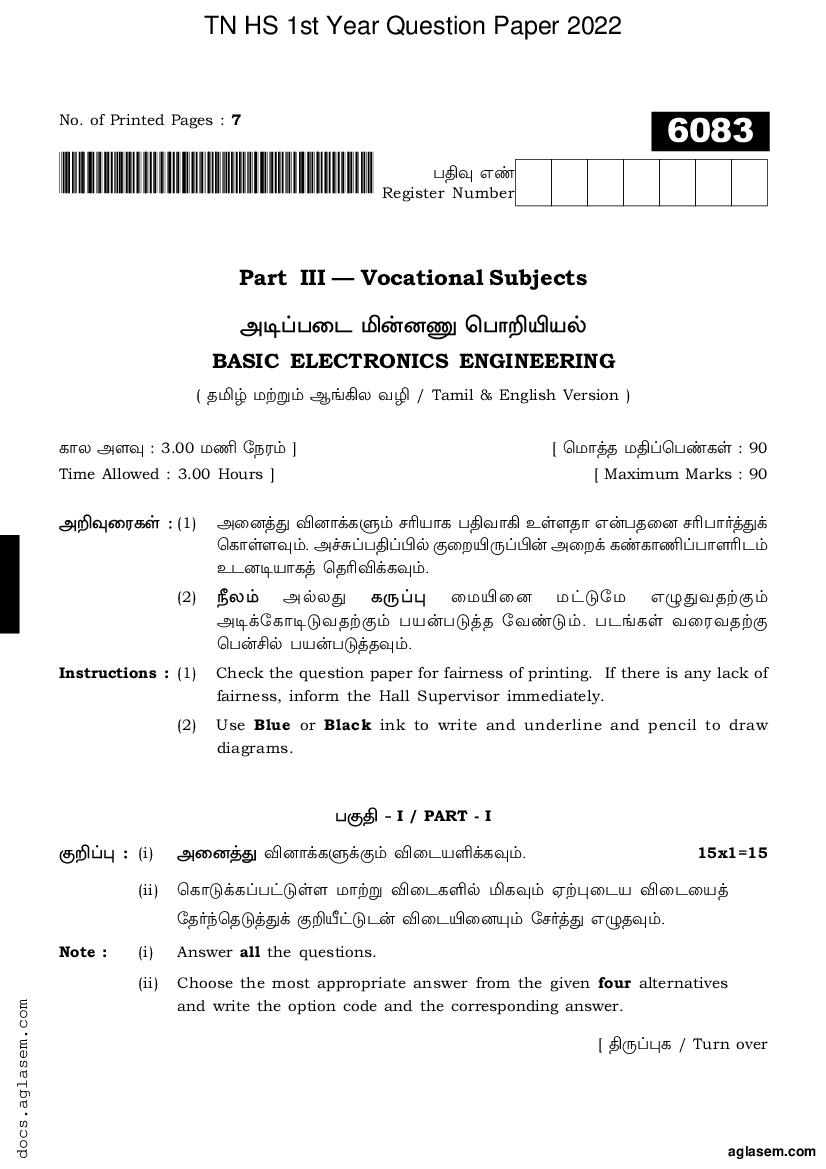
TN 11th Question Paper 2022 Basic Electronics Engineering
Finished viewing? Save it for later —
Download TN 11th Question Paper 2022 Basic Electronics Engineering (PDF · 7 pages)About TN 11th Question Paper 2022 Basic Electronics Engineering
TN 11th Question Paper 2022 Basic Electronics Engineering is available here for free download. Published by Tamil Nadu Board for Class 11, this question paper can be viewed online or downloaded as a PDF (7 pages). Candidates preparing for Class 11 can use TN 11th Question Paper 2022 Basic Electronics Engineering to understand the exam pattern, the type of questions asked, and the overall difficulty level.
Frequently Asked Questions
How can I download TN 11th Question Paper 2022 Basic Electronics Engineering?
Open this page and click the Download button to save TN 11th Question Paper 2022 Basic Electronics Engineering as a PDF. It is completely free on AglaSem Docs.
Is TN 11th Question Paper 2022 Basic Electronics Engineering free to download?
Yes. TN 11th Question Paper 2022 Basic Electronics Engineering can be viewed online and downloaded as a PDF free of cost on AglaSem Docs.
How many pages does TN 11th Question Paper 2022 Basic Electronics Engineering have?
TN 11th Question Paper 2022 Basic Electronics Engineering contains 7 pages, which you can read online or download together as a single PDF.
Where can I find more Class 11 study material?
You can find more Class 11 question papers, sample papers, syllabus, and answer keys on AglaSem Docs.
TN 11th Question Paper 2022 Basic Electronics Engineering – Text
Read the full text of this question paper below — useful to quickly search, copy and reference the content online without downloading the PDF.
📄 View text version (7 pages)
Page 1
6083
!6083IstYearBasicElectronicsEngineering! £vÄ Gs
Register Number
Part III — Vocational Subjects
Ai¨£øh ªßÚq ö£õÔ°¯À
BASIC ELECTRONICS ENGINEERING
( uªÌ ©ØÖ® B[Q» ÁÈ / Tamil & English Version )
Põ» AÍÄ : 3.00 ©o ÷|µ® ] [ ö©õzu ©v¨ö£sPÒ : 90
Time Allowed : 3.00 Hours ] [ Maximum Marks : 90
AÔÄøµPÒ : (1) AøÚzx ÂÚõUPЮ \›¯õP £vÁõQ EÒÍuõ GߣuøÚ \›£õºzxU
öPõÒÍÄ®. Aa_¨£v¨¤À SøÓ°¸¨¤ß AøÓU PsPõo¨£õÍ›h®
EhÚi¯õPz öu›ÂUPÄ®.
(2) }»® AÀ»x P¸¨¦ ø©°øÚ ©mk÷© GÊxÁuØS®
AiU÷PõikÁuØS® £¯ß£kzu ÷Ásk®. £h[PÒ ÁøµÁuØS
ö£ß]À £¯ß£kzuÄ®.
Instructions : (1) Check the question paper for fairness of printing. If there is any lack of
fairness, inform the Hall Supervisor immediately.
(2) Use Blue or Black ink to write and underline and pencil to draw
diagrams.
£Sv & I / PART - I
SÔ¨¦ : (i) AøÚzx ÂÚõUPÐUS® Âøh¯ÎUPÄ®. 15x1=15
(ii) öPõkUP¨£mkÒÍ ©õØÖ ÂøhPÎÀ ªPÄ® Hئøh¯ Âøhø¯z
÷uº¢öukzxU SÔ±mkhß Âøh°øÚ²® ÷\ºzx GÊuÄ®.
Note : (i) Answer all the questions.
(ii) Choose the most appropriate answer from the given four alternatives
and write the option code and the corresponding answer.
Page 2
1. 10,00,000 Ω ©v¨-¦-øh¯ ªß-u-øh-°ß Ás-nU SÔ-±m-i-øÚU TÖ-P.
(A) £Ê¨¦, P¸¨¦, £a-ø\ (B) £Ê¨¦, P¸¨¦, £Ê¨-¦
(C) £Ê¨¦, P¸¨¦, u[-P® (D) £Ê¨¦, P¸¨¦, ©g-\Ò
What is the colour coding of a resistor with resistance value 10,00,000 Ω ?
(a) Brown, Black, Green (b) Brown, Black, Brown
(c) Brown, Black, Gold (d) Brown, Black, Yellow
2. ªß ys-i-°ß A»-S __________.
(A) öíºmì (B) K®ì (C) öíß-Ô (D) £õ-µm
The unit of an inductor is __________.
(a) Hertz (b) Ohms (c) Henry (d) Farad
3. ªß ys-i-°ß ªß ©Ö¨-¦z vÓß Põn `z-v-µ® :
1 1
(A) XL = 2π f L (B) XL=2πf L (C) XL = (D) XL =
2πLC 2πf L
The formula for inductive reactance is :
1 1
(a) X L = 2π f L (b) XL=2πf L (c) XL = (d) XL =
2πLC 2πf L
4. RÌU-Ps-h-øÁ-P-ÎÀ G¢u uÛ-©® I¢x Cøn-v-Óß G»Um-µõß-PøÍ ö£Óõ-ux ?
(A) Bs-i-©-o (B) £õì-£-µì (C) Cs-i-¯® (D) Bº-ö\-ÛU
Which of the following elements does not have five valence electrons ?
(a) Antimony (b) Phosphorous (c) Indium (d) Arsenic
5. ©õ-`m-h¨-£mh SøÓPhz-vø¯ __________ GßÖ TÖ-Q-÷Óõ®.
(A) _z-u-©õÚ SøÓ-P-hz-v (B) P»¨¦ SøÓPhzv
(C) ¦Ó-Â-¯-»õÚ SøÓ-P-hz-v (D) EÒÍõº¢u SøÓ-P-hz-v
A doped semiconductor is called :
(a) Pure Semiconductor (b) Impure Semiconductor
(c) Extrinsic Semiconductor (d) Intrinsic Semiconductor
Page 3
6. RÌU-Psh v¸zv _Ø-ÔÀ |õßS øh÷¯õ-k-PÒ EÒÍx Gx ?
(A) £õ» ÁøPz v¸z-v (B) Aøµ Aø»z v¸zv
(C) ^µõU-Q (D) •Ê Aø»z v¸z-v
Which of the following rectifiers needs four diodes ?
(a) Bridge rectifier (b) Half-wave rectifier
(c) Regulator (d) Full-wave rectifier
7. J¸ iµõß-]ì-h-›À __________.
(A) IE=IC+IB (B) IC=IE+IB (C) IE=2×IC (D) IB=IC+IE
In a transistor __________.
(a) IE=IC+IB (b) IC=IE+IB (c) IE=2×IC (d) IB=IC+IE
8. ö£¸U- Q - P - Î À HØ- £ - k ® Es- ø ©- ¯ õÚ \ªU- ø b- P - Ð U- S ®, ö£¸U- P ¨- £ mh
\ªU-øb-P-ÐU-S® EÒÍ ÷ÁÖ-£õm-øh __________ GßÖ TÖ-Q-÷Óõ®.
(A) v¸z-u® (B) Sø»-Ä (C) Ái-Pm-k-uÀ (D) ¤ß-Þm-h®
The change in output wave-shape from the input wave-shape of an amplifier is
known as __________.
(a) Rectification (b) Distortion (c) Filtration (d) Feedback
9. J¸ UJT &ø¯ GuØS £¯ß-£-kzu C¯-»õx ?
(A) _Âm-][ _Ø-Ö (B) Pmh Pm-k¨-£õk _Ø-Ö
(C) ö£¸UQ (D) ÷|µa _Ø-Ö
A UJT is not used as a :
(a) Switching device (b) Phase control circuit
(c) Amplifier (d) Timing device
10. ö\¯Ø- ø PU ÷PõÒ- P - Î ß ö\¯À- £ õm- i Ø- S z ÷uøÁ- ¯ õÚ BØ- Ó - ø » __________
ÁÇ[-S-Qß-Ó-x.
(A) Qøµ-÷¯õ-öá-ÛU ÷\ª¨-£-P® (B) G›-ö£õ-¸Ò ªß-P-»ß
(C) `›-¯ ªß-P-»ß (D) Gi-\ß ªß-P-»ß
For satellites, the source of energy is __________.
(a) Cryogenic storage (b) Fuel cells
(c) Solar cell (d) Edison cells
Page 4
11. Pm-h ©õØÓ Aø»-¯õU-Q-°À £¯ß-£-kz-u¨-£-k® RC ¤›-Ä-PÒ __________.
(A) |õßS (B) Cµsk (C) Jß-Ö (D) ‰ßÖ
In a phase shift oscillator, we use __________ RC sections.
(a) Four (b) Two (c) One (d) Three
12. v¸zv Jß-Ôß öÁÎ-±k __________.
(A) _z-u-©õÚ ©õÖvø\ ªß-\õ-µ®
(B) Aø»-QßÓ ÷|º ªß-\õ-µ®
(C) Aø»-QßÓ ©õ-Ö-vø\ ªß-\õ-µ®
(D) _z-u-©õÚ ÷|º ªß-\õ-µ®
The output of a rectifier is __________.
(a) Pure AC
(b) Pulsating DC
(c) Pulsating AC
(d) Pure DC
13. RÌU-Psh §¼-¯ß ÷uØ-Ó[-P-ÎÀ Gx \›-¯õ-Úx ?
(A) A+A=0 (B) 0+A=1 (C) 1+A=0 (D) A+A=A
Which of the following relation is valid according to Boolean theorem ?
(a) A+A=0 (b) 0+A=1 (c) 1+A=0 (d) A+A=A
14. öuõ-S¨¦ ©Ø-Ö® Á›-ö©õÈ ©õØ-Ô-PÒ __________.
(A) ö©õÈ ö£¯º¨-£õͺ-PÒ (B) Áß-ö£õ-¸Ò
(C) C¯UP •øÓ-ø© (D) ö©õ-È-PÒ
Compilers and Interpreters are __________.
(a) Translators (b) Hardware parts
(c) Operating system (d) Language
15. Q÷»õ Áõm ©o-°ß ÁºzuP A»-S :
(A) ©o (B) Q÷»õ (C) ³Ûm (D) Áõm
The commercial name for kilo watt hour is :
(a) Hour (b) Kilo (c) Unit (d) Watt
Page 5
£Sv & II / PART - II
SÔ¨¦ : GøÁ÷¯Ý® £z-x ÂÚõUPÐUS ©m-k® Âøh¯ÎUPÄ®. AÁØ-ÔÀ ÂÚõ
Gs 28 &US Pmhõ¯©õP Âøh¯ÎzuÀ ÷Ás-k®. 10x3=30
Note : Answer any ten questions briefly. Q.No. 28 is compulsory.
16. hõs-h-»® ªß-÷uU-Q-°ß AÝ-T-»[-P-øÍU TÖ-P.
State advantages of tantalum capacitors.
17. J¼ Áõ[-Q-°ß £o ©Ø-Ö® Auß ÁøP-P-øÍU TÖP.
What is the function of microphone and write its types.
18. Aq Gs Gß-£x GßÚ ?
What is an atomic number ?
19. ãÚº øh÷¯õk Gß-ÓõÀ GßÚ ? Auß SÔ-±k £h® Áøµ-P.
What is Zener diode ? Draw its symbol.
20. iµõß-]ì-hº Pm-h-ø©¨¦ – Áø-P¨-£-kz-x-P.
Classification of transistor configurations.
21. LED &°ß |ß-ø©-PÒ ¯õøÁ ?
What are the advantages of LED ?
22. JÎ- øh-÷¯õk ©Ø-Ö® JÎ iµõß-]ì-hº GÆ-ÁõÖ ÷ÁÖ-£k
- Q
- ß-ÓÚ Gß-£ø
- uU TÖ-P.
Differentiate photodiode and phototransistor.
23. £i-P Aø»-¯õU-Q-°ß |ßø©, wø©-P-øÍz u¸-P.
Give merits and demerits of Crystal Oscillator.
24. OR Áõ-°À – Áøµ-¯-ÖU-P-Ä®.
Define OR gate.
Page 6
25. §¼-¯ß C¯Ø-P-o-uz-vÀ Tm-hÀ-SÔ (+) Gß-£-uß ö£õ-¸Ò ¯õx ?
What is meant by plus sign (+) in Boolean algebra ?
26. Po-Û-°À EÒÍ EÒ-Ïk ©Ø-Ö® öÁÎ-±k \õ-u-Ú[-PøÍ GÊ-x-P.
Write about Input and Output devices of computer.
27. J¨-¦ø© £» AÍ-øÁ-©õ-Û-°ß ~s-v-ÓøÚ Áøµ-¯-ÖU-P-Ä®.
Define sensitivity of an analog multimeter.
28. öÁ¨£ A¯Û öÁÎ-±k £Ø-ÔU SÔ¨¦ Áøµ-P.
Write short notes on thermionic emission.
£Sv & III / PART - III
SÔ¨¦ : GøÁ÷¯Ý® I¢- x ÂÚõUPÐUS ©m- k ® Âøh¯ÎUPÄ®. ÂÚõ Gs
35 &US Pmhõ¯©õP Âøh¯ÎzuÀ ÷Ás-k®. ÷uøÁ-¯õÚ Ch[-PÎ
- À £h®
Áøµ-¯Ä
- ®. 5x5=25
Note : Answer any five questions. Q.No. 35 is compulsory. Draw diagrams wherever
necessary.
29. £ø\ ªß-÷uU-Q-PÒ £ØÔ £hz-x-hß ÂÁ-›U-P-Ä®.
Draw and explain about electrolytic capacitors.
30. ªß©õØ-Ô-°À HØ-£-k® CǨ-¦-PÒ £ØÔ ÂÁ-›U-P-Ä®.
Explain about the losses occurred in the transformer.
31. ªß-Ú-Êz-u¨ ö£¸UQ ©Ø-Ö® ªß-\U-v¨ ö£¸UQ – J¨-¤-k-P.
Compare voltage amplifier and power amplifier.
32. SCR &ø¯ •ß-÷ÚõU-Sa \õº¦ {ø»-°-÷»÷¯ C¯U-S-Áx Hß ? ÂÍU-S-P.
Why SCR operating only in forward biased condition ? Explain it.
33. C»U-P-ÁøP ªß-Ú-q-Â-¯-¼ß AÝ-T-»[-P-øÍ-²® ¤µ-vT»[-P-øÍ-²® GÊ-x-P.
What are the advantages and disadvantages of digital electronics ?
Page 7
34. _¸U-P-©õP GÊ-x-P :
(i) Âø\¨ £»-øP (ii) vøµ-¯-P®
(iii) _mi (iv) ø©¯a ö\¯-»-P®
Write short notes on :
(i) Keyboard (ii) Monitor
(iii) Mouse (iv) CPU
35. PN \¢v Gß-ÓõÀ GßÚ ? Ax GÆ-ÁõÖ Aø©U-P¨-£-k-Q-Óx Gß-£øu ÂÁ-›U-P-Ä®.
What is PN junction ? Briefly explain the formation of PN junction.
£Sv & IV / PART - IV
SÔ¨¦ : AøÚzx ÂÚõUPÐUS® Âøh¯ÎUPÄ®. ÷uøÁ-¯õÚ Ch[-PÎ
- À £h®
Áøµ-¯Ä
- ®. 2x10=20
Note : Answer all the following questions. Draw diagrams wherever necessary.
36. (A) Ás- n U SÔ- ± kPøÍU öPõsk ªß- u - ø h- P - Î ß ©v¨- ø £U Ps- h - Ô - ² ®
•øÓø¯ ÂÁ-›U-P-Ä®.
AÀ»x
(B) Aøµ Aø»-v¸- zv Jß-Ôß ö\¯À-£õmøh ªß-_ØÖ £h® Áøµ¢x ÂÁ-›U-PÄ - ®.
(a) How can you find the resistance value using colour coding ?
OR
(b) Explain the function of Half Wave Rectifier using suitable circuit.
37. (A) £iP Aø»-¯õU-Q-°ß ªß-_Ø-Ö¨ £h® Áøµ¢x Auß ö\¯À-•-øÓ-PøÍ
ÂÁ-›U-P-Ä®.
AÀ»x
(B) C»UPÁøP £» AÍ-øÁ-©õ-Û-PÒ ©Ø-Ö® J¨-¦ø© ÁøP £» AÍ-øÁ-©õ-Û-&
PøÍ J¨-¤-k-P.
(a) Draw and explain the working functions of Crystal Oscillator.
OR
(b) Compare Digital and Analog multimeters.
-oOo-
Document Details
| Board / Org | Tamil Nadu Board |
| Exam | Class 11 |
| Type | Question Paper |
| Pages | 7 |
| Updated | 30 Apr 2026 |