CUSAT CAT 2016 Question Paper 5 Year LLB
Finished viewing? Save it for later —
Download CUSAT CAT 2016 Question Paper 5 Year LLB (PDF · 29 pages)About CUSAT CAT 2016 Question Paper 5 Year LLB
CUSAT CAT 2016 Question Paper 5 Year LLB is available here for free download. Published by Cochin University for CUSAT Common Admission Test, this question paper can be viewed online or downloaded as a PDF (29 pages). Candidates preparing for CUSAT Common Admission Test can use CUSAT CAT 2016 Question Paper 5 Year LLB to understand the exam pattern, the type of questions asked, and the overall difficulty level.
Frequently Asked Questions
How can I download CUSAT CAT 2016 Question Paper 5 Year LLB?
Open this page and click the Download button to save CUSAT CAT 2016 Question Paper 5 Year LLB as a PDF. It is completely free on AglaSem Docs.
Is CUSAT CAT 2016 Question Paper 5 Year LLB free to download?
Yes. CUSAT CAT 2016 Question Paper 5 Year LLB can be viewed online and downloaded as a PDF free of cost on AglaSem Docs.
How many pages does CUSAT CAT 2016 Question Paper 5 Year LLB have?
CUSAT CAT 2016 Question Paper 5 Year LLB contains 29 pages, which you can read online or download together as a single PDF.
Where can I find more CUSAT Common Admission Test study material?
You can find more CUSAT Common Admission Test question papers, sample papers, syllabus, and answer keys on AglaSem Docs.
CUSAT CAT 2016 Question Paper 5 Year LLB – Text
Read the full text of this question paper below — useful to quickly search, copy and reference the content online without downloading the PDF.
📄 View text version (29 pages)
Page 1
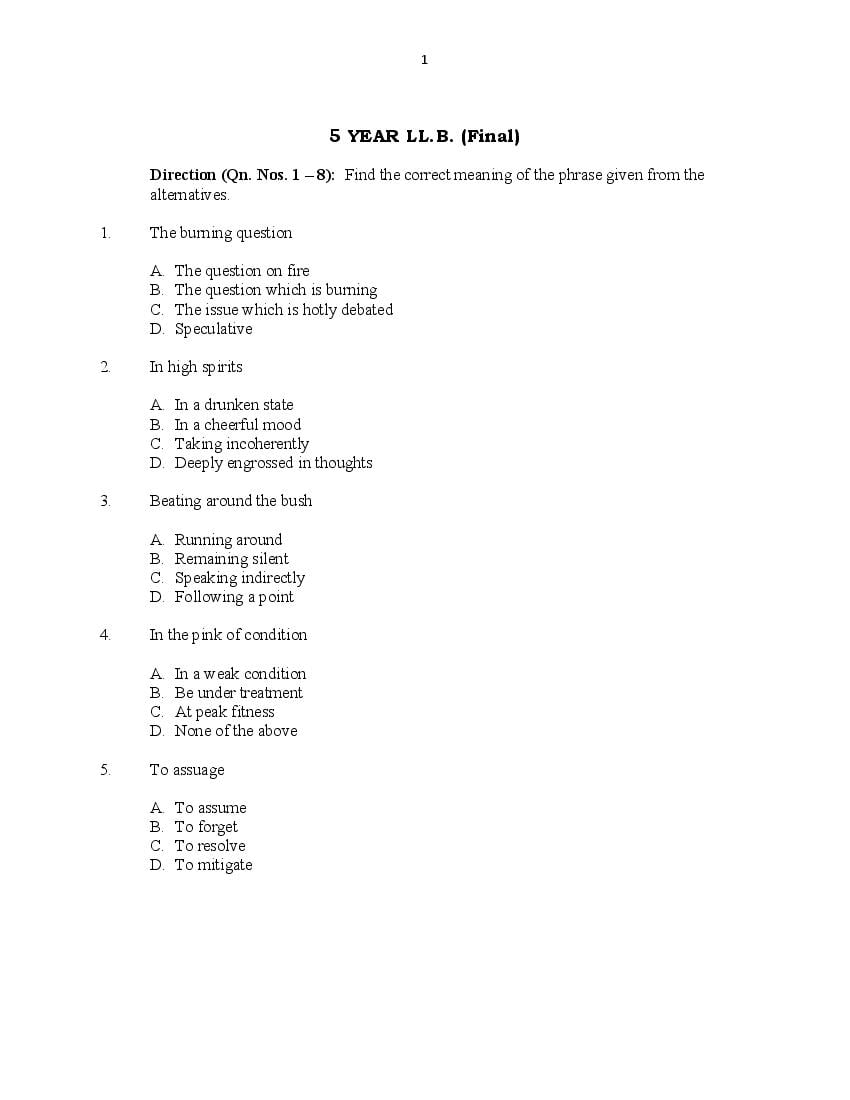
5 YEAR LL.B. (Final)
Direction (Qn. Nos. 1 – 8): Find the correct meaning of the phrase given from the
alternatives.
1. The burning question
A. The question on fire
B. The question which is burning
C. The issue which is hotly debated
D. Speculative
2. In high spirits
A. In a drunken state
B. In a cheerful mood
C. Taking incoherently
D. Deeply engrossed in thoughts
3. Beating around the bush
A. Running around
B. Remaining silent
C. Speaking indirectly
D. Following a point
4. In the pink of condition
A. In a weak condition
B. Be under treatment
C. At peak fitness
D. None of the above
5. To assuage
A. To assume
B. To forget
C. To resolve
D. To mitigate
Page 2
6. Duress
A. Cover
B. Difficulty
C. Compulsion
D. Hardship
7. Pragmatic
A. Unyielding
B. Practicable
C. Mathematical
D. Logical
8. Lackluster
A. Tender
B. Vibrant
C. Superficial
D. Abundant
9. Legitimate means
A. Valid
B. Correct
C. Rightful
D. Possessive
10. A highly skilled person is
A. Consummate
B. Genius
C. Gregarious
D. Inveterate
11. Ombudsman refers to the person
A. who looks into complaints against public authorities
B. who is the Chief of gang
C. who is declined from the court process
D. who is the retired judge
Page 3
Direction (Qn. Nos. 12 – 15): Complete the sentences choosing the most appropriate
alternative.
12. The President of India is invested ……………… executive powers
A. with
B. of
C. from
D. in
13. The man is ………………. Television
A. seeing
B. watching
C. reviewing
D. listening to
14. The court is not concerned …………… political status of the accused
A. about
B. from
C. in
D. for
15. We are ready …………….. the battle
A. to
B. of
C. with
D. for
Direction (Qn. Nos. 16 and 17): Give antonyms of the given words.
16. PROXIMATE
A. Distant
B. Near
C. Non-transferable
D. Insincere
Page 4
17. PLETHORA
A. Piety
B. Paucity
C. Chagrin
D. Rude
Direction (Qn. Nos. 18 and 19): Give synonyms of the given words.
18. ADEPT
A. Skilful
B. Perspective
C. Wealthy
D. Animate
19. MITIGATE
A. Ease
B. Imperfect
C. Cruel
D. Damaged
20. I cannot consent ………. this proposal.
A. to
B. for
C. with
D. in
21. He filled the glass with water to the………….
A. margin
B. edge
C. brim
D. rim
22. The sun is shining brightly, please ………….. the light.
A. put off
B. put out
C. take off
D. put on
Page 5
23. More than one boy ……………… absent today.
A. is
B. was
C. are
D. were
24. One of my friends ………………. going abroad tomorrow.
A. are
B. is
C. were
D. will
25. His conduct is bad, and his honesty is not ………….. suspicion.
A. above
B. beyond
C. under
D. in
26. The prolonged illness left him totally…………
A. enervated
B. healthy
C. invalid
D. indisposed
27. The boy you met yesterday is in class ………..
A. nine
B. the nine
C. ninth
D. the ninth
28. Her face is quite familiar ……………. us.
A. for
B. to
C. on
D. with
Page 6
29. The train was ……………. platform No. 6.
A. from
B. by
C. at
D. on
Direction (Qn. Nos. 30 – 33): Read the following passage and answer the questions
given below:
Passage No.1 One dull, dark day in autumn, I was travelling on horseback through a
dreary stretch of the countryside. At nightfall, I came in sight of the House of Usher. This
was the house of Rodrick Usher, who had been my childhood pal. It had been umpteen
years since he and I had seen each other. I lived in a distant part of the country during my
childhood. However, he had recently corresponded with me telling me at length of a
serious illness and a mental disturbance that was troubling him. Beleaguered by his
problems, Rodrick was leading the existence of a hermit.
30. The House of Usher was the home of
A. The author's relative
B. An old acquaintance
C. A companion
D. A friend
31. The author lived in a distant part of the country during
A. The time of writing
B. Childhood
C. The period in between
D. His youth
32. The author came to know of his friend's illness
A. through letters
B. through local gossip
C. from a mutual friend
D. from a newspaper correspondent
33. Rodrick
A. was living in the company of his friends
B. was engaged in many social activities
C. was involved in his thriving business
D. had become a recluse
Page 7
Direction (Qn. Nos. 34 – 38): Read the following passage and answer the questions
given below:
Passage No.2. Ordinarily nothing upset the equilibrium of the Pundit. But the loss of the
necklace, which his wife had borrowed from a neighbour, and the fact that he had to
replace it worried him. He spent all his time in devising ways and means to repay the
debt. Six months later, he gave his wife a gold necklace. It was exactly what she had
yearned for. “There is no need to repay it”, she said. The pundit was surprised. She
explained, “the necklace was not stolen. That was the only way I could think of making
you get me one”.
34. The pundit was almost never upset as he
A. had the courage to face a problem
B. had a balanced attitude
C. was different to ordinary incident
D. always succeeded in finding a solution to his problem
35. What was it that worried the Pundit most?
A. His wife had lost the necklace.
B. He had to replace the necklace.
C. His wife was so foolish and careless.
D. The necklace was very expensive.
36. The Pundit struggled for six months so that
A. he could present a necklace to is wife
B. he could lend the necklace to others
C. his wife could replace the lost necklace
D. his wife could satisfy her desire to own a necklace
37. The reason why the Pundit's wife refused to return the neckalce was because
A. she had always wanted one like it
B. the real owner did not expect it back
C. she had not lost any necklace
D. she was tempted to keep this one for herself
Page 8
38. The Pundit's wife had told him a lie in order to
A. trick him into satisfying her yearning
B. punish him
C. make him repay a debt
D. force him to work hard to earn more
Direction (Qn. Nos. 39 – 43): Read the following passage and answer the questions
given below:
Passage No.3 It was 7 a.m. on Sunday, June 4, 1944. Field Marshal Erwin Rommel,
Commander in chief of the German Army Group B – guarding the occupied French coast
facing the English Channel – was travelling in a car next to the driver’s seat. He was tired
of waiting for the Allied invasion to begin. Leaving on this particular dismal Sunday
morning suited Rommel fine. The timing of the trip could not have been better for the
weather was so bad that the Allied would not even think of a landing. Beside him on the
seat was a cardboard box containing a pair of handmade grey-shade shoes, size 5’1/2”,
for his wife Lucie-Maria. There was a special and very human reason why he wanted to
be with her on Tuesday, June 6. It was her birthday.
39. Rommel was
A. a famous German detective during the Second World War
B. the Commander in Chief of the German army in occupied France
C. a war-weary old man
D. a German messenger during the war
40. Rommel was going back to Germany because
A. he was afraid of facing the Allies
B. he was annoyed with the weather in Fracne
C. he was homesick and wanted to see his wife
D. he loved his wife and wanted to be with her
41. Rommel considered June 4, as a good time to travel because
A. the weather conditions ruled out an Allied invasion
B. by then the enemy was not ready for the attack
C. all his junior generals were present there
D. he had to consult Hitler
Page 9
42. The contents of the cardboard box had for Rommel
A. Strategic importance
B. Great monetary significnace
C. No imprtance at all
D. Sentimental value
43. Rommel was keen to be with his wife on 6th June because it was
A. their wedding day
B. her birthday
C. their son's birthday
D. Hitler's birthday
Direction (Qn. Nos. 44 – 50): Read the conversation between the receiptionist and Mr.
Frank and complete with missing words.
44. Receptionist: _____ your name Frank :?
A. Am
B. Who
C. Are
D. Is
45. Frank: Yes, _____ is.
A. Are
B. It
C. You
D. She
46. Receptionist : _____ you from France, Frank :?
A. Am
B. Where
C. Are
D. Is
47. Frank : No, _____ from France. I’m from Birmingham, in England.
A. I'm
B. I'm not
C. Not
D. Never
Page 10
48. Receptionist : Are _____ a teacher?
A. you
B. she
C. I
D. he
49. Frank : No, I’m _____ . I’m a doctor.
A. he
B. a teacher
C. not
D. am
50. Receptionist : Thanks. And are you _____ ?
Frank : No, I’m not.
A. England
B. married
C. marry
D. from
51. The sum of two numbers is 15. Their difference is 3. The numbers are:
A. 8 and 7
B. 9 and 6
C. 10 and 5
D. 4 and 11
52. 76% of 80 is
A. 56.6
B. 56.8
C. 60.4
D. 60.8
53. The difference between the local value and face value of 6 in the numeral 586723 is
A. 723
B. 6717
C. 5994
D. 8432
Page 11
54. 469157 × 9999 = ?
A. 4586970843
B. 4686970743
C. 4691100843
D. 584649125
55. 106 × 106 – 94 × 94 = ?
A. 2400
B. 2000
C. 1904
D. 1906
56. There are four prime numbers written in ascending order. The product of first three is
385 and that of the last three is 1001. The first number is :
A. 5
B. 7
C. 11
D. 17
57. How many numbers between 200 and 600 are divisible by 4, 5 and 6 ?
A. 5
B. 6
C. 7
D. 8
58. Which of the following is related to Islamabad in the same manner as New York is
related to San Francisco?
A. Pakistan
B. Kabul
C. Punjab
D. Karachi
59. Which of the following is absolutely essential for a house?
A. Bricks
B. Concrete
C. Roof
D. Locks
Page 12
60. The least number by which 450 must be multiplied in order to make it a perfect square is?
A. 4
B. 3
C. 2
D. 1
61. Frequent : Often : : Courage : ?
A. Cowardice
B. Always
C. Bravery
D. Strong
62. Pointing to a photograph of a boy Suresh said, "He is the son of the only son of my
mother." How is Suresh related to that boy?
A. Brother
B. Uncle
C. Cousin
D. Father
63. Pointing to a man in a photograph, a woman said, "His brother's father is the only son of
my grandfather." How is the woman related to the man in the photograph?
A. Sister
B. Aunt
C. Grandmother
D. Daughter
64. Six members of a family ABCDE and F are travelling together. B is the son of C but C is
not the mother of B. A and C are married couple. E is the brother of C. D is the daughter
of A. F is the brother of B. How many male members are there in the family?
A. 4
B. 3
C. 2
D. 1
Page 13
65. Three ladies X, Y and Z marry three men A, B and C. X is married to A, Y is not married
to an engineer, Z is not married to a doctor, C is not a doctor and A is a lawyer. Then
which of the following statements is correct?
A. Y is married to C who is an engineer
B. Z is married to C who is a doctor
C. X is married to a doctor
D. None of thes above
Directions (Qn. Nos. 66 – 71): In each question below are given two statements
followed by two conclusions numbered I and II. You have to take the given two
statements to be true even if they seem to be at variance from commonly known facts.
Read the conclusion and then decide which of the given conclusions logically follows
from the two given statements, disregarding commonly known facts.
Give answer
A. If only conclusion I follows
B. If only conclusion II follows
C. If either conclusion I or II follows
D. If neither conclusion I nor II follows
66. Statements: All men are dogs. All dogs are cats.
Conclusions: I. All men are cats.
II .All cats are men.
67. Statements: All pens are chalks. All chairs are chalks.
Conclusions: I. Some pens are chairs.
II. Some chalks are pens.
68. Statements: All mangoes are golden in colour. No golden-coloured things are cheap.
Conclusions: I. All mangoes are cheap.
II. Golden-coloured mangoes are not cheap.
69. Statements: No women teacher can play. Some women teachers are athletes.
Conclusions: I. Male athletes can play.
II. Some athletes can play.
70. Statements: All educated people read newspapers. Rahul does not read newspaper.
Conclusions: I. Rahul is not educated.
II. Reading newspaper is not essential to be educated.
Page 14
71. Statements: Some engineers are fools. Ashok is an engineer.
Conclusions: I. Some fools are engineers.
II. Ashok is a fool.
Directions (Qn. Nos. 72 – 77): Each question given below consists of a statement,
followed by three or four arguments numbered I, II, III and IV. You have to decide which
of the arguments is/are ‘strong’ argument(s) and which is/are ‘weak’ argument(s) and
accordingly choose your answer from the alternatives given below each question.
72. Statement: Should all the management institutes in the country be brought under
government control?
Arguments:
I. No. The government does not have adequate resources to run such institutes
effectively.
II. No. Each institute should be given freedom to function on its own.
III. Yes. This will enable to have standardized education for all the students.
IV. Yes. Only then the quality of education would be improved.
A. None is strong
B. Only I,II and III are strong
C. Only I and III are strong
D. All are strong
73. Statement: Should there be compulsory military training for each college student in
India ?
Arguments:
I. Yes. This is the only way to build a strong and powerful nation.
II. No. Compulsion always leads to repulsion.
III. Yes. This is the only way to impart discipline to the young generation.
IV. No. This goes against the basic democratic right of an individual to choose his/her
own programs.
A. Only I and III are strong
B. Only II and IV are strong
C. Only I and IV are strong
D. Only I,III and IV are strong
Page 15
74. Statement: Should there be a complete ban on manufacture and use of firecrackers ?
Arguments:
I. No. This will render thousands of workers jobless.
II. Yes. The firecracker manufacturers use child labour to a large extent.
III. Yes. This will be a concrete step to reduce noise and air pollution.
IV. No. Use of firecrackers makes certain special occasions more lively and joyful.
A. Only I and II are strong
B. Only I and III are strong
C. Only III and IV are strong
D. Only I, II and III are strong
75. Statement: Should seniority be the only criterion for the promotion?
Arguments:
I. No. It would be an injustice to those juniors who are more deserving and suitable
For higher positions than their senior counterparts.
II. Yes. Otherwise senior employees do feel humiliated.
III. Yes. Senior employees are more experienced and must be rewarded for the same.
A. None is strong
B. Only I is strong
C. Only I and III are strong
D. Only I and II are strong
76. Statement: Should women be given equal opportunity in the matter of employment in
every field ?
Arguments:
I. Yes. They are equally capable.
II. No. They have to shoulder household responsibilities.
III. Yes. They should also go into the outside world.
A. Only I is strong
B. Only I and II are strong
C. Only II and III are strong
D. Only I and III are strong.
Page 16
77. Statement : Should coal engines be replaced by electric engines in trains?
Arguments:
I. Yes. Coal engines cause a lot of pollution.
II. Yes. Electric engines are good on performance, easy to operate and low on
maintenance.
III. No. India does not produce enough electricity to fulfil its domestic needs also.
A. All are strong
B. Only I and II are strong
C. Only II and III are strong
D. Only I and III are strong
Directions (Qn. Nos. 78 – 83): In each question below are given two statements
followed by two assumptions numbered I and II. You have to consider the statement and
the following assumptions and decide which of the assumptions is implicit in the
statement.
Give answer:
A. If only assumption I is implicit.
B. If only assumption II is implicit.
C. If either I or II is implicit.
D. If neither I nor II is implicit.
78. Statement: If you have any problems, bring them to me.
Assumptions: I. You have some problems.
II. I can solve any problem.
79. Statement: Detergents should be used to clean clothes.
Assumptions: I. Detergents form more lather.
II. Detergents help to dislodge grease and dirt.
80. Statement: Like a mad man, I decided to follow him.
Assumptions: I. I am not a mad man.
II. I am a mad man.
81. Statement: Most people who stop smoking gain weight.
Assumptions: I. If one stops smoking, one will gain weight.
II. If one does not stop smoking, one will not gain weight.
82. Statement: If he is intelligent, he will pass the examination.
Assumptions: I. To pass, he must be intelligent.
II. He will pass the examination.
Page 17
83. Statement: Films have become indispensable for the entertainment of the people.
Assumptions: I. Films are the only media of entertainment.
II. People enjoy films.
Direction (Qn. Nos. 84 – 89): In each of the following questions, two statements
numbered I and II are given. There may be cause and effect relationship between the two
statements. These two statements may the effect of the same cause or independent causes.
These statements may be independent causes without having any relationship. Read both
the statements in each question and mark your answer as
A. If statement I is the cause and statement II is its effect.
B. If statement II is the cause and statement I is its effect.
C. If both the statements I and II are independent causes.
D. If both the statements I and II are effects of independent causes.
84. I. Police resorted to lathy-charge to disperse the unlawful gathering of large number of
people.
II. The citizen’s forum called a general strike in protest against the police atrocities.
85. I. The university authority has instructed all the colleges under its jurisdiction to ban use
of all hones inside the college premises.
II. Majority of the teachers of the colleges signed a joint petition to the university
complaining the disturbances caused by cell phone ringtones inside the classrooms.
86. I. The literacy rate in the district has been increasing for the last four years.
II. The district administration has conducted extensive training programme for the
workers involved in the literacy drive.
87. I. The prices of petrol and diesel in the domestic market have remained unchanged for
the past few months.
II. The crude oil prices in the international market have gone up substantially in the last
few months.
88. I. The private medical colleges have increased the tuition fees in the current year by 200
percent over the last year’s fees to meet the expenses.
II. The government medical colleges have not increased their fees in spite of escalation.
89. I. The Reserve Bank of India has recently put restrictions on few small banks in the
country.
II. The small banks in the private and co-operative sector in India are not in a position to
withstand the competitions of the bigger banks in the public sector.
Page 18
Direction (Qn.Nos. 90 – 92): In the following items some parts of the sentence have been
Jumbled up. Arrange the parts to make it a meaningful sentence.
90. When the woman
P. Lamenting their evil desire
Q. That had brought
R. Wept loudly
S. This sorrow upon them
The proper sequence should be
A. RPQS
B. RQPS
C. PQRS
D. PRQS
91. After reading the letter
P. of the absurd ideas of his brother
Q. and told the friends around him.
R. An uncontrollable fire of laughter
S. he burst into.
The proper sequence should be
A. PQSR
B. SRQP
C. PSRQ
D. SRPQ
92. He was so kind and generous that
P. He not only
Q. made others do so
R. but also
S. helped themselves
The proper sequence should be
A. PSRQ
B. SPQR
C. PRSQ
D. QPRS
Page 19
Direction (Qn.Nos. 93 - 96): In the following items each passage consists of six
sentences. The first and sixth sentences are given in the beginning. The rest of the
sentences are jumbled and are labeled PQR and S. Find the right sequence.
93. S1: The mother tongue is the true vehicle of mother wit.
P: Another medium of speech may bring with it a new current of new ideas.
Q: It is through the vernacular that the new conception of the mind should press their
way to birth in speech.
R: But the mother tongue is one with the air in which a man is born.
S: This is almost universally true, except in cases so rare as to emphasize the general
rule.
S6: A man’s native speech is almost like shadow inseparable from his personality.
The correct sequence should be
A. PRSQ
B. PRQS
C. QRPS
D. PSQR
94. S1: The invention of printing is a milestone in the history of civilization.
P: In the Middle Ages all books were copied by hand.
Q: As time went on all could possess copies of the great classics
R: Books were hence rare and costly
S: After 1460, printing made a plentiful supply of books possible.
S6: With this invention to aid, new ideas spread all over Europe.
The correct sequence should be
A. PSQR
B. PRSQ
C. SQRP
D. SRPQ
Page 20
95. S1: We are what our thoughts have made us
P: And so take care of what you think
Q: Every man’s character is determined by the sum total of these impressions
R: Every work we do, every thought that we think, leaves an impression on the mind shift
S: Thoughts live; they travel far.
S6: If good impressions prevail, the character becomes good, if bad, it becomes bad.
The correct sequence should be
A. SPRQ
B. RQSP
C. SPQR
D. RQPS
96. S1: My hobby is collecting stamps.
P: Of course she did not let me touch the stamps
Q: I could touch them when I was old enough not to spoil them
R: When I was still only a baby, my mother began to collect for me.
S: I remember that it was on my 15th birthday that she first put them into my hands
S6: They were in four fit books.
The correct sequence should be
A. SRPQ
B. RPQS
C. SPRQ
D. RSPQ
Direction (Qn. Nos. 97 and 98): In these series, you will be looking at both the letter
pattern and the number pattern. Fill the blank in the middle of the series or end of the
series.
97. B2CD, _____, BCD4, B5CD, BC6D
A. B2C2D
B. BC3D
C. B2C3D
D. BCD7
98. JAK, KBL, LCM, MDN, _____
A. OEP
B. NEO
C. MEN
D. PFQ
Page 21
Direction (Qn. Nos. 99 – 102): A good way to figure out the relationship in a given
question is to make up a sentence that describes the relationship between the first two
words. Then, try to use the same sentence to find out which of the answer choices
completes the same relationship with the third word.
99. Elated is to despondent as enlightened is to
A. Aware
B. Ignorant
C. Miserable
D. Tolerant
100. Artist is to painting as senator is to
A. Attorney
B. Law
C. Politician
D. Constituents
101. Which is the oldest Veda ?
A. Samaveda
B. Yajurveda
C. Atharvaveda
D. Rigveda
102. Consider the following ports :
1. Karaikal
2. Machilipatnam
3. Paradeep
4. Vishakhapatnam
What is the correct sequence of the above ports from north to south ?
A. 1-2-4-3
B. 1-4-2-3
C. 3-2-4-1
D. 3-4-2-1
Page 22
103. Golden Fibre refers to :
A. Hemp
B. Cotton
C. Jute
D. Nylon
104. Who invented Mobile phone?
A. Martin Cooper
B. Steev Jobs
C. Bill Gates
D. Mark Jukerburg
105. Name the Architect who designed a ring shape bridge in Urugua.
A. Rafel Vinanli
B. Christiano
C. Edin
D. Philip Salmond
106. Which one of the following city has not been included in the list of 20 cities for Smart
City Project?
A. Surat
B. Mumbai
C. Kakinada
D. Kochi
107. From which date “Pradhan mantri Jan Dhan Yojana” came into being?
A. 15th August 2014
B. 20th August 2014
C. 28th August 2014
D. 31st August 2014
108. One associated with another or others in the commission of crime.
A. Partner in Crime
B. Assistant
C. Gangster
D. Accomplice
Page 23
109. A voluntary statement made by a person charged with commission of a crime
acknowledging his guilt.
A. Confession
B. Statement
C. Acceptance
D. Consent
110. Dispossession of an occupier from land occupied by her.
A. Removal
B. Eviction
C. Movement
D. Vacancy
111. The act of giving or enacting laws.
A. Judgment
B. Pronouncement
C. Declaration
D. Legislation
112. A proposed law for consideration and enactment into actual law.
A. Draft
B. Proposal
C. Bill
D. Agenda
113. The devolution of property on the death of its owner to other persons.
A. Appropriation
B. Transfer
C. Inheritance
D. Possession
114. A person who sues is called _______ .
A. Party
B. Client
C. Aggrieved
D. Plaintiff
Page 24
115. Which of the following is related to secularism in India?
A. Right to education
B. Minority Rights
C. Uniform Civil Code
D. Elections
116. The politico-economic ideology allowing control over the property into the hands of
collectivity or society itself.
A. Socialism
B. Industrialism
C. Existentialism
D. Secularism
117. Which of the following is an exception to RTI application process?
A. Good governance
B. Official Secret
C. Publication
D. Public Policy
118. The Constituent Assembly adopted the Constitution of India on 26th November 1949.
When did it come into effect?
A. 26th December 1949
B. 26th January 1950
C. 25th January 1950
D. 26th November 1949
119. Which of the following form the Security Council?
A. 5 permanent member with the power of veto
B. 10 non-permanent members elected for 2 years term
C. Both (A) and (B)
D. None of the above
120. Who is an abettor?
A. A person who commits the offence
B. A person who instigates the commission of the offence
C. A person against whom the ofence is committed
D. A person who is innocent
Page 25
121. Who is the author of “Wealth of Nations”?
A. Max Muller
B. Karl Marx
C. Adam Smith
D. Ricardo
122. Which one of the following is the highest peacetime gallantry award of India?
A. ParamVir Chakra
B. Ashok Chakra
C. MahaVir Chakra
D. Kirti Chakra
123. The mountaineer who died during his recent adventure?
A. Malli Mastan
B. Milka Singh
C. Tensing Narke
D. Edmond Hillari
124. Planning Commission is scraped and replaced by
A. Niti Aayog
B. Bharat Aayog
C. Yojana Aayog
D. Samvidhan Aayog
125. National Good Governance Day was observed on the Birth day of
A. Indira Gandhi
B. Rajiv Gandhi
C. Jawaharlal Nehru
D. Atal Bihari Vajpayee
126. Who decides upon the disqualification of a Member of Parliament ?
A. Election Commision
B. President
C. Speaker
D. Supreme Court
Page 26
127. Election petitions can be filed in
A. State High Courts
B. Local District Court
C. Office of Regional Election Commissioner
D. Election Commission
128. India’s federal system has been imbibed from
A. U.S.A.
B. U.S.S.R.
C. Canada
D. Australia
129. Rajya Sabha
A. has term of 6 years.
B. has term of 5 years.
C. is a permanent body, with 1/3rd members retiring every 6th year.
D. is a permanent body, with 1/3rd member regtiring every 2nd year.
130. By convention, Deputy Speaker is a member of
A. party in power
B. party in opposition
C. leftist
D. rightist
131. Under which Article of the Constitution of India, union gives direction to states?
A. Article 257
B. Article 258
C. Article 259
D. Article 260
132. The onus of proving a criminal case falls on the
A. Accused
B. Plaintiff
C. Judge
D. Prosecution
Page 27
133. The marriage of minor boys and girls is prohibited under
A. Juvenile Justice (Care and Protection) Act, 2000
B. Child Marriage Restraint Act, 1929
C. Indian Penal Code (45 of 1860)
D. Juvenile Justice Act, 1986
134. A person who shares in a crime along with other accused is called
A. a co-accused
B. an approver
C. an accomplice
D. None of the above
135. When was Federal Court established in Delhi ?
A. 1932
B. 1937
C. 1935
D. 1939
136. Writ issued against wrongful detention of a person
A. Habeas corpus
B. Mandamus
C. Certiorari
D. Quo Warranto
137. Union Public Service Commission is a
A. Statutory body
B. Legal Body
C. Constitutional body
D. None of the above
138. Which among the following has right to determine the procedure for elections?
A. Parliament
B. President
C. Election Commission
D. Cabinet Secretariat
Page 28
139. The concept of ‘Rule of Law’ has been given by
A. A.V. Dicey
B. H.L.A. Hart
C. G. Williams
D. Henry Maine
140. Right of way, right to light etc. is covered under
A. Easement Act
B. Right to Passage Act
C. Contract Act
D. Property Act
141. Article 343 of our Constitution provides for
A. Hindi as an official language
B. English as an official language
C. Both Hindi and English as official languages
D. None of the above
142. An aspirant for Prime Minister’s office must be …… of age
A. Above 25 years
B. Above 30 years
C. Above 35 years
D. Above 40 years
143. Bye-laws are made by
A. Legislature
B. Executive
C. Judiciary
D. None of the above
144. The Central Government can assign any function to the States
A. on the directive of the President
B. on the recommendation of Parliament
C. any time it wishes to do so
D. with the consent of the State Government
Page 29
145. International Day for elimination of Racial Discrimination is celebrated on
A. 21st December
B. 21st March
C. 20th April
D. 20th May
146. United Nations Day is observed on
A. 24th October
B. 25th January
C. 30th January
D. 1st April
147. The power to issue the writs in cases involving Fundamental Rights belongs to
A. Supreme Court and High Courts
B. Supreme Court only
C. High Court only
D. Law Department of Union
148. Parliament consists of
A. Council of States, the House of People and the President
B. Council of States and Presidency
C. House of People and President
D. Prime Minister and President
149. In a criminal case, an accused person, who in consideration of his non-prosecution
offers to give evidence against other accused, is called
A. Accomplice
B. Hostile witness
C. Approver
D. Hostile accomplice
150. The Universal Declaration of Human Rights was a result of which war?
A. World War II
B. The Gulf War
C. The Vietnam War
D. World War I
***
Document Details
| Board / Org | Cochin University |
| Exam | CUSAT Common Admission Test |
| Type | Question Paper |
| Pages | 29 |
| Updated | 22 Jul 2026 |