AHSEC HS 2nd Year Question Paper 2019 Logic and Philosophy
Finished viewing? Save it for later —
Download AHSEC HS 2nd Year Question Paper 2019 Logic and Philosophy (PDF · 8 pages)About AHSEC HS 2nd Year Question Paper 2019 Logic and Philosophy
AHSEC HS 2nd Year Question Paper 2019 Logic and Philosophy is available here for free download. Published by Assam Board for Class 12, this question paper can be viewed online or downloaded as a PDF (8 pages). Candidates preparing for Class 12 can use AHSEC HS 2nd Year Question Paper 2019 Logic and Philosophy to understand the exam pattern, the type of questions asked, and the overall difficulty level.
Frequently Asked Questions
How can I download AHSEC HS 2nd Year Question Paper 2019 Logic and Philosophy?
Open this page and click the Download button to save AHSEC HS 2nd Year Question Paper 2019 Logic and Philosophy as a PDF. It is completely free on AglaSem Docs.
Is AHSEC HS 2nd Year Question Paper 2019 Logic and Philosophy free to download?
Yes. AHSEC HS 2nd Year Question Paper 2019 Logic and Philosophy can be viewed online and downloaded as a PDF free of cost on AglaSem Docs.
How many pages does AHSEC HS 2nd Year Question Paper 2019 Logic and Philosophy have?
AHSEC HS 2nd Year Question Paper 2019 Logic and Philosophy contains 8 pages, which you can read online or download together as a single PDF.
Where can I find more Class 12 study material?
You can find more Class 12 question papers, sample papers, syllabus, and answer keys on AglaSem Docs.
AHSEC HS 2nd Year Question Paper 2019 Logic and Philosophy – Text
Read the full text of this question paper below — useful to quickly search, copy and reference the content online without downloading the PDF.
📄 View text version (8 pages)
Page 1
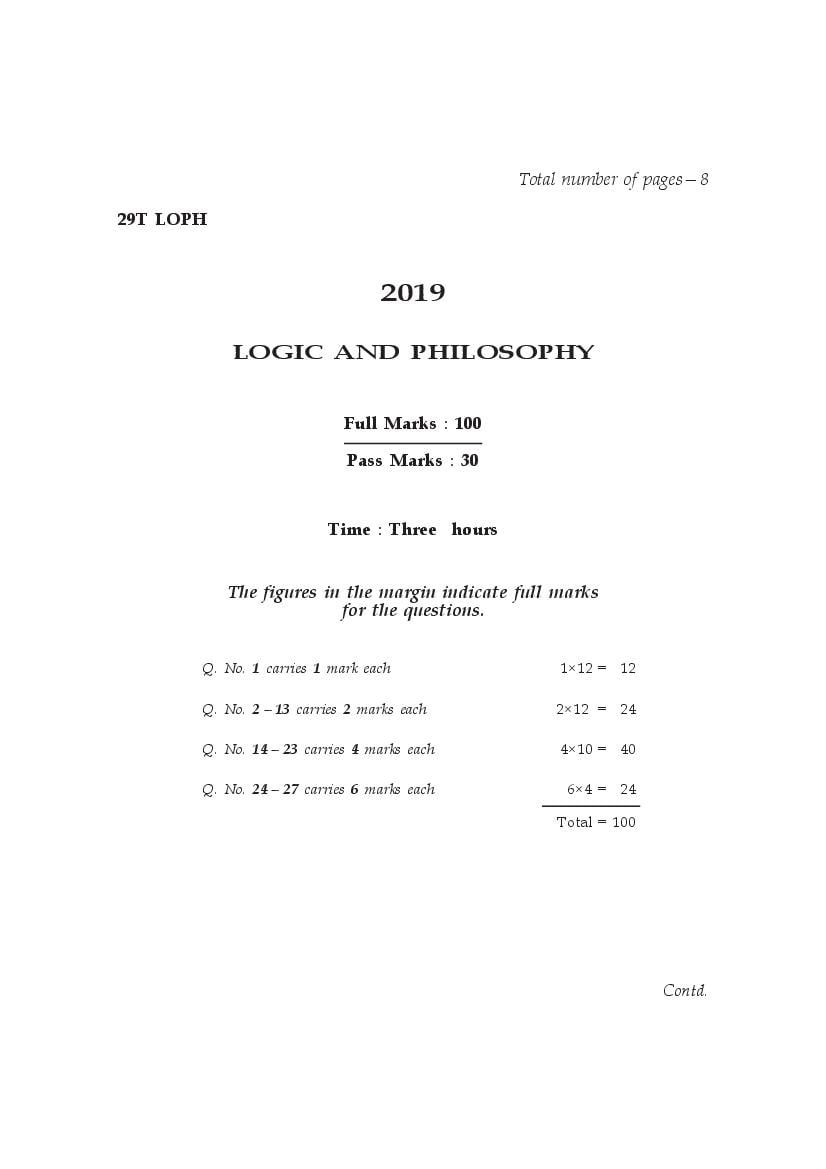
29T LOPH
2019
LOGIC AND PHILOSOPHY
Full Marks : 100
Pass Marks : 30
Time : Three hours
The figures in the margin indicate full marks
for the questions.
Q. No. 1 carries 1 mark each 1×12 = 12
Q. No. 2 – 13 carries 2 marks each 2×12 = 24
Q. No. 14 – 23 carries 4 marks each 4×10 = 40
Q. No. 24 – 27 carries 6 marks each 6×4 = 24
Total = 100
Contd.
Page 2
Ó¬fl«¬ø¬ı:±Ú1 ˜”˘ ’±À˘±‰¬… ø¬ı¯∏˚˛ øfl¬ ∑
(b) Is the conclusion of Unscientific Induction certain ? 1
’Õ¬ı:±øÚfl¬ ’±·˜Ú1 ø¸X±ôL√ øÚøù‰¬Ó¬ ¶§ˆ¬±ª1 ˝˚˛ ŒÚ ∑
(c) Is there ‘inductive leap’ in Perfect Induction ? 1
¬Û”Ì« ’±·˜ÚÓ¬ ë’±·˜Ú ʱ¬Ûí ’±ÀÂ√ÀÚ ∑
(d) The Paradox of Induction is connected with the Principle of the
Uniformity of Nature. Is it true ? 1
’±·˜Ú1 ø¬ıÀ1±Ò±ˆ¬±¸ √õ∂fl‘¬øÓ¬1 ¤fl¬1+¬ÛÓ¬± ÚœøÓ¬1 ˘·Ó¬ ¸—˚≈Mêº fl¬Ô±ÀȬ± qXÀÚ ∑
(e) Which is the first stage of hypothesis suggested by Mill’s
definition of hypothesis ? 1
ø˜˘1 √õ∂fl¬ä1 ¸—:± ’Ú≈¸ø1 √õ∂fl¬ä1 √õ∂Ô˜ ô¶∏1ÀȬ± øfl¬ ∑
(f) What is the meaning of ‘vera causa’ ? 1
¬¬ı±ô¶∏ª fl¬±1Ì1 ’Ô« øfl¬ ∑
(g) What is the exact object of moral judgement ? 1
ΔÚøÓ¬fl¬ ø¬ı‰¬±11 √õ∂fl‘¬Ó¬ ø¬ı¯∏˚˛¬ıd øfl¬ ∑
(h) Name the theory which states that the external world can be
directly known. 1
¬ı±˝…Ê·Ó¬‡Ú √õ∂Ó¬…鬈¬±Àª ʱøÚ¬ı ¬Û1± ˚±˚˛ ¬ı≈ø˘ ˆ¬¬ı± ˜Ó¬¬ı±ÀȬ±1 Ú±˜ øfl¬ ∑
(i) Is the conclusion of Method of Agreement certain ? 1
¬’i§˚˛œ √õ∂̱˘œ1 ø¸X±ôL√ øÚøù‰¬Ó¬ ŒÚ ∑
(j) Ethics is a positive science. Is it true ? 1
ÚœøÓ¬˙±¶a ø¬ı¯∏˚˛øÚᬠø¬ı:±Úº fl¬Ô±ÀȬ± qXÀÚ ∑
29T LOPH [2]
Page 3
¬ëÒ˜«í ˙sÀȬ± øfl¬ ¸—¶‘®Ó¬ Ò±Ó≈¬1 ¬Û1± ά◊æª Δ˝ÀÂ√ ∑
(l) Which principle of elimination forms the basis of Method of
Agreement ? 1
’¬Û¸1Ì1 Œfl¬±ÚÀȬ± ¸”S1 ›¬Û1Ó¬ ’i§˚˛œ √õ∂̱˘œ √õ∂øÓ¬øá¬Ó¬ ∑
2. State two points of differences between deduction and induction.
2
øÚ·˜Ú ’±1n∏ ’±·˜Ú1 ˜±ÊÓ¬ Ôfl¬± ≈Ȭ± ¬Û±Ô«fl¬… ά◊À~‡ fl¬1±º
3. Why the law of causation is called the formal ground of induction ?
2
fl¬±˚«- fl¬±1Ì ø¬ıøÒfl¬ øfl¬˚˛ ’±·˜Ú1 ’±fl¬±1·Ó¬ øˆ¬øM Œ¬ı±˘± ˝˚˛ ∑
4. Define Scientific Induction. 2
Δ¬ı:±øÚfl¬ ’±·˜Ú1 ¸—:± ø˚˛±º
5. State any two qualitative marks of causation. 2
fl¬±1Ì1 ø˚Àfl¬±ÀÚ± ≈Ȭ± &Ì·Ó¬ ˘é¬Ì ά◊À~‡ fl¬1±º
Define conjunction of causes with an example. 2
¤È¬± ά◊±˝1̸˝ fl¬±1Ì ¸˜i§˚˛1 ¸—:± ø˚˛±º
6. How many types of verification are there in a hypothesis and what
are these ? 2
√õ∂fl¬ä1 √õ∂˜±Ìœfl¬1Ì Œfl¬˝◊ √õ∂fl¬±11 ’±1n∏ øfl¬ øfl¬ ∑
What do you mean by analogical hypothesis ? 2
¸±‘˙…˜”˘fl¬ √õ∂fl¬ä ¬ı≈ø˘À˘ øfl¬ ¬ı≈ʱ ∑
29T LOPH [3] Contd.
Page 4
¸1˘ ¬ı±ô¶∏ª¬ı±1 ≈Ȭ± ¸˜±À˘±‰¬Ú± ’±·¬ıÀϬˇ±ª±º
8. Give a definition of Idealism in your own words. 2
ŒÓ¬±˜±1 øÚÊ1 ˆ¬±¯∏±À1 ˆ¬±ª¬ı±1 ¤È¬± ¸—:± ø˚˛±º
9. Distinguish between fallacy of non-observation and fallacy of mal-
observation. 2
’ÚÀ¬ıé¬Ì ’±1n∏ √w±ôL√ ¬Û˚«À¬ıé¬Ì Œ±¯∏1 ˜±ÊÓ¬ Ôfl¬± ¬Û±Ô«fl¬… øÚÌ«˚˛ fl¬1±º
10. Write two advantages of observation as the material ground of
Induction. 1+1=2
¬’±·˜Ú1 ¬ıd·Ó¬ øˆ¬øM ø˝‰¬±À¬Û øÚ1œé¬Ì1 ≈Ȭ± ¸≈ø¬ıÒ± ø˘‡±º
11. Why the Idealism of Leibnitz is called Pluralistic Idealism ? 2
˘±˝◊ªøÌÊ1 ˆ¬±ª¬ı±fl¬ øfl¬˚˛ ¬ıUQ¬ı±œ ˆ¬±ª¬ı± Œ¬ı±˘± ˝˚˛ ∑
12. Define negative condition with the help of a suitable example.
1+1=2
ά◊¬Û˚≈Mê ά◊±˝1Ì1 ¸˝±˚˛Ó¬ √õ∂øÓ¬fl”¬˘ ¬ı± Ú¤û±Ô«fl¬ ά◊¬Ûfl¬±1Ì1 ¸—:± ø˚˛±º
13. Write the name of one primary and one secondary quality of an
object. 1+1=2
¬ıd1 ¤È¬± ˜≈‡… ’±1n∏ ¤È¬± Œ·ÃÌ &Ì1 Ú±˜ ø˘‡±º
14. State the qualitative marks of a cause. 4
¬¤È¬± fl¬±1Ì1 &Ì·Ó¬ ˘é¬Ì Œfl¬˝◊Ȭ± ά◊À~‡ fl¬1±º
What do you mean by plurality of causes ? Why plurality of causes
is not scientifically acceptable ? 2+2=4
¬ıUfl¬±1̬ı± ¬ı± Ú±Ú±fl¬±1̬ı± ¬ı≈ø˘À˘ øfl¬ ¬ı≈ʱ ∑ ¬ıUfl¬±1̬ı± øfl¬˚˛ ø¬ı:±Ú¸iúÓ¬ Ú˝˚˛ ∑
29T LOPH [4]
Page 5
view. 1+3=4
¬¸1˘ ¬ı±ô¶∏ª¬ı± ¸˜Ô«Ú fl¬1±ÀÚ ∑ ŒÓ¬±˜±1 ˜Ó¬1 ¸˜Ô«ÚÓ¬ ˚≈øMê √õ∂±Ú fl¬1±º
16. What is ‘Crucial Instance’ ? Explain. 4
ëøÚÌ«±˚˛fl¬ ‘©Ü±ôL√í øfl¬ ∑ ¬ı…±‡…± fl¬1±º
17. State two advantages and two disadvantages of the Method of
difference. 2+2=4
¬ı…øÓ¬À1fl¬œ √õ∂̱˘œ1 ≈Ȭ± ¸≈ø¬ıÒ± ’±1n∏ ≈Ȭ± ’¸≈ø¬ıÒ± ά◊À~‡ fl¬1±º
Write two advantages and two disadvantages of the Method of
Agreement. 2+2=4
’i§˚˛œ ¬ÛXøÓ¬1 ≈Ȭ± ¸≈ø¬ıÒ± ’±1n∏ ≈Ȭ± ’¸≈ø¬ıÒ± ø˘‡±º
18. Briefly express any four characteristics of Scientific Realism. 4
Δ¬ı:±øÚfl¬ ¬ı±ô¶∏ª¬ı±1 ø˚Àfl¬±ÀÚ± ‰¬±ø1Ȭ± Δ¬ıø˙©Ü… ‰¬˜≈Õfl¬ √õ∂fl¬±˙ fl¬1±º
19. Name the philosopher who made the statement ‘Esse Est Percipi’.
Explain the meaning of the statement. 1+3=4
ëõ∂Ó¬…é¬ÀÓ¬ ¬ıd ø¬ı…˜±Úí ñ ¤˝◊ ά◊øMêÀȬ±1 ˘·Ó¬ ÊøάˇÓ¬ ±˙«øÚfl¬ÊÚ1 Ú±˜ ø˘‡±º
ά◊øMêÀȬ±1 ’Ô« ¬ı…±‡…± fl¬1±º
Do you think that Hegel’s idealism tries to reconcile idealism and
realism ? Explain. 4
Œ˝À·˘1 ˆ¬±ª¬ı±À ¬ı±ô¶∏ª¬ı± ’±1n∏ ˆ¬±ª¬ı±1 ¸˜i§˚˛ ¸±ÒÚ fl¬ø1¬ıÕ˘ Œ‰¬©Ü± fl¬ø1ÀÂ√ ¬¬ı≈ø˘
Ó≈¬ø˜ ˆ¬±¬ı±ÀÚ ∑ ¬ı≈ʱ˝◊ ø˘‡±º
20. Explain briefly the Dharma and Artha as Purusa-rthas. 2+2=4
¬Û≈1n∏¯∏±Ô« ø˝‰¬±À¬Û Ò˜« ’±1n∏ ’Ô« ‰¬˜≈Õfl¬ ¬ı…±‡…± fl¬1±º
29T LOPH [5] Contd.
Page 6
ÚœøÓ¬˙±¶aÓ¬ ’±À˘±ø‰¬Ó¬ Œ˝±ª± ‰¬±ø1Ȭ± &1n∏Q¬Û”Ì« ø¬ı¯∏˚˛1 ’±À˘±‰¬Ú± fl¬1±º
21. Write a note on Plato’s Idealism. 4
Œõ≠ÀȬ±1 ˆ¬±ª¬ı±1 ›¬Û1Ó¬ ¤øȬ ŒÈ¬±fl¬± ø˘‡±º
22. Write briefly the nature of religion. 4
Ò˜«1 ¶§1+¬Û ¸•ÛÀfl«¬ ‰¬˜≈Õfl¬ ø˘‡±º
23. Briefly explain the four stages of hypothesis. 4
√õ∂fl¬ä1 ‰¬±ø1Ȭ± ô¶∏11 ‰¬˜≈ ά◊À~‡ fl¬1±º
24. State any three similarities and any three dissimilarities between
Unscientific Induction and Analogy. 3+3=6
’Õ¬ı:±øÚfl¬ ’±·˜Ú ’±1n∏ ¸±‘˙…˜”˘fl¬ ’Ú≈˜±Ú1 ˜±ÊÓ¬ Ôfl¬± ø˚Àfl¬±ÀÚ± øÓ¬øÚȬ± ¸±‘˙…
’±1n∏ øÓ¬øÚȬ± Δ¬ı¸±‘˙… ά◊À~‡ fl¬1±º
Define Unscientific Induction and state its main characteristics.
1+5=6
’Õ¬ı:±øÚfl¬ ’±·˜Ú1 ¸—:± ø˚˛± ’±1n∏ ˝◊˚˛±1 ˜”˘ Δ¬ıø˙©Ü… ¸˜”˝ ά◊À~‡ fl¬1±º
25. Define the Joint Method of Agreement and Difference with concrete
example. State two advantages and two disadvantages of this
method. 2+2+2=6
¬ı±ô¶∏ª ά◊±˝1ÀÌÀ1 Δ¸ÀÓ¬ ø˜| ’i§˚˛œ ¬ı…øÓ¬À1fl¬œ √õ∂̱˘œ1 ¸—:± ø˚˛±º ¤˝◊ √õ∂̱˘œ1 ≈Ȭ±
¸≈ø¬ıÒ± ’±1n∏ ≈Ȭ± ’¸≈ø¬ıÒ± ά◊À~‡ fl¬1±º
Explain the Method of Residues with examples. 6
ά◊±˝1̸˝ ¬Ûø1À˙¯∏ √õ∂̱˘œ1 ¬ı…±‡…± fl¬1±º
29T LOPH [6]
Page 7
fl¬±1Ì ¸•ÛÀfl«¬ ¤ø1©ÜȬí˘1 Ò±1̱ ¬ı…±‡…± fl¬1±º
Explain the Law of Causation as one of the formal grounds of
Induction. 6
’±·˜Ú1 ¤fl¬ ’±fl¬±1·Ó¬ øˆ¬øM ø˝‰¬±À¬ı fl¬±˚«…fl¬±1Ì ø¬ıøÒ ¬¬ı…±‡…± fl¬1±º
27. “Religion and Morality are mutually dependable” — Discuss it.
6
ëëÒ˜« ’±1n∏ ÚœøÓ¬ ¬Û1¶Û1 øÚˆ«¬1˙œ˘íí ñ ’±À˘±‰¬Ú± fl¬1±º
What do you mean by Religion ? Which is the most acceptable
definition of Religion ? Explain two characteristics of Religion.
2+2+2=6
Ò˜« ¬ı≈ø˘À˘ øfl¬ ¬ı≈ʱ ∑ Ò˜«1 ’±È¬±˝◊Ó¬Õfl¬ ¸ÀôL√±¯∏ÊÚfl¬ ¸—:± Œfl¬±ÚÀȬ± ∑ Ò˜«1 ≈Ȭ± Δ¬ıø˙©Ü…
¬ı≈ʱ˝◊ ø˘‡±º
——— ×———
29T LOPH [7]
Page 8
Document Details
| Board / Org | Assam Board |
| Exam | Class 12 |
| Type | Question Paper |
| Pages | 8 |
| Updated | 22 Jul 2026 |