TN 11th Question Paper 2022 Biology
Finished viewing? Save it for later —
Download TN 11th Question Paper 2022 Biology (PDF · 12 pages)About TN 11th Question Paper 2022 Biology
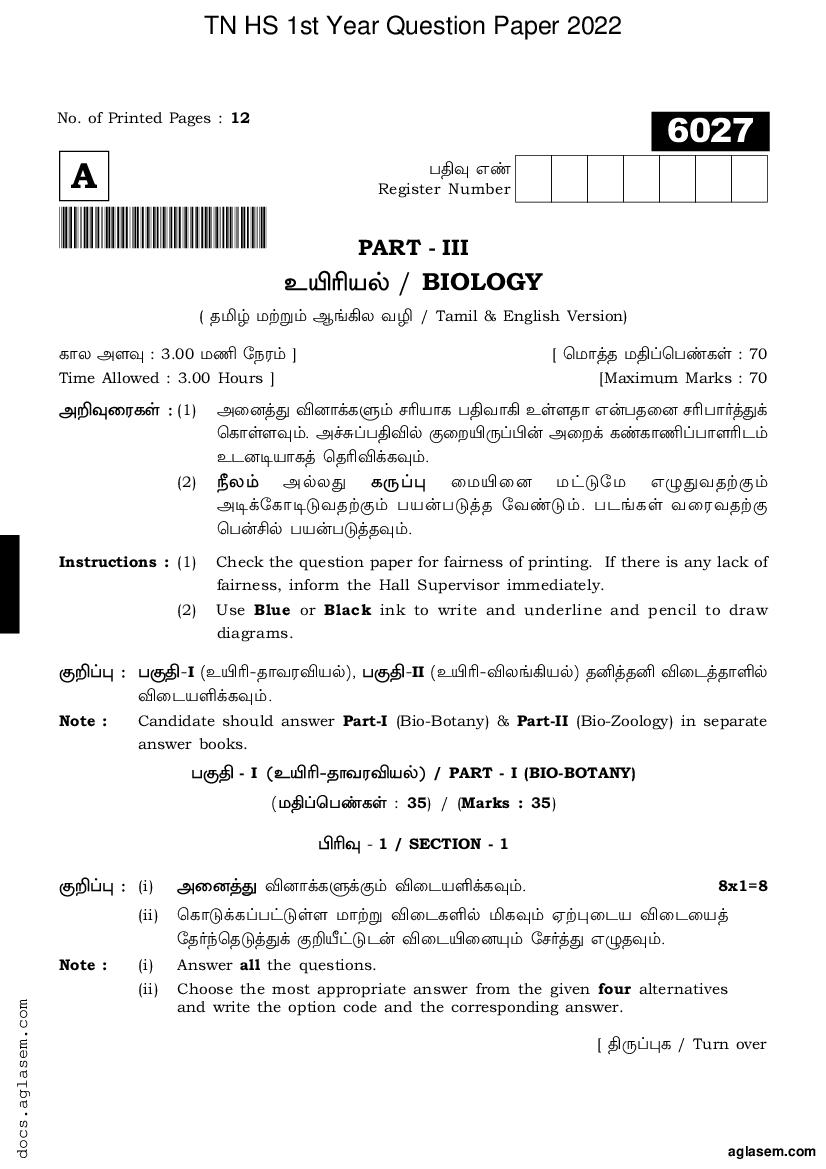
TN 11th Question Paper 2022 Biology is available here for free download. Published by Tamil Nadu Board for Class 11, this question paper can be viewed online or downloaded as a PDF (12 pages). Candidates preparing for Class 11 can use TN 11th Question Paper 2022 Biology to understand the exam pattern, the type of questions asked, and the overall difficulty level.
Frequently Asked Questions
How can I download TN 11th Question Paper 2022 Biology?
Open this page and click the Download button to save TN 11th Question Paper 2022 Biology as a PDF. It is completely free on AglaSem Docs.
Is TN 11th Question Paper 2022 Biology free to download?
Yes. TN 11th Question Paper 2022 Biology can be viewed online and downloaded as a PDF free of cost on AglaSem Docs.
How many pages does TN 11th Question Paper 2022 Biology have?
TN 11th Question Paper 2022 Biology contains 12 pages, which you can read online or download together as a single PDF.
Where can I find more Class 11 study material?
You can find more Class 11 question papers, sample papers, syllabus, and answer keys on AglaSem Docs.
TN 11th Question Paper 2022 Biology – Text
Read the full text of this question paper below — useful to quickly search, copy and reference the content online without downloading the PDF.
📄 View text version (12 pages)
Page 1
6027
£vÄ Gs
A Register Number
!6027IstYearBiology! PART - III
E°›¯À / BIOLOGY
( uªÌ ©ØÖ® B[Q» ÁÈ / Tamil & English Version)
Põ» AÍÄ : 3.00 ©o ÷|µ® ] [ ö©õzu ©v¨ö£sPÒ : 70
Time Allowed : 3.00 Hours ] [Maximum Marks : 70
AÔÄøµPÒ : (1) AøÚzx ÂÚõUPЮ \›¯õP £vÁõQ EÒÍuõ GߣuøÚ \›£õºzxU
öPõÒÍÄ®. Aa_¨£vÂÀ SøÓ°¸¨¤ß AøÓU PsPõo¨£õÍ›h®
EhÚi¯õPz öu›ÂUPÄ®.
(2) }»® AÀ»x P¸¨¦ ø©°øÚ ©mk÷© GÊxÁuØS®
AiU÷PõikÁuØS® £¯ß£kzu ÷Ásk®. £h[PÒ ÁøµÁuØS
ö£ß]À £¯ß£kzuÄ®.
Instructions : (1) Check the question paper for fairness of printing. If there is any lack of
fairness, inform the Hall Supervisor immediately.
(2) Use Blue or Black ink to write and underline and pencil to draw
diagrams.
SÔ¨¦ : £Sv&I (E°›&uõÁµÂ¯À), £Sv&II (E°›&»[Q¯À) uÛzuÛ ÂøhzuõÎÀ
Âøh¯ÎUPÄ®.
Note : Candidate should answer Part-I (Bio-Botany) & Part-II (Bio-Zoology) in separate
answer books.
£Sv - I (E°›&uõÁµÂ¯À) / PART - I (BIO-BOTANY)
(©v¨ö£sPÒ : 35) / (Marks : 35)
¤›Ä - 1 / SECTION - 1
SÔ¨¦ : (i) AøÚzx ÂÚõUPÐUS® Âøh¯ÎUPÄ®. 8x1=8
(ii) öPõkUP¨£mkÒÍ ©õØÖ ÂøhPÎÀ ªPÄ® Hئøh¯ Âøhø¯z
÷uº¢öukzxU SÔ±mkhß Âøh°øÚ²® ÷\ºzx GÊuÄ®.
Note : (i) Answer all the questions.
(ii) Choose the most appropriate answer from the given four alternatives
and write the option code and the corresponding answer.
[ v¸¨¦P / Turn over
Page 2
1. ö\À \ÆÂß Aø©¨¤À £õ´© vmk ©õv›ø¯U P¸zvÀ öPõsk ¼¨¤kPЮ,
¦µu[PЮ, ¼¨¤k JØøÓ AkUQ¼¸¢x ©Ö¦ÓzvØS Ch® ö£¯º¢x ö\À»U
RÌUPõq® TØÖPÎÀ Gx \›¯õÚx ?
(A) ¼¨¤kPÒ A›uõP A[S® C[S® Ch®ö£¯ºQßÓÚ. ¦µu[PÒ AÀ».
(B) ¼¨¤kPÒ ©ØÖ® ¦µu[PÒ A[S® C[S® Ch®ö£¯ºÁvÀø».
(C) ¦µu[PÒ A[S® C[S® Ch®ö£¯ºQßÓÚ. ¼¨¤kPÒ AÀ».
(D) ¼¨¤k ©ØÖ® ¦µu[PÒ A[S® C[S® Ch®ö£¯ºQßÓÚ.
Keeping in view the fluid mosaic model for the structure of cell membrane, which
one of the following statements is correct with respect to the movement of lipids
and proteins from one lipid monolayer to the other ?
(a) While lipids can rarely flip-flop, proteins cannot.
(b) Neither lipid nor proteins can flip-flop.
(c) While proteins can flip-flop, lipids cannot.
(d) Both lipid and proteins can flip-flop.
2. ©soÀ Põn¨£k® ø|m÷µm ÁΩsh» ø|mµáÚõP ©õØÓ¨£k® {PÌÄ
__________ GÚ¨£k®.
(A) ø|mµáß }UP® (B) A÷©õÛ¯õÁõuÀ
(C) ø|m÷µm uß©¯©õuÀ (D) ø|m÷µmhõuÀ
Nitrates in the soil are converted back into atmospheric nitrogen by a process
called __________.
(a) Denitrification (b) Ammonification
(c) Nitrate assimilation (d) Nitrification
A
Page 3
3. BºUQ£õUj›¯zvøÚU PshÔP.
(A) i›¨÷£õÛ©õ (B) A\m÷hõ£õUhº
(C) ö©zu÷Úõ£õUj›¯® (D) GºÂܯõ
Identify the Archaebacterium.
(a) Treponema (b) Acetobacter
(c) Methanobacterium (d) Erwinia
4. J¸ uõÁµzvØS AøÚzxU PÛ©[PЮ ÁÇ[P¨£mk Mn ö\ÔÄ ©mk®
AvP©õP C¸¢uõÀ HØ£k® SøÓ£õk ¯õx ?
(A) Ca EmöPõÒ vÓøÚ ©mk® AvP›US®.
(B) Fe, Mg EmöPõÒ vÓøÚ ukUS®. BÚõÀ Ca uµ.
(C) Fe, Mg ©ØÖ® Ca EmöPõÒ vÓøÚz ukUS®.
(D) Fe, Mg ©ØÖ® Ca EmöPõÒ vÓøÚ AvP›US®.
If a plant is provided with all mineral nutrients but, Mn concentration is increased,
what will be the deficiency ?
(a) Only increases the uptake of Ca.
(b) Mn prevents the uptake of Fe, Mg but not Ca.
(c) Prevents the uptake of Fe, Mg and Ca.
(d) Mn increases the uptake of Fe, Mg and Ca.
A [ v¸¨¦P / Turn over
Page 4
5. Aª÷Úõ Aª»® JßÖ Põµ{ø»°÷»õ AÀ»x Aª» {ø»°÷»õ Põn¨£mhõÀ
AøÁ __________ GßÖ AøÇUP¨£kQÓx.
(A) {³UÎ÷¯õøhk (B) £õ¼ö£¨øhk
(C) B®÷£õöh›U (D) øhö£¨øhk
Amino acid is both an acid and a base and hence it is called as __________.
(a) Nucleotide (b) Polypeptide
(c) Amphoteric (d) Dipeptide
6. ø©mhõmiU ö\À £S¨¤ß ÷£õx, ö\À _ÇØ]°À G1 {ø»°À Áøµ¯øÓ¨
£kzu¨£k® {ø» :
(A) M {ø» (B) S {ø» (C) G0 {ø» (D) G2 {ø»
If mitotic division is restricted in G1 phase of the cell cycle then the condition is
known as __________.
(a) M phase (b) S phase (c) G0 phase (d) G2 phase
7. RÌUPsh ÁõUQ¯[PÎÀ \›¯õÚÁØøÓ ÷uº¢öukzx GÊxP.
Á\¢u Põ»zvÀ Áõì-S-»º ÷P®¤¯®.
(i) SøÓÁõÚ Áõì-S-»º ö\¯À£õk öPõshx.
(ii) AvP¨£i¯õÚ ø\»UTÖPøÍ ÷uõØÖÂUQßÓÚ.
(iii) APßÓ EÒöÁÎ öPõsh ø\»USÇõ´PøÍ E¸ÁõUSQÓx.
(A) (i) ©Ø-Ö® (ii) ©mk® (B) (i) ©mk®
(C) (iii) ©mk® (D) (ii) ©ØÖ® (iii) ©mk®
Consider the following statements and select the correct option.
In spring season Vascular Cambium
(i) is less active.
(ii) produces a large number of xylary elements.
(iii) forms vessels with wide cavities.
(a) (i) and (ii) only (b) Only (i)
(c) Only (iii) (d) (ii) and (iii) only
A
Page 5
8. RÌUPsh £hzvøÚ EØÖ÷|õUQa \›¯õÚ Âøhø¯z ÷uº¢öukUPÄ®.
(i) A, B ©ØÖ® C usk ~Û°ß îì÷hõáß öPõÒøP BS®.
(ii) A &ö©kÀ»õ, PvºPøÍ E¸ÁõUSQßÓx.
(iii) B &¦Óoø¯ E¸ÁõUSQÓx.
(iv) C &¦Óz÷uõø» E¸ÁõUSQÓx.
(A) (i) ©Ø-Ö® (iii) ©mk® (B) (i) ©Ø-Ö® (ii) ©m-k®
(C) (iii) ©ØÖ® (iv) ©mk® (D) (ii) ©ØÖ® (iii) ©mk®
Refer to the given figure and select the correct statement.
(i) A, B and C are histogen theory of shoot apex.
(ii) A gives rise to medullary rays.
(iii) B gives rise to cortex.
(iv) C gives rise to epidermis.
(a) (i) and (iii) only (b) (i) and (ii) only
(c) (iii) and (iv) only (d) (ii) and (iii) only
A [ v¸¨¦P / Turn over
Page 6
¤›Ä - 2 / SECTION - 2
SÔ¨¦ : GøÁ÷¯Ý® |õßS ÂÚõUPÐUS Âøh¯ÎUPÄ®. 4x2=8
Note : Answer any four questions.
9. ›¯õß GßÓõÀ GßÚ ?
What is Virion ?
10. usiß •uÀ{ø» £oPÎÀ H÷uÝ® CµsiøÚ GÊxP.
List out any two primary functions of stem.
11. vÓ¢u ÁõìS»º PØøÓ°ß £h® Áøµ¢x, £õP[PøÍU SÔ¨¤-k-P.
Draw a neat labelled diagram of open vascular bundle.
12. ö\ßm÷µõª¯›ß Aø©Âhzvß Ai¨£øh°À S÷µõ÷©õ÷\õªß ÁøPPÒ
¯õøÁ ?
Name the types of chromosomes classified based on the position of centromere.
13. }›¯À vÓøÚ Pmk¨£kzx® TÖPÒ ¯õøÁ ?
What are the parameters which control water potential ?
14. ~Û BvUP® GßÓõÀ GßÚ ?
What is Apical dominance ?
¤›Ä - 3 / SECTION - 3
SÔ¨¦ : GøÁ÷¯Ý® ‰ßÖ ÂÚõUPÐUS Âøh¯ÎUPÄ®. ÂÚõ Gs 19 &US
Pmhõ¯©õP Âøh¯ÎUPÄ®. 3x3=9
Note : Answer any three questions. Question No. 19 is Compulsory.
15. §gø\ ÷Á›PÎß •UQ¯zxÁzøu GÊxP.
Write the importance of Mycorrhizae.
16. uõÁµz öuõS¨¤ß ‰ßÖ ÁøP¨£õmk •øÓPÒ ¯õøÁ ?
What are the three types of Taxonomic classification ?
A
Page 7
17. ¦Óz÷uõÀ v_zöuõS¨¤ß £oPÎÀ H÷uÝ® ‰ßÔøÚ GÊxP.
List out any three functions of Epidermal Tissue System.
18. \õØÖUPmøhUS® øÁµUPmøhUS® Cøh÷¯¯õÚ ÷ÁÖ£õkPÒ ¯õøÁ ?
Write the differences between Sap wood and Heart wood.
19. ø\¯õzv¯® ©g\›ø¯ £hzxhß ÂÍUSP.
Describe Cyathium inflorescence with neat diagram.
¤›Ä - 4 / SECTION - 4
SÔ¨¦ : AøÚzx ÂÚõUPÐUS® Âøh u¸P. 2x5=10
Note : Answer all the questions.
20. (A) ø\m÷hõøPÛß Áõ̯À ÂøÍÄPÒ ¯õøÁ ?
AÀ»x
(B) QøÍUPõø»]ìêß £i{ø»PøÍ GÊxP.
(a) Write the Physiological effects of Cytokinins.
OR
(b) Write the schematic representation of Glycolysis.
21. (A) uõÁµaö\À¼ß ~sAø©¨ø£ £h® Áøµ¢x £õP[PøÍ ÂÍUPÄ®.
AÀ»x
(B) £õ]PÎÀ £_[PoPzvß ÁiÁ® uÛzxÁ® Áõ´¢ux GÚ P¸xQÓõ¯õ ?
EÚx Âøhø¯ {¯õ¯¨£kzxP.
(a) Draw the ultrastructure of a plant cell and explain its parts.
OR
(b) Do you think shape of chloroplast is unique for algae. Justify your answer.
A [ v¸¨¦P / Turn over
Page 8
£Sv & II (E°›&»[Q¯À) / PART - II (BIO-ZOOLOGY)
(©v¨ö£sPÒ : 35) / (Marks : 35)
¤›-Ä & 1 / SECTION - 1
SÔ¨¦ : (i) AøÚzx ÂÚõUPÐUS® Âøh¯ÎUPÄ®. 8x1=8
(ii) öPõkUP¨£mkÒÍ ©õØÖ ÂøhPÎÀ ªPÄ® Hئøh¯ Âøhø¯z
÷uº¢öukzxU SÔ±mkhß Âøh°øÚ²® ÷\ºzx GÊuÄ®.
Note : (i) Answer all the questions.
(ii) Choose the most appropriate answer from the given four alternatives
and write the option code and the corresponding answer.
1. Põv¾ÒÍ G¨£Sv AÊzu Aø»PøÍa ö\¯À{ø» ªßÚÊzu©õP ©õØÖQÓx ?
(A) }ÒÁmh¨ £»Po (B) ö\¨£øÓ \ÆÄ
(C) AøµÁmhU SÇÀPÒ (D) Põºmøh EÖ¨¦
Which structure in the ear converts pressure waves to action potentials ?
(a) Oval window (b) Tympanic membrane
(c) Semicircular canal (d) Organ of Corti
2. C¯ØøP°À ªP AvP GsoUøP°À ]ØÔÚ[PøÍU öPõsh E°›PÒ
__________.
(A) Bg]÷¯õìö£º®PÒ (B) §a]PÒ
(C) §gø\PÒ (D) £ÓøÁPÒ
Which of the following have the highest number of species in nature ?
(a) Angiosperms (b) Insects
(c) Fungi (d) Birds
3. øuµõUêß EØ£zvUS ÷uøÁ¨£k® uÛ©® __________.
(A) PõÀ]¯® (B) ÷\õi¯® (C) A÷¯õiß (D) ö£õmhõ]¯®
__________ is required for the formation of thyroxine.
(a) Calcium (b) Sodium (c) Iodine (d) Potassium
A
Page 9
4. uø\PÒ __________ BÀ BÚøÁ.
(A) Bìi÷¯õø\mkPÒ (B) uø\a ö\ÀPÒ
(C) ¼®÷£õø\mkPÒ (D) ¼³U÷Põø\mkPÒ
Muscles are formed by :
(a) Osteocytes (b) Myocytes
(c) Lymphocytes (d) Leucocytes
5. PÚ\xµ ÁiÁ G¤w¼¯zvß •UQ¯¨ £o :
(A) £õxPõ¨¦ (B) _µ¨¦
(C) EÔg_uÀ (D) (B) ©ØÖ® (C)
The main function of cuboidal epithelium is :
(a) Protection (b) Secretion
(c) Absorption (d) Both (b) and (c)
6. öPõʨ¦ ö\›©õÚzvß •uÀ £i :
(A) »õUjÀPÒ ÁÈ÷¯ EmQµQzuÀ (B) £õÀ©©õuÀ
(C) Ai÷£õì v_UPÎÀ ÷\ª¨¦ (D) ö|õv ö\¯À£õk
First step in digestion of fat is :
(a) Absorption by lacteals (b) Emulsification
(c) Storage in adipose tissue (d) Enzyme action
A [ v¸¨¦P / Turn over
Page 10
7. »õ®¤m÷hõ ©õ›mj ©s¦ÊÂß ]Ó¨¦¨ £Sv¯õÚ QøÍöhÀ»® Põn¨£kÁx :
(A) 12 •uÀ 13 Áøµ EÒÍ Psh[PÎÀ
(B) 13 •uÀ 14 Áøµ EÒÍ Psh[PÎÀ
(C) 14 •uÀ 16 Áøµ EÒÍ Psh[PÎÀ
(D) 14 •uÀ 17 Áøµ EÒÍ Psh[PÎÀ
The clitellum, a distinct part in the body of earthworm Lampito Mauritii, is found
in :
(a) Segments 12 - 13
(b) Segments 13 - 14
(c) Segments 14 - 16
(d) Segments 14 - 17
8. Cu¯zvÀ "h¨' J¼ __________ HØ£kQÓx.
(A) Aøµa \¢vµ ÁõÀÄPÒ ‰kÁuõÀ
(B) B›US÷»õ & öÁßm›US»õº ÁõÀÄPÒ ‰kÁuõÀ
(C) B›US÷»õ öÁßm›US»õº ÁõÀÄPÒ vÓ¨£uõÀ
(D) Aøµa \¢vµ ÁõÀÄPÒ vÓ¨£uõÀ
Dub sound of heart is caused by :
(a) closure of semi-lunar valves.
(b) closure of atrio-ventricular valves.
(c) opening of atrio-ventricular valves.
(d) opening of semi-lunar valves.
A
Page 11
¤›Ä & 2 / SECTION - 2
SÔ¨¦ : GøÁ÷¯Ý® |õßS ÂÚõUPÐUS Âøh¯ÎUPÄ®. 4x2=8
Note : Answer any four questions.
9. ¤ÍÄ EhØSÈø¯, EnĨ£õøu EhØSȲhß J¨¤kP.
Compare Schizocoelom with enterocoelom.
10. uÁøÍ Cµzuzvß £Sv¨ö£õ¸mPÒ ¯õøÁ ?
What are the components of blood of frog ?
11. Áõzvß uÛ¨ £s¦PøÍ GÊxP.
Write the peculiar characters of Duck.
12. ]ØÔÚ® ÷Põm£õmiÀ \õº»ì hõºÂÛß £[S ¯õx ?
What is the role of Charles Darwin in relation to concept of species ?
13. Cµzu öÁÒøͯqUPÎß ÁøPPøÍU SÔ¨¤kP.
List out the different types of WBC.
14. EhÀ \©{ø»¨ ÷£quÀ £ØÔ GÊxP.
Comment on Homeostasis.
¤›Ä & 3 / SECTION - 3
SÔ¨¦ : GøÁ÷¯Ý® ‰ßÖ ÂÚõUPÐUS Âøh¯ÎUPÄ®. ÂÚõ Gs 19 &US
Pmhõ¯©õP Âøh¯ÎUPÄ®. 3x3=9
Note : Answer any three questions. Question No. 19 is Compulsory.
15. Dµõµa \©a^º Eøh¯ »[Qß £s¦PøÍ GkzxUPõmkhß ÂÍUSP.
Describe the characteristic features of bi-radially symmetrical animal with
example.
16. uÁøÍ°ß ö£õ¸Íõuõµ •UQ¯zxÁzøuU SÔ¨¤kP.
Write the economic importance of Frog.
A [ v¸¨¦P / Turn over
Page 12
17. ©Ûu ]Ö}µPzvß }ÒöÁmkz ÷uõØÓzøu¨ £h® Áøµ¢x £õP[PøÍU
SÔUPÄ®.
Draw and label the L.S. of Human Kidney.
18. (i) AvP JΰÀ ©mk÷©, |®©õÀ {Ó[PøÍ ]Ó¨£õP Enµ •iQÓx. Hß ?
(ii) Psoß G¨£Sv°À JÎ EnºÂPÒ Qøh¯õx ?
(i) We can perceive colours only in bright light. Why ?
(ii) Which region of the eye is devoid of Photoreceptors ?
19. øu©ì _µ¨¤¯õÚx |õͪÀ»õa _µ¨¤¯õPÄ® ©ØÖ® {n}º EÖ¨£õPÄ®
ö\¯»õØÖQÓx. CUTØÔØS Põµn® u¸P.
“Thymus gland act as Endocrine gland as well as Lymphoid organ”. Give reasons.
¤›Ä & 4 / SECTION - 4
SÔ¨¦ : AøÚzx ÂÚõUPÐUS® Âøh¯ÎUPÄ®. 2x5=10
Note : Answer all the questions.
20. (A) ¤zu }øµa _µ¨£x ©mkªßÔ PÀ½µ¼ß ©ØÓ £oPøͲ® ÂÍUSP.
AÀ»x
(B) PõÀ|øh CÚ¨ö£¸UPzvÀ ÷©ØöPõÒͨ£k® £À÷ÁÖ öuõÈÀ
~m£[Pøͨ £ØÔ ÂÁõvUPÄ®.
(a) Write the functions of liver apart from bile secretion.
OR
(b) Discuss the various techniques adopted in cattle breeding.
21. (A) ©ÛuÛÀ _Áõ\® |øhö£Ö® •øÓø¯ ÂÁ›UPÄ®.
AÀ»x
(B) •xS|õqøh¯ »[SPÎß ‰ßÖ Ai¨£øh¨ £s¦PøÍ uS¢u
£hzxhß ÂÍUSP.
(a) Explain the mechanism of breathing in Human.
OR
(b) Briefly explain the three fundamental distinct features of chordates with a
neat labelled diagram.
-o0o-
A
Document Details
| Board / Org | Tamil Nadu Board |
| Exam | Class 11 |
| Type | Question Paper |
| Pages | 12 |
| Updated | 30 Apr 2026 |