TN 11th Question Paper 2022 Botany
Finished viewing? Save it for later —
Download TN 11th Question Paper 2022 Botany (PDF · 11 pages)About TN 11th Question Paper 2022 Botany
TN 11th Question Paper 2022 Botany is available here for free download. Published by Tamil Nadu Board for Class 11, this question paper can be viewed online or downloaded as a PDF (11 pages). Candidates preparing for Class 11 can use TN 11th Question Paper 2022 Botany to understand the exam pattern, the type of questions asked, and the overall difficulty level.
Frequently Asked Questions
How can I download TN 11th Question Paper 2022 Botany?
Open this page and click the Download button to save TN 11th Question Paper 2022 Botany as a PDF. It is completely free on AglaSem Docs.
Is TN 11th Question Paper 2022 Botany free to download?
Yes. TN 11th Question Paper 2022 Botany can be viewed online and downloaded as a PDF free of cost on AglaSem Docs.
How many pages does TN 11th Question Paper 2022 Botany have?
TN 11th Question Paper 2022 Botany contains 11 pages, which you can read online or download together as a single PDF.
Where can I find more Class 11 study material?
You can find more Class 11 question papers, sample papers, syllabus, and answer keys on AglaSem Docs.
TN 11th Question Paper 2022 Botany – Text
Read the full text of this question paper below — useful to quickly search, copy and reference the content online without downloading the PDF.
📄 View text version (11 pages)
Page 1
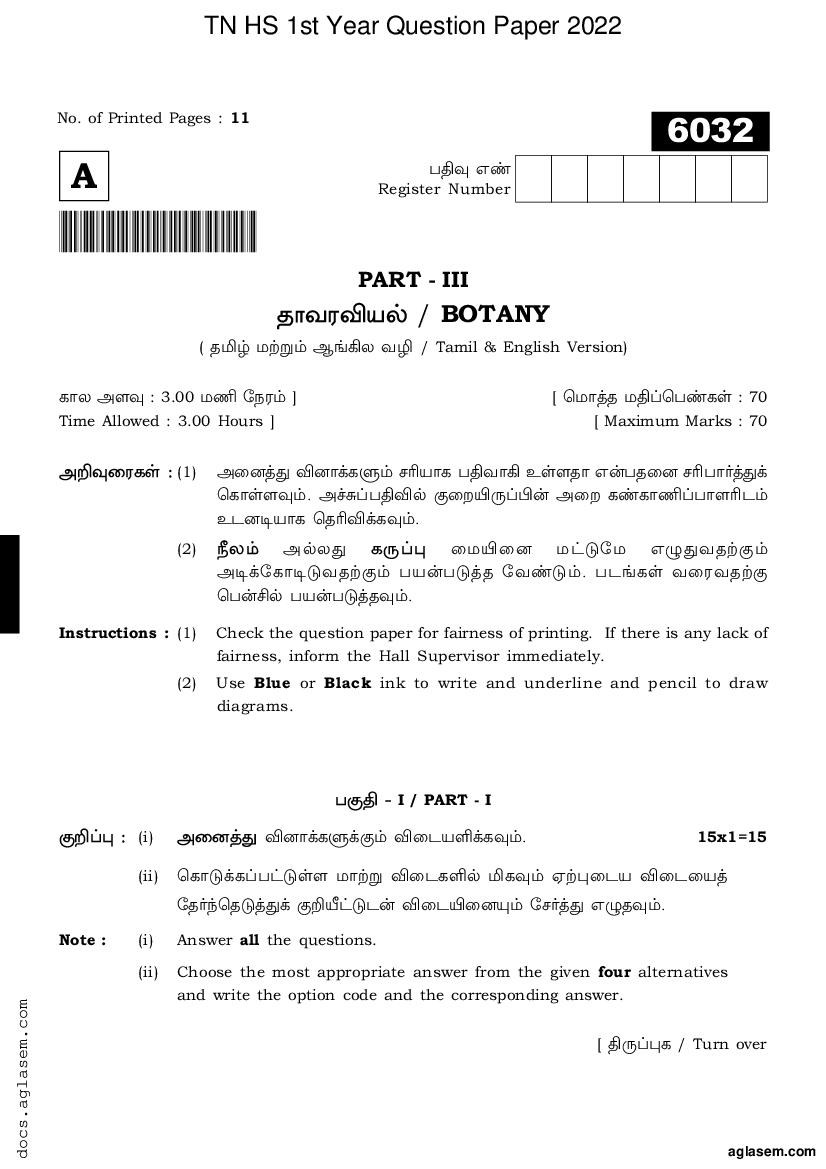
6032
£vÄ Gs
A Register Number
!6032IstYearBotany!
PART - III
uõÁµÂ¯À / BOTANY
( uªÌ ©ØÖ® B[Q» ÁÈ / Tamil & English Version)
Põ» AÍÄ : 3.00 ©o ÷|µ® ] [ ö©õzu ©v¨ö£sPÒ : 70
Time Allowed : 3.00 Hours ] [ Maximum Marks : 70
AÔÄøµPÒ : (1) AøÚzx ÂÚõUPЮ \›¯õP £vÁõQ EÒÍuõ GߣuøÚ \›£õºzxU
öPõÒÍÄ®. Aa_¨£vÂÀ SøÓ°¸¨¤ß AøÓ PsPõo¨£õÍ›h®
EhÚi¯õP öu›ÂUPÄ®.
(2) }»® AÀ»x P¸¨¦ ø©°øÚ ©mk÷© GÊxÁuØS®
AiU÷PõikÁuØS® £¯ß£kzu ÷Ásk®. £h[PÒ ÁøµÁuØS
ö£ß]À £¯ß£kzuÄ®.
Instructions : (1) Check the question paper for fairness of printing. If there is any lack of
fairness, inform the Hall Supervisor immediately.
(2) Use Blue or Black ink to write and underline and pencil to draw
diagrams.
£Sv & I / PART - I
SÔ¨¦ : (i) AøÚzx ÂÚõUPÐUS® Âøh¯ÎUPÄ®. 15x1=15
(ii) öPõkUP¨£mkÒÍ ©õØÖ ÂøhPÎÀ ªPÄ® Hئøh¯ Âøhø¯z
÷uº¢öukzxU SÔ±mkhß Âøh°øÚ²® ÷\ºzx GÊuÄ®.
Note : (i) Answer all the questions.
(ii) Choose the most appropriate answer from the given four alternatives
and write the option code and the corresponding answer.
[ v¸¨¦P / Turn over
Page 2
1. ö\¯ØøP BU]ß Gߣx :
(A) IAA (B) IBA (C) GA (D) NAA
One of the synthetic auxin is :
(a) IAA (b) IBA (c) GA (d) NAA
2. ©Pµ¢uz yÒPÒ JßÓõP Cøn¢x J¸ öuõS¨£õPU Põn¨£kÁx :
(A) øP÷Úõìj⯮ (B) ]g]Ûæ¯ì
(C) ]Úõßhµì (D) ö£õ¼Û¯®
Pollen grains are fused together as a single mass called as :
(a) Gynostegium (b) Syngenesious
(c) Synandrous (d) Pollinium
3. __________ ö\À öPõÒøPUS J¸ Âv»US.
(A) §gø\ (B) £õUj›¯õ
(C) ø©U÷Põ¤Íõì©õ (D) øÁµì
__________ is an exception to Cell Theory.
(a) Fungi (b) Bacteria
(c) Mycoplasma (d) Virus
A
Page 3
4. £õUj›¯õøÁz uõUQ AÈUS® øÁµì :
(A) \¯÷ÚõL£õä (B) £õUj›÷¯õL£õä
(C) `L£õä (D) ø©U÷PõL£õä
Virus infecting bacteria are called :
(a) Cyanophage (b) Bacteriophage
(c) Zoophage (d) Mycophage
5. «sk® Ch®ö£¯µõu uÛ©® Gx ?
(A) PõÀ]¯® (B) £õ죵ì
(C) ø|mµáß (D) ö£õmhõ]¯®
The element which is not remobilized ?
(a) Calcium (b) Phosphorous
(c) Nitrogen (d) Potassium
6. QøÍUPõø»]ì ©ØÖ® Qµ¨ì _ÇØ]°øÚ CønUS® ÷\º©® :
(A) A]møhÀ CoA (B) \U]ÛU Aª»®
(C) ]m›U Aª»® (D) ø£¸ÂU Aª»®
The compound which links Glycolysis and Kreb cycle is :
(a) Acetyl CoA (b) Succinic acid
(c) Citric acid (d) Pyruvic acid
A [ v¸¨¦P / Turn over
Page 4
7. öuõÊ÷|õ´ ©ØÖ® öÁs¦ÒÎ ÷|õ´PÐUS ©¸¢uõP¨ £¯ß£k® uõÁµ® :
(A) ö\õµõ¼¯õ ÷Põ›¼L÷£õ¼¯õ
(B) Cßi÷PõLö£µõ i[Um÷hõ›¯õ
(C) ¤³i¯õ ÷©õ÷Úõìö£º©õ
(D) QøÍm÷hõ›¯õ öhº÷Úæ¯õ
The plant used in leprosy and leucoderma :
(a) Psoralea corylifolia
(b) Indigofera tinctoria
(c) Butea monosperma
(d) Clitoria ternatea
8. ÷µõ÷hõLø£]°ß ÷\ª¨¦ ö£õ¸Ò :
(A) \¯÷ÚõLø£]¯ß uµ\® (B) L¨÷Íõ›i¯ß uµ\®
(C) £õµõø©»õß uµ\® (D) uµ\®
The storage product in Rhodophyceae is :
(a) Cyanophycean starch (b) Floridean starch
(c) Paramylon starch (d) Starch
9. Cø»zxøÍ ‰kÁøuz ysk® uõÁµ íõº÷©õß Gx ?
(A) A¨]]U Aª»® (B) BUêß
(C) ø\m÷hõøPÛß (D) ⨵¼ß
Which plant hormones induces closure of stomata ?
(a) Abscissic acid (b) Auxin
(c) Cytokinin (d) Gibberellin
A
Page 5
10. RÌUPshÁØÔÀ \›¯õÚ TØøÓz ÷uº¢öukUPÄ®.
(A) ÷ÁºyÂPÒ £» ö\ÀPÍõÀ BÚx.
(B) iøµ÷Põ®PÒ, PÛPÒ ©ØÖ® ÂøuPÒ £µÄÁuØS Eu ¦›QßÓÚ.
(C) \¨ÍõU Pmøh ÁiÁ Põ¨¦ ö\ÀPÒ C¸Âøu Cø»z uõÁµ[PÎÀ
Põn¨£kQßÓÚ.
(D) Cø»zxøÍPÒ Cø»°ß R̦Óz÷uõø» Âh ÷©Ø¦Óz÷uõ¼À AvP
GsoUøP°À EÒÍÚ.
Pick out the correct statement from the following :
(a) Root hairs are multi-cellular.
(b) Trichomes helps in dispersal of fruits and seeds.
(c) Dumb-bell shaped guard cells are seen in Dicots.
(d) Stomata are seen more in the upper epidermis than the lower epidermis.
11. öÁ[Põ¯zvß C¸ ö\õØö£¯º __________.
(A) A¼¯® ^£õ (B) A¼¯® \møhÁ®
(C) hõUPì P÷µõmhõ (D) µõ£Úõì \møhÁì
The binomial of Onion is :
(a) Allium cepa (b) Allium sativum
(c) Daucus carota (d) Raphanus sativus
12. Gx AvP {ø»zußø© ö£ØÓ RNA ?
(A) tRNA (B) dsRNA (C) rRNA (D) mRNA
The most stable RNA is :
(a) tRNA (b) dsRNA (c) rRNA (d) mRNA
A [ v¸¨¦P / Turn over
Page 6
13. Pmøh Gߣx :
(A) Cµshõ® {ø» ø\»® (B) Cµshõ® {ø» ¦÷Íõ¯®
(C) Cµshõ® ö©kÀ»› PvºPÒ (D) Cµshõ® {ø» ¦Óo
Wood is :
(a) Secondary Xylem (b) Secondary Phloem
(c) Secondary Medullary rays (d) Secondary Cortex
14. ö\À _ÇØ]°ß \›¯õÚ Á›ø\ :
(A) G1 - S - G2 - M (B) S - M - G1 - G2
(C) M - G1 - G2 - S (D) S - G1 - G2 - M
The correct sequence in cell cycle is :
(a) G1 - S - G2 - M (b) S - M - G 1 - G2
(c) M - G 1 - G2 - S (d) S - G1 - G2 - M
15. RÌUPshÁØÖÒ \›¯õÚ Cønø¯z ÷uº¢öukUPÄ®.
(A) uUPõ롧 {Ó©õØÓ® & ¼³miß
(B) PÛPÒ £ÊzuÀ & P÷µõmiÚõ´k
(C) Cø»°ß ©g\Ò {Ó® & £aø\¯®
(D) Cø»°ß {Ó©õØÓ® & ø»÷Põ¥ß
Pick out the correct pair.
(a) Change of Fruit colour in Tomato - Lutein
(b) Fruit ripening - Carotenoids
(c) Yellowing in Leaf - Chlorophyll
(d) Change in Leaf colour - Lycopene
A
Page 7
£Sv & II / PART - II
SÔ¨¦ : GøÁ÷¯Ý® BÖ ÂÚõUPÐUS ©mk® Âøh¯ÎUPÄ®. ÂÚõ Gs
24&US Pmhõ¯©õP Âøh¯ÎUPÄ®. 6x2=12
Note : Answer any six questions. Question No. 24 is Compulsory.
16. ø»UöPßPÎß ö£õx¨ £s¦PÒ H÷uÝ® CµsiøÚ GÊxP.
Write any two general characteristic features of Lichen.
17. ¤øµ÷¯õLø£mPÒ ÁõìS»zv_UPÍØÓ §Áõz uõÁµ[PÒ GÚ AøÇUP¨£hU
Põµn® GßÚ ?
Why Bryophytes are called Non-Vascular Cryptogams ?
18. Cø» AkUPø©Ä – Áøµ¯ÖUPÄ®.
Define Phyllotaxy.
19. ©Pµ¢uzuõÎß £h® Áøµ¢x £õP[PøÍU SÔUPÄ®.
Draw the diagram of stamen and label its parts.
20. hõmlµõ ö©mhÀ uõÁµ ©»›ß `zvµzøu GÊxP.
Write the floral formula of Datura metel.
A [ v¸¨¦P / Turn over
Page 8
21. ¤Íõì÷©õöhì÷©mhõ GßÓõÀ GßÚ ?
What is Plasmodesmata ?
22. ö\À _ÇØ] – Áøµ¯ÖUPÄ®.
Define cell cycle.
23. ø|mµáß }UP® – Áøµ¯ÖUPÄ®.
Define Denitrification.
24. {³UÎ÷¯õø\k ©ØÖ® {³UÎ÷¯õøhk ÷ÁÖ£kzxP.
Write the differences between Nucleoside and Nucleotide.
£Sv & III / PART - III
SÔ¨¦ : GøÁ÷¯Ý® BÖ ÂÚõUPÐUS ©mk® Âøh¯ÎUPÄ®. ÂÚõ Gs
33 &US Pmhõ¯©õP Âøh¯ÎUPÄ®. 6x3=18
Note : Answer any six questions. Question No. 33 is Compulsory.
25. ÁøP¨£õmi¯À ©ØÖ® SÊ©¨£›nõ© ÁøP¨£õmi¯À – ÷ÁÖ£kzxP.
Differentiate Taxonomy and Systematics.
26. }µõ¨÷£õUQß ÁøPPÒ ¯õøÁ ?
What are the different types of Transpiration ?
27. EmP¸Âß £oPøͨ £mi¯¼kP.
List the functions of Nucleus.
A
Page 9
28. G0 {ø»¨£ØÔ J¸ ]Ö SÔ¨¦ u¸P.
Give an account of G0 Phase.
29. Aø©Âhzvß Ai¨£øh°À BUSzv_Âß ÁøPPøÍ £h® Áøµ¢x £õP®
SÔUPÄ®.
Draw and label a diagram to show the different types of meristem based on their
position in the plant body.
30. £ÁÇ ÷ÁºPÒ GßÓõÀ GßÚ ? GkzxUPõmk u¸P.
What is Coralloid root ? Give an example.
31. §Áia ö\v¾øh¯, §UPõ®¦a ö\v»ØÓ C¸£õÀ ©»º •Êø©¯õÚ I¢u[P ©»º,
uÛzu ¦À¼Ámh®, uÛzu AÀ¼Ámh®, ÷©À©mha `»P¨ø£ öPõsh ©»›ß
©»º `zvµzvøÚ GÊxP.
Find out the floral formula for a bisexual flower with bract, regular, pentamerous,
distinct calyx and corolla, superior ovary without bracteole.
32. §gø\ ÷Á›PÎß •UQ¯zxÁ[PÒ GøÁ÷¯Ý® ‰ßÔøÚU SÔ¨¤kP.
Write any 3 importance of Mycorrhizae.
33. Qµ¨ì _ÇØ] Cµmøh {PÌÄz ußø© GßÖ Hß AøÇUP¨£kQÓx ?
Why Krebs cycle is called as ‘amphibolic pathway’ ?
A [ v¸¨¦P / Turn over
Page 10
£Sv & IV / PART - IV
SÔ¨¦ : AøÚzx ÂÚõUPÐUS® Âøh¯ÎUPÄ®. 5x5=25
Note : Answer all questions.
34. (A) \õØÖUPmøhUS® øÁµUPmøhUS® Cøh÷¯¯õÚ ÷ÁÖ£õkPøÍ GÊxP.
AÀ»x
(B) ö|õvPÎß £s¦Pøͨ £mi¯¼kP.
(a) Write the differences between Sap wood and Heart wood.
OR
(b) List out the properties of Enzymes.
35. (A) ö£s÷hõì L£õì÷£m ÁÈzuhzvß •UQ¯zxÁzøuU SÔ¨¤kP.
AÀ»x
(B) \õ÷ÓØÓzøu ÂÍUS® £õÀ\® uõÁµzvß ÷\õuøÚø¯ ÂÍUSP.
(a) Mention the significance of Pentose Phosphate Pathway.
OR
(b) Explain with an experiment to prove Ascent of Sap with Balsam plant.
36. (A) _ÇÀ JΣõ죛Pµn® ©ØÖ® _Ç»õ JΣõ죛Pµn® ÷ÁÖ£kzxP.
AÀ»x
(B) APõ›Pêß ÁõÌUøPa _ÇØ]ø¯ ÁøµP.
(a) Differentiate Cyclic Photophosphorylation and Non-cyclic
Photophosphorylation.
OR
(b) Draw the life cycle of Agaricus.
A
Page 11
37. (A) £» ÁøP¯õÚ RNA &Âß Aø©¨¦ ©ØÖ® £oPøÍ ÂÍUSP.
AÀ»x
(B) ø\m÷hõøPÛß Áõ̯À ÂøÍÄPøÍ GÊxP.
(a) Explain the structure and functions of different types of RNA.
OR
(b) Write the Physiological effects of Cytokinin.
38. (A) ø|mµáß {ø»{ÖzuzvÀ ø|m÷µõâ÷Úì ö|õv°ß £[QøÚ
ÂÁ›UPÄ®.
AÀ»x
(B) QøÍm÷hõ›¯õ öhº÷Úæ¯õÂß ©»º £s¦PøÍ ÂÍUSP.
(a) Write the role of nitrogenase enzyme in nitrogen fixation.
OR
(b) Give the floral characters of clitoria ternatea.
-o0o-
A [ v¸¨¦P / Turn over
Document Details
| Board / Org | Tamil Nadu Board |
| Exam | Class 11 |
| Type | Question Paper |
| Pages | 11 |
| Updated | 30 Apr 2026 |