CUSAT CAT 2016 Question Paper Botany
Finished viewing? Save it for later —
Download CUSAT CAT 2016 Question Paper Botany (PDF · 26 pages)About CUSAT CAT 2016 Question Paper Botany
CUSAT CAT 2016 Question Paper Botany is available here for free download. Published by Cochin University for CUSAT Common Admission Test, this question paper can be viewed online or downloaded as a PDF (26 pages). Candidates preparing for CUSAT Common Admission Test can use CUSAT CAT 2016 Question Paper Botany to understand the exam pattern, the type of questions asked, and the overall difficulty level.
Frequently Asked Questions
How can I download CUSAT CAT 2016 Question Paper Botany?
Open this page and click the Download button to save CUSAT CAT 2016 Question Paper Botany as a PDF. It is completely free on AglaSem Docs.
Is CUSAT CAT 2016 Question Paper Botany free to download?
Yes. CUSAT CAT 2016 Question Paper Botany can be viewed online and downloaded as a PDF free of cost on AglaSem Docs.
How many pages does CUSAT CAT 2016 Question Paper Botany have?
CUSAT CAT 2016 Question Paper Botany contains 26 pages, which you can read online or download together as a single PDF.
Where can I find more CUSAT Common Admission Test study material?
You can find more CUSAT Common Admission Test question papers, sample papers, syllabus, and answer keys on AglaSem Docs.
CUSAT CAT 2016 Question Paper Botany – Text
Read the full text of this question paper below — useful to quickly search, copy and reference the content online without downloading the PDF.
📄 View text version (26 pages)
Page 1
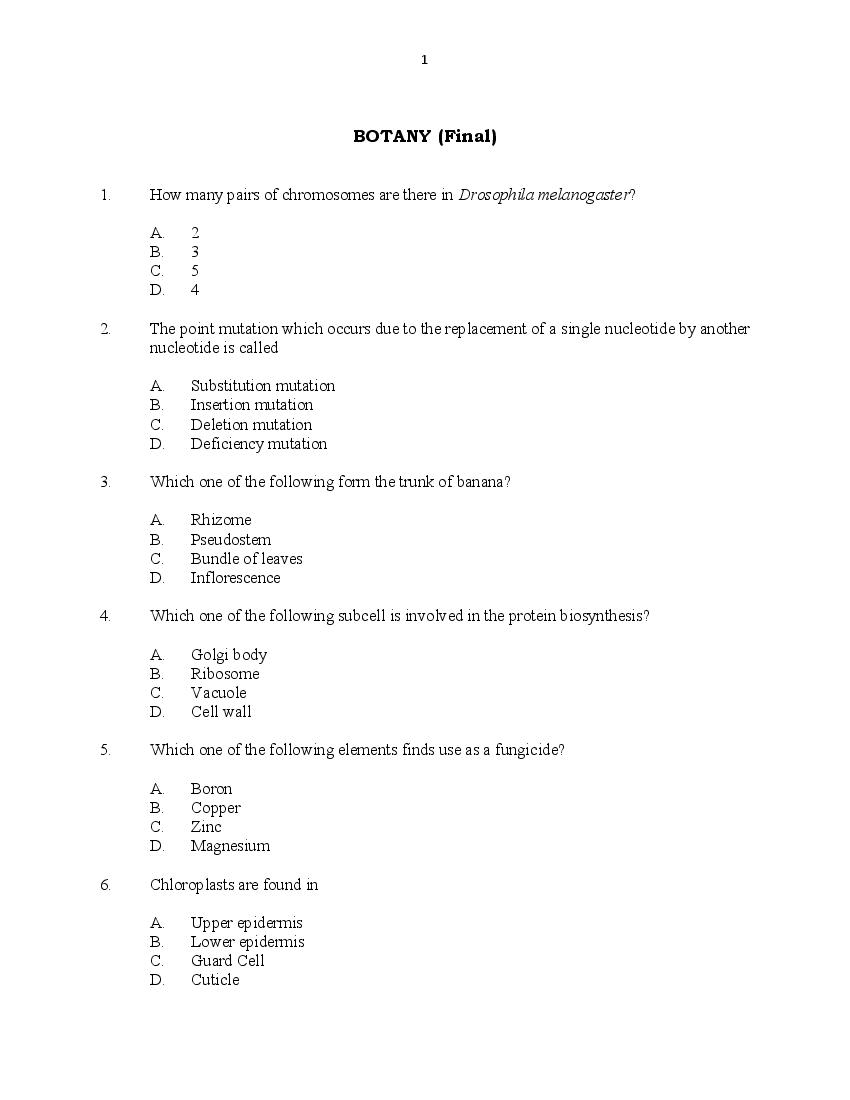
BOTANY (Final)
1. How many pairs of chromosomes are there in Drosophila melanogaster?
A. 2
B. 3
C. 5
D. 4
2. The point mutation which occurs due to the replacement of a single nucleotide by another
nucleotide is called
A. Substitution mutation
B. Insertion mutation
C. Deletion mutation
D. Deficiency mutation
3. Which one of the following form the trunk of banana?
A. Rhizome
B. Pseudostem
C. Bundle of leaves
D. Inflorescence
4. Which one of the following subcell is involved in the protein biosynthesis?
A. Golgi body
B. Ribosome
C. Vacuole
D. Cell wall
5. Which one of the following elements finds use as a fungicide?
A. Boron
B. Copper
C. Zinc
D. Magnesium
6. Chloroplasts are found in
A. Upper epidermis
B. Lower epidermis
C. Guard Cell
D. Cuticle
Page 2
7. Withania somnifera belongs to the family
A. Malvaceae
B. Magnoliaceae
C. Solanaceae
D. Sterculiaceae
8. Iodine has the capacity to turn this biomolecule into blue
A. Protein
B. Fat
C. Starch
D. Vitamin A
9. The method of reproduction in pteriodophytes is through
A. Seeds
B. Fruits
C. Spores
D. Fossils
10. The germination of pinus seed is
A. Hypogeal
B. Epigeal
C. Vivipary
D. Ovipary
11. An important ingredient to prepare jam that is obtained from within the fruit is
A. Lectin
B. Pectin
C. Glutelin
D. Albumin
12. Jaundice is cured by
A. Wedellia calendulacea
B. Phyllanthus niruri
C. Helianthus annus
D. Lactra saliva
Page 3
13. Which of the following seeds are used as weight by goldsmiths?
A. Butea frondosa
B. Clitoria ternata
C. Abutlion indicum
D. Abrus precatorius
14. Phyllode is a modified leaf form that helps to
A. Reduce transpiration
B. Increase water uptake
C. Reduce photosynthesis
D. Increase disease resistance
15. The interior of the leaf between upper and lower epidermis is called
A. Mesophyll
B. Vascular bundle
C. Xylem
D. Phloem
16. Venation indicates the arrangement of
A. Anthers in a flower
B. Veins in a leaf
C. Fruits in a bunch
D. Grains in a head
17. Development of fruits without fertilization is called as
A. Apocarpy
B. Syncorpy
C. Polycorpy
D. Parthenocarpy
18. Stamens attached to the petals are termed as
A. Episepalous
B. Epipetalous
C. Epitepalous
D. Polypetalous
Page 4
19. Seedless fruits are seen in
A. Banana
B. Grapes
C. Pine apple
D. All of the above
20. The maximum biodiversity in India occurs at
A. Western Himalayas
B. North East Himalayas
C. Western Ghats
D. Eastern Ghats
21. Cambium is present in
A. Dicot stem
B. Monocot stem
C. Dicot root
D. Dicot leaf
22. Gregore Johannes Mendel published the results of his experiment in the journal
A. Genera Plantarum
B. Hortus Uplandicus
C. Flora Lapponica
D. Transactions of Natural History Society
23. In hybridization technique, emasculation means the removal of
A. Stamen
B. Pistil
C. Corolla
D. Calyx
24. In a cross between two individuals pure for contrasting characters of a pair, the character
which is not represented in F1 generation is the
A. Dominant character
B. Recessive character
C. Incomplete dominant character
D. Intermediate character
Page 5
25. The chemical name for milk sugar is
A. D-Galactose
B. α-D Galactosyl pyranose
C. D- Glucose
D. None of the above
26. Cells of higher plants are grown artificially in laboratory conditions using the technique
of
A. Molecular cloning
B. Gene cloning
C. Tissue culture
D. Hybridization
27. An example of fusogen is
A. Methanol
B. Ethyl alcohol
C. Polyethylene alcohol
D. Polyethylene glycol ( PEG)
28. Transposon was discovered by
A. Darwin
B. Barbara McClintok
C. Monod
D. Watson
29. A popular technique to amplify thousands of copies of a DNA sequence is
A. RFLP
B. PCR
C. Translation
D. Duplication
30. The type of light microscopy used to visualize living cells is
A. Fluorescence microscopy
B. Electron microscopy
C. Phase-contrast microscopy
D. Confocal scanning microscopy
Page 6
31. mRNA molecule specifying for more than one polypeptide is called
A. Polysomic
B. Polycistronic
C. Polygenic
D. None of the above
32. Which organelle has only single membrane?
A. Mitochondria
B. Peroxisomes
C. Chloroplasts
D. Nucleus
33. The plant with the smallest genome is
A. Maize
B. Arabidopsis thaliana
C. Mungbean
D. Rice
34. DNA synthesis occurs during
A. G1 phase
B. G2 phase
C. S phase
D. M phase
35. Regulated processes leading to cell death via a series of well-defined morphological
changes is termed as
A. Apolysis
B. Apoptosis
C. Apomixis
D. Endodupliction
36. Trypsin inhibitor is present in
A. Wheat
B. Paddy
C. Maize
D. Soybean
Page 7
37. DNA replication is
A. Semi-discontinuous
B. Semi-conservative
C. Fully conservative
D. DNA degradation
38. Meiosis is
A. Reduction division
B. Equal division
C. Unreduction division
D. Nuclear fission
39. The character that appears in F1 is called
A. Recessive
B. Dominant
C. Incomplete dominance
D. None of the above
40. Enzymatic isolation of protoplasts was first demonstrated by
A. Zimmermann
B. Vasil
C. Cocking
D. Murashige
41. A synthetic plant hormone is
A. IAA
B. IBA
C. 2, 4-D
D. ABA
42. Lycopene is the coloring pigment of
A. Carrot
B. Tomato
C. Papaya
D. Lime
Page 8
43. Agar-Agar is obtained from
A. Ficus
B. Polysiphonia
C. Gelidium
D. Laminaria
44. Which of the algae is responsible for red color of red sea?
A. Chlamydomonas braui
B. Trichodesmium erythrium
C. Ulothrix zonata
D. Gelidium sps
45. Increase in girth in woody plants is due to the activity of
A. Cork cambium
B. Procambium
C. Fascicular cambium
D. All of the above
46. Casparian strips are present in
A. Pericycle
B. Endodermis
C. Hypodermis
D. Collenchyma
47. Grafting is not possible in monocotyledons because they
A. Have parallel bundles
B. Lack cambium
C. Are herbaceous
D. Have scattered vascular bundles
48. rRNA synthesis takes place in
A. Nucleus
B. Mitochondrion
C. Nucleolus
D. Cytosol
Page 9
49. Name the biological source of Iodine
A. Sea water
B. Oedogonium
C. Laminaria
D. None of the above
50. H2O2 clearance inside the cell is carried out by
A. Glyoxysome with enzyme isocitrate lyase
B. Peroxisome with enzyme lipase
C. Glyoxysome with enzyme catalase
D. Peroxisome with enzyme amino oxidase
51. All are particulate pollutants except
A. dust
B. ozone
C. Soot
D. smoke
52. The true statement about ‘green house effect’ is that it is
A. Caused by combinatin of many gases
B. Caused by CO2
C. Caused only by CO2, CFC, CH4 and NO2 gases
D. None of the above
53. Carbon monoxide is poisonous because it
A. Reacts with O2
B. Inhibits glycolysis
C. Makes nervous system inactive
D. Reacts with haemoglobin
54. Family Labiatae can be easily identified with the help of
A. Spurred corolla and quadrangular stem
B. Verticillaster inflorescence and many stamens
C. Gynobasic style and four ovules
D. Two stigmas and regular corolla
Page 10
55. What is the edible part in Jack fruit?
A. Thalamus
B. Ovary (ripened)
C. Perianth and seeds
D. Fleshy aril
56. Phyllocade is seen in
A. Rice
B. Caesalpinia
C. Casuarina
D. Cotton
57. The process of photorespiration in plants leads to
A. Release of enhanced levels of O2
B. Removal of waste metabolites
C. Lowering of the efficiency of photosynthetic carbon fixation
D. Enhanced plant yield
58. Under water stress, the leaves of plants are found to contain higher concentration of
A. Gibberellic acid
B. Cytokinins
C. Auxins
D. Abscisic acid
32
59. P is one of the radioactive isotopes commonly used in biological studies. Its half-life is
A. 14.3 days
B. 87.5 days
C. 8.07 days
D. 3.2 days
60. Which one of the following bacteria has found extensive use in genetic engineering work
in plants?
A. Agrobacterium tumefaciens
B. Clostridium septicum
C. Xanthomonas citri
D. Bacillus coagulens
Page 11
61. Which one of the following techniques is employed to detect the proteins of a particular
specificity?
A. Western blotting
B. Southern blotting
C. Northern blotting
D. Slot blotting
62. The protein in the pollen wall that causes allergy is contributed by
A. Exine
B. Pollen cytoplasm
C. Tapetum
D. Intine
63. Fluorescein diacetate is used to test pollen viability based on the activity of which one of
the following enzymes?
A. Catalase
B. Amylase
C. Esterase
D. Callase
64. Restriction enzymes are used in genetic engineering because
A. They can join different DNA fragments
B. They can cleave DNA at a specific target site
C. They are nucleases that cut DNA at variable sites
D. They are proteolytic enzymes which can degrade harmful enzymes
65. The hydrostatic pressure developed within a plant cell through endo-osmosis and exerted
on its wall is termed as
A. Wall pressure
B. Osmotic pressure
C. Suction pressure
D. Turgor pressure
66. In Nature, the orchid seeds germinate only in association with
A. Myxomycetes
B. Mycorrhiza
C. Blue green algae
D. Actinomycetes
Page 12
67. Which is major factor contributing to loss of biodiversity?
A. Habitat loss and fragmentation
B. Introduced species
C. Over exploitation of plants and animals
D. Industrial farming and forestry
68. The discipline dealing with the inheritance of characters is called
A. Cytology
B. Evolution
C. Genetics
D. Embryology
69. Puccinia graminis causes in cereals one of the following diseases
A. Blight
B. Gall
C. Rust
D. Wilt
70. Which of the following can only be viewed by electron microscopy?
A. Viruses
B. Bacteria
C. Nuclei
D. Mitochondria
71. Which of the following units is used to measure energy?
A. Joule
B. Mole
C. Watt
D. Meter
72. Which of the following is not a base used in DNA replication?
A. Cytosine
B. Uracil
C. Thymine
D. Guanine
Page 13
73. Which of the following molecules would not readily cross an intact cell membrane by
simple diffusion?
A. Water
B. Fatty acids
C. Ethanol
D. Glucose
74. The most widely used method for determining the purity of a protein is
A. High pressure liquid chromatography (HPLC)
B. Ion exchange chromatography
C. Isoelectric focusing
D. Polyacrylamide gel electrophoresis (PAGE)
75. The normal cell cycle usually proceeds in the following sequence
A. S phase – mitosis – G1 phase – G2 phase
B. S Phase – G1 phase – G2 phase - mitosis
C. G1 Phase - G2 phase – S phase - mitosis
D. Mitosis – G1 phase – S phase – G2 phase
76. Biochemical Oxygen Demand measures
A. Pollution level
B. Industrial pollution
C. Dissolved oxygen needed by microbes to decompose organic waste
D. Degree of contamination
77. Phosphorous and Nitrogen ions generally get depleted in soil because they usually occur
as
A. Neutral ions
B. Negatively charged ions
C. Positively charged ions
D. Both positively and negatively charged but disproportionate mixture
78. What causes a green plant to bend towards light as it grows?
A. Auxin accumulates on shaded side stimulating greater cell elongation
B. Because green plants are phototrophic
C. Light stimulates plant cells on the lighted side to grow faster
D. Because green plants need light to carry on photosynthesis
Page 14
79. The transmembrane region of a protein is likely to have
A. A stretch of hydrophilic amino acids
B. Alternating hydrophilic and hydrophobic amino acids
C. A stretch of hydrophobic amino acids
D. A disulphide loop
80. The ‘eyes’ of the potato tuber are
A. Root buds
B. Axillary buds
C. Flower buds
D. Shoot buds
81. Water moulds belongs to the Division
A. Ascomycota
B. Basidiomycota
C. Chytridiomycota
D. Oomycota
82. Litmus which is used for the detection of acids or alkalies is obtained from
A. Algae
B. Lichens
C. Fungi
D. Bacteria
83. Which one of the following is called as the ‘brewers yeast’?
A. Saccharomyces cerevisiae
B. Saccharomyces ludwigi
C. Saccharomyces boulardii
D. Saccharomyces pastorianus
84. Transcription is the transfer of genetic information from
A. RNA to cDNA
B. t-RNA to mRNA
C. DNA to mRNA
D. mRNA to protein
Page 15
85. Transpiration is least in
A. High wind velocity
B. Good soil moisture
C. Dry environment
D. High atmospheric humidity
86. Indole 3-acetic acid is chemically similar to the amino acid
A. Methionine
B. Tryptophan
C. Proline
D. Phenylalanine
87. The root in mangrove tree is
A. Tuberous
B. Buttress
C. Respiratory
D. Fibrous
88. The process of pinocytosis means
A. Cells excreting fluids
B. Cells engulfing solids
C. Cells engulfing bacteria
D. Cells engulfing fluids
89. If the endosperm cells of an angiosperm seed are pentaploid, then such a seed may have
been formed by which of the following parents?
A. Pentaploid female and pentaploid male
B. Triploid female and diploid male
C. Diploid male and tetraploid female
D. Triploid male and diploid female
90. Fungi in the division Deuteromycota are characterized by the fact that
A. A method of sexual reproduction has not been identified
B. They only reproduce sexually
C. They form sexual spores called deuterospores
D. They are incapable of sexual reproduction
Page 16
91. Which one of the following statements about ATP is correct?
A. ATP is considered a low energy phosphate compound
B. Hydrolysis of ATP is a strongly exergonic reaction
C. ATP cannot be taken up through cell membrane
D. ATP is present at high concentration in the cell
92. One thousand micrometers is equivalent to
A. 0.1 millimeter
B. 10 millimeters
C. 1 millimeter
D. 100 millimeters
93. If an endosperm cell of an angiosperm contains 24 chromosomes, the number of
chromosomes in each cell of the root will be
A. 8
B. 16
C. 4
D. 24
94. Pericycle of roots gives
A. Lateral roots
B. Mechanical support
C. Vascular bundles
D. Adventitious roots
95. Which of the following is a parasitic alga?
A. Sargassum
B. Cladophora
C. Oedogonium
D. Celphaleuros
96. The ploidy of endosperm in Gymnosperms is
A. Haploid
B. Diploid
C. Triploid
D. Polyploid
Page 17
97. Lichens serve as an indicator of pollution by
A. NO3
B. CO2
C. CO
D. SO2
98. Carbon dioxide joins the photosynthetic pathway in
A. PS I
B. PS II
C. Dark reaction
D. Light reaction
99. In grafting scion forms
A. Root system
B. Shoot system
C. Hybrid plant
D. Chimeric plant
100. ‘The energy available to do useful work’ is a description of which of the following terms
A. Free energy
B. Enthalpy
C. Kinetic energy
D. Entropy
101. Littoral zone is located along the
A. Deserts
B. Mountain ranges
C. Sea
D. Rivers
102. Which of the following is not a member of the division Ascomycota?
A. Claviceps
B. Aspergillus
C. Penicillium
D. Rhizopus
Page 18
103. Azolla is used as biofertilizer as it has
A. Higher humus and nitrates
B. Cyanobacteria
C. Rhizobium
D. Mycorrhiza
104. Which of the following pair of diseases is caused by virus?
A. Typhoid and Tetanus
B. Cholera and Tuberculosis
C. Rabies and Measles
D. AIDS and Syphilis
105. A common structural feature of vessel elements and sieve tube elements is
A. Thick secondary walls
B. Pores on lateral walls
C. Enucleate condition
D. Presence of ‘P’ protein
106. Which of the following statements about the functions of the cell membrane is not
correct?
A. Cell membranes are selectively permeable to most molecules
B. Cell membranes are passively not permeable to inorganic ions
C. Cell membrane always maintains the shape of the cell
D. Cell membrane retain the contents of the cell
107. Identify non-membranous organelle from the following
A. Ribosome
B. Endoplasmic reticulum
C. Nucleus
D. Chloroplast
108. The fully formed male gametophyte of angiosperms contains
A. One tube nucleus, one vegetative cell and one generative cell
B. One generative cell, one tube cell and one stalk cell
C. One generative cell, one tube cell and one body cell
D. One vegetative nucleus, and two male gametes
Page 19
109. Why is vivipary an undesirable character for annual crop plants?
A. It reduces the vigour of the plant
B. The seeds cannot be stored under normal conditions for the next season
C. It adversely affects the fertility of the plant
D. The seeds exhibit long dormancy
110. During respiration yeast converts glucose into
A. Ethanol and oxygen
B. Lactic acid and CO2
C. Ethanol and CO2
D. Ethanol and water
111. A transgenic crop which may help in solving the problem of night blindness in
developing countries is
A. Golden rice
B. Bt soy bean
C. ‘Flavr Savr’ tomato
D. Starlink maize
112. The flax fibres are obtained from
A. Cannabis sativa
B. Cocos nucifera
C. Crotolaria juncea
D. Linum usitatissimum
113. Correct order of geological era is
A. Archaeozoic→Cenozoic→ Paleozoic
B. Cenozoic→Paleozoic→ Archaeozoic
C. Paleozoic→ Mesozoic→Cenozoic
D. Mesozoic→Archaeozoic→ Cenozoic
114. Organization of stem apex into tunica and corpus is mainly determined by
A. Planes of cell division
B. Rate of cell grown
C. Rate of shoot tip grown
D. Regions of meristematic activity
Page 20
115. An example of a heterozygous but homogenous population is
A. Pure line
B. Synthetic variety
C. Inbreds
D. Hybrid variety
116. Jute is obtained from Corchorus sp. This is
A. Phloem fiber
B. Xylem fiber
C. Surface fiber
D. Tracheo fiber
117. Dry indehiscent single-seeded fruit formed from bicarpellary syncarpous inferior ovary is
A. Berry
B. Caryopsis
C. Cypsela
D. Cremocarp
118. Which of the following spores are characteristic of the black bread mould Rhizopus?
A. Arthrospore and Blastospore
B. Sporangiospore and Zygospore
C. Ascospore and Zygospore
D. Arthrospore and Ascospore
119. The effect of gaseous pollutants depend mainly on their –
A. Longevity in air
B. Ability to settle down
C. Hydrophobic nature
D. Solubility in water
120. Spore mother cell in Bryophytes is
A. Diploid
B. Haploid
C. Polyploid
D. Triploid
Page 21
121. Which of the following is a disadvantage of most of the renewable energy sources?
A. Highly polluting
B. Unreliable supply
C. High waste disposal cost
D. High running cost
122. The classification that is exhaustive and broad based
A. Phylogenetic system
B. Natural system
C. Modern system
D. Artificial system
123. The element found in all amino acids that is not found in carbohydrates is
A. Oxygen
B. Hydrogen
C. Carbon
D. Nitrogen
124. Smooth endoplasmic reticulum is the site of
A. Protein synthesis
B. Lipid synthesis
C. Amino acid synthesis
D. Carbohydrate synthesis
125. Electron transport system is located in mitochondrial
A. Inner membrane
B. Outer membrane
C. Inter membrane space
D. Matrix
126. Accurate determination of water content in soil is made by
A. Calcium carbide method
B. Sand bath method
C. Alcohol method
D. Oven-drying method
Page 22
127. The dark reaction in photosynthesis is called so because
A. It is light-independent
B. It cannot occur during day time
C. It occurs rapidly at night
D. Things cannot be seen during this period
128. Removal of hydrogen and CO2 from substrate is called
A. Decarboxylation
B. Reductive decarboxylation
C. Oxidative decarboxylation
D. Oxidation
129. The six most common atoms in organic molecules are
A. C, H, O. He, Ca and K
B. C, H, N, O, P and S
C. C, H, O, Mn, Mg and S
D. C, H, N, O, P and K
130. Gregore Johannes Mendel did not observe linkage due to
A. Independent assortment
B. Mutation
C. Synapsis
D. Crossing over
131. In Pteridophytes, reduction division occurs when
A. Gametes are formed
B. Spores are formed
C. Prothallus is formed
D. Sex organs are formed
132. Viral genome attached to the bacterial genome is termed as
A. Bacteriophage
B. Prophage
C. Lysophage
D. Virophage
Page 23
133. Enzyme immobilization is
A. Changing a soluble enzyme into insoluble state
B. Changing pH so that enzyme is not able to carry out its function
C. Conversion of an active enzyme into inactive form
D. Providing enzyme with protective covering
134. Population of genetically similar plants obtained from same individual by vegetative
method
A. Propagules
B. Buds
C. Clone
D. Callus
135. Enzymes having slightly different molecular structure but performing identical activity
are
A. Coenzymes
B. Apoenzymes
C. Holoenzymes
D. Isoenzymes
136. Intellectual Property Rights protect the use of information and ideas that are of
A. Moral value
B. Commercial value
C. Ethical value
D. Social value
137. Pyrenoids are
A. Starch grains surrounded by oil droplets
B. Protein surrounded by starch grains
C. Protein surrounded by oil droplets
D. Starch grains surrounded by protein
138. Pasteurization is a
A. Low temperature treatment
B. Steaming treatment
C. High temperature treatment
D. Ultralow temperate treatment
Page 24
139. Protonema is found in
A. Polytrichum
B. Porella
C. Marchantia
D. Anthoceros
140. Ozone is found in
A. Exosphere
B. Ionosphere
C. Stratosphere
D. Mesosphere
141. A tautonym is –
A. Same name for genus and species
B. Non-latinised name
C. Common name used as scientific name
D. Unscientific explanation of a phenomenon
142. Some of the enzymes, which are associated in converting fats into carbohydrates, are
present in
A. Glyoxysomes
B. Liposomes
C. Microsomes
D. Golgi bodies
143. How many hydrogen bonds form between U and A in a Watson-Crick base pair
interactions?
A. 1
B. 2
C. 3
D. 4
144. Phytochrome is involved in
A. Photosynthesis
B. Photorespiration
C. Geotropism
D. Photoperiodism
Page 25
145. Why are haploids superior to diploids in study of mutations?
A. They have smaller number of chromosomes
B. They have shorter life time
C. They allow expression of recessive mutation
D. They can be produced large number very easily
146. What is the correct descending sequence of taxonomic categories?
A. Class, order, division, family, species, tribe
B. Family, order, genus, tribe, division, class
C. Tribe, genus, class, division, family, order
D. Division, class, order, family, tribe, genus
147. The negative charge of DNA is due to
A. Deoxy ribose sugar
B. Sugar, phosphate and amino aicd
C. Phosphate group
D. Nitrogen bases particularly Adenine
148. Which of the following is best suited method for production of virus-free plants?
A. Embryo culture
B. Meristem culture
C. Ovule culture
D. Callus culture
149. Acid rains are produced by
A. Excess NO2 and SO2 from burning fossil fuels
B. Excess production of NH3 by industry and coal gas
C. Excess release of carbon monoxide by incomplete combustion
D. Excess formation of CO2 by combustion and animal respiration
150. A character is determined by many genes and does not show discrete variation and is
known as
A. Qualitative character
B. Quantitative character
C. Pseudo dominance
D. Multiple allelic character
Page 26
***
Document Details
| Board / Org | Cochin University |
| Exam | CUSAT Common Admission Test |
| Type | Question Paper |
| Pages | 26 |
| Updated | 22 Jul 2026 |