CUSAT CAT 2016 Question Paper Chemistry
Finished viewing? Save it for later —
Download CUSAT CAT 2016 Question Paper Chemistry (PDF · 31 pages)About CUSAT CAT 2016 Question Paper Chemistry
CUSAT CAT 2016 Question Paper Chemistry is available here for free download. Published by Cochin University for CUSAT Common Admission Test, this question paper can be viewed online or downloaded as a PDF (31 pages). Candidates preparing for CUSAT Common Admission Test can use CUSAT CAT 2016 Question Paper Chemistry to understand the exam pattern, the type of questions asked, and the overall difficulty level.
Frequently Asked Questions
How can I download CUSAT CAT 2016 Question Paper Chemistry?
Open this page and click the Download button to save CUSAT CAT 2016 Question Paper Chemistry as a PDF. It is completely free on AglaSem Docs.
Is CUSAT CAT 2016 Question Paper Chemistry free to download?
Yes. CUSAT CAT 2016 Question Paper Chemistry can be viewed online and downloaded as a PDF free of cost on AglaSem Docs.
How many pages does CUSAT CAT 2016 Question Paper Chemistry have?
CUSAT CAT 2016 Question Paper Chemistry contains 31 pages, which you can read online or download together as a single PDF.
Where can I find more CUSAT Common Admission Test study material?
You can find more CUSAT Common Admission Test question papers, sample papers, syllabus, and answer keys on AglaSem Docs.
CUSAT CAT 2016 Question Paper Chemistry – Text
Read the full text of this question paper below — useful to quickly search, copy and reference the content online without downloading the PDF.
📄 View text version (31 pages)
Page 1
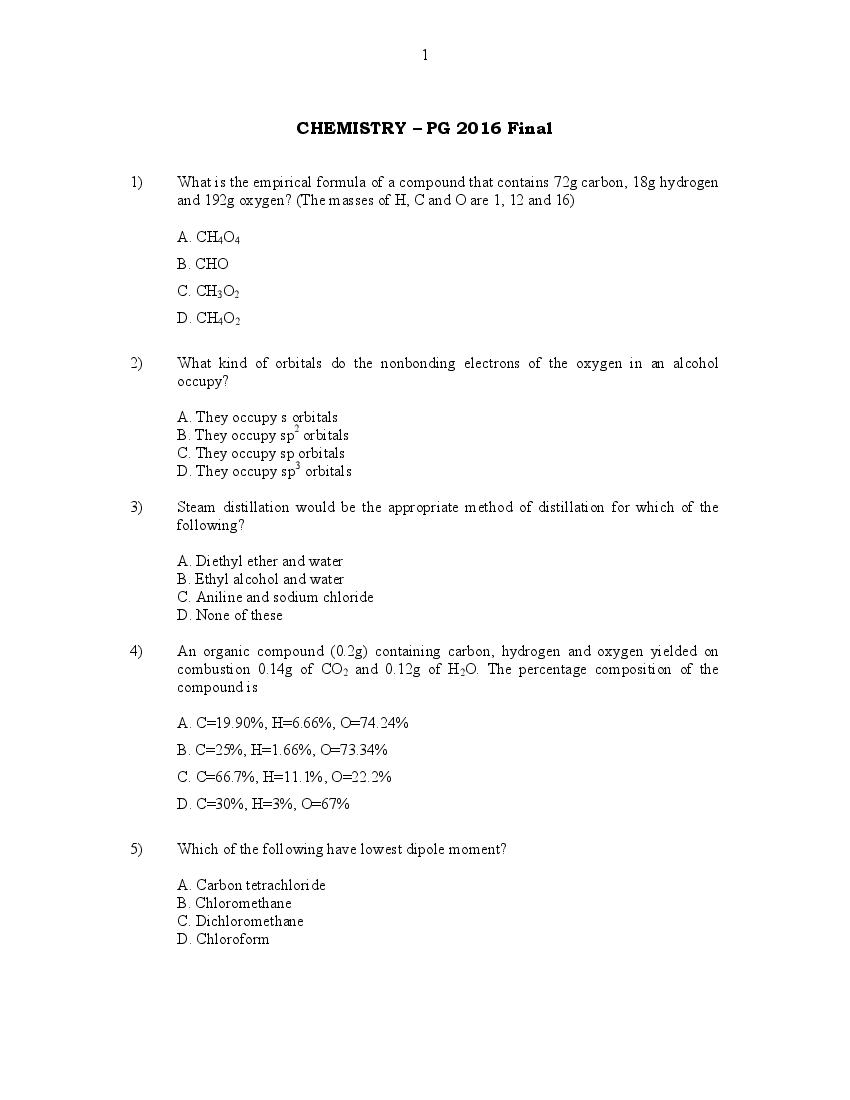
CHEMISTRY – PG 2016 Final
1) What is the empirical formula of a compound that contains 72g carbon, 18g hydrogen
and 192g oxygen? (The masses of H, C and O are 1, 12 and 16)
A. CH4O4
B. CHO
C. CH3O2
D. CH4O2
2) What kind of orbitals do the nonbonding electrons of the oxygen in an alcohol
occupy?
A. They occupy s orbitals
B. They occupy sp2 orbitals
C. They occupy sp orbitals
D. They occupy sp3 orbitals
3) Steam distillation would be the appropriate method of distillation for which of the
following?
A. Diethyl ether and water
B. Ethyl alcohol and water
C. Aniline and sodium chloride
D. None of these
4) An organic compound (0.2g) containing carbon, hydrogen and oxygen yielded on
combustion 0.14g of CO2 and 0.12g of H2O. The percentage composition of the
compound is
A. C=19.90%, H=6.66%, O=74.24%
B. C=25%, H=1.66%, O=73.34%
C. C=66.7%, H=11.1%, O=22.2%
D. C=30%, H=3%, O=67%
5) Which of the following have lowest dipole moment?
A. Carbon tetrachloride
B. Chloromethane
C. Dichloromethane
D. Chloroform
Page 2
6) Optical isomerism is shown by
A. n-butyl chloride
B. sec-butyl chloride
C. tert- butyl chloride
D. isobutyl chloride
7) LPG is a mixture of
A. methane+ethane
B. O2 + Acetylene
C. butane + Isobutane
D. acetylene + H2
8) Baeyer’s reagent is
A. dil KMnO4
B. HCl + ZnCl2
C. Br2 in CCl4
D. NH2NH2
9) 1,3-butadiene reacts with bromine to mainly give
A. 3,4-dibromo-1-butene
B. 4-bromo-1-butene
C. 1,4-dibromo-2-butene
D. 1-bromo-2-butene
10) Ozonolysis of 2-butyne gives
A. formic acid
B. propanoic acid
C. acetic acid
D. butanoic acid
11) Which compound would react most rapidly in an SN2 reaction?
A. CH3CH2I
B. CH2=CH-I
C. (CH3)2 CHI
D. (CH3)3CI
12) Which compound will give tert-butyl alcohol with methyl magnesium bromide?
A. Acetyl chloride
B. Acetone
C. Isopropyl alcohol
Page 3
D. Acetaldehyde
13) Isopropyl alcohol can be converted to acetone by treatment with
A. HCl/ZnCl2
B. Na2Cr2O7 / H2SO4
C. NaOH
D. LiAlH4
14) Compound (A) reacts with sodium metal to form one mole of H2. The compound (A)
can be
A. CH3CH2CH=CH2
B. HOCH2CH2CH2CH2OH
C. CH2=CH-CH=CH2
D. CH3CH2CH2CH2OH
15) Compound (A) gave a positive iodoform test, but did not reduce silver metal in
ammonia solution. Compound (A) could be
A.
B.
C.
D.
Page 4
NaOH (A) + NaBr
16) 2-bromobutyric acid
reflux
(A) can be
A.
B.
C.
D.
17) Acetamide can be converted to methylamine by
A. P2O5
B. PCl5
C. Br2/ NaOH
D. LiAlH4
18) Hydrolysis of an ester can be accomplished by
A. base-promoted hydrolysis
B. acid-catalyzed hydrolysis
C. Both of the above
D. Neither of the above
19) Diethyl malonate reacts with urea to give
A. butyric acid
B. barbituric acid
C. glutaric acid
D. mandelic acid
20) The degree of unsaturation of a fat can be determined by means of its
A. iodine number
B. octane number
C. saponification
D. melting point
Page 5
Page 6
21) Which of the following compounds react with nitrous acid to form an alcohol?
A. CH3CH2NH2
B. (CH3CH2)2NH
C. (CH3CH2)3N
D.
22) Glycine reacts with nitrous acid to form
A. glycollic acid
B. diketopiperazine
C. methylamine
D. ethylalcohol
23) Which molecule will decolourize bromine in carbon tetrachloride most readily?
A. 1,2-dimethylcyclopropane
B. Cyclopentane
C. 1,2-dimethylcyclobutane
D. Cyclohexane
24) Uric acid on oxidation with alkaline KMnO4 forms
A. urea
B. barbituric acid
C. allantoin
D. caffeine
25) α-D-glucopyranose is a (n)
A. hemiacetal
B. hemiketal
C. acetal
D. ketal
26) How many signals will vinyl chloride have in its proton NMR spectrum?
A. 4
B. 1
C. 3
D. 2
Page 7
27) What is the order of basicity (most basic to least)?
O
NH2
NH2 NH C CH3
I II III
A. I, II, III
B. I, III, II
C. III, II, I
D. II, I, III
28) Naphthalene undergoes oxidation with Na2Cr2O7/H2SO4 to form
A. Phthalic acid
B. Benzoic acid
C. Tetralin
D. Decalin
29) The aromaticity of the heterocycles is in the order
A. Thiophene > pyrrole > furan > pyridine
B. Furan > pyrrole > thiophene > pyridine
C. Pyridine > thiophene > pyrrole > furan
D. Pyridine > furan > pyrrole > thiophene
30) The Lindlar catalyst is
A. Na in alcohol
B. Raney nickel
C. Pd / CaCO3
D. Na / LiqNH3
31) Which of the following depict the same stereoisomer?
A. 1 and 2
B. 1 and 3
C. 2 and 3
D. 1, 2 and 3
Page 8
32) Rank the following species in order of decreasing nucleophilicity in a polar protic
solvent (most least nucleophilicity).
CH3CH2CH2O‒ CH3CH2CH2S‒ CH3CH2COO‒
1 2 3
A. 3 > 1 > 2
B. 2 > 3 > 1
C. 1 > 3 > 2
D. 2 > 1 > 3
33) Which of the following are pyrimidines?
1. Adenine 2. Cytosine 3. Guanine 4. Thymine
A. 1, 2
B. 1, 3
C. 1, 4
D. 2, 4
34) A D carbohydrate is
A. always dextrorotatory
B. always levorotatory
C. always the anomer of the corresponding
D. None of the above
35) The optical rotation of the -form of a pyranose is +150.7o and that of the -form is
+52.8o. In solution an equilibrium mixture of the anomers has an optical rotation of
+80.2o. The percentage of the -form at equilibrium is
A. 28%
B. 32%
C. 68%
D. 72%
36) Which of the following reactions is more effective?
I. C6H5ONa + CH3CH2CH2Br
II. CH3CH2CH2ONa + C6H5Br
A. Reaction I is more effective
B. Reaction II is more effective
C. Both reactions I and II are effective
D. Neither reaction I nor reaction II is effective
Page 9
37) The reaction
most likely occurs by which of the following mechanisms?
A. Addition - elimination
B. Elimination - addition
C. Both (A) and (B)
D. Neither of these
38) Which of the following compounds gives a single benzyne intermediate on reaction
with sodium amide?
A. 1 only
B. 1 and 3
C. 3 only
D. 1 and 2
39) Choose the response that matches the correct functional group classification with the
following group of
A. Anhydride Lactam Lactone
B. Lactam Imide Lactone
C. Imide Lactone Anhydride
D. Imide Lactam Lactone
Page 10
40) Which of the following pairs of aldehydes gives a single product in a mixed aldol
condensation?
A. C6H5CH2CHO + C6H5CHO
B. C6H5CHO + CH2O
C. C6H5CHO + (CH3)3CCHO
D. CH3CHO + (CH3)2CHCHO
41) Which of the following is a linear polymer?
A. High density polythene
B. Low density polythene
C. Bakelite
D. Vulcanized rubber
42) Bakelite is the product of the reaction between
A. formaldehyde and NaOH
B. aniline and urea
C. phenol and methanol
D. phenol and chloroform
43) Dettol consists of
A. xylenol + terpeneol
B. chloroxylenol + terpeneol
C. cresol + ethanol
D. None of the above
44) Which of the following is an ester?
A. Kerosene oil
B. Soap
C. Bees wax
D. Peptoses
45) Isopropylamine X Y. In the above sequence X and Y are
respectively
A. Acetaldimine, Ethanol
B. Ethanol, Ketimine
C. Ketimine, Acetone
D. Acetone, Propan-2-ol
Page 11
46) Green Chemistry means such reactions which
A. are related to the depletion of ozone layer
B. study of reactions in plants
C. produce colour during reactions
D. reduce the use and production of hazardous chemicals
47) The presence of chlorine is indicated in a compound if its mass spectrum, show M+
and (M+2)+ peaks in the intensity ratio
A. 2:1
B. 3:1
C. 1:1
D. 1:2
48) Infrared region lies between
A. ultraviolet and radiowave
B. visible and radio waves
C. Visible and microwave
D. UV and Visible waves
49) What reagent and/or reaction conditions would you choose to bring about the
following conversion?
A. LiAlH4, 2H2O
B. H2O, NaOH
C. H2O, H2SO4
D. PCC, CH2Cl2
50) Which of the following alcohols gives the best yield of dialkyl ether on being heated
with a trace of sulphuric acid?
A. 1-Pentanol
B. 2-Pentanol
C. Cyclo pentanol
D. 2-Methyl-2-butanol
51) dS = 0 for a
A. Reversible process in an isolated system
B. Reversible process in a closed system
Page 12
C. Reversible process in an open system
D. Irreversible process in an isolated system
52) Dispersion of liquid into a gas is called
A. sol
B. aerosol
C. emulsion
D. gel
53) Choose the correct statement:
The enthalpy of mixing for perfect gas
A. Δmix H = 0
B. Δmix H =1
C. Δmix H = <1
D. Δmix H = >1
54) Match the following:
Molecule Point group
(I) H2O (i) Td
(II) CH3Cl (ii) D2h
(III) C2H4 (iii) C3v
(IV) CH4 (iv) C2v
A. (I) - (iv), (II) - (iii), (III) - (ii), (IV) - (i)
B. (I) - (ii), (II) - (i), (III) - (iv), (IV) - (iii)
C. (I) - (iii), (II) - (i), (III) - (iv), (IV) - (ii)
D. (I) - (iv), (II) - (ii), (III) - (i), (IV) - (iii)
55) Choose the molecule(s) with a center of symmetry
(I) SF6 (II) CO2 (III) XeF4 (IV) H2O
A. I, II and III only
B. IV only
C. III and IV only
D. I and IV only
Page 13
56) Einstein temperature of solid, θ E , is equal to
A. ħ /kT
B. ħ
C. ħ /k
D. PV
(where k is Boltzmann constant)
57) Match the following:
List I List II
I) Total number of characteristic operations (i) Symmetry element
II) Sum of diagonal elements (ii) Identity
III) Doing nothing (iii) Character
IV) The point, line or plane with (iv) Order of the point group
A. (I)-(iv), (II)-(iii), (III)-(ii), (IV)-(i)
B. (I)-(ii), (II)-(iv), (III)-(i), (IV)-(iii)
C. (I)-(ii), (II)-(i), (III)-(iii), (IV)-(iv)
D. (I)-(i), (II)-(iii), (III)-(iv), (IV)-(ii)
58) The entropy is ___________if there is only one way of achieving a given total energy
A. One
B. Zero
C. >1
D. Infinity
59) A reaction is thermodynamically feasible if
A. Δ r G θ <0
B. Δ r G θ >0
C. Δ r G θ =0
D. Δ r G θ 1
60) Number of orbitals in a shell with n=5 (where n is the principal quantum number) is
A. 25
B. 5
C. 125
D. 3
Page 14
61) Which one of the following statements is not true?
A. Ice has a residual entropy of 3.4 J K-1 mol-1
B. The osmotic pressure of a solution is proportional to the concentration of
the solute
C. An ideal solution is one in which the solute obeys Henry’s law
D. All heteronuclear diatomic molecules are nonpolar
62) If a system can exchange matter with the surroundings, it is called
A. open system
B. closed system
C. isolated system
D. metastable system
63) Which one of the following statements is not true?
A. Bosons are particles with half integral spin.
B. The stiffer the bond, the greater is the force constant.
C. Unit of pressure is pascal.
D. Normal value of the pH of the human blood plasma is 7.4.
64) Heat capacity is defined as
A. C = dS/dT
B. C = dq/dT
C. C = dq
D. C = RT
65) The ideal gas constant, R, is equal to
A. 8.314 cal mol‒1
B. 8.314 J K‒1 mol‒1
C. 8.314 J oC‒1 mol‒1
D. 2 J K‒1 mol‒1
66) Which one of the following statements is not true?
A. Gold at the nanoscale is red.
B. CP - CV = nR
C. e‒ is a Fermion.
D. IR inactive vibration in CO2 is bending vibration.
67) Possible quantum states for a carbon atom with the configuration 1s2 2s2 2p2
A. 12
B. 6
Page 15
C. 15
D. 9
68) Stirling’s approximation is
A. ln X! ; X ln X‒X
B. ln X! ; X ln X
C. ln X! ; X ln X + X
D. ln X! ; X
69) Unit of partition function is
A. dimensionless
B. s‒1
C. D
D. K‒1
70) Boltzmann’s constant, k, is equal to
A. ideal gas constant
B. ideal gas constant × Avogadro’s number
C. ideal gas constant / T
D. ideal gas constant / Avogadro’s number
71) Number of IR active normal modes of H2O molecule is
A. three
B. two
C. one
D. None of the above
72) Match the following:
Acids pKa (at 25ºC)
I) Acetic acid (i) 3.75
II) Formic acid (ii) 6.49
III) Chromic acid (iii) 1.64
IV) Periodic acid (iv) 4.76
A. (I)-(i), (II)-(iv), (III)-(ii), (IV) - (iii)
B. (I)-(ii), (II)-(i), (III)-(iv), (IV) - (iii)
C. (I)-(iii), (II)-(iv), (III)-(i), (IV) - (ii)
D. (I)-(iv), (II)-(i), (III)-(ii), (IV) - (iii)
Page 16
73) Pick out the nuclei having spin, I = 1
(I) 1H (II) 2D (III) 14N (IV) 19F
A. (II) and (III) only
B. (I) only
C. (IV) only
D. (I) and (IV) only
74) ___________ is known as dry ice.
A. Solid CO2
B. H2O2
C. Phenol
D. NH4Br
75) Choose the correct statement(s)
(I) An ensemble is defined as a collection of identical units of a system.
(II) Exponent is unitless.
(III) Absorbance, A=log I0
(IV) In fluorescence, the spontaneous emission may persist for long periods.
A. (I) and (II) only
B. (III) and (IV) only
C. (III) only
D. (IV) only
76) Best catalyst for NH3 synthesis is
A.Mo
B. Ni
C. Fe
D. None of the above
77) The number of vibrational degrees of freedom for a nonlinear polyatomics are
A. 3N-6
B. 3N
C. 3N-5
D. 3N+6
78) The coordination number of a primitive cubic lattice is
A. 4
B. 8
C. 6
Page 17
D. 9
79) Unit of molar absorption coefficient, , is
A. s‒1
B. dm3 mol‒1
C. dm3 mol‒1 cm‒1
D. kJ mol‒1
80) The bond order of NO is
A. 2 ½
B. 2
C. 1
D. 3
81) Pick out Boson(s) from the following:
(I) 2H (II) 4He (III) 14N (IV) Photon
A. All four
B. None
C. (I) only
D. (II) Only
82) Selection rule for rotational transition is
A. ΔJ = ± 1
B. ΔJ = ± 2
C. ΔJ = 0
D. ΔJ = ± 3
83) S branch lines arise from ___________ transition (Raman spectra)
A. J J+1
B. J J
C. J J+2
D. J J – 1
84) The root mean square velocity is
A. 3kT
B. 3kTm
C. (3kT/m)1/2
D. (m /3kT)1/2
Page 18
85) Spectral region of rotation of polyatomic molecules is
A. Microwave
B. UV
C. Infrared
D. Visible
86) Pick out the microwave active molecule
A. HCl
B. CH4
C. H2
D. SF6
87) Match the following:
Bond Bond Length (Aº)
I) C – C (i) 1.09
II) C = C (ii) 1.20
III) C ≡ C (iii) 1.34
IV) N ≡ N (iv) 1.54
A. (I) – (i), (II) – (ii), (III) – (iv), (IV) – (iii)
B. (I) – (ii), (II) – (iii), (III) – (iv), (IV) – (i)
C. (I) – (iii), (II) – (iv), (III) – (i), (IV) – (ii)
D. (I) – (iv), (II) – (iii), (III) – (ii), (IV) – (i)
88) Pick out the polar molecule(s) from the following:
(I) HCl (II) O3 (III) NH3 (IV) CO2
A. I, II and III only
B. IV only
C. I and II only
D. II and IV only
89) Match the following:
Region Molecular Process
(I) Microwave (i) Vibration of flexible bonds
(II) Far IR (ii) Electronic transitions
(III) IR (iii) Rotation of small molecules
(IV) Visible & UV (iv) Rotation of polyatomic molecule
A. (I) – (iv), (II) – (iii), (III)- (i), (IV) – (ii)
B. (I) – (iii), (II) – (iv), (III)- (ii), (IV) – (i)
Page 19
C. (I) – (ii), (II) – (iv), (III)- (iii), (IV) – (i)
D. (I) – (i), (II) – (ii), (III)- (iv), (IV) – (iii)
90) Match the following:
Vibration Type v /cm‒1
I) C C stretch (i) 700-1250
II) C O stretch (ii) 1640 – 1780
III) C - C stretch, bend (iii) 2100-2260
IV) Hydrogen bonds (iv) 3200-3570
A. (I) - (iii), (II) - (ii), (III) - (i), (IV) - (iv)
B. (I) - (iii), (II) - (iv), (III) - (ii), (IV) - (i)
C. (I) - (ii), (II) - (iv), (III) - (iii), (IV) - (i)
D. (I) - (i), (II) - (ii), (III) - (iv), (IV) - (iii)
91) Dipole moment of CCl4 is
A. Zero
B. 1.85
C. 1.08
D. 0.45
92) Variance is
A. Equal to standard deviation
B. Average value
C. Square root of the standard deviation
D. Square of the standard deviation
93) Which one of the following statements is not true?
A. The freezing temperature when the pressure is 1atm is called the normal
freezing point.
B. Charge on a proton is equal to 1.6022×10‒19 C.
C. Vibrational energy levels are equally or evenly spaced.
D. The conductivity of a metallic conductor increases as the temperature is
raised.
94) Calculate the height of column of water that exerts same pressure as a column of
mercury of 760 mm height (density of mercury = 13.6g/cm3).
A. 1.05m
B. 5.25m
C. 10.3m
D. 8.3m
Page 20
95) A balloon inside a room, where the temperature is 27oC has a volume of 2.00L. What
will its volume be outdoors, where the temperature is ‒23oC (Assume no change in
the gas pressure).
A. 1.20 L
B. 1.67 L
C. 4.80 L
D. 2.40 L
96) How much heat does it take to raise the temperature of 225g water from 25.0 to
100.0oC?
A. 70.5 kJ
B. 40.37 kJ
C. 58.5 kJ
D. 705.00 J
97) For the reaction A products a plot of [A] versus time is found to be a straight line.
The order of the reaction is
A. first
B. second
C. zero
D. impossible to determine from the graph
98) The reaction 2A+B C+2D is first order in A and first order in B. For this reaction
A. rate of reaction = k[A]2[B]
B. rate of reaction = k[A]2
C. rate of disappearance of A = rate of disappearance of B
D. rate of formation of C = ‒(rate of disappearance of B)
99) The first order reaction has a half life of 13.9 mm. The rate at which the reaction
proceeds when [A] = 0.40 M is
A. 0.020 M min‒1
B. 8.0 M min‒1
C. 0.050 M min‒1
D. 0.125 M min‒1
100) Which of the following is most likely to lead to the complete precipitation of a metal
ion as its sulphide from a saturated solution of H2S?
A. Add an acid
B. Increase the [H2S] in the solution
C. Raise the pH
D. Heat the solution
Page 21
101) A body mass of 10 mg is moving with a velocity of 100 ms‒1. The wavelength of the
deBroglie wave associated with it would be
A. 6.63 × 10‒37 m
B. 6.63 × 10‒31 m
C. 6.63 × 10‒34 m
D. 6.63 × 10‒35 m
102) Which of the following is used as moderator in nuclear reactors?
A. Cadmium
B. Heavy water
C. Uranium
D. Boron
103) If MX3 is T shaped, then the lone pair around M is
A. 2
B. 0
C. 3
D. 5
104) Which of the following is amphoteric oxide?
A. CO
B.N2O
C. Al2O3
D. P4O10
105) XeF6 on reaction with CsF gives
A. [XeF5]+[CsF2]‒
B. XeF8
C. [XeF4]2+[CsF3]2‒
D. Cs+[XeF7]‒
106) The oxidation number of Pt in [Pt(C2H4)Cl3] ‒ is
A. +1
B. +2
C. +3
D. +4
Page 22
107) An example of a molecule with 3center‒2 electron band is
A. XeF2
B. B2H6
C. ICl2
D. BF4
108) Which of the following gives red precipitate with AgNO3?
A. KI
B. K2CrO4
C. NaBr
D. NaNO3
109) When a substance A reacts with water, it produces a combustible gas B and a solution
of substance C in water. When another substance D reacts with this solution of C, it
also produces the same gas B on warming but D can produce gas B on reaction with
dilute sulphuric acid at room temperature. A imparts a deep golden yellow colour to a
smokeless flame of Bunsen burner. A, B, C and D respectively are
A. Na, H2, NaOH, Zn
B. K, H2, KOH, Al
C. Ca, H2, Ca(OH)2, Sn
D. CaC2, C2H2, Ca(OH)2, Fe
110. If 3.22 g of Na2SO4.nH2O on heating expels 1.80 g of water to give the anhydrous
salt, then its molecular formula is
A. Na2SO4.H2O
B. B. 2Na2SO4.H2O
C. Na2SO4.10H2O
D. 3Na2SO4.4H2O
111. The order of polarity of bonds, shown by a dash is
A. H-Cl > H-OH > H-NH2
B. H-OH > H-Cl > H-NH2
C. H-Cl > H-NH2 > H-OH
D. H-OH > H-NH2 > H-Cl
Page 23
112. The first four ionization energies of an element are 288, 412, 650 and 3220 kJ/mol
respectively. The number of valence electrons present in the element is
A. 1
B. 2
C. 3
D. 4
113. The correct order of the first ionization energies of C, N, O and F is
A. C < N < O < F
B. F < N < O < C
C. O < F < N < C
D. C < O < N < F
114. The common isotopes of carbon are 12C (98.9%) and 13C (1.1%). The atomic mass of
naturally occurring carbon is
A. 12.50 u
B. 13.00 u
C. 12.00 u
D. 12.01 u
115. The boiling points of H2O, H2S and H2Se are in the order
A. H2O < H2S < H2Se
B. H2O > H2S < H2Se
C. H2O > H2S > H2Se
D. H2S > H2O > H2Se
116. The radii of hydrated ions is in the order
A. Rb+ > K+ > Na+ > Li+
B. Li+ > Na+ > K+ > Rb+
C. Na+ > K+ > Rb+ > Li+
D. Rb+ >Na+ > K+ > Li+
117. In the graph of atomic number vs. ionization energy for the elements through Na to
Ar,
A. maxima occur at Mg and S
B. maxima occur at Mg and P
C. maxima occur at Na and P
D. maxima occur at Na and S
Page 24
118. In the series, O2‒, F‒, Na+ and Mg2+, the ionic radii varies in the order
A. O2‒ > F‒ > Na+ > Mg2+
B. O2‒ < F‒ > Na+ < Mg2+
C. O2‒ > F‒ < Na+ > Mg2+
D. O2‒ = F‒ = Na+ = Mg2+
119. The formal charge on oxygen in the species
is
A. ‒2
B. ‒1
C. +1
D. +3
120. Both the structures, (a) and (b) of CO2 given below satisfy the octet rule.
The better structure between them and the reason for that is
A. (a); there is no formal charge on any atom.
B. (a); all the electron pairs are symmetrically arranged.
C. (b); sum of the single and triple bond energies is greater than the sum of the
two double bond energies.
D. (b); the two oxygens carry opposite formal charges and hence attract each other.
121. Which one of the following properties is not the characteristic of alkali metals?
A. Low I E
B. Low electronegativity
C. Outermost ns1 electronic configuration
D. Low atomic volume
122. According to the VSEPR theory, the structures of PF5 and BrF5 are respectively
A. TBP and SP
B. SP and TBP
C. TBP and TBP
D. SP and SP
Page 25
123. The number of bond pairs and lone pairs present in the molecules, (a) BF3 and (b)
PF3 are,
A. (a) 3, 1; (b) 3,1
B. (a) 3, 0; (b) 3,1
C. (a) 1, 0; (b) 3,1
D. (a) 3, 0; (b) 3,0
124. The hybridisations and the geometries of XeF4 and SF4 are respectively,
A. sp3d2, octahedral and sp3, tetrahedral
B. sp3d2, octahedral and sp3d, see-saw
C. sp3d2, square planar and sp3, tetrahedral
D.sp3d2, square planar and sp3d, see-saw
125. In which of the following the O-N-O bond angle is the highest?
A. N2O4
B. NO2+
C. NO2‒
D. NO3‒
126. The order of screening effect of electrons in the inner orbitals of an atom on the outer
most electrons is
A. s > p > d > f
B. s > d > p > f
C. p > d > f > s
D. d > f > p > s
Page 26
127. Which of the following represents the best resonance structure for N2O?
A.
B.
C.
D.
128. Among H2O, PF5, BrF5 and BF3, the molecules with zero dipole moment are
A. BrF5 and BF3
B. PF5 and BrF5
C. PF5 and BF3
D. BF3 and H2O
129. The strongest Bronsted base among H2PO4‒, HSO4‒, NO3‒ and CH3COO‒ is
A. H2PO4‾
B. HSO4‾
C. CH3COO‾
D. NO3‾
130. Among O2, N2, NO, NO+, O2+ and O22‒, the species having the same bond orders are
A. O2, NO,
B. N2, NO+
C. N2, O22‒
D. NO+, O2+
131. Which of the following reactions of xenon compounds is not feasible?
A. 3XeF4 + 6H2O 2Xe + XeO3 + 12HF + 1.5O2
B. XeO3 + 6HF XeF6 + 3H2O
C. 2XeF2 + 2H2O 2Xe + 4HF + O2
Page 27
D. XeF6 + RbFRb [XeF7]
132. When Br2 reacts with hot concentrated KOH, the oxidation numbers of bromine in the
products changes as
A. 0 to ‒1 and 0 to +3
B. 0 to ‒1 and 0 to +5
C. 0 to ‒1 and 0 to +7
D. 0 to +3
133. The most acidic and the least acidic among P2O5, As2O3, Sb2O3 and Bi2O3 are
respectively,
A. P2O5, As2O3
B. P2O5, Bi2O3
C. Bi2O3, P2O5
D. Bi2O3, P2O5
134. Which among the following compounds would have optical isomers?
I : cis-[Co(en)2Cl2]+, II: trans-[Co(en)2Cl2]+, III :[Pt(NH3)2Cl2] and
IV: [Ni(CO)2(PPh3)2].
A. Both I and II
B. both I and III
C. All the four
D. I only
135. The order of CFSEs for octahedral complexes of Cr(III) with I‒, H2O, NH3 and CN‒
are in the order,
A. CN‒ < H2O < NH3 < I‒
B. CN‒ < H2O < I‒ < NH3
C. I‒ < H2O < NH3 < CN‒
D. I‒ < NH3 < H2O < CN‒
136. The complex [Ma4bc] can exist as cis- and trans-isomer. Which one of them will give
three isomeric products by replacing a ‘a’ ligand by ‘c’? (a, b and c are monodentate
ligands).
A. cis-only
B. trans-only
C. both cis- and trans
D. none of them
Page 28
137. Identify the not true statement among the following:
A. [CoF6]3–: octahedral and paramagnetic
B. [NiCl4]2–: square planar and diamagnetic
C. [Ni(CN)4]2–: square planar and diamagnetic
D. [CuCl4]2–: square planar and paramagnetic
138. In which of the following compounds, the formal oxidation state and coordination
number of Co are, respectively, ‒1 and 4?
A. Co2(CO)8
B. MeCo(CO)4
C.NaCo(CO)4
D. Co4(CO)12
139. The increasing order of magnetic moments of I:
[Fe(CN)6]4‒, II: [Fe(CN)6]3‒, III: [CrCl6]3‒ and IV: Ni(H2O)6]2+ is
A. I < II < III< IV
B. I < II < IV < III
C. IV < III < I < II
D. II < III< I < IV
140. Which one of the following pairs of isomers and types of isomerism are correctly
matched?
(I) [Co(NH3)5NO2]Cl2 and [Co(NH3)5(ONO)]Cl2 linkage
(II) [Cu(NH3)4][PtCl4] and [Pt(NH3)4][CuCl4] coordination
(III) [Pt(NH3)4Cl2]SO4 and [Pt(NH3)4Cl2]Br2 ionization
A. (II) and (III)
B. (I), (II) and (III)
C. (I) and (II)
D. (I) and (III)
141. Which one of the following combinations is likely to yield a stable molecule of the
type XY7?
A. X = F, Y = I
B. X = Cl, Y = F
C. X = Br, Y = Cl
D. X = I, Y = F
Page 29
Page 30
142. The number of P-O-P bridges in P4O6 and P4O10 are respectively,
A. 4, 4
B. 4, 6
C. 6, 4
D. 6, 6
143. Identify the isostructural pairs among the following: NF3, NO3‒, H3O+, I3‒ and BF3.
A. [NF3, NO3‒] and [H3O+ and BF3]
B. [NF3, H3O+] and [NO3‒and BF3]
C. [NF3, BF3] and [NO3‒and I3‒]
D. [NF3, NO3‒] and [BF3and I3‒]
144. For a transition metal ion having eight electrons in its d-orbitals, the spin-only
magnetic moment (in B M) will be
A. 18
B. 8
C. 9
D. 10
145. The E0 values for Ag+/Ag, K+/K, Mg2+ /Mg and Cr3+/Cr are 0.80V, ‒2.93V, ‒2.37V
and ‒0.74 V respectively. The reducing power of the metals is in the order
A. Ag > Cr > Mg > K
B. K>Mg>Cr>Ag
C. Ag > Cr > K > Mg
D. Cr > Ag > Mg > K
146. Metallic copper and iron have respectively FCC and BCC structures at room
temperature. The coordination numbers of Cu and Fe in their structures are
A. Cu : 12 and Fe : 8
B. Cu : 8 and Fe : 12
C. Cu : 6 and Fe : 8
D. Cu : 6 and Fe : 6
Page 31
147. Which of the following are peroxo acids of suphur?
A. H2SO5 and H2S2O8
B. H2SO5 and H2S2O7
C. H2S2O8and H2S2O7
D. H2S2O6 and H2S2O7
148. The atomicity and the total number of bonds in elemental white phosphorus molecule
are, respectively
A. 4 and 6
B. 6 and 4
C. 4 and 4
D. 6 and 6
149. Which one of the following does not obey 18-electron rule?
A. [Fe(CO)5]
B. [Cr(CO)5]2‒
C. [Mn(CO)6]+
D. [V(CO)6]
150. If the CFSE for an octahedral complex ML6 is 20000 cm‒1, then the CFSE of the
tetrahedral complex, ML4 will be approximately
A. 20000 cm‒1
B. 15000 cm‒1
C. 9000 cm‒1
D. 45000 cm‒1
***
Document Details
| Board / Org | Cochin University |
| Exam | CUSAT Common Admission Test |
| Type | Question Paper |
| Pages | 31 |
| Updated | 22 Jul 2026 |