CUSAT CAT 2016 Question Paper Engineering Science
Finished viewing? Save it for later —
Download CUSAT CAT 2016 Question Paper Engineering Science (PDF · 29 pages)About CUSAT CAT 2016 Question Paper Engineering Science
CUSAT CAT 2016 Question Paper Engineering Science is available here for free download. Published by Cochin University for CUSAT Common Admission Test, this question paper can be viewed online or downloaded as a PDF (29 pages). Candidates preparing for CUSAT Common Admission Test can use CUSAT CAT 2016 Question Paper Engineering Science to understand the exam pattern, the type of questions asked, and the overall difficulty level.
Frequently Asked Questions
How can I download CUSAT CAT 2016 Question Paper Engineering Science?
Open this page and click the Download button to save CUSAT CAT 2016 Question Paper Engineering Science as a PDF. It is completely free on AglaSem Docs.
Is CUSAT CAT 2016 Question Paper Engineering Science free to download?
Yes. CUSAT CAT 2016 Question Paper Engineering Science can be viewed online and downloaded as a PDF free of cost on AglaSem Docs.
How many pages does CUSAT CAT 2016 Question Paper Engineering Science have?
CUSAT CAT 2016 Question Paper Engineering Science contains 29 pages, which you can read online or download together as a single PDF.
Where can I find more CUSAT Common Admission Test study material?
You can find more CUSAT Common Admission Test question papers, sample papers, syllabus, and answer keys on AglaSem Docs.
CUSAT CAT 2016 Question Paper Engineering Science – Text
Read the full text of this question paper below — useful to quickly search, copy and reference the content online without downloading the PDF.
📄 View text version (29 pages)
Page 1
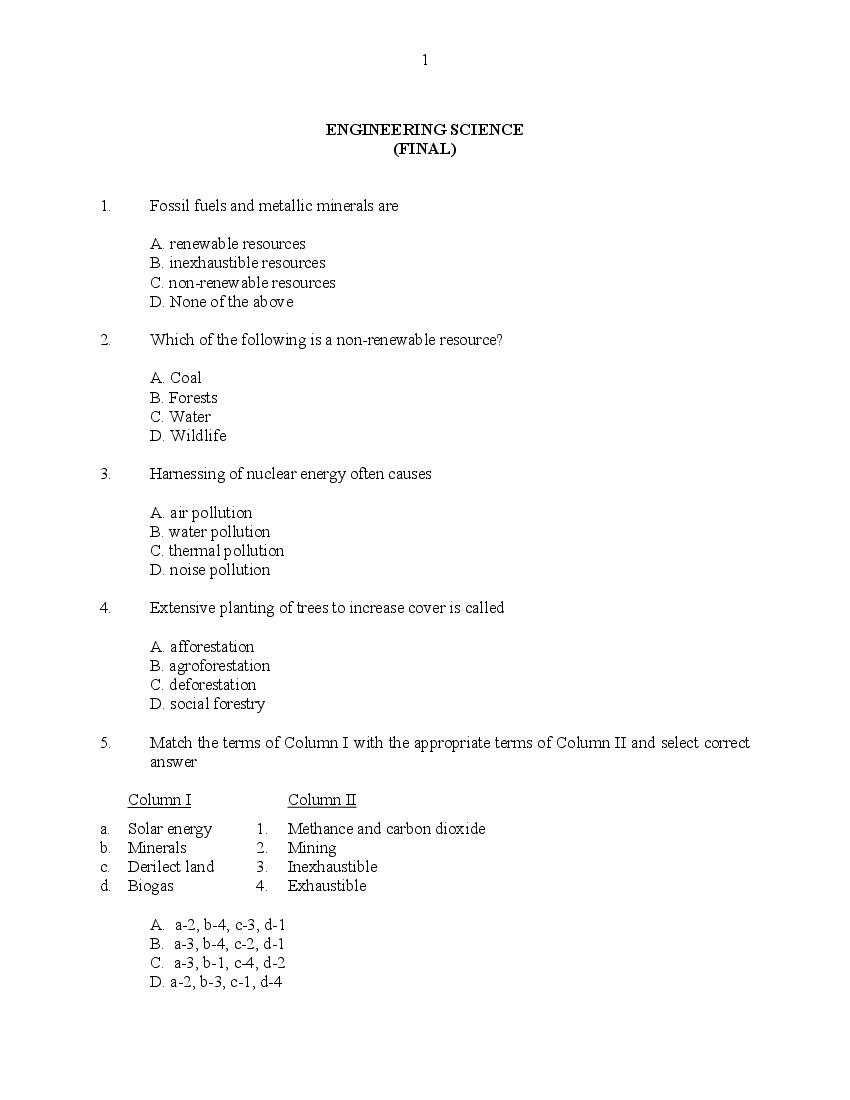
ENGINEERING SCIENCE
(FINAL)
1. Fossil fuels and metallic minerals are
A. renewable resources
B. inexhaustible resources
C. non-renewable resources
D. None of the above
2. Which of the following is a non-renewable resource?
A. Coal
B. Forests
C. Water
D. Wildlife
3. Harnessing of nuclear energy often causes
A. air pollution
B. water pollution
C. thermal pollution
D. noise pollution
4. Extensive planting of trees to increase cover is called
A. afforestation
B. agroforestation
C. deforestation
D. social forestry
5. Match the terms of Column I with the appropriate terms of Column II and select correct
answer
Column I Column II
a. Solar energy 1. Methance and carbon dioxide
b. Minerals 2. Mining
c. Derilect land 3. Inexhaustible
d. Biogas 4. Exhaustible
A. a-2, b-4, c-3, d-1
B. a-3, b-4, c-2, d-1
C. a-3, b-1, c-4, d-2
D. a-2, b-3, c-1, d-4
Page 2
6. In a food chain animals constitute the
A. first trophic level
B. second trophic level
C. intermediate trophic level
D. ultimate trophic level
7. The food chain in which microorganisms breakdown dead producers is called
A. consumer food chain
B. predator food chain
C. parasitic food chain
D. detritus food chain
8. Most stable ecosystem is
A. forest
B. desert
C. ocean
D. mountain
9. New approach to conservation is the establishment of
A. sanctuaries
B. biosphere reserves
C. national parks
D. reserve forests
10. The greenhouse effect is due to
A. impermeability of long wavelength radiations through CO2 of the atmosphere
B. penetrability of low wavelength radiations through O3 layer
C. penetrability of low wavelength radiations through CO2 layer
D. impermeability of long wavelength radiations through O3 layer
11. Which important greenhouse gas other than methane is being provided from the
agricultural fields?
A. SO2
B. Nitrous oxide
C. SO3
D. Ammonia
Page 3
12. Study of trends in human population growth and prediction of future growth is called
A. Demography
B. Biography
C. Kalography
D. Psychology
13. If the rate of addition of new members increases with respect to the individual lost of the
same population, then the graph obtained has
A. declined growth
B. exponential growth
C. zero growth
D. None of the above
14. All water that occurs below the surface of the earth is called
A. ground water
B. underground water
C. sub-surface water
D. All of the above are correct
15. The vertical wells sink along the banks of a river to draw ground water in dry season are
called
A. open wells
B. tube wells
C. artesian wells
D. infiltration wells
16. Dug wells are preferred when they have to be used up to a depth of
A. 10 meters
B. 20 meters
C. 50 meters
D. 100 meters
17. The specific retention is least in
A. coarse gravel
B. sand
C. clay
D. silt
Page 4
18. To determine the velocity of flow ground water, the most commonly used non-empirical
formula is
A. Darcy’s formula
B. Slichter’s formula
C. Hazen’s formula
D. Lacy’s formula
19. Strainer type tube wells are considered unsuitable for
A. coarse gravel
B. fine and strata
C. clean gravel
D. All of the above
20. Under normal conditions, the average domestic consumption in India per person per day
in liters is
A. 105
B. 135
C. 180
D. 215
21. As per norms, 45 litres of water per person per day is provided in case of
A. hotels
B. hospitals
C. office buildings
D. public places
22. Per capita consumption will be higher if
A. pressure in distribution system will be more
B. quality of water will be good
C. the living standard of people is higher
D. All of the above
23. The compensate for losses, thefts and wastage of water, an allowance provided is
A. 5%
B. 10%
C. 15%
D. 25%
Page 5
24. The distribution mains in water supply system are designed for
A. maximum daily demand
B. peak hourly demand
C. average daily demand
D. maximum hourly demand on maximum consumption day
25. As compared to geometric increase method of forecasting population, arithmetical
increase method gives
A. higher value
B. lesser value
C. same value
D. more accurate value
26. The water of a river has an important property called
A. turbidity
B. self-purification
C. permeability
D. infiltration capacity
27. Ground water is generally free from
A. suspended impurities
B. dissolved impurities
C. Both (A) and (B)
D. None of the above
28. Suspended impurities consist of
A. iron
B. chlorine
C. bacteria
D. All of the above
29. Turbidity
A. is a measure of the resistance of water to the passage of light through it
B. is expressed in parts per million or milligrams per liter
C. Both (A) and (B)
D. produced by one milligram of silica in one litre of water is the unit of turbidity
Page 6
30. Permanent hardness of water can be removed by
A. lime soda process
B. base-exchange process
C. de-mineralisation process
D. All of the above
31. The maximum permissible colour for domestic supplies based on coball scale is
A. 5 ppm
B. 10 ppm
C. 20 ppm
D. 50 ppm
32. Taste and odour in the water are caused due to presence of
A. living algae
B. decaying organic matter
C. phenolic substances
D. All of the above
33. For public water supply threshold odour number should be
A. one
B. between 1 and 3
C. three
D. more than 3
34. The permissible pH value for public supply water is between
A. 4.5 to 5.5
B. 5.5 to 6.5
C. 6.5 to 8.5
D. 8.5 to 10.5
35. pH value of fresh sewage is usually
A. zero
B. anywhere between 7 and 14
C. 1
D. anywhere between 1 and 7
Page 7
36. The maximum permissible total solid content in water for domestic purpose should not
exceed
A. nil
B. 400 ppm
C. 500 ppm
D. 1000 ppm
37. The presence of high quantity of chloride in a river or stream waters indicate
A. pollution of water due to sewage of industrial wastes
B. hardness of water
C. stage of decomposition of organic matter
D. All of the above
38. Presence of free ammonia in water indicates the presence of
A. undecomposed organic matter
B. partly decomposed organic matter
C. full decomposed organic matter
D. None of the above
39. Mottling of teeth is associated with the presence of
A. chlorides in water
B. fluorides in water
C. calcium in water
D. sulphur in water
40. The phenolic compound in public water supply is limited to
A. 0.1 ppm
B. 0.01 ppm
C. 0.001 ppm
D. 0.0001 ppm
41. Lead poisoning occurs when the lead content in water exceeds
A. 0.05 ppm
B. 0.1 ppm
C. 0.15 ppm
D. 0.5 ppm
Page 8
42. BOD of safe drinking water should be
A. Nil
B. 10 ppm
C. 20 ppm
D. 40 ppm
43. Bacterias which can survive with or without free oxygen are called
A. aerobic bacteria
B. anaerobic bacteria
C. faculative bacteria
D. None of the above
44. If the coliform bacteria are present in water, then the test carried out is
A. presumptive coliform test
B. confirmed coliform test
C. completed coliform test
D. All of the above
45. Disease caused by protozoal infections is
A. poliomyelitis
B. amoebic dysentery
C. bacillary dysentery
D. malaria
46. In one litre of drinking water, coliform organism should not exceed
A. 10000 per cc
B. 1000 per cc
C. 100 per cc
D. 10 per cc
47. The system which collect the water from the source and then discharge the collected
water by means of pumps or directly to the treatment system of water is known as
A. intake
B. conduit
C. reservoir
D. pumping
Page 9
48. Gravity conducts
A. carry water under gravity
B. follow the hydraulic gradient line
C. are carried through tunnels in deep cuttings
D. All of the above
49. Most commonly used section in the grade aqueduct is
A. circular
B. rectangular
C. parabolic
D. All of the above
50. Advantage of pressure conduit, is
A. flow is independent of grade of hydraulic grade line
B. economical, since it follows shorter routes
C. less chances of water pollution, as it is closed
D. All of the above
51. The area of openings in screens is so kept that the velocity of flow through them does not
exceed
A. 0.75 to 1 m/sec
B. 1.5 to 3 m/sec
C. 0.3 to 0.9 m/sec
D. less than 0.5 m/sec
52. The first stage in water treatment is
A. sedimentation
B. filtration
C. disinfection
D. coagulation and mixing
53. The zone which is designed in such a fashion so that the incoming water should be
uniformly distributed on the full width of settling tank is known as
A. inlet zone
B. outlet zone
C. settling zone
D. approach
Page 10
54. The tank which is generally used for plan sedimentation is of
A. circular shape
B. rectangular shape
C. hopper bottom type
D. hectagonal shape
55. The overflow rate of plain sedimentation is
A. 500-750 litres/hour/sq.m
B. 1000-1500 litres/hour/sq.m
C. 1500-2000 litres/hour/sq.m
D. 2500-3000 litres/hour/sq.m
56. Alum increases
A. hardness of water
B. acidity of water
C. carbonates in water
D. sulphates in water
57. For sedimentation with coagulation, the detention period varies from
A. 1-2 hours
B. 2-4 hours
C. 4-8 hours
D. 8-12 hours
58. The organic impurities are converted into simple and harmless compounds due to
A. mechanical straining
B. sedimentation
C. biological action
D. electrolytic action
59. The effective size of sand particles for slow and filters varies from
A. 0.30 to 3.5 mm
B. 0.35 to 0.50 mm
C. 0.50 to 0.65 mm
D. 0.65 to 0.75 mm
Page 11
60. The required depth of sand bed in slow sand filter should be
A. 0.6 to 0.9 m
B. 0.6 to 0.75 m
C. 0.3 to 0.45 m
D. 1 to 2 m
61. The required percentage of total water available for washing the filter of slow san d filter
is
A. 0.2 to 0.5%
B. 2 to 4%
C. 0.2 to 4%
D. 0%
62. Air binding can be prevented by
A. avoiding increase in water temperature
B. avoiding excessive negative head
C. the control of algae growth
D. All of the above
63. Pre-chlorination
A. improve coagulation
B. reduces odour and taste
C. reduces organisms
D. All of the above
64. During epidemics the best and economic method of disinfection of water treatment is
A. by ozone
B. by potassium permanganate
C. by boiling of water
D. by chlorination
65. The radio-activity of water due to strontium can be removed by
A. aeration
B. lime-soda solution
C. phosphate coagulation
D. alum coagulation
Page 12
66. The suitable layout of a distribution system for haphazardly developing city is
A. dead end system
B. grid iron system
C. ring system
D. radial system
67. The system which requires uniform rate of pumping is
A. pumping without storage system
B. gravitational system
C. pumping and storage system
D. All of the above
68. According to Lee economic diameter of the pipe is given by
A. D 0.67 to 0.87 Q
B. D 0.67 to 0.97 Q
C. D 0.97 to 1.22 Q
D. D 1.22 to 1.32 Q
69. Consider the following statements:
In water supply distribution network the dead end system is not favoured because
1. It is cumbersome in design.
2. The pressure at the dead ends become undesirably low in the case of additional
extension.
3. It is difficult to maintain residual chlorine levels at dead ends.
4. At the time of repairs, service connections beyond the point of repair a deprived of
water.
Of these statements
A. 1, 2 and 3 are correct
B. 2, 3 and 4 are correct
C. 1, 3 and 4 are correct
D. 1, 2 and 4 are correct
Page 13
70. Which one of the following pairs is not correctly matched?
A. Check valve – To check water flow in all directions.
B. Sluice valve – To control flow of water through pipelines.
C. Air valve – To release the accumulated air.
D. Scour valve – T remove silt in pipeline.
71. The unit in which both sedimentation and digestion processes of sludge take place
simultaneously is
A. skimming tank
B. Imhoff tank
C. detritus tank
D. digestion tank
72. The BOD removal efficiency, in percentage, during primary treatment under normal
conditions is about
A. 65%
B. 85%
C. 30%
D. zero
73. Critical factors for the activated sludge treatment process are
A. maximum hourly flow rate.
B. maximum and minimum flow rate.
C. maximum hourly flow rate and maximum daily organic load.
D. minimum hourly flow rate and minimum daily organic load.
74. Standard 5 – day BOD of a waste water sample is nearly x% of the ultimate BOD,
where x is
A. 48
B. 58
C. 68
D. 78
75. The minimum dissolved oxygen content (ppm) in a river necessary for the survival of
aquatic life is
A. 0
B. 2
C. 4
D. 8
Page 14
76. Chlorine is sometimes used in sewage treatment
A. to avoid flocculation
B. to increase biological activity of bacteria
C. to avoid bulking of activated sludge
D. to help in grease separation
77. Sewage treatment in an oxidation pond is accomplished primarily by
A. algal-bacterial symbiosis
B. algal photosynthesis
C. bacterial oxidation only
D. chemical oxidation only
78. An inverted siphon is a
A. device for distributing septic tank effluent to a soil absorption system.
B. device for preventing overflow from elevated water storage tank.
C. device for preventing crown corrosion of sewer.
D. section of sewer which is dropped below the hydraulic grade line in order to avoid
obstacle.
79. Pathogens are usually removed by
A. chemical precipitation
B. sedimentation
C. activated sludge process
D. chlorination
80. The adsorbent most commonly used in water and waste water treatment is
A. sand of grain size form 0.1 to 2 mm
B. activated carbon granules of size 0.1 to 2 mm
C. ordinary wood shavings of fine size
D. coal tar
81. Among the following disinfectants of waste water, the one that is most commonly used,
is
A. chlorine dioxide
B. chlorine
C. ozone
D. UV radiation
Page 15
82. Alkalinity of water can be defined correctly in one of the following ways:
A. It is the measure of ability of water to neutralize oxygen
B. It is the measure of ability of water to neutralize carbonates
C. It is the presence of ions in water that will neutralize hydrogen ions.
D. It is the measure of ability of water to neutralize hydroxides.
83. The BODs of a surface water sample is 200 mg/litre at 20oC. The value of reaction
constant is k 0.2 day 1 with base ' e ' . The ultimate BOD of the sample is
A. 126 mg/litre
B. 544 mg/litre
C. 146 mg/litre
D. 316 mg/litre
84. MPN index is a measure of one of the following
A. coliform bacteria
B. BODs
C. dissolved oxygen content
D. hardness
85. Chemical Oxygen Demand (COD) of a sample is always greater than Bio-chemical
Oxygen Demand (BOD) since it represents
A. biodegradable organic matter only
B. biodegradable and non biodegradable organic matter
C. non-biodegradable organic matter
D. inorganic matter
86. The drop manholes are provided in a sewerage system when there is
A. change in alignment of sewer line
B. change in size of sewers
C. change in the elevation of ground level
D. change from gravity system to pressure system
87. The main constituents of gas generated during the anaerobic digestion of sewage sludge
are
A. carbon dioxide and methane
B. methane and ethane
C. carbon dioxide and carbon monoxide
D. carbon monoxide and nitrogen
Page 16
88. A single rapid test to determine the pollution status of river water is
A. biochemical oxygen demand
B. chemical oxygen demand
C. total organic solids
D. dissolved oxygen
89. For sludge index pick up the incorrect statement
A. it ranges between 60 – 150 ml/gm
B. a high S.I indicates sludge bulking
C. it indicates concentration of sludge
D. None of the above
90. The suitable method for disinfection of swimming pool water is
A. ultra violet rays treatment
B. chlorination
C. lime treatment
D. use of potassium permanganate
91. Match the terms of Column I with the appropriate terms of Column II and select correct
answer
Column I Column II
a. Fluoridation 1. Corrosive action
b. Liming 2. Dental caries
c. Recarbonation 3. Calcium carbonate scale
d. Desalination 4. Excess salt removal
A. a-1, b-2, c-3, d-4
B. a-3, b-2, c-1, d-4
C. a-2, b-4, c-3, d-4
D. a-1, b-4, c-3, d-2
Page 17
92. Match the terms of Column I with the appropriate terms of Column II and select correct
answer
Column I Column II
a. Disinfection 1. Removal of unpleasant tastes and odours
b. Aeration 2. Removal of hardness
c. Softening 3. Making water free from pathogenic bacteria
d. Desalination 4. Removal of salt
A. a-3, b-1, c-2, d-4
B. a-1, b-2, c-3, d-4
C. a-4, b-1, c-2, d-3
D. a-2, b-4, c-1, d-3
93. Match the terms of Column I with the appropriate terms of Column II and select correct
answer
Column I Column II
(Coagulant) (Effect)
a. Alum Al2 SO 4 3 18H 2 O 1. Raw water not to be coloured
b. Copperas FeSO 4 7H 2 O 2. Removes colours of raw water of less
pH value
c. Chlorinated copperas 3. For boilers fed water of low values of
hardness
d. Sodium Aluminate Na 2 Al 2 O 4 4. Presence of an alkali required
A. a-1, b-2, c-3, d-4
B. a-4, b-1, c-3, d-2
C. a-4, b-3, c-4, d-2
D. a-4, b-1, c-2, d-3
Page 18
94. Match the terms of Column I with the appropriate terms of Column II and select correct
answer
Column I Column II
a. Zone of degradation 1. Appearance of usual aquatic life
b. Zone of recovery 2. Unfavourable to the development of
aquatic life
c. Zone of active decomposition 3. Bacteria flora flourishes
d. Zone of cleaner water 4. Algae reappears while fungi decreases
A. a-2, b-4, c-3, d-1
B. a-4, b-2, c-1, d-3
C. a-2, b-3, c-4, d-1
D. a-1, b-2, c-3, d-4
95. Match the terms of Column I with the appropriate terms of Column II and select correct
answer
Column I Column II
(Treatment method) (Design parameter)
a. Plain sedimentation tank 1. Hydraulic, loading rate
b. Ion-exchange 2. Exhaust of bed
c. Flocculator 3. Settling velocity
d. Rapid sand filter 4. Velocity gradient
A. a-1, b-4, c-2, d-3
B. a-2, b-1, c-3, d-4
C. a-3, b-2, c-4, d-1
D. a-4, b-3, c-1, d-2
96. Match the terms of Column I with the appropriate terms of Column II and select correct
answer
Column I Column II
(Process Terms) (Meaning)
a. Dechlorination 1. Only chlorine treatment is availed
b. Super chlorination 2. Apply chlorine at the end of all treatments
c. Post chlorination 3. Apply of extra chlorine for highly polluted water
d. Plain chlorination 4. Removal of chlorine from water
A. a-4, b-2, c-3, d-4
B. a-4, b-3, c-2, d-1
C. a-4, b-1, c-2, d-3
D. a-4, b-3, c-1, d-2
Page 19
97. Consider the following statements
Assertion (A) : Ozone is not widely used to community water supplies
Reasons (B) : It is not possible to maintain residual concentration of ozone in water
after the disinfection process.
A. Both A and R are true and R is the correct explanation of A
B. Both A and R are true but R is not a correct explanation of A
C. A is true but R is false
D. A is false but R is true
98. Consider the following statements
Assertion (A) : The tapered flocculation is more efficient compared to conventional
process of flocculation.
Reasons (B) : In tapered flocculation, velocity gradient at the inlet is lesser compared
to that at the outlet end of the flocculation unit.
A. Both A and R are true and R is the correct explanation of A
B. Both A and R are true but R is not a correct explanation of A
C. A is true but R is false
D. A is false but R is true
99. Stale sewage is usually
A. neutral
B. acidic
C. alkaline
D. of pH value of 7
100. The self cleaning velocity normally adopted for sewers to
A. 0.1 m/sec
B. 0.2 m/sec
C. 0.4 m/sec
D. 0.8 m/sec
101. The minimum diameter of sewer pipe is
A. 1 cm
B. 5 cm
C. 10 cm
D. 15 cm
Page 20
102. The process of removing suspended and colloidal matter from sewage is called
A. purification
B. clarification
C. suspension
D. dewatering
103. Where it is not possible to obtain self-cleansing velocities for sewers, flush tanks are
installed with minimum available head of
A. 1 – 2 m
B. 2 – 3 m
C. 5 – 7 m
D. 10 – 17 m
104. The ratio between length of the sewer and velocity of flow when running full is known as
A. inlet time
B. time of flow
C. time of concentration
D. time intensity
105. The gas that is mainly responsible for explosion in sewers is
A. ammonia
B. methane
C. oxygen
D. carbon monoxide
106. The lowest point of the interior of a sewer or drain at any cross-section is called
A. bottom point
B. negative head point
C. revetral point
D. invert
107. Generally salt glazed stone ware pipes are manufactured in size 600 to 750 mm in
diameter and their length is upto
A. 60 to 90 cm
B. 3 m
C. 5 m
D. 6 m
Page 21
108. The quantity of storm water from an area depends upon
A. shape of the area
B. slope of the area
C. nature of the soil
D. All of the above
109. The time that would be required for a drop of water to flow from the upper limit of the
drainage area to the point where concentration or the maximum effect of flood is
considered is called
A. inlet time
B. time of flow
C. time of concentration
D. time intensity
110. Manholes on sewer lines are provided for
A. periodic cleaning
B. providing air for oxidation
C. removal of part of sewerage
D. All of the above
111. Single cell micro organisms in which organic matter diffuse into the cell and is consumed
as food is known as
A. bacteria
B. algae
C. fungi
D. rotifers
112. In the nitrogen cycle, ammonia is produced from
A. carbohydrates
B. cellulose
C. proteins
D. sugar
113. The major effect of bacteria in sewage treatment is to help in
A. disinfection of sewage
B. removal of objectionable odours
C. the process of breaking the complex organic compounds into simple and stable
compounds
D. changing the colour and composition including pH value of the contents
Page 22
114. The depletion of dissolved oxygen due to B.O.D. reaction of sewage is called
A. deoxygenation
B. reaeration
C. aeration
D. oxidation
115. Bacteria which use carbon dioxide as a source of carbon are known as
A. autotrophic
B. heterotrophic
C. aerobic
D. anaerobic
116. The polluted water can be used for “Fish culture” if
A. dissolved oxygen > 3 to 5 ppm
B. CO2 < 40 ppm
C. Both A. and B. are correct
D. Both A. and B. are not correct
117. A test used to measure the strength of waste water is called
A. detention period
B. pH
C. BOD
D. surface setting rate
118. A detritus tank is provided in the primary treatment of sewage to remove
A. suspended solids
B. grit
C. stones
D. oils and greases
119. The spacing of steel bars in coarse screens used for the treatment of sewage is
A. 10 mm
B. 20 mm
C. 30 mm
D. 50 mm
Page 23
120. The bulking of sludge in activated sludge process can be remedied to some extent by
A. chlorination
B. reducing the aeration period
C. reducing the pH value of the sewage
D. addition of fresh water
121. Elutrition is the process of
A. adding oxygen to the sludge
B. washing digested sludge
C. sludge digestion
D. disposing off the sludge
122. The settling velocity does not depend on
A. specific gravity of particles
B. depth of tank
C. size of particles
D. temperature of liquid
123. In case the surface area of a sedimentation tank is increased, it will remove more
A. fine particles
B. large particles
C. particles of all sizes
D. water
124. The normal trickling filter removes
A. 50% of BOD
B. 80 – 90% of BOD
C. 95% of BOD
D. 95 – 99% of BOD
125. In a high rate rickling filter, high rate of loading is achieved by
A. better filter media
B. recirculation of sewage
C. dunbar filters
D. Any of the above
Page 24
126. Lagooning is
A. method of sludge disinfection
B. method of sludge dilution
C. method of rapid sludge digestion
D. method of sludge disposal
127. Priming of a centrifugal pump may not be necessary, in case the pump is located
A. all less than 10 m height above the reservoir level
B. at less than 5 m height above the reservoir level
C. immediately above the reservoir level
D. below the reservoir level
128. Which of the following disease is not considered as water borne?
A. Typhoid
B. Jaundice
C. Bacillary dysentery
D. Malaria
129. From septic tank the effluents are discharged into
A. soak pit
B. drainage
C. oxidation pond
D. sewer
130. The presence of which of the following contaminants in water lead to ‘ blue baby
syndrome’
A. nitrate
B. sulphate
C. chloride
D. lead
131. In an atmosphere under super-adiabatic lapse rate conditions, the emission from a
chimney produces a plume describable as
A. coning
B. loffing
C. looping
D. fumigation
Page 25
132. A waste water sample diluted to 100 times with aeration water had and initial dissolved
oxygen (DO of 7.0 mg/L and after 5 days of incubation at 20oC, the DO was zero. The
BOD of waste water is
A. 700 mg/L
B. 100 mg/L
C. cannot be determined
D. 7 mg/L
133. During temperature inversion in atmosphere, air pollutants tend to
A. accumulate above inversion layer
B. accumulate below inversion layer
C. disperse laterally
D. disperse vertically
134. One litre of sewage when allowed to settle for 30 minutes gives a sludge volume of
27 cm3. If the dry weight of this sludge is 3.0 gms then its sludge volume index will be
A. 9
B. 24
C. 30
D. 81
135. The following reactions take place during anaerobic digestion of organics
1. methane production
2. alkaline fermentation
3. acid fermentation
4. acid regression
The correct sequence of these reactions is
A. 3, 4, 2, 1
B. 4, 3, 2, 1
C. 3, 4, 1, 2
D. 4, 3, 1, 2
136. Fort the combined sewage system egg-shaped sewers are preferred because
A. their construction is economical
B. they are structurally more stable
C. they maintenance is easier
D. the offer good flow velocity during the dry-weather-flow condition
Page 26
137. Corrosion of concrete sewers occur due to
A. high velocity of flow of sewage
B. aerobic decomposition of sewage solids
C. anaerobic decomposition of sewage solids
D. high pH value of sewage
138. A polluted stream undergoes self purification in four distinct zones
1. zone of clear water
2. zone of active decomposition
3. zone of degradation
4. zone of recovery
A. 4, 3, 2, 1
B. 2, 3, 4, 1
C. 2, 4, 3, 1
D. 3, 2, 4, 1
139. Which one of the following solid waste disposal methods is ecologically most
acceptable?
A. sanitary land fill
B. incineration
C. composting
D. pyrolysis
140. The following are the sewage treatment processes
1. Primary sedimentation
2. Screening
3. Grit removal
4. Secondary sedimentation
When only preliminary treatment is to be given for sewage, select the required treatment
processes including their correct sequence from the codes given below
Codes:
A. 2,3
B. 2, 3, 1
C. 1, 2, 3, 4
D. 3, 1, 2, 4
Page 27
141. Eutrophication of water bodies is caused by the
A. discharge of toxic substances
B. excessive discharge from nutrients
C. excessive discharge from suspended solids
D. excessive discharge of chlorides
142. Which of the following is not likely to prove very effective in checking indoor pollution
control?
A. less total indoor exposure
B. increased household ventilation
C. reduced aerosol spray
D. use of cleaner fuels
143. Velocity of sound in air is around
A. 144 m/s
B. 244 m/s
C. 344 m/s
D. 444 m/s
144. A process applied to solid wastes (metal and glass removed) in a thermo-chemical
process for conversion of complex organic solids, in the absence of oxygen to water,
combustible gases, tarry liquids and a stable residue, is known as
A. pyrolysis
B. wet oxidation
C. incineration
D. clacination
145. All of the following give beta and gamma radiations EXCEPT
A. irridium 192
B. iodine 131
C. cobalt 60
D. polonium 210
146. Mecotoxins are poisonous chemicals produced by
A. bacteria
B. virus
C. molds
D. algae
Page 28
147. The following three stages are known to occur in the biological action involved in the
process of sludge digestion
1. Acid fermentation
2. Alkaline fermentation
3. Acid regression
The correct sequence of these stages is
A. 1, 2, 3
B. 2, 3, 1
C. 3, 1, 2
D. 1, 3, 2
148. Match the terms of Column I with the appropriate terms of Column II and select correct
answer
Column I Column II
(Treatment units) (Detention period)
a. Grit chamber 1. Six hours
b. Primary sedimentation 2. Two minutes
c. Activated sludge 3. Two hours
d. Sludge digestion 4. Twenty days
A. a-1, b-2, c-3, d-4
B. a-2, b-1, c-3, d-4
C. a-3, b-4, c-1, d-2
D. a-4, b-3, c-2, d-1
149. Match the terms of Column I with the appropriate terms of Column II and select correct
answer
Column I Column II
(Pollutant) (Effect produced)
a. CO 1. Green house effect
b. CO2 2. Acid rains
c. SO2 3. Acute toxicity
d. NOx 4. Ozone liberation at ground level
A. a-3, b-2, c-1, d-4
B. a-2, b-3, c-4, d-1
C. a-3, b-1, c-2, d-4
D. a-4, b-1, c-2, d-3
Page 29
150. Which of the following is not matched correctly?
A. Looping plume : Occurs in super adiabatic environment, produces highly
unstable atmosphere.
B. Neutral plume : Occurs when environmental lapse rate is equal to the adiabatic
lapse rate, upward vertical rate upward vertical rise.
C. Fanning plume : Occur under extreme inversion conditions.
D. Lofting plume : Under a strong super adiabatic lapse rate above a surface
inversion.
***
Document Details
| Board / Org | Cochin University |
| Exam | CUSAT Common Admission Test |
| Type | Question Paper |
| Pages | 29 |
| Updated | 22 Jul 2026 |