CUSAT CAT 2016 Question Paper Fisheries
Finished viewing? Save it for later —
Download CUSAT CAT 2016 Question Paper Fisheries (PDF · 31 pages)About CUSAT CAT 2016 Question Paper Fisheries
CUSAT CAT 2016 Question Paper Fisheries is available here for free download. Published by Cochin University for CUSAT Common Admission Test, this question paper can be viewed online or downloaded as a PDF (31 pages). Candidates preparing for CUSAT Common Admission Test can use CUSAT CAT 2016 Question Paper Fisheries to understand the exam pattern, the type of questions asked, and the overall difficulty level.
Frequently Asked Questions
How can I download CUSAT CAT 2016 Question Paper Fisheries?
Open this page and click the Download button to save CUSAT CAT 2016 Question Paper Fisheries as a PDF. It is completely free on AglaSem Docs.
Is CUSAT CAT 2016 Question Paper Fisheries free to download?
Yes. CUSAT CAT 2016 Question Paper Fisheries can be viewed online and downloaded as a PDF free of cost on AglaSem Docs.
How many pages does CUSAT CAT 2016 Question Paper Fisheries have?
CUSAT CAT 2016 Question Paper Fisheries contains 31 pages, which you can read online or download together as a single PDF.
Where can I find more CUSAT Common Admission Test study material?
You can find more CUSAT Common Admission Test question papers, sample papers, syllabus, and answer keys on AglaSem Docs.
CUSAT CAT 2016 Question Paper Fisheries – Text
Read the full text of this question paper below — useful to quickly search, copy and reference the content online without downloading the PDF.
📄 View text version (31 pages)
Page 1
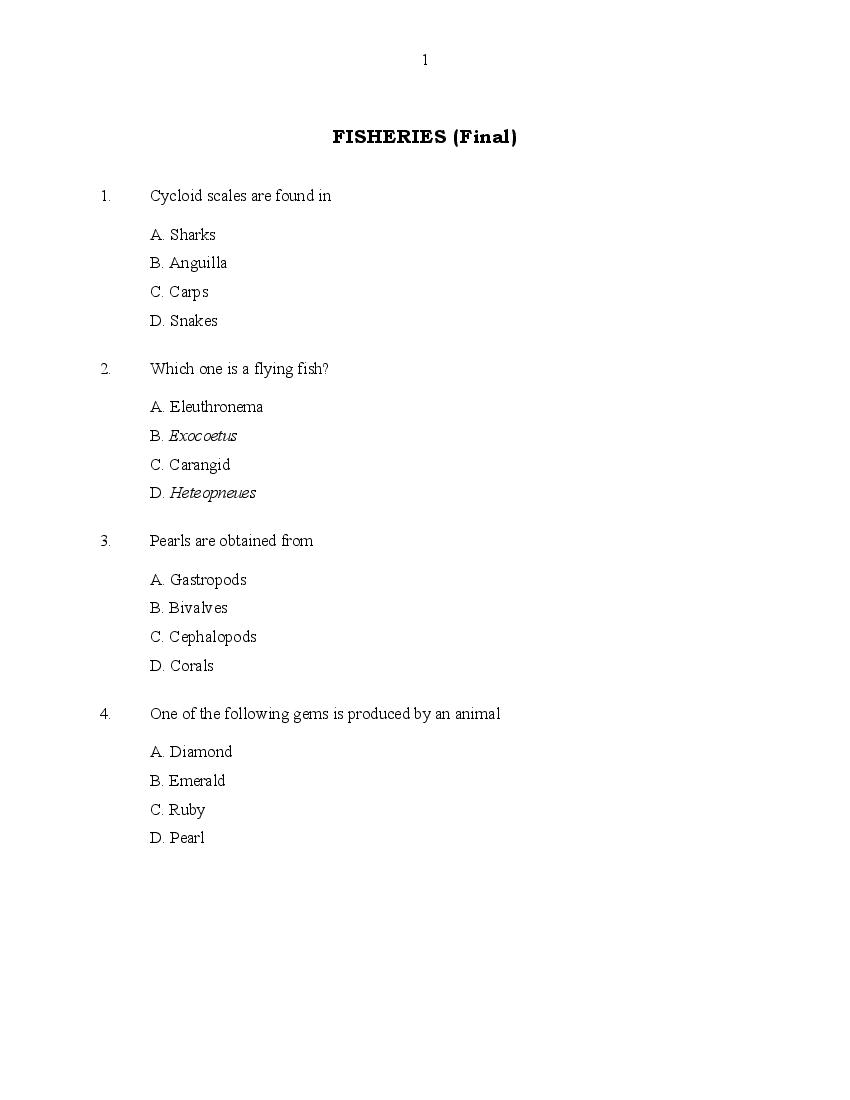
FISHERIES (Final)
1. Cycloid scales are found in
A. Sharks
B. Anguilla
C. Carps
D. Snakes
2. Which one is a flying fish?
A. Eleuthronema
B. Exocoetus
C. Carangid
D. Heteopneues
3. Pearls are obtained from
A. Gastropods
B. Bivalves
C. Cephalopods
D. Corals
4. One of the following gems is produced by an animal
A. Diamond
B. Emerald
C. Ruby
D. Pearl
Page 2
5. What is Aquaculture?
A. Culture of silkworm
B. Culture of tissues
C. Culture of aquatic plants and animals
D. Culture of bees
6. Animals which live at the bottom of the sea are called
A. Benthic
B. Pelagic
C. Lotic
D. Lentic
7. What is the function of Petasma?
A. Transfer the spermatophores
B. Protection
C. Transport eggs
D. Change its size
8. Eyestalkablation is done to induce the spawning of
A. Mullet
B. Shrimps
C. Chanos
D. Channa
9. Vitamin A is more in
A. Cod liveroil
B. Sunlight
C. Fish flesh
D. Seed
Page 3
10. Evler is the larva of
A. Eel
B. Murrel
C. Mullet
D. Channa
11. Heterocercal type of caudal fin is found in
A. Scorpion
B. Scoliodon
C. Eel
D. Tilapia
12. Which fish can produce electricity?
A. Narcine
B. Sardine
C. Mugil
D. Milkfish
13. Which is the primary cause of spoilage of fish?
A. Bacteria
B. Fungai
C. Protozoa
D. Virus
14. Which is also called ‘Pearl Spot’?
A. Tilapia
B. Clarias
C. Etroplus
D. Macropolies
Page 4
15. Mermaid purse is produced by
A. Shark
B. Tilapia
C. Etroplus
D. Chanos
16. ‘Roe’ is called
A. Sperm
B. Ovary of fish
C. Lung of fish
D. Vasdeferens of fish
17. Which one of the following is an ornamental fish?
A. Guppy
B. Trout
C. Tuna
D. Teapon
18. Which is called ‘Eagle ray’?
A. Clarias
B. Narcine
C. Myliobatus
D. Etroplus
19. ICAR is
A. Indian Council of Agricultural Research
B. Indian Coastal Aquacultural Research
C. Indian Council of Aquatic Research
D. Institute for Coastal Area Research
Page 5
20. Crustaceans release excess water through
A. Kidney
B. Chloride cells
C. Gills
D. Green glands
21. Which are called ‘Round mouthed fishes’?
A. Elasmobranchii
B. Teleostomes
C. Cyclostomata
D. None
22. What is the use of shark fin?
A. Medicine
B. Soup
C. Soap
D. Oil
23. Which is called as tiger prawn?
A. Penaeus indicus
B. Metapenaeus dobsoni
C. Penaeus monodon
D. Metapenaeus monoceros
24. What is a plankton?
A. Floating plants
B. Floating animals
C. Floating micro plants and animals
D. Free swimming organisms
Page 6
25. Elasmobranchi are
A. Bony fishes
B. Cartilaginous fishes
C. Jawless fishes
D. Flying fishes
26. Exoskeleton of crab is made up of
A. Calcium
B. Chitin
C. Phosphate
D. None of the above
27. The association between shark and sucker fish is referred to as
A. Mutualism
B. Commensalism
C. Symbiosis
D. Parasitism
28. Indicate the correct hierarchy
A. family, species, genus
B. genus, family, species
C. species, family, genus
D. family, genus, species
29. The larva of the prawn is
A. Pilidium
B. Trochophore
C. Zoea
D. Myotoxin
Page 7
30. Leeches hold on the …….. of fishes and suck their blood.
A. Skin
B. Heart
C. Liver
D. Brain
31. Fishes are able to detect odour with the help of
A. Scales
B. Olfactory rosette
C. Fins
D. Gills
32. Eyes are absent in ………….
A. Pelagic fishes
B. Benthic fishes
C. Cave fishes
D. Brackish water fishes
33. Fishes breathe by means of …………
A. Nose
B. Gills
C. Mouth
D. Skin
34. Agnatha are characterized by the absence of
A. Scales
B. Jaws
C. Fins
D. Eyes
Page 8
35. Ribbon fishes swim very actively by ………… movements of their body
A. Rotating
B. Undulating
C. Streaching
D. Forward
36. When slow progress is desired fishes use their …………
A. Fins
B. Head
C. Scales
D. Muscle
37. Anguili form type of movement is seen in …………
A. Eels
B. Sardines
C. Perches
D. Anchovies
38. Gill rakers help the fish in filtering …………
A. Air
B. Sand
C. Bacteria
D. Food materials
39. In the west coast of India ‘mud banks’ are formed during ………..
A. Summer
B. South west monsoon
C. North east monsoon
D. Winter
Page 9
40. Protected marine animals of India are included in
A. Schedule I
B. Schedule II
C. Schedule III
D. Schedule IV
41. The sole fishes are also called as
A. Blind fishes
B. Flat fishes
C. Black fishes
D. Thin fishes
42. Fishes lay eggs are commonly called as
A. Viviparous
B. Oviparous
C. Ovoviviparous
D. Vivioviparous
43. Trouts were imported to India by the
A. Americans
B. Europeans
C. Chinese
D. Arabs
44. The larvae of the fresh water muscle is
A. Bipinnaria
B. Zoea
C. Glochidia
D. Nauplius
Page 10
45. The first step in fertilization of a pond is the application
A. Fertilizer
B. Quick lime
C. Bordow mixture
D. Slacked lime
46. Fish leather is prepared from
A. Shark
B. Whales
C. Sea bass
D. Dolphin
47. “Typhlosole” is found in
A. Earthwarm
B. Amphioxus
C. Ascaris
D. Plannaria
48. Egg laying mammal is
A. Dog
B. Kangaroo
C. Platypus
D. Pigeon
49. Aquaculture process comes under?
A. Pond culture
B. Pen culture
C. Cage culture
D. All the above
Page 11
50. Best quality of pearl is
A. Button Pearl
B. Baroque Pearl
C. Blister Pearl
D. Lingha Pearl
51. In which country pearl culture originated?
A. India
B. China
C. Japan
D. Malaysia
52. Aeration is done in the aquarium?
A. To reduce the temperature
B. To increase the dissolved oxygen
C. For both the purposes
D. For none of these
53. Which of the following is a phytoplankton?
A. Noctiluca
B. Nauplius
C. Microcystis
D. Daphnia
54. The fish helpful in controlling mosquitoes is
A. Gambusia
B. Arius
C. Opiocephalus
D. All of these
Page 12
55. Corals are most closely related to
A. Barnacles
B. Sea anemones
C. Clams
D. Sea urchins
56. The sea fans belong to the……….
A. Order Gorgonacea
B. Phylum Porifera
C. Class Hydrozoa
D. Kingdom Protista
57. In temperature zones the thermocline will be most pronounced during?
A. Spring
B. Fall
C. Summer
D. Winter
58. The group of marine animals with largest number of species identified as threatened or
endangered is?
A. Fishes
B. Mollusks
C. Echinoderms
D. Mammals
59. Kelp lacks?
A. A stipe
B. A holdfast
C. Roots
D. Blades
Page 13
60. Each time a tidal current changes directions, there is a period of no current known as?
A. A flood current
B. An ebb current
C. A reversed current
D. A slack current
61. Which of the following occurs along a seashore as a result of a rise in seal level?
A. Marine terraces
B. Wave-cut beaches
C. Beach ridges
D. Sand bars
62. The primary process by which nutrients are returned to the surface waters is?
A. Heating of subsurface waters
B. Upwelling along coastlines
C. Subsidence where ocean currents meet
D. Dead organisms surfacing
63. The gas normally used to fill the SCUBA dive cylinders is/are?
A. Oxygen
B. Oxygen and nitrogen
C. Liquefied ammonia
D. Atmospheric air
64. The coral symbiont zooxanthellae is a
A. Dinoflagellate
B. Diatom
C. Bacteria
D. Fungi
Page 14
65. Which of the algae is responsible for the red colour of red sea?
A. Chlamydomonas brauii
B. Trichodesmium
C. Ulothrix zonata
D. Aspergillus niger
66. In chilled shrimp ………… is chiefly responsible for spoilage?
A. Achromobacter
B. Pseudomonas
C. Micrococcus
D. Molds
67. Who is known as Father of Indian Fisheries?
A. Frederick Nicholson
B. S. Jones
C. Francis Day
D. James Hornell
68. The head quarters of Central Inland Fisheries Research Institute is in
A. Bombay
B. Calcutta
C. Cochin
D. Barrackpore
69. Primary productivity is measured by using?
A. Radioactive tracers like C14
B. Radioactive K40
C. Radioactive iodine
D. Radioactive Cs137
Page 15
70. One nautical mile is equivalent to
A. 1.852 m
B. 18.52 km
C. 1.852 km
D. 1.072 km
71. Which colour is used to express the distress message in the vessel?
A. Green
B. Yellow or Light green
C. Orange or Red
D. White
72. Dolnet is used for catching
A. Tuna
B. Cat fish
C. Anchovies
D. Bombay duck
73. Species caught by pole and line fishing is
A. Tuna
B. Squid
C. Shrimp
D. Mackerel
74. ‘Trepang’ is
A. Processed sea cucumber
B. Processed sea urchin
C. Processed sea anemone
D. Processed jelly fish
Page 16
75. Pearl essence is prepared from
A. Crustacean shell waste
B. Fish scale
C. Fish liver
D. Shark fin
76. Ambergris is obtained from
A. Sperm whale
B. Shark
C. Fish scale
D. Oil sardine
77. Masmin is
A. Dried swim bladder of shark
B. Smoke cured tuna
C. Dried fish
D. Dried bonito sticks
78. Exploitation of a fish stock at right age is called as
A. Under fishing
B. Over fishing
C. Eumetric fishing
D. None
79. In tropical countries, the fish mature
A. Late
B. Seasonally
C. At the given time
D. Earlier
Page 17
80. Scales of elasombranch are
A. Ctenoid
B. Ganoid
C. Cycloid
D. Placoid
81. Climbing fish is
A. Anguilla
B. Labeo
C. Scoliodon
D. Anabas
82. Which is the most poisonous fish in the world?
A. Common stingray
B. Red neon
C. Japanese puffer fish
D. Deep sea fish
83. Number of gill slits present in Scoliodon is
A. 5 pairs
B. 8 pairs
C. 6 pairs
D. 7 pairs
84. Hard part used for age determination of fishes
A. Otolithus
B. Vertebrae
C. Scales
D. All the above
Page 18
85. The type specimen selected subsequent to the original description from one of the same
type is
A. Zeotype
B. Syntype
C. Holotype
D. None
86. Respiratory pigment in fishes is
A. Haemoglobin
B. Haemocyanin
C. Erythrocyanin
D. None
87. Purpose of tagging is
A. To study population parameter
B. Growth and age determination
C. To study the migratory pattern
D. All the above
88. A catadromous fish migrates from
A. River to sea
B. Sea to river
C. River to estuary
D. None
89. Young one of a fish is called
A. Nymph
B. Larva
C. Fry
D. None
Page 19
90. Cartilaginous fishes do not have
A. Operculum
B. Pelvic fins
C. Scales
D. Gill slits
91. Sting rays carry a poison sting on their
A. Mouth
B. Tail
C. Head
D. Fin
92. The generic name of the ‘flying fish’ is
A. Remora
B. Exocoetus
C. Hippocampus
D. Echeneis
93. Which of the following fish is famous for migration?
A. Salmon
B. Shark
C. Ribbon fish
D. Carp
94. Rampani net is used to catch
A. Mackerals
B. Sardines
C. Indian Salmon
D. None
Page 20
95. Intestine is long and coiled in
A. Carnivorous fish
B. Herbivorous fish
C. Omnivorous fish
D. None
96. Abundant blooms of Fragillaria oceanic indicates the presence of a particular fish
A. Sardine
B. Mackeral
C. Bombay duck
D. Tuna
97. The mud flat and saline swamps located in West Bengal is called
A. Bheries
B. Lagoon
C. Backwater
D. Embanked brackish water
98. Transparency of water is measured by
A. Hydrometer
B. Ecco sounder
C. Naphlometer
D. Secchi disc
99. Respiratory root found in mangrove is called
A. Tube feet
B. Pedaldisc
C. Pneumatophores
D. Osculum
Page 21
100. Ring shaped or horse – shoe shaped coral reefs are called
A. Fjords
B. Fringing reef
C. Atolls
D. Barrier reef
101. Neritic zone extends up to a depth of
A. 100 to 200 m
B. 50 to 200 m
C. 101 to 200 m
D. 0 to 200m
102. Which is the deemed university for fishery education in India?
A. CIFRI
B. CIFE
C. CIBA
D. CMFRI
103. Adayar and Vellar are the estuaries located in the
A. East Coast
B. West coast
C. North coast
D. South coast
104. “Mugger-Mukh” is a lagoon associated with
A. Kerala back water
B. Narmada estuary
C. Chilka Lake
D. Godavary estuary
Page 22
105. Pokkali is the term used for
A. Village pond
B. Kind of cage
C. Paddy field
D. Bhasabadha
106. The ratio between food consumed and weight gained by the body is expressed by
A. Food Conversion rate
B. Food Absorption rate
C. Food Consumption rate
D. Food Assimilation rate
107. The first Marine National Park came into existence at
A. Gulf of Manner
B. South Andaman
C. Gulf of Kutch
D. Lakshadweep Islands
108. Mesh size of phytoplankton sampling net is
A. 50 micron
B. 100 micron
C. 20 micron
D. 75 micron
109. Which is called ‘Portuguese Man of War?
A. Physalia
B. Cobra
C. Sea horse
D. Flying fish
Page 23
110. Male sea – horse carries the eggs
A. In its mouth
B. As a glutinous mass on the back
C. In its pouch
D. In its stomach
111. Fishes in the culture ponds come to the surface in the morning for want of
A. Oxygen
B. Food
C. Sunlight
D. Shade
112. Polyculture means
A. Culture of more than one variety of fish
B. Culture of fish in a pond
C. Culture of prawns in a pond
D. Culture of crabs in a pond
113. Vertical swimming with prehensile tail is the characteristic of
A. Top Minnows
B. Pipe fishes
C. Cornets
D. Flying fishes
114. The ‘Milk Fish’ belongs to the family
A. Chanidae
B. Mugilidae
C. Bagridae
D. Cichidae
Page 24
115. ‘Murrel’ or ‘Snake Head’ is the common name for
A. Mystus
B. Mugil
C. Channa
D. Chanos
116. ‘Pomfret’ is the common name for
A. Tuna
B. Stromateus
C. Perch
D. Harpadon
117. Which of the following is a ‘MOUTH-BREEDING’ Catfish?
A. Tachysurus
B. Tilapia
C. Plotosus
D. Wallago
118. ‘Bombay Duck’ is the common name of
A. Halosaur
B. Harpadon
C. Heteropneustes
D. Hara
119. Expand FAO
A. Food and Agricultural Organisation
B. Food and Aquaculture Organisation
C. Fish Administration Office
D. Fisheries Administration Organisation
Page 25
120. The giant freshwater prawn is
A. Macrobrachium malcomsonii
B. Macrobrachium gangeticum
C. Macrobrachium rosenbergii
D. Macrobrachiumr idea
121. Blue revolution is related to
A. Agriculture
B. Fisheries
C. Horticulture
D. Poultry
122. On the basis of salinity, aquaculture system can be classified as
A. Freshwater aquaculture
B. Brackishwater aquaculture
C. Marinewater aquaculture
D. All of the above
123. The largest mangrove area occur in
A. Singapore
B. Australia
C. Indonesia
D. Malaysia
124. Largest mangrove area in India
A. West Bengal
B. Gujarat
C. Kerala
D. Tamil Nadu
Page 26
125. Most productive areas of the world oceans
A. Benthic areas
B. Upwelling areas
C. Surface areas
D. Subsurface areas
126. India’s largest lake is
A. Chilika lake
B. Vembanad lake
C. Pulicat lake
D. Kolleru lake
127. World’s largest Ocean
A. Arctic Ocean
B. Indian Ocean
C. Pacific Ocean
D. Atlantic Ocean
128. The Himalayan rivers are
A. Ganga
B. Indus
C. Brahmaputra
D. All of the above
129. India’s largest Estuary
A. Baga creek
B. Chilka
C. Hooghly Matlah
D. Thane creek
Page 27
130. In India, which of the following states comprised longest coastline area?
A. Gujarat
B. Maharashtra
C. Tamil Nadu
D. West Bengal
131. Mackerel mainly feed on
A. Dinoflagellates
B. Diatoms
C. Zooplankton
D. Blue Green Algae
132. In India, EEZ is extended up to ______ nautical mile
A. 12
B. 200
C. 212
D. 400
133. Quality of fish can be assessed by
A. Peroxide value
B. Vitamin C
C. Glucose
D. Arginine
134. Which one is the cheapest method of fish preservation?
A. Sun drying
B. Pit curing
C. Colombo curing
D. None of the above
Page 28
135. Reproductive function can be controlled by
A. Insulin
B. Thyroxin
C. Adrenalin
D. Hypothalamus
136. A fish has no
A. Tail
B. Neck
C. Head
D. Trunk
137. In fishes, heart comprise of
A. 1 auricle and 1 ventricle
B. 2 auricles and 2 ventricles
C. 2 auricles and 1 ventricle
D. 1 auricle and 2 ventricles
138. Fish change its direction suddenly by
A. Pelvic fins
B. Caudal fin
C. Pectoral fins
D. All of the above
139. Which is the most powerful electric fish in the world?
A. Northern Pike
B. Electric catfish
C. Electric eel
D. Black Torpedo Ray
Page 29
140. Which one of the following is slowest moving marine fish?
A. Cod fish
B. Hag fish
C. Sea horse
D. Bombay duck
141. Which is the largest fish in the world?
A. Grey shark
B. Whale shark
C. Basking shark
D. Japanese Horn shark
142. In a sucker fish, the sucker is the modification of
A. Mouth
B. Gill slit
C. Dorsal fin
D. Ventral fin
143. Smallest shark is
A. Hammer headed shark
B. Carpet shark
C. Grey shark
D. Dog fish
144. Larvae of sea cucumber is
A. Alevin
B. Bipinaria
C. Trochopore
D. Auricularia
Page 30
145. The copulatory organ in shark is
A. Cloacal aperture
B. Claspers
C. Anal fins
D. Gill slit
146. A male mate with several females is called
A. Monogamy
B. Polygamy
C. Polyandry
D. Monoyandry
147. A female mate with several males
A. Monogamy
B. Polygamy
C. Polyandry
D. Monoyandry
148. The fusion of male and female gametes to form zygote is called as
A. Ovulation
B. Spermiation
C. Blastulation
D. Fertilization
149. The __________ fish is the most prized table fish in West Bengal
A. Mackerel
B. Lady fish
C. Catfish
D. Hilsa
Page 31
150. Species caught by jig line fishing
A. Squid
B. Tuna
C. Cuttle fish
D. None of the above
***
Document Details
| Board / Org | Cochin University |
| Exam | CUSAT Common Admission Test |
| Type | Question Paper |
| Pages | 31 |
| Updated | 22 Jul 2026 |