DUET 2021 Question Paper Ph.D in Genetics
Finished viewing? Save it for later —
Download DUET 2021 Question Paper Ph.D in Genetics (PDF · 8 pages)About DUET 2021 Question Paper Ph.D in Genetics
DUET 2021 Question Paper Ph.D in Genetics is available here for free download. Published by NTA for DUET, this question paper can be viewed online or downloaded as a PDF (8 pages). Candidates preparing for DUET can use DUET 2021 Question Paper Ph.D in Genetics to understand the exam pattern, the type of questions asked, and the overall difficulty level.
Frequently Asked Questions
How can I download DUET 2021 Question Paper Ph.D in Genetics?
Open this page and click the Download button to save DUET 2021 Question Paper Ph.D in Genetics as a PDF. It is completely free on AglaSem Docs.
Is DUET 2021 Question Paper Ph.D in Genetics free to download?
Yes. DUET 2021 Question Paper Ph.D in Genetics can be viewed online and downloaded as a PDF free of cost on AglaSem Docs.
How many pages does DUET 2021 Question Paper Ph.D in Genetics have?
DUET 2021 Question Paper Ph.D in Genetics contains 8 pages, which you can read online or download together as a single PDF.
Where can I find more DUET study material?
You can find more DUET question papers, sample papers, syllabus, and answer keys on AglaSem Docs.
DUET 2021 Question Paper Ph.D in Genetics – Text
Read the full text of this question paper below — useful to quickly search, copy and reference the content online without downloading the PDF.
📄 View text version (8 pages)
Page 1
Topic:‐ GENETICS PHD
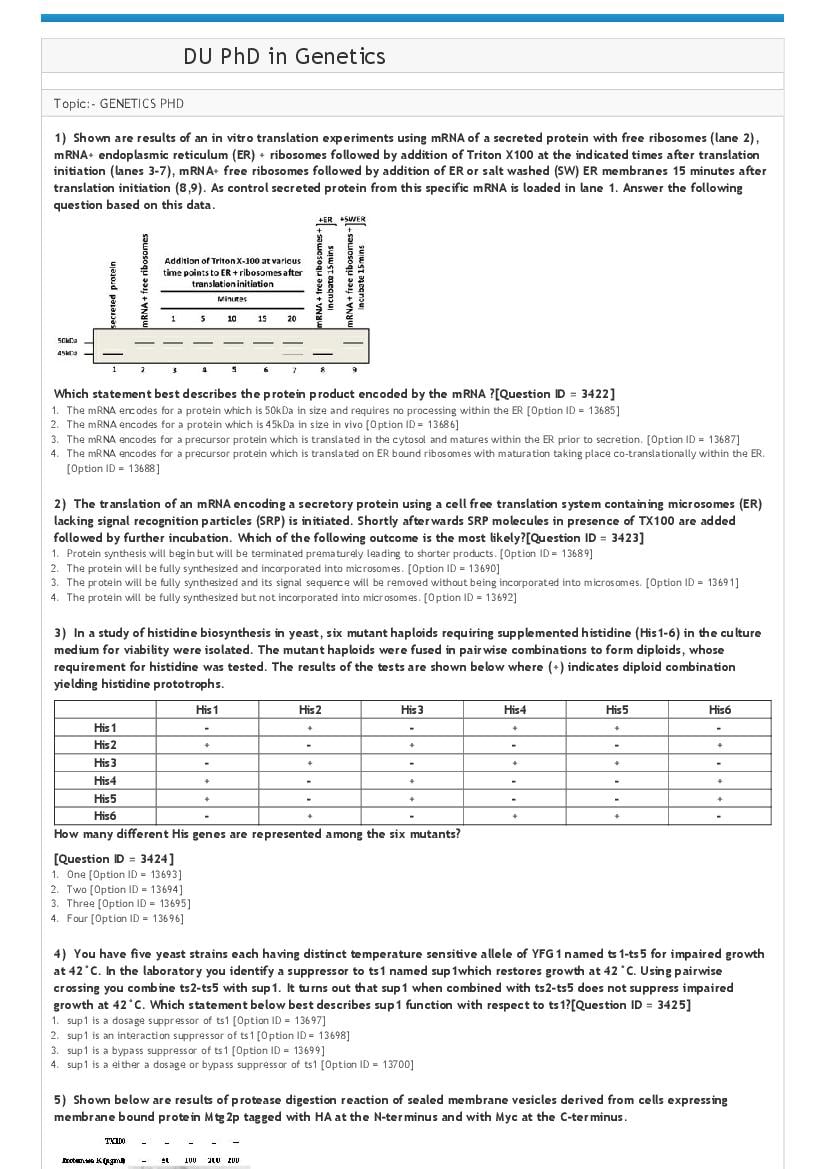
1) Shown are results of an in vitro translation experiments using mRNA of a secreted protein with free ribosomes (lane 2),
mRNA+ endoplasmic reticulum (ER) + ribosomes followed by addition of Triton X100 at the indicated times after translation
initiation (lanes 3‐7), mRNA+ free ribosomes followed by addition of ER or salt washed (SW) ER membranes 15 minutes after
translation initiation (8,9). As control secreted protein from this specific mRNA is loaded in lane 1. Answer the following
question based on this data.
Which statement best describes the protein product encoded by the mRNA ?[Question ID = 3422]
1. The mRNA encodes for a protein which is 50kDa in size and requires no processing within the ER [Option ID = 13685]
2. The mRNA encodes for a protein which is 45kDa in size in vivo [Option ID = 13686]
3. The mRNA encodes for a precursor protein which is translated in the cytosol and matures within the ER prior to secretion. [Option ID = 13687]
4. The mRNA encodes for a precursor protein which is translated on ER bound ribosomes with maturation taking place co‐translationally within the ER.
[Option ID = 13688]
2) The translation of an mRNA encoding a secretory protein using a cell free translation system containing microsomes (ER)
lacking signal recognition particles (SRP) is initiated. Shortly afterwards SRP molecules in presence of TX100 are added
followed by further incubation. Which of the following outcome is the most likely?[Question ID = 3423]
1. Protein synthesis will begin but will be terminated prematurely leading to shorter products. [Option ID = 13689]
2. The protein will be fully synthesized and incorporated into microsomes. [Option ID = 13690]
3. The protein will be fully synthesized and its signal sequence will be removed without being incorporated into microsomes. [Option ID = 13691]
4. The protein will be fully synthesized but not incorporated into microsomes. [Option ID = 13692]
3) In a study of histidine biosynthesis in yeast, six mutant haploids requiring supplemented histidine (His1‐6) in the culture
medium for viability were isolated. The mutant haploids were fused in pairwise combinations to form diploids, whose
requirement for histidine was tested. The results of the tests are shown below where (+) indicates diploid combination
yielding histidine prototrophs.
His1 His2 His3 His4 His5 His6
His1 ‐ + ‐ + + ‐
His2 + ‐ + ‐ ‐ +
His3 ‐ + ‐ + + ‐
His4 + ‐ + ‐ ‐ +
His5 + ‐ + ‐ ‐ +
His6 ‐ + ‐ + + ‐
How many different His genes are represented among the six mutants?
[Question ID = 3424]
1. One [Option ID = 13693]
2. Two [Option ID = 13694]
3. Three [Option ID = 13695]
4. Four [Option ID = 13696]
4) You have five yeast strains each having distinct temperature sensitive allele of YFG1 named ts1‐ts5 for impaired growth
at 42°C. In the laboratory you identify a suppressor to ts1 named sup1which restores growth at 42°C. Using pairwise
crossing you combine ts2‐ts5 with sup1. It turns out that sup1 when combined with ts2‐ts5 does not suppress impaired
growth at 42°C. Which statement below best describes sup1 function with respect to ts1?[Question ID = 3425]
1. sup1 is a dosage suppressor of ts1 [Option ID = 13697]
2. sup1 is an interaction suppressor of ts1 [Option ID = 13698]
3. sup1 is a bypass suppressor of ts1 [Option ID = 13699]
4. sup1 is a either a dosage or bypass suppressor of ts1 [Option ID = 13700]
5) Shown below are results of protease digestion reaction of sealed membrane vesicles derived from cells expressing
membrane bound protein Mtg2p tagged with HA at the N‐terminus and with Myc at the C‐terminus.
Page 2
1. N‐terminus faces the cytosol and C‐terminus faces the lumen of the membrane vesicle [Option ID = 13701]
2. C‐terminus faces the cytosol and N‐terminus faces the lumen of the membrane vesicle [Option ID = 13702]
3. N‐terminus and C‐terminus both face the lumen of the membrane vesicle [Option ID = 13703]
4. N‐terminus and C‐terminus both face the cytosol [Option ID = 13704]
6) You have a mixture of three proteins having molecular weights 40kDa, 150kDa and 250kDa respectively. You separate
them on a size exclusion column packed in such a manner that proteins greater than 300kDa elute in the void volume. What
below best describes the elution order of the three proteins?[Question ID = 3427]
1. 40kDa followed by 150kDa followed by 250kDa [Option ID = 13705]
2. 250kDa followed by 150kDa followed by 40kDa [Option ID = 13706]
3. 250kDa followed by 40kDa followed by 150kDa [Option ID = 13707]
4. 40kDa and 150kDa in the same fraction followed by 250kDa [Option ID = 13708]
7) Mitochondrial membrane fractions were treated with either Tris‐Cl buffer pH 8.0 or Tris‐Cl buffer pH 8.0 containing 1M
NaCl. Soluble (S) and pellet (P) fractions were separated by centrifugation and probed for presence of Mtg2p. Shown below
are results.
Which statement below best describes the interaction of Mtg2p with the mitochondrial membrane?[Question ID = 3428]
1. Mtg2p is an integral membrane protein of the mitochondria [Option ID = 13709]
2. Mtg2p is a peripheral membrane protein [Option ID = 13710]
3. Mtg2p is partially imbedded in the inner mitochondrial membrane [Option ID = 13711]
4. Mtg2p is a soluble matrix protein [Option ID = 13712]
8) The following experiment was carried out to identify the different regulatory elements present in a promoter. Three
different mutated promoter (X, Y and Z) were developed where different regions were mutated as indicated by filled
regions in the figure below. The promoter was cloned upstream to a reporter gene and the activity of the mutated
promoters studied in a cell line. The wild type (WT) promoter was used as a control. The activity of the wild type and the
mutant promoters are mentioned in the figure below:
Based on the above observations, which one of the following options represents the correct conclusions?
[Question ID = 3429]
1. In promoter X binding site for a positive regulator is mutated, in promoter Y binding site for a negative regulator is mutated and in promoter Z
binding site for RNA polymerase is mutated.
[Option ID = 13713]
2. In promoter X the binding site for RNA polymerase is mutated, in promoter Y binding site for a negative regulator is mutated and in promoter Z
binding site for a positive regulator is mutated.
[Option ID = 13714]
3. In promoter X the binding site for RNA polymerase is mutated, in promoter Y binding site for a positive regulator is mutated and in promoter Z
binding site for a negative regulator is mutated.
[Option ID = 13715]
4. In promoter X binding site for a negative regulator is mutated, in promoter Y binding site for a positive regulator is mutated and in promoter Z
binding site for RNA polymerase is mutated.
[Option ID = 13716]
9) Mendel in his experiment observed that round seed phenotype was dominant to wrinkled seed. In order to distinguish
Page 3
progeny. Fast forward to 1990, scientists had identified that insertion of a transposable element leads to wrinkled
phenotype. When the gene responsible for round and wrinkled seed shape is isolated and run on a gel, the pattern
observed is shown in figure ‘a’ below. In 2016 a geneticist crosses two pea plants and screens the progeny for gene
responsible for round and wrinkled seed shape. The profile of DNA bands obtained are shown in figure b. The number of
progeny with each profile are also indicated on top.
Which one of the following options correctly predicts the genotype of the two parents that were crossed by the geneticist in
2016 and identifies the nature of the DNA markers?[Question ID = 3430]
1. Rr X rr; dominant [Option ID = 13717]
2. Rr X rr; co‐dominant [Option ID = 13718]
3. Rr X RR; dominant [Option ID = 13719]
4. Rr X RR; co‐dominant [Option ID = 13720]
10) Mammalian cell cultures were treated with chloramphenicol for 30 minutes prior to addition 35S‐methionine. What
molecular entity will NOT be labelled?[Question ID = 3431]
1. Proteins in peroxisomes [Option ID = 13721]
2. Proteins in cytosol [Option ID = 13722]
3. Proteins in lysosome [Option ID = 13723]
4. Proteins in mitochondria [Option ID = 13724]
11) A cell lysate was solubilized in presence of non‐ionic detergent and treated with Endo H which cleaves N‐linked
glycosyl moieties. Shown below are western blots with antibodies to integral membrane protein IMP1, containing multiple N‐
linked glycosyl sites in absence or presence of Endo H. Which statement below DOES NOT accurately describe the cellular
localization of IMP1?
[Question ID = 3432]
1. IMP1 is an ER resident protein [Option ID = 13725]
2. IMP1 is a Golgi resident protein [Option ID = 13726]
3. IMP1 traffics from ER to Golgi and back [Option ID = 13727]
4. IMP1 is plasma membrane protein [Option ID = 13728]
12) On discovery of a virus with a circular dsDNA of approximately 10,000bp, its map was constructed by digesting the DNA with
various restriction endonucleases. The following results were obtained:
Endonuclease Length of fragments (kb)
EcoRI 6.9 , 3.1
HindIII 4.4, 5.1, 0.5
BamHI 10.0
EcoRI + HindIII 3.6, 3.3, 1.1,1.5, 0.5
EcoRI + BamHI 5.1, 3.1, 1.8
HindIII + BamHI 4.4, 3.3, 1.8,0.5
EcoRI + HindIII +BamHI 3.3, 1.8, 1.5, 1.1,0.5
Which of the following maps correctly represents the observations?
[Question ID = 3433]
1.
Page 4
2.
[Option ID = 13730]
3.
[Option ID = 13731]
4.
[Option ID = 13732]
13) You wish to amplify the region in CAPS below using PCR.
5'gagatcaggacttaGATTACAGATTACAGATTACAGATTACAacttggccc3' Select the correct set of 8bp primer pair:
[Question ID = 3434]
1. 5'AGGACTTA3' and 5'GGCCAAGT3'
[Option ID = 13733]
2. 5'TAAGTCCT3' and 5'ACTTGGCC3'
[Option ID = 13734]
3. 5'AGGACTTA3' and 5'ACTTGGCC3'
[Option ID = 13735]
4. 5'AGGACTTA3' and 5'TGAACCGG3'
[Option ID = 13736]
14) You want to express recombinant human insulin protein in E. coli. You are given a clone containing the pig insulin gene
and human pancreatic tissue. Listed below are steps that are required.
A. isolate mRNA from human pancreas
B. probe cDNA library with cloned pig insulin gene
C. select positive clones that hybridize to the cloned pig insulin gene
D. using reverse transcriptase, make cDNA
E. express recombinant human insulin in E. coli
F. clone cDNAs into expression vector to make library
Choose the correct answer from the options given below
[Question ID = 3435]
1. A, E, C, B, D F
[Option ID = 13737]
2. B, D, A, F, E C
[Option ID = 13738]
3. A, D, B, F, E C
[Option ID = 13739]
4. A, D, F, B, C, E
Page 5
15) A PCR reaction that continues for 30 cycles will produce approximately how many PCR products from a single template
DNA molecule?[Question ID = 3436]
1. 64 [Option ID = 13741]
2. 128,000 [Option ID = 13742]
3. Approximately 1 million [Option ID = 13743]
4. Approximately 1 billion [Option ID = 13744]
16) A plasmid is digested with EcoRI (5’ G/AATTC 3’) to linearize it at a cloning site and a DNA fragment is digested with
KpnI (5’ GGTAC/C 3’) for cloning. Both the vector and the DNA fragment is treated with Klenow enzyme and four dNTP
substrates to make them blunt ends following which they are ligated. Which one of the following represents the sequence
at the ligated junction (at the point of ligation between blunt‐ended EcoRI and KpnI ?[Question ID = 3437]
1. 5’ GGTACC 3’ [Option ID = 13745]
2. 5’ GAATTC 3’ [Option ID = 13746]
3. 5’ GAATTGTACC 3’ [Option ID = 13747]
4. 5’ CTTAACATGG 3’ [Option ID = 13748]
17) For a 96mCi radioactive sample with a half‐life of 2.7 days, how many days later will 6mCi of sample be left?[Question
ID = 3438]
1. 2.7 days [Option ID = 13749]
2. 5.4 days [Option ID = 13750]
3. 8.1 days [Option ID = 13751]
4. 10.8 days [Option ID = 13752]
18) Among the statements below which least describes the nature of mutagenic mechanism by nitrous acid and 5 bromo‐
uracil.[Question ID = 3439]
1. Nitrous acid and 5‐bromo‐uracil both are chemical mutagens [Option ID = 13753]
2. Nitrous acid and 5‐bromo‐uracil both lead to transitions [Option ID = 13754]
3. Nitrous acid and 5‐bromo‐uracil act only on replicating DNA [Option ID = 13755]
4. Nitrous acid acts via oxidative deamination of bases and 5‐bromo‐uracil is a thymine analog. [Option ID = 13756]
19) Inactivation by mutation of which gene within the E. coli lactose operon would lead to its constitutive expression.
[Question ID = 3440]
1. Promoter
[Option ID = 13757]
2. Structural gene z
[Option ID = 13758]
3. Operator
[Option ID = 13759]
4. Structural gene y
[Option ID = 13760]
20) You want to make a 100ml solution of 0.1N MgCl2. You are provided with a 1N stock solution of MgCl2. The volume of
H20 and the stock MgCl2 that’ll needed to be mixed is
[Question ID = 3441]
1. 90ml H20 + 10ml MgCl2
[Option ID = 13761]
2. 99ml H20 + 1ml MgCl2
[Option ID = 13762]
3. 100ml H20 + 10ml MgCl2
[Option ID = 13763]
4. 9ml H20 + 91ml MgCl2
[Option ID = 13764]
21) Given that husband and wife are both heterozygous for a recessive allele for albinism. If they have dizygotic twins, the
probability that both the twins will have the same phenotype for pigmentation will be[Question ID = 3442]
1. 0.625 [Option ID = 13765]
2. 0.25 [Option ID = 13766]
3. 0.75 [Option ID = 13767]
4. 0.0625 [Option ID = 13768]
22) If the recombination frequency between X‐Y loci is 12, X‐Z loci is 4, and Y‐Z loci is 8 , then the order of the loci on the
chromosome is[Question ID = 3443]
1. X‐Y‐Z [Option ID = 13769]
2. Y‐X‐Z [Option ID = 13770]
3. X‐Z‐Y [Option ID = 13771]
4. Z‐Y‐X [Option ID = 13772]
Page 6
genotypes and phenotypes are possible?
[Question ID = 3444]
1. 3 genotypes; 4 phenotypes
[Option ID = 13773]
2. 4 genotypes; 4 phenotypes
[Option ID = 13774]
3. 3 genotypes; 3 phenotypes
[Option ID = 13775]
4. 4 genotypes; 3 phenotypes
[Option ID = 13776]
24) For a given genotype (AA), a diploid cell at metaphase will have:[Question ID = 3445]
1. 2 copies of the alleles on 2 chromosomes [Option ID = 13777]
2. 4 copies of the alleles on 2 chromosomes [Option ID = 13778]
3. 2 copies of the alleles on 4 chromosomes [Option ID = 13779]
4. 4 copies of the alleles on 4 chromosomes [Option ID = 13780]
25) You transcribe mRNA from a DNA sample and purify it. You then separate the two strands of the DNA and analyse the
base composition of each strand and that of the mRNA. You obtain the data shown in the table below. Which strand of the
DNA is serving as a template for mRNA synthesis?
A G C T U
DNA Stand 1 19.1 26.0 31.0 23.9 0
DNA Stand 2 24.2 30.8 25.7 19.3 0
mRNA Stand 19.0 25.9 30.8 0 24.3
[Question ID = 3446]
1. Strand 1 [Option ID = 13781]
2. Strand 2 [Option ID = 13782]
3. Either of the strand [Option ID = 13783]
4. Need to know the position of the promoter [Option ID = 13784]
26) A mutant of E coli with heat sensitive DNA Ligase ( 22°C permissive , 37°C restrictive ) has been used to show that the
DNA synthesis is discontinuous. Examination of DNA replication in the presence of [3H]–Thymidine in the mutant would
demonstrate the accumulation of short fragments of
[Question ID = 3447]
1. unlabelled DNA at 22°C and at 37°C
[Option ID = 13785]
2. unlabelled DNA at 22°C but not at 37°C
[Option ID = 13786]
3. radioactive DNA at 37°C but not at 22°C
[Option ID = 13787]
4. radioactive DNA at 22° C but not at 37°C
[Option ID = 13788]
27) Which one of the following histones is required to achieve the solenoid structure of chromatin?[Question ID = 3448]
1. H1 [Option ID = 13789]
2. H2A [Option ID = 13790]
3. H3 [Option ID = 13791]
4. H4 [Option ID = 13792]
28) Which one of the following proteins is required for establishment of monopolar attachment of sister kinetochores during
meiosis?[Question ID = 3449]
1. Rec8 [Option ID = 13793]
2. SCC1 [Option ID = 13794]
3. Separase [Option ID = 13795]
4. SMC3 [Option ID = 13796]
29) Which one of the following parts of the brain functions as the primary respiratory control center?[Question ID = 3450]
1. Hypothalamus [Option ID = 13797]
2. Medulla oblongata [Option ID = 13798]
3. Basal ganglia [Option ID = 13799]
4. Substantia nigra [Option ID = 13800]
30) Which one of the following disorders manifests due to defects in nucleotide excision repair?[Question ID = 3451]
1. Hereditary nonpolyposis colorectal cancer (HNPCC) [Option ID = 13801]
2. Xeroderma pigmentosum (XP) [Option ID = 13802]
3. Lynch syndrome [Option ID = 13803]
Page 7
31) Which of the following is a bypass repair system:[Question ID = 3452]
1. Base excision repair [Option ID = 13805]
2. Nucleotide excision repair [Option ID = 13806]
3. SOS repair [Option ID = 13807]
4. Recombinational repair [Option ID = 13808]
32) The spatial distribution of mRNA’s in a cell can be detected by:[Question ID = 3453]
1. Immunofluorescence [Option ID = 13809]
2. Northern blot hybridization [Option ID = 13810]
3. Dot blot hybridization [Option ID = 13811]
4. Fluorescent in situ hybridization [Option ID = 13812]
33) Matrix assisted laser desorption ionization time of flight (MALDI‐TOF) spectrometry is most useful for predicting which of
the following?[Question ID = 3454]
1. Isoelectric point [Option ID = 13813]
2. Secondary structure [Option ID = 13814]
3. Molecular mass [Option ID = 13815]
4. Three‐dimensional structure [Option ID = 13816]
34) Which of the following techniques CANNOT be utilized to demonstrate Protein:Protein interaction?[Question ID = 3455]
1. Florescence resonance energy transfer (FRET) [Option ID = 13817]
2. Co‐immunoprecipitation [Option ID = 13818]
3. Yeast three hybrid assay [Option ID = 13819]
4. Yeast two hybrid assay [Option ID = 13820]
35) Cyclins facilitate progression of cell cycle by:[Question ID = 3456]
1. Activating the protein kinases which are critical regulators of cell division. [Option ID = 13821]
2. Directly activating G proteins which in turn affects the protein kinases [Option ID = 13822]
3. Increasing the production of DNA polymerases so cells can enter into G2 phase. [Option ID = 13823]
4. Inducing synthesis of constitutively active forms of growth cell receptors to trigger signalling cascades. [Option ID = 13824]
36) Translation repression does not include:[Question ID = 3457]
1. decapping enzymes. [Option ID = 13825]
2. molecules that target the eukaryotic initiation factors (eIFs). [Option ID = 13826]
3. ribonucleotide sequences and structural motifs within the mRNA template. [Option ID = 13827]
4. specific and nonspecific mRNA‐binding proteins. [Option ID = 13828]
37) A patient has an abnormal karyotype exhibiting 3 copies of chromosome 21. This chromosomal anomaly most likely arose
from an error during the following stage of cell cycle:[Question ID = 3458]
1. Mitosis [Option ID = 13829]
2. Cytokinesis [Option ID = 13830]
3. Meiosis I [Option ID = 13831]
4. Interphase [Option ID = 13832]
38) The development of the antero‐posterior axis of Drosophila is initiated when:
[Question ID = 3459]
1. the mother contributes and packages bicoid and nanos mRNA into the developing oocyte
[Option ID = 13833]
2. the terminal group protein Torso sets up the anterior and posterior poles of the embryo
[Option ID = 13834]
3. The homeotic genes specify the fate of individual segments
[Option ID = 13835]
4. The sperm enters the micropile at the anterior end, thus specifying the antero‐posterior axis
[Option ID = 13836]
39) Plasmid vectors used in cloning often contain a gene for the N‐terminal 146 amino acids of the enzyme β‐galactosidase.
What is the purpose of including this gene in the vector?[Question ID = 3460]
1. Allow plasmid replication [Option ID = 13837]
2. Allow resistant transformants to grow in the selective medium [Option ID = 13838]
3. Screen for recombinant vectors with inserts [Option ID = 13839]
4. Allow plasmid conjugation [Option ID = 13840]
40) The unusual property of Taq polymerase that is critical to the PCR is its[Question ID = 3461]
1. ability to use dNTPs as substrate [Option ID = 13841]
2. thermostability [Option ID = 13842]
3. ability to synthesize DNA in the 3’ to 5’ direction [Option ID = 13843]
4. ability to use RNA as a template [Option ID = 13844]
41) Which of the following amino acids are incorrectly grouped based on their side chain polarity properties?[Question ID =
Page 8
1. Methionine, Cysteine, Serine [Option ID = 13845]
2. Arginine, Lysine, Proline [Option ID = 13846]
3. Phenylalanine, Tyrosine, Tryptophan [Option ID = 13847]
4. Isoleucine, Leucine, Alanine [Option ID = 13848]
42) Which one of the following listed processes below starts from 3՛ to 5՛ direction?[Question ID = 3463]
1. Polyadenylation [Option ID = 13849]
2. Translation [Option ID = 13850]
3. Trans‐splicing [Option ID = 13851]
4. mRNA editing [Option ID = 13852]
43) Access of transcription factors to DNA is usually influenced by:[Question ID = 3464]
1. acetylation of histones in the euchromatin [Option ID = 13853]
2. sumoylation of histones in the euchromatin [Option ID = 13854]
3. acetylation of DNA in the euchromatin [Option ID = 13855]
4. phosphorylation of CTD of Rpb1 in RNA polymerase II [Option ID = 13856]
44) This amino acid is NOT yet found in proteins?[Question ID = 3465]
1. L‐lysine [Option ID = 13857]
2. Selenocysteine [Option ID = 13858]
3. D‐lysine [Option ID = 13859]
4. Pyrrolysine [Option ID = 13860]
45) A protective mechanism in a eukaryotic cell that destroys mRNA leading to its reduced expression via a dsRNA with the
same sequence is:[Question ID = 3466]
1. Nonsense mediated decay. [Option ID = 13861]
2. RNA interference. [Option ID = 13862]
3. Proteasome. [Option ID = 13863]
4. CRISPR. [Option ID = 13864]
46) When a culture of bacteria is shifted to high temperatures, the heat shock response is triggered by:[Question ID =
3467]
1. a sensor protein on the ribosome. [Option ID = 13865]
2. specific sigma factors. [Option ID = 13866]
3. removal of a repressor protein. [Option ID = 13867]
4. a conversion of a repressor protein to an activator protein. [Option ID = 13868]
47) RISC mediates all of the following aspects of RNA interference EXCEPT:[Question ID = 3468]
1. Binding dsRNA [Option ID = 13869]
2. Chopping up dsRNA [Option ID = 13870]
3. Degrading mRNA [Option ID = 13871]
4. Unwinding dsRNA [Option ID = 13872]
48) An alpha helical conformation of a globular protein in solution is best determined by which of the following?[Question ID
= 3469]
1. Fluorescence spectroscopy [Option ID = 13873]
2. Circular Dichroism [Option ID = 13874]
3. Analytical centrifugation [Option ID = 13875]
4. NMR spectroscopy [Option ID = 13876]
49) Which is the common terminology used for the enzymes which activate or inactivate other proteins by phosphorylating
them?[Question ID = 3470]
1. Protein phosphatase [Option ID = 13877]
2. Protein kinase [Option ID = 13878]
3. Maturation promoting factors (MPF) [Option ID = 13879]
4. Cyclin [Option ID = 13880]
50) You are testing a new plant products “A” as potential new therapeutics in cultured human cells to arrest the cell
division at the S phase of the cell cycle. Which of the following is the most likely the target of molecule “A”?[Question ID =
3471]
1. A topoisomerase [Option ID = 13881]
2. The G1 cyclin‐CDK enzyme [Option ID = 13882]
3. The anaphase‐promoting complex (APC) [Option ID = 13883]
4. An RNA ligase [Option ID = 13884]
Document Details
| Board / Org | NTA |
| Exam | DUET |
| Type | Question Paper |
| Pages | 8 |
| Language | english |
| Updated | 30 Apr 2026 |