DUET 2021 Question Paper Ph.D in Home Science
Finished viewing? Save it for later —
Download DUET 2021 Question Paper Ph.D in Home Science (PDF · 10 pages)About DUET 2021 Question Paper Ph.D in Home Science
DUET 2021 Question Paper Ph.D in Home Science is available here for free download. Published by NTA for DUET, this question paper can be viewed online or downloaded as a PDF (10 pages). Candidates preparing for DUET can use DUET 2021 Question Paper Ph.D in Home Science to understand the exam pattern, the type of questions asked, and the overall difficulty level.
Frequently Asked Questions
How can I download DUET 2021 Question Paper Ph.D in Home Science?
Open this page and click the Download button to save DUET 2021 Question Paper Ph.D in Home Science as a PDF. It is completely free on AglaSem Docs.
Is DUET 2021 Question Paper Ph.D in Home Science free to download?
Yes. DUET 2021 Question Paper Ph.D in Home Science can be viewed online and downloaded as a PDF free of cost on AglaSem Docs.
How many pages does DUET 2021 Question Paper Ph.D in Home Science have?
DUET 2021 Question Paper Ph.D in Home Science contains 10 pages, which you can read online or download together as a single PDF.
Where can I find more DUET study material?
You can find more DUET question papers, sample papers, syllabus, and answer keys on AglaSem Docs.
DUET 2021 Question Paper Ph.D in Home Science – Text
Read the full text of this question paper below — useful to quickly search, copy and reference the content online without downloading the PDF.
📄 View text version (10 pages)
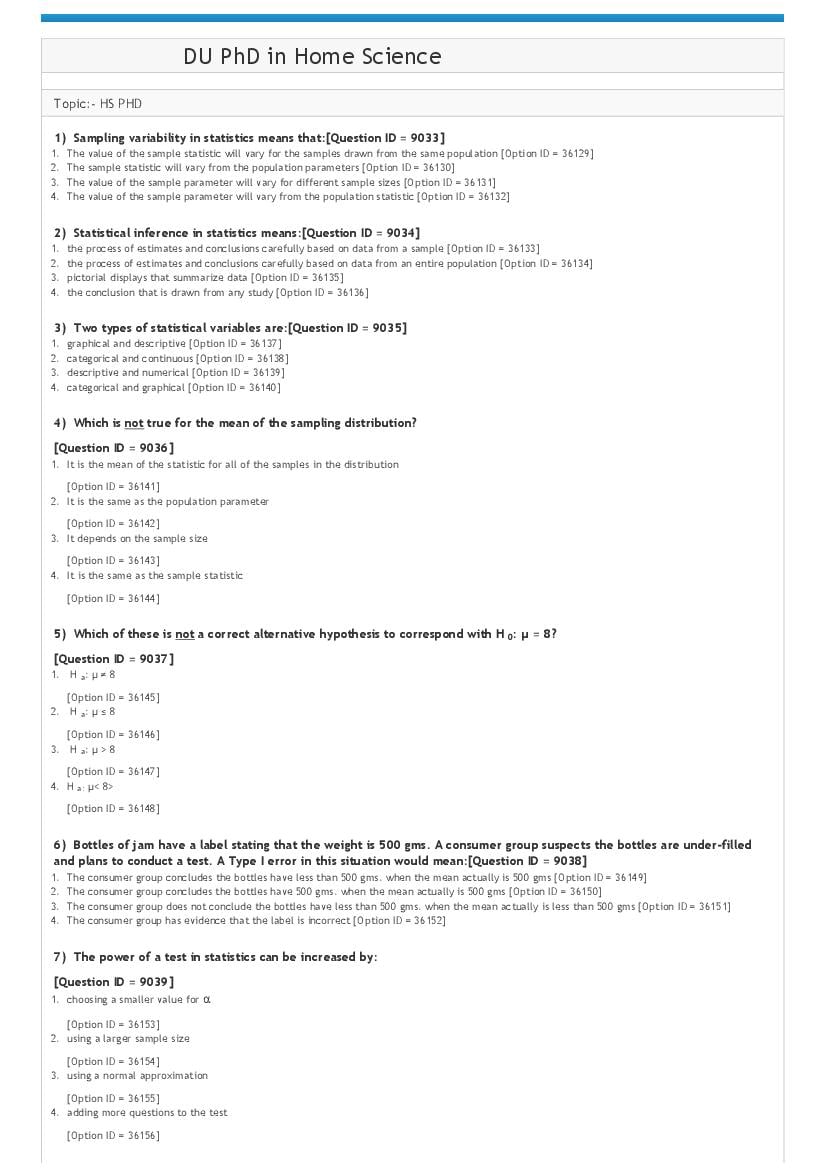
Page 1
Topic:‐ HS PHD
1) Sampling variability in statistics means that:[Question ID = 9033]
1. The value of the sample statistic will vary for the samples drawn from the same population [Option ID = 36129]
2. The sample statistic will vary from the population parameters [Option ID = 36130]
3. The value of the sample parameter will vary for different sample sizes [Option ID = 36131]
4. The value of the sample parameter will vary from the population statistic [Option ID = 36132]
2) Statistical inference in statistics means:[Question ID = 9034]
1. the process of estimates and conclusions carefully based on data from a sample [Option ID = 36133]
2. the process of estimates and conclusions carefully based on data from an entire population [Option ID = 36134]
3. pictorial displays that summarize data [Option ID = 36135]
4. the conclusion that is drawn from any study [Option ID = 36136]
3) Two types of statistical variables are:[Question ID = 9035]
1. graphical and descriptive [Option ID = 36137]
2. categorical and continuous [Option ID = 36138]
3. descriptive and numerical [Option ID = 36139]
4. categorical and graphical [Option ID = 36140]
4) Which is not true for the mean of the sampling distribution?
[Question ID = 9036]
1. It is the mean of the statistic for all of the samples in the distribution
[Option ID = 36141]
2. It is the same as the population parameter
[Option ID = 36142]
3. It depends on the sample size
[Option ID = 36143]
4. It is the same as the sample statistic
[Option ID = 36144]
5) Which of these is not a correct alternative hypothesis to correspond with H 0: μ = 8?
[Question ID = 9037]
1. H a: μ ≠ 8
[Option ID = 36145]
2. H a: μ ≤ 8
[Option ID = 36146]
3. H a: μ > 8
[Option ID = 36147]
4. H a: μ< 8>
[Option ID = 36148]
6) Bottles of jam have a label stating that the weight is 500 gms. A consumer group suspects the bottles are under‐filled
and plans to conduct a test. A Type I error in this situation would mean:[Question ID = 9038]
1. The consumer group concludes the bottles have less than 500 gms. when the mean actually is 500 gms [Option ID = 36149]
2. The consumer group concludes the bottles have 500 gms. when the mean actually is 500 gms [Option ID = 36150]
3. The consumer group does not conclude the bottles have less than 500 gms. when the mean actually is less than 500 gms [Option ID = 36151]
4. The consumer group has evidence that the label is incorrect [Option ID = 36152]
7) The power of a test in statistics can be increased by:
[Question ID = 9039]
1. choosing a smaller value for α
[Option ID = 36153]
2. using a larger sample size
[Option ID = 36154]
3. using a normal approximation
[Option ID = 36155]
4. adding more questions to the test
[Option ID = 36156]
Page 2
1. Categories are established for analysis purposes [Option ID = 36157]
2. Data are usually collected in a laboratory setting [Option ID = 36158]
3. Focus is on studying the “whole” [Option ID = 36159]
4. Intuition and abstraction are suppressed [Option ID = 36160]
9) Data for qualitative studies are:[Question ID = 9041]
1. Based on words rather than numbers [Option ID = 36161]
2. Easy and straightforward to interpret [Option ID = 36162]
3. Gathered quickly from large numbers of people [Option ID = 36163]
4. Precisely analyzed on a computer [Option ID = 36164]
10) The purpose of control in a study design is to:[Question ID = 9042]
1. Establish the credibility of the researcher [Option ID = 36165]
2. Highlight design flaws [Option ID = 36166]
3. Increase the probability that the results are true to reality [Option ID = 36167]
4. Interfere with the validity of the findings [Option ID = 36168]
11) Which of the following is not a common data collection method in qualitative research?[Question ID = 9043]
1. Examining written text [Option ID = 36169]
2. Interviewing participants [Option ID = 36170]
3. Observing participants [Option ID = 36171]
4. Obtaining written surveys [Option ID = 36172]
12) A researcher was interested in the stress levels of students during exams. She took the same group of 8 students and
measured their anxiety on a scale of 1‐5 during a class test and again in a competitive exam. The data were not normally
distributed. Which test should she use to compare her experimental conditions?[Question ID = 9044]
1. Paired samples t‐test [Option ID = 36173]
2. Mann–Whitney test [Option ID = 36174]
3. Wilcoxon rank‐sum test [Option ID = 36175]
4. Wilcoxon signed‐rank test [Option ID = 36176]
13) For a random sample of 9 women, their average resting pulse rate is 76 beats per minute, and the sample standard
deviation is 5. The standard error of the sample mean is:[Question ID = 9045]
1. 0.557 [Option ID = 36177]
2. 0.745 [Option ID = 36178]
3. 1.667 [Option ID = 36179]
4. 2.778 [Option ID = 36180]
14) What is an outlier?[Question ID = 9046]
1. A type of variable that cannot be quantified [Option ID = 36181]
2. A person who is out and out a liar [Option ID = 36182]
3. A score that is left out of the analysis because of missing data [Option ID = 36183]
4. An extreme value at either end of a distribution [Option ID = 36184]
15) A research study that attempts to describe systematically a situation, problem, phenomenon, service or programme is
referred to as:[Question ID = 9047]
1. Exploratory study [Option ID = 36185]
2. Pilot study [Option ID = 36186]
3. Descriptive study [Option ID = 36187]
4. Correlational study [Option ID = 36188]
16) Limits of a score interval that extend from the smallest unit of measurement in the interval to the largest and explicitly
do not display continuity are referred to as:[Question ID = 9048]
1. Real limits [Option ID = 36189]
2. Apparent limits [Option ID = 36190]
3. Exact limits [Option ID = 36191]
4. Fractional limits [Option ID = 36192]
17) When asked questions concerning personal hygiene, people commonly lie. This is an example of:[Question ID = 9049]
1. Sampling bias [Option ID = 36193]
2. Confounding [Option ID = 36194]
3. Response bias [Option ID = 36195]
4. Non‐response bias [Option ID = 36196]
18) Teaching method A has been used for years in order to teach autistic children. An experiment is to be conducted in
order to see whether a new method B is more effective than A. Method A will continue to be used unless there is sufficient
evidence that method B is more effective. The alternative hypothesis in this problem is:[Question ID = 9050]
1. Method B is more effective than Method A [Option ID = 36197]
2. Method A is more effective than Method B [Option ID = 36198]
3. Method A is not more effective than Method B [Option ID = 36199]
4. Method B is not more effective than Method A [Option ID = 36200]
Page 3
9051]
1. Quartile points [Option ID = 36201]
2. Semi‐interquartile range [Option ID = 36202]
3. Variance [Option ID = 36203]
4. Deviation scores [Option ID = 36204]
20) The validity that is judged by the degree to which an instrument can forecast an outcome is called:[Question ID =
9052]
1. Content validity [Option ID = 36205]
2. Predictive validity [Option ID = 36206]
3. Concurrent validity [Option ID = 36207]
4. Construct Validity [Option ID = 36208]
21) A normal distribution in which scores have been transformed to standard scores is referred to as:[Question ID = 9053]
1. Standardized Normal Curve [Option ID = 36209]
2. Deviation Curve [Option ID = 36210]
3. Spearman Standard Curve [Option ID = 36211]
4. Random Sampling Curve [Option ID = 36212]
22) The assumption that the population variances are the same for all treatment conditions is referred to as:[Question ID =
9054]
1. Assumption of Heterogeneity of Variance [Option ID = 36213]
2. Assumption of Homogeneity of Variance [Option ID = 36214]
3. Assumption of Error of Variance [Option ID = 36215]
4. Assumption of Mean Variance [Option ID = 36216]
23) Rejection of the true null hypothesis is referred to as:[Question ID = 9055]
1. Type I Error [Option ID = 36217]
2. Type II Error [Option ID = 36218]
3. Acceptance Error [Option ID = 36219]
4. Rejection Error [Option ID = 36220]
24) Which of the following is a true statement, for comparing the t‐distribution with standard normal curve:[Question ID =
9056]
1. The normal curve is symmetrical whereas the t‐distributions are slightly skewed [Option ID = 36221]
2. The proportion of area beyond a specific value of “t” is less than the proportion of normal curve [Option ID = 36222]
3. Greater the degree of freedom, the more the t‐distribution resembles the standard normal distribution [Option ID = 36223]
4. The t‐distribution is used by students and standard normal curve by researchers [Option ID = 36224]
25) The probability value that is used as a criterion to decide that an obtained sample statistic has a low probability of
occuring by chance if the null hypothesis is true is referred to as:[Question ID = 9057]
1. Level of acceptance [Option ID = 36225]
2. Level of rejection [Option ID = 36226]
3. Central limit theorem [Option ID = 36227]
4. Level of significance [Option ID = 36228]
26) Which of the following can not be used for checking similarity in a research document[Question ID = 9058]
1. Turnitin [Option ID = 36229]
2. Urkund [Option ID = 36230]
3. Ithenticate [Option ID = 36231]
4. Zotero [Option ID = 36232]
27) Which of the following are types of quantitative research
A. Ethnographic
B. Correlational
C. Quasi‐experimental
D. Experimental
Choose the correct answer from the options given below:
[Question ID = 9059]
1. A, B and C only
[Option ID = 36233]
2. A, B and D only
[Option ID = 36234]
3. B, C and D only
[Option ID = 36235]
4. A, C and D only
[Option ID = 36236]
Page 4
A. Looks at cause‐and‐effect relationships
B. Is highly controlled and systematic study
C. Involves the measurement of independent and dependent variables
D. Focuses on understanding the whole
Choose the correct answer from the options given below:
[Question ID = 9060]
1. A, B and C only
[Option ID = 36237]
2. A, B and D only
[Option ID = 36238]
3. B, C and D only
[Option ID = 36239]
4. A, C and D only
[Option ID = 36240]
29) Which of these variables would meet the assumptions of parametric tests based on the level of measurement:
A. Reaction time
B. Temperature
C. Gender
D. Heart Rate
Choose the correct answer from the options given below:
[Question ID = 9061]
1. A, B and C only
[Option ID = 36241]
2. A, B and D only
[Option ID = 36242]
3. B, C and D only
[Option ID = 36243]
4. A, C and D only
[Option ID = 36244]
30) Characteristics of a normal curve are:
A. It is unimodal
B. It is continuous distribution
C. It is asymmetrical
D. It is asymptotic
Choose the correct answer from the options given below:
[Question ID = 9062]
1. A, B and D only
[Option ID = 36245]
2. A, C and D only
[Option ID = 36246]
3. B, C and D only
[Option ID = 36247]
4. A, B and C only
[Option ID = 36248]
31) A linear transformation is one in which each raw score changes only by:
A. Addition of a constant
B. Subtraction of a constant
C. Multiplication of a constant
D. Deviation of a constant
Choose the correct answer from the options given below:
Page 5
1. A, B and D only
[Option ID = 36249]
2. A, C and D only
[Option ID = 36250]
3. A, B and C only
[Option ID = 36251]
4. B, C and D only
[Option ID = 36252]
32) Typical assumptions of parametric tests are:
A. Normality
B. Homogeneity of variances
C. Linearity
D. Nominal data
Choose the correct answer from the options given below:
[Question ID = 9064]
1. A, B and D only
[Option ID = 36253]
2. A, B and C only
[Option ID = 36254]
3. A, C and D only
[Option ID = 36255]
4. B, C and D only
[Option ID = 36256]
33) Which of these characteristics would you expect to give high test‐retest reliability
A. Attention
B. Dyslexia
C. Religious beliefs
D. Intelligence
E. Self esteem
Choose the correct answer from the options given below:
[Question ID = 9065]
1. A, B and E only
[Option ID = 36257]
2. A, B and C only
[Option ID = 36258]
3. A, C and E only
[Option ID = 36259]
4. B, C and D only
[Option ID = 36260]
34) Match List I with List II
List I List II
I. Correlation
A. The middle point in a distribution dividing the group in two equal parts
coefficient
II. Standard deviation
B. The score that occurs most frequently in a distribution
C. Sum of the numerical values of each and every observation divided by the total number of
III. Median
observations
D. A measure of the dispersion of a set of data from its mean IV. Mean
V. Mode
Choose the correct answer from the options given below:
[Question ID = 9066]
1. A ‐ I, B ‐ II, C ‐ V, D ‐ IV [Option ID = 36261]
2. A ‐ II, B ‐ IV, C ‐ I, D ‐ V [Option ID = 36262]
3. A ‐ III, B ‐ V, C ‐ IV, D ‐ II [Option ID = 36263]
4. A ‐ IV, B ‐ V, C ‐ III, D ‐ II [Option ID = 36264]
Page 6
List I List II
A. Income (Rupees) I. Interval scale
B. Dress size (large/small) II. Ratio scale
C. Temperature (in celsius)III. Ordinal scale
D. Post codes (zip codes) IV. Likert scale
V. Nominal scale
Choose the correct answer from the options given below:
[Question ID = 9067]
1. A ‐ IV, B ‐ II, C ‐ I, D ‐ III [Option ID = 36265]
2. A ‐ II, B ‐ V, C ‐ I, D ‐ III [Option ID = 36266]
3. A ‐ IV, B ‐ I, C ‐ II, D ‐ III [Option ID = 36267]
4. A ‐ II, B ‐ III, C ‐ I, D ‐ V [Option ID = 36268]
36) Match List I with List II
List I List II
A. Non‐probability samplesI. The true value of a population attribute
B. Probability samples II. An estimate, based on sample data of a population
C. Sample statistic III. Each population element has a known and equal chance of being chosen for a sample
D. Population parameter IV. Chance that each population element will be chosen is not known
V. Association between samples
Choose the correct answer from the options given below:
[Question ID = 9068]
1. A ‐ IV, B ‐ II, C ‐ I, D ‐ III [Option ID = 36269]
2. A ‐ II, B ‐ V, C ‐ I, D ‐ III [Option ID = 36270]
3. A ‐ IV, B ‐ III, C ‐ II, D ‐ I [Option ID = 36271]
4. A ‐ II, B ‐ III, C ‐ I, D ‐ IV [Option ID = 36272]
37) Match List I with List II
List I List II
A. Systematic watching of activity I. Interview
B. Face to face interaction II. Reliability
C. Completion of incomplete sentences III. Observation
D. Written list of questions answered by the respondentIV. Questionnaire
V. Projective technique
Choose the correct answer from the options given below:
[Question ID = 9069]
1. A ‐ III, B ‐ I, C ‐ V, D ‐ IV [Option ID = 36273]
2. A ‐II, B ‐ V, C ‐ I, D ‐ IV [Option ID = 36274]
3. A ‐ IV, B ‐ I, C ‐ II, D ‐ V [Option ID = 36275]
4. A ‐ II, B ‐ I, C ‐ V, D ‐ III [Option ID = 36276]
38) Match List I with List II
List I List II
A. Arriving from specific to general statementsI. Consistency
B. Reliability II. Inductive reasoning
C.Research conducted at one time is called III. Cross‐sectional research
D. Research carried for many years IV. Longitudinal studies
V. Deductive reasonng
Choose the correct answer from the options given below:
[Question ID = 9070]
1. A ‐ III, B ‐ I, C ‐ V, D ‐ IV [Option ID = 36277]
2. A ‐ II, B ‐ I, C ‐ III, D ‐ IV [Option ID = 36278]
3. A ‐ IV, B ‐ I, C ‐ II, D ‐ V [Option ID = 36279]
4. A ‐ II, B ‐ I, C ‐ V, D ‐ III [Option ID = 36280]
39) Match List I with List II
List I List II
A. Procedure of investigation I. Bibliography
B. A section or table of subsidiary matter at the end of a document. II. Literature review
C. Systematic collation of published research work related to study topicIII. Methodology
Page 7
V. Abstract
Choose the correct answer from the options given below:
[Question ID = 9071]
1. A ‐ III, B ‐ IV, C ‐ II, D ‐ I [Option ID = 36281]
2. A ‐ II, B ‐ IV, C ‐ I, D ‐ V [Option ID = 36282]
3. A ‐ V, B ‐ II, C ‐ IV, D ‐ III [Option ID = 36283]
4. A ‐ IV, B ‐ V, C ‐ I, D ‐ III [Option ID = 36284]
40) Match List I with List II
List I List II
A. In‐depth analysis of a person, group or phenomenonI. Laboratory experiment
B. Conducted under highly controlled conditions II. Case study
C. Studies carried out in the course of an activity III. Action research
D. Research carried for many years IV. Longitudnal studies
V. Historical research
Choose the correct answer from the options given below:
[Question ID = 9072]
1. A ‐ III, B ‐ I, C ‐ V, D ‐ IV [Option ID = 36285]
2. A ‐ II, B ‐ I, C ‐ III, D ‐ IV [Option ID = 36286]
3. A ‐ IV, B ‐ I, C ‐ II, D ‐ V [Option ID = 36287]
4. A ‐ II, B ‐ I, C ‐ V, D ‐ III [Option ID = 36288]
41) Given below are two statements
Statement I: For any investigation, the selection of an appropriate research design is crucial in enabling you to arrive at
valid findings, comparisons and conclusions.
Statement II: Faulty research designs have poor internal and external validity In light of the above statements,
choose the correct answer from the options given below
[Question ID = 9073]
1. Both Statement I and Statement II are true
[Option ID = 36289]
2. Both Statement I and Statement II are false
[Option ID = 36290]
3. Statement I is true but Statement II is false
[Option ID = 36291]
4. Statement I is false but Statement II is true
[Option ID = 36292]
42) Given below are two statements
Statement I: The sign test is appropriate in place of a one‐sample t‐test or in place of a paired t‐test if the data
measurement is not on ratio or interval scale
Statement II: The sign test is used to test the null hypothesis that the median of a distribution is equal to a calculated value.
In light of the above statements,
choose the correct answer from the options given below
[Question ID = 9074]
1. Both Statement I and Statement II are true
[Option ID = 36293]
2. Both Statement I and Statement II are false
[Option ID = 36294]
3. Statement I is true but Statement II is false
[Option ID = 36295]
4. Statement I is false but Statement II is true
[Option ID = 36296]
43) Given below are two statements
Statement I: A survey that asks the respondents to indicate their monthly income and includes response categories of
Rs. <5000, Rs. 5000‐10000 and >Rs.10000, fulfills the rules of categorization.
Statement II: For constructing closed‐ended items for questionnaires the categories should be mutually exclusive. In light of
the above statements,
choose the correct answer from the options given below
Page 8
1. Both Statement I and Statement II are true
[Option ID = 36297]
2. Both Statement I and Statement II are false
[Option ID = 36298]
3. Statement I is true but Statement II is false
[Option ID = 36299]
4. Statement I is false but Statement II is true
[Option ID = 36300]
44) Given below are two statements
Statement I: Analysis of narratives involves Open Coding.
Statement II : Coding qualitative data includes labeling concepts, defining and developing categories based on their
properties and dimensions. In light of the above statements,
choose the correct answer from the options given below
[Question ID = 9076]
1. Both Statement I and Statement II are true
[Option ID = 36301]
2. Both Statement I and Statement II are false
[Option ID = 36302]
3. Statement I is true but Statement II is false
[Option ID = 36303]
4. Statement I is false but Statement II is true
[Option ID = 36304]
45) Given below are two statements
Statement I : Existing body of knowledge enhances relevance of the research study.
Statement II : Literature review brings clarity and focus to a research problem.
In light of the above statements, choose the correct answer from the options given below
[Question ID = 9077]
1. Both Statement I and Statement II are true
[Option ID = 36305]
2. Both Statement I and Statement II are false
[Option ID = 36306]
3. Statement I is true but Statement II is false
[Option ID = 36307]
4. Statement I is false but Statement II is true
[Option ID = 36308]
46) Given below are two statements
Statement I: Increase in the sample size reduces the sampling error.
Statement II: Precision of sampling plan eliminates sampling error.
In light of the above statements, choose the correct answer from the options given below
[Question ID = 9078]
1. Both Statement I and Statement II are true
[Option ID = 36309]
2. Both Statement I and Statement II are false
[Option ID = 36310]
3. Statement I is true but Statement II is false
[Option ID = 36311]
4. Statement I is false but Statement II is true
[Option ID = 36312]
47) For any scientific research enquiry, that seeks to apply the statistics, the correct sequence of conducting research
involves:
A. Formulating statistical question
B. Formulating research question
C. Arriving at research conclusion
Page 9
Choose the correct answer from the options given below
[Question ID = 9079]
1. A, B, C, D
[Option ID = 36313]
2. B, A, C, D
[Option ID = 36314]
3. B, A, D, C
[Option ID = 36315]
4. A, C, D, B
[Option ID = 36316]
48) Identify the correct sequence of steps involved in conducting a literature review:
A. Developing a theoretical framework
B. Developing a conceptual framework
C. Reviewing the selected literature
D. Searching for the existing literature in your area of research
Choose the correct answer from the options given below
[Question ID = 9080]
1. D, C, B, A
[Option ID = 36317]
2. B, C, A, D
[Option ID = 36318]
3. D, C, A, B
[Option ID = 36319]
4. A, C, D, B
[Option ID = 36320]
49)
As per the given graphical representation of data which of the following holiday activities is most preferred amongst school
going children?
[Question ID = 9081]
1. Visiting friends
[Option ID = 36321]
2. School clubs
[Option ID = 36322]
3. Chat online
[Option ID = 36323]
4. Cannot find out with the given information
[Option ID = 36324]
50)
Page 10
[Question ID = 9082]
1. Pie Chart
[Option ID = 36325]
2. Histogram
[Option ID = 36326]
3. Frequency Polygon
[Option ID = 36327]
4. Ogive
[Option ID = 36328]
Document Details
| Board / Org | NTA |
| Exam | DUET |
| Type | Question Paper |
| Pages | 10 |
| Language | english |
| Updated | 30 Apr 2026 |