AHSEC HS 2nd Year Question Paper 2019 Sanskrit
Finished viewing? Save it for later —
Download AHSEC HS 2nd Year Question Paper 2019 Sanskrit (PDF · 12 pages)About AHSEC HS 2nd Year Question Paper 2019 Sanskrit
AHSEC HS 2nd Year Question Paper 2019 Sanskrit is available here for free download. Published by Assam Board for Class 12, this question paper can be viewed online or downloaded as a PDF (12 pages). Candidates preparing for Class 12 can use AHSEC HS 2nd Year Question Paper 2019 Sanskrit to understand the exam pattern, the type of questions asked, and the overall difficulty level.
Frequently Asked Questions
How can I download AHSEC HS 2nd Year Question Paper 2019 Sanskrit?
Open this page and click the Download button to save AHSEC HS 2nd Year Question Paper 2019 Sanskrit as a PDF. It is completely free on AglaSem Docs.
Is AHSEC HS 2nd Year Question Paper 2019 Sanskrit free to download?
Yes. AHSEC HS 2nd Year Question Paper 2019 Sanskrit can be viewed online and downloaded as a PDF free of cost on AglaSem Docs.
How many pages does AHSEC HS 2nd Year Question Paper 2019 Sanskrit have?
AHSEC HS 2nd Year Question Paper 2019 Sanskrit contains 12 pages, which you can read online or download together as a single PDF.
Where can I find more Class 12 study material?
You can find more Class 12 question papers, sample papers, syllabus, and answer keys on AglaSem Docs.
AHSEC HS 2nd Year Question Paper 2019 Sanskrit – Text
Read the full text of this question paper below — useful to quickly search, copy and reference the content online without downloading the PDF.
📄 View text version (12 pages)
Page 1
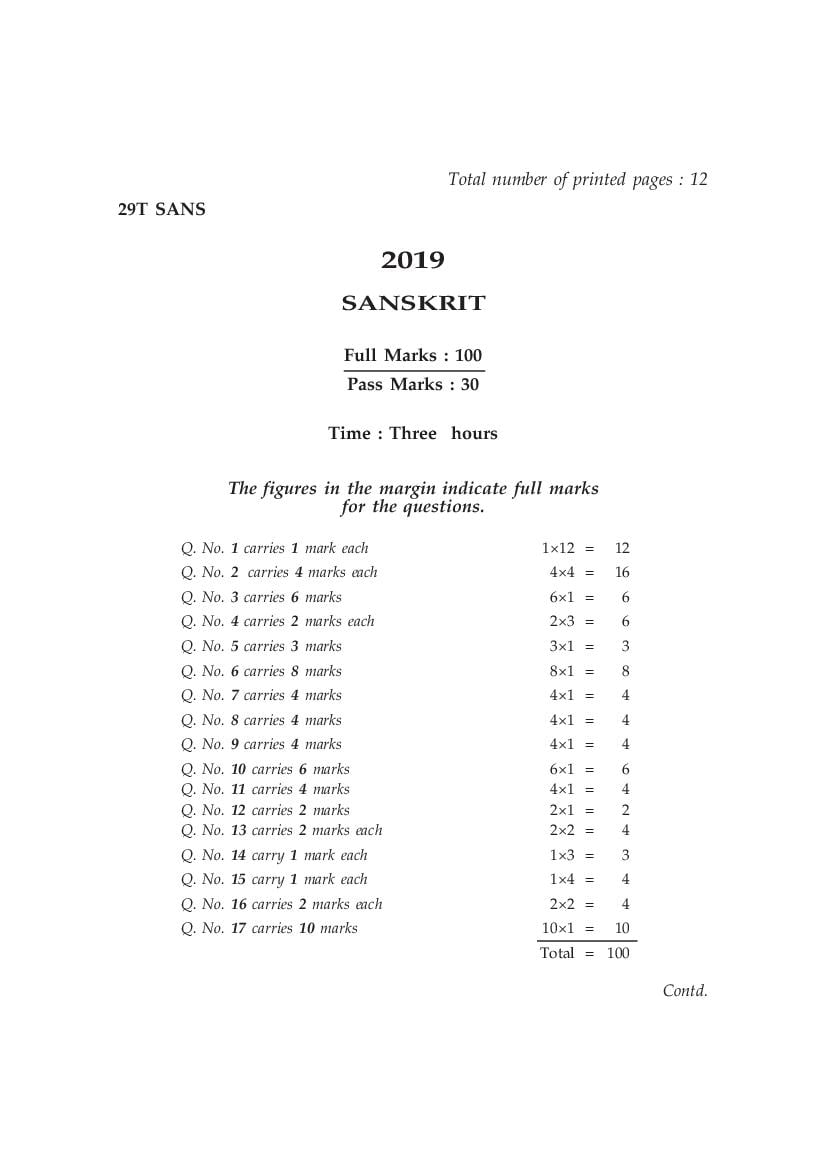
29T SANS
2019
SANSKRIT
Full Marks : 100
Pass Marks : 30
Time : Three hours
The figures in the margin indicate full marks
for the questions.
Q. No. 1 carries 1 mark each 1×12 = 12
Q. No. 2 carries 4 marks each 4×4 = 16
Q. No. 3 carries 6 marks 6×1 = 6
Q. No. 4 carries 2 marks each 2×3 = 6
Q. No. 5 carries 3 marks 3×1 = 3
Q. No. 6 carries 8 marks 8×1 = 8
Q. No. 7 carries 4 marks 4×1 = 4
Q. No. 8 carries 4 marks 4×1 = 4
Q. No. 9 carries 4 marks 4×1 = 4
Q. No. 10 carries 6 marks 6×1 = 6
Q. No. 11 carries 4 marks 4×1 = 4
Q. No. 12 carries 2 marks 2×1 = 2
Q. No. 13 carries 2 marks each 2×2 = 4
Q. No. 14 carry 1 mark each 1×3 = 3
Q. No. 15 carry 1 mark each 1×4 = 4
Q. No. 16 carries 2 marks each 2×2 = 4
Q. No. 17 carries 10 marks 10×1 = 10
Total = 100
Contd.
Page 2
word : 1×12=12
Ó¬˘1 √õ∂ùüÀ¬ı±11 √õ∂ÀÓ¬…fl¬ÀȬ±1 Î◊¬M1Ó¬ Œfl¬ª˘ √õ∂fl‘¬Ó¬ ’±1n qX ˙s√√ ø˘‡± –
.
(a) The ‘Raghuvams' am ’ is a Maha–ka–vya/Khan.d.aka–vya.
(Choose the correct answer)
ë1‚≈¬ı—˙˜ƒí ¤‡Ú ˜˝√√±fl¡±¬ı…/‡Gfl¡±¬ı…º
[qX ά◊M√1ÀȬ± ¬ı±øÂ√ ά◊ø˘›ª±]
.
(b) What is the name of the canto XIII of the ‘Raghuvams' am ’ ?
ë1‚≈¬ı—˙˜ƒí 1 SÀ˚˛±√˙ ¸·«ÀȬ±1 Ú±˜ øfl¡∑
(c) What is the name of the source book of the ‘S' ri–madbhagavadgi–ta– ’ ?
뿘æ√·ªƒ√·œÓ¬±í1 ’±Ò±1 ¢∂Lö‡Ú1 Ú±˜ øfl¡∑
(d) Who is referred to as “œŸÜ¡ÿ” ?
ëÒÚ?˚˛í ¬ı≈ø˘ fl¡±fl¡ ¬ı≈ÀÊ√±ª± Δ˝√√ÀÂ√∑
(e) How many verses are there in the ‘Gi–ta– ’ ?
뷜Ӭ±íÓ¬ ¸¬ı«˜≈ͬ øfl¡˜±Ú Œù≠±fl¡ ’±ÀÂ√∑
29T SANS [2]
Page 3
ëÚ±·±Úμ˜í1 1‰¬ø˚˛Ó¬± Œfl¡±Ú∑
(g) Write an equivalent of the word “¬ÿÙŒ” in Sanskrit.
ë¬ÛÀ˚˛±√í ˙sÀȬ±1 ¤È¬± ¸—¶‘®Ó¬ õ∂øÓ¬˙s ø˘‡±º
(h) Who was Malayavati– ?
˜˘˚˛¬ıÓ¬œ Œfl¡±Ú ’±øÂ√˘∑
(i) Fill in the blank :
‡±˘œ ͬ±˝◊√ ¬Û”À1±ª± –
‡ÊÊSòÊcflÊl¢ __________º
(j) ~jari– ’ ?
Who wrote ‘Vr.ttaman
묬ı‘M√˜?1œí Œfl¡±ÀÚ 1‰¬Ú± fl¡ø1øÂ√˘∑
(k) What is said to be the mouth of Veda–ngas ?
øfl¡ ˙±¶afl¡ Œ¬ı√±e1 ˜≈‡ ¬ı≈ø˘ Œfl¡±ª± ˝√√˚˛∑
(l) Write the name of the Sanskrit book written by Dr Mukunda Madhava
Sharma.
ά0 ˜≈fl≈¡μ ˜±Òª ˙•ú«±˝◊√ 1‰¬Ú± fl¡1± ¸—¶‘®Ó¬ ¢∂Lö‡Ú1 Ú±˜ ø˘‡±º
29T SANS [3] Contd.
Page 4
4×4=16
Ó¬˘Ó¬ ø√˚˛± õ∂øÓ¬ÀȬ± ’—˙1 ¬Û1± ¤È¬±Õfl¡ ¬ı±øÂ√ ˜≈ͬ ‰¬±ø1Ȭ±1 ’Ú≈¬ı±√ fl¡1± –
Part I / √õ∂Ô˜ ’—˙
(a) •ÕÊà◊Ÿ— ‡Ê錪ÈáÊ¢ ªÈáÊôÊ—
¬Œ¢ Áfl◊ÊŸŸ ÁflªÊ„U◊ÊŸ—–
⁄UàŸÊ∑§⁄¢U flˡÿ Á◊Õ— ‚ ¡ÊÿÊ¢
⁄UÊ◊ÊÁ÷œÊŸÙ „UÁ⁄UÁ⁄UàÿÈflÊ øH
(b) ⁄U‚ÊËʌÊÁŒ÷flŸ ¬È¢‚Ê
÷Èfl— ¬˝ÿÙÄÃÙm„UŸÁ∑˝§ÿÊÿÊ—–
•SÿÊë¿U◊ê÷— ¬˝‹ÿ¬˝’Îh¢
◊È„ÍUøflÄòÊÊ÷⁄UáÊ¢ ’÷ÍflH
Part II / ø ZÓ¬œ˚˛ ’—˙
(c) •‡ÊÙëÿÊŸãfl‡ÊÙøSàfl¢ ¬˝ôÊÊflʌʢ‡ø ÷Ê·‚–
ªÃÊ‚ÍŸªÃÊ‚Í¢‡ø ŸÊŸÈ‡ÊÙøÁãà ¬Áá«UÃÊ—––
(d) Ÿ ¡Êÿà Á◊˝ÿà flÊ ∑§ŒÊÁøØ
ŸÊÿ¢ ÷ÍàflÊ ÷ÁflÃÊ flÊ Ÿ ÷Íÿ—–
•¡Ù ÁŸàÿ— ‡ÊʇflÃÙ˘ÿ¢ ¬È⁄UÊáÊÙ
Ÿ „Uãÿà „Uãÿ◊ÊŸ ‡Ê⁄UË⁄UH
29T SANS [4]
Page 5
(e) ÷Ù ◊„UÊ‚ûfl, Á∑§◊ŸŸ flÎÕʬ˝ÿÊ‚Ÿ? Ÿ π‹È ‡ÊæU˜ πøÍ«U— ‡Êæ˜U πœfl‹¢ ‡Êæ˜Uπ¬Ê‹∑ȧ‹¢
◊Á‹ŸË∑§Á⁄UcÿÁÖ •Õ à flÿ◊ŸÈ∑§ê¬ŸËÿÊ—, ÃÁŒÿ◊S◊Ám¬ÁûÊÁflÄ‹flÊ ÿÕÊ Ÿ ¬Á⁄Uàÿ¡ÁÃ
¡ËÁflÃ◊ê’Ê, ÃÕÊèÿȬÊÿÁpÀÿÃÊ◊˜–
(f) •ÿ– ßÿ◊‚ı ÿÙÁ·Ã˜– (‡ÊæU˜ πøÍ«U¢ ŒÎ¶UÔÊ) ŸÍŸ◊ŸŸÊåÿSÿÊ— ‚Èß ÷ÁflÃ√ÿ◊˜ , ÿŒÕ¸◊Ê∑˝§ãŒÁÖ
(‚◊ãÃÊŒfl‹ÙÄÿ) Ÿ π‹È ¬ÈŸ— Á∑§ÁÜøŒ˜ ÷ÿ∑§Ê⁄UáÊ¢ ¬‡ÿÊÁ◊– ÃØ ∑ȧÃÙ˘Sÿ ÷ÿ¢
÷ÁflcÿÃËÁà Á∑§◊Ȭàÿ ¬Îë¿UÊÁ◊?
Part IV / ‰¬Ó≈¬Ô« ’—˙
(g) ◊äÿÿȪSÿ ¬˝Ê⁄Uê÷ (Ÿfl◊‡ÊÁÃ∑§ÊÿÊ◊˜) ∑§ÊÁ‹∑§Ê¬È⁄UÊáÊÁ◊Áà ¬È⁄UÊáÊ¢ Áfl⁄UÁøÃ◊Ê‚ËØ– ÃS◊ÊØ
∑§Ê‹ÊŒÊ⁄Uèÿ •‚◊⁄UÊÖÿ ‚¢S∑ΧÃ÷Ê·ÊÿÊ— ÁøãÃÊøøʸ •÷flØ– ·Ù«U‡Ê‡ÊÁÃ∑§ÊÿÊ¢ ∑§Ê◊M§¬Sÿ
∑§ÙøÁfl„UÊ⁄U ßÁà SÕÊŸ (•œÈŸÊ ¬Á‡ø◊’æ˜U ª) ⁄UàŸ◊Ê‹Ê-√ÿÊ∑§⁄UáÊŸÊêŸÊ ŸÍßSÿ
√ÿÊ∑§⁄UáÊ‚ê¬˝ŒÊÿSÿÙŒ˜÷flÙ ¡Ê×–
(h) ·«˜UÁfl¢‡ÊàÿÁœ∑§ÙáÊÁfl¢‡ÊÁÇÊÃÃ◊ (1926) fl·¸ üÊË„U^ÔUŸÊ◊∑§ SÕÊŸ ““•‚◊-‚¢S∑ΧÃflÙ«¸U””
ßÁà ∞∑§Ê ‚Á◊Á× •‚◊‚fl¸∑§Ê⁄UáÊ ÁŸÁ◊¸ÃÊ– •SÿÊ— ‚Á◊× •œËŸ ’„Ufl— ¬ÊΔU‡ÊÊ‹Ê—
‚Áãà ÿòÊ ‚¢S∑ΧÃSÿ •äÿÿŸ◊äÿʬŸ¢ ø ߌʟ˥ ÿÊflØ øÁ‹Ã S×–
29T SANS [5] Contd.
Page 6
1+1+4=6
Ó¬˘Ó¬ Œù≠±fl¡À¬ı±11 ø˚Àfl¡±ÀÚ± ¤È¬±1 õ∂¸e ¸eøÓ¬ √˙«±˝◊√ ¬ı…±‡…± fl¡1± –
(a) ¬ˇÊÁë¿UŒÊ ªÙòÊÁ÷ŒÊûʪãœÊ—
‡Ê⁄Uáÿ◊Ÿ¢ ‡ÊÇÊÙ ◊„UËœ˝Ê—–
ŸÎ¬Ê ßflÙ¬å‹ÁflŸ— ¬⁄UèÿÙ
œ◊Ù¸ûÊ⁄¢U ◊äÿ◊◊ÊüÊÿãÃH
(b) ªÈ⁄UÙÁÿÿˇÊÙ— ∑§Á¬‹Ÿ ◊äÿ
⁄U‚ÊË¢ ‚¢∑˝§Á◊à ÃÈ⁄UXÔU–
Ìո÷Èfl˸◊flŒÊ⁄UÿÁj—
¬ÍflÒ¸— Á∑§‹Êÿ¢ ¬Á⁄U’Áœ¸ÃÙ Ÿ—–
4. (a) Account for the case ending in “Áfl◊ÊŸŸ” in 2(a) and “¬⁄Uèÿ—” in 3(a).
1×2=2
õ∂ùü ¸—‡…± 2(a) Ó¬ Ôfl¡± “Áfl◊ÊŸŸ” ’±1n∏ õ∂ùü ¸—‡…± 3(a) Ó¬ Ôfl¡± “¬⁄Uèÿ—” ¬Û√ ≈√Ȭ±1
ø¬ıˆ¬øMê√ øÚÌ«˚˛ fl¡1±º
(b) Derive “÷Ê·‚” in 2(c) and “Á◊˝ÿÔ in 2(d). 1×2=2
õ∂ùü ¸—‡…± 2(c) Ó¬ Ôfl¡± “÷Ê·‚” ’±1n∏ õ∂ùü ¸—‡…± 2(d) Ó¬ Ôfl¡± “Á◊˝ÿÔ ¬Û√ ≈√Ȭ±1
¬ı≈»¬ÛøM√√ øÚÌ«˚˛ fl¡1±º
29T SANS [6]
Page 7
3(a). 1×2=2
õ∂ùü ¸—‡…± 2(b) Ó¬ Ôfl¡± “•ÊÁŒ÷flŸ” ’±1n∏ õ∂ùü ¸—‡…± 3(a) Ó¬ Ôfl¡± “ªÙòÊÁ÷ŒÊ” ¬Û√ ≈√Ȭ±1
¬ı…±¸¬ı±fl¡…¸˝√√ ¸˜±¸1 Ú±˜ ø˘‡±º
5. Elucidate the idea contained in any one of the following : 3
Ó¬˘1 ø˚Àfl¡±ÀÚ± ¤È¬±1 ˆ¬±¬ı ¸•x¸±1Ì fl¡1± –
(a) ŒÁ„UŸÙ˘ÁS◊Ÿ˜ ÿÕÊ Œ„U ∑§ı◊Ê⁄¢U ÿıflŸ¢ ¡⁄UÊ–
ÃÕÊ Œ„UÊãÃ⁄U¬˝ÊÁåÜ˸⁄USÃòÊ Ÿ ◊ȱÿÁÃH
(b) ¡ÊÃSÿ Á„U œ˝ÈflÙ ◊ÎàÿÈœ˝Èfl¢ ¡ã◊ ◊ÎÃSÿ ø–
ÃS◊ÊŒ¬Á⁄U„UÊÿ¸˘Õ¸ Ÿ àfl¢ ‡ÊÙÁøÃÈ◊„¸UÁ‚H
–
6. (a) Write after ‘S' ri–madbhagavadgita– ’ chapter-II, the nature of Atman.
6
뿘æ√·ªƒ√·œÓ¬±í¬1 ø¡ZÓ¬œ˚˛ ’Ò…±˚˛ ’Ú≈¸ø1 ’±R±1 ¶§1+¬Û ¬ıÌ«Ú± fl¡1±º
(b) Write a short note on any one of the following : 2×1=2
Ó¬˘Ó¬ ø√˚˛±À¬ı±11 ø˚Àfl¡±ÀÚ± ¤È¬±1 ‰¬˜≈ ŒÈ¬±fl¡± ø˘‡± –
üÊË÷ªflÊŸ˜ , √ÿfl‚ÊÿÊÁà◊∑§Ê ’ÈÁh—, ’˝ÊrÊÔËÁSÕÁ×–
29T SANS [7] Contd.
Page 8
.
in the 13th canto of the ‘ Raghuvams' am’. 4
1‚≈¬ı—˙1 SÀ˚˛±√˙ ¸·«Ó¬ Œ¬Û±ª± Ò1ÀÌ ˙1ˆ¬e ’Ô¬ı± ˙Ó¬fl¡øÌ« ˜≈øÚ1 ¤øȬ ¬ıÌ«Ú± ’±·¬ıÀϬˇ±ª±º
8. ∑˝§Ù«UË∑§⁄UÙÁà ¬˝Õ◊¢ ¡Êâ ÁŸàÿ◊ÁŸàÿÃÊ– 1+1+2=4
œÊòÊËfl ¡ŸŸË ¬pÊûÊŒÊ ‡ÊÙ∑§Sÿ ∑§— ∑˝§◊—H
Who is the speaker here ? Whom did he say so ? Under what circumstances
did the speaker make the above remark ?
ά◊Mê√ Œù≠±fl¡Ù¬±øfl¡ Œfl¡±ÀÚ fl¡±fl¡ Δfl¡øÂ√˘∑ øfl¡ ¬Ûø1ø¶öøÓ¬Ó¬ ¬ıMê√±˝◊√ ά◊Mê√ ˜ôL¬ı… fl¡ø1øÂ√˘∑
9. (‚ÊSòÊ◊˜) ¬ÈòÊ∑§, ∑§Õ¢ ‚◊ʇflÁ‚Á◊? 1+1+2=4
Who said the above sentence ? Who is addressed as “¬ÈòÊ∑§”? Why was the
speaker shedding tears ?
ά◊Mê√ ¬ı±fl¡…˙±1œ Œfl¡±ÀÚ Δfl¡øÂ√˘∑ “¬ÈòÊ∑§” ¬ı≈ø˘ fl¡±fl¡ ¸À•§±ÒÚ fl¡1± Δ˝√√ÀÂ√∑ ¬ıMê√±˝◊√ øfl¡˚˛ ‰¬fl≈¡¬Û±Úœ
È≈¬øfl¡øÂ√˘∑
10. Write a note on the contribution of Bhavadeva Bha–gavati– and Manoranjan
Sha–stri to the field of Sanskrit studies in Assam. 6
’¸˜1 ¸—¶‘®Ó¬ ‰¬‰«¬±1 Œé¬SÕ˘ ˆ¬ªÀ√ª ˆ¬±·ªÓ¬œ ’±1n∏ ˜ÀÚ±1?Ú ˙±¶aœ1 ’ª√±Ú1 ø¬ı¯∏À˚˛ ¤øȬ
ŒÈ¬±fl¡± ø˘‡±º
29T SANS [8]
Page 9
‡±˘œ ͬ±˝◊√ ¬Û”À1±ª± –
¬ΔUÊÁ◊ ________ ________ flŒÊÁ◊ ‚¢S∑Χâ ‚ŒÊ–
________ ‚¢S∑Χâ ‚êÿª˜ fl㌠________H
12. Write the names of two Assamese poetic compositions which have been
translated into Sanskrit by Manoranjan Shastri and Bipin Chandra Goswami.
2
˜ÀÚ±1?Ú ˙±¶aœ ’±1n∏ ø¬ıø¬ÛÚ‰¬f Œ·±¶§±˜œÀ˚˛ ¸—¶‘®Ó¬ ˆ¬±¯∏±Õ˘ ’Ú≈¬ı±√ fl¡1± ’¸˜œ˚˛± fl¡ø¬ıÓ¬± ¬Û≈øÔ
≈√‡Ú1 Ú±˜ ø˘‡±º
13. Explain with examples any two of the following : 2×2=4
Ó¬˘1 ø˚Àfl¡±ÀÚ± ≈√Ȭ± ά◊√±˝√√1ÀÌÀ1 Δ¸ÀÓ¬ ¬ı…±‡…± fl¡1± –
•√ÿÿÿÙª ø, ‚„UÿÈÄÃ˘¬˝œÊŸ, ∑§Ê‹ÊäflŸÙ⁄Uàÿã¢ÿÙª, ÃÊŒâÿ¸ øÃÈÕ˸, ÿÃpÁŸœÊ¸⁄UáÊ◊˜–
14. Choose the correct words for any three of the following : 1×3=3
Ó¬˘1 ø˚Àfl¡±ÀÚ± øÓ¬øÚȬ±1 qX ˙s ¬ı±øÂ√ ά◊ø˘›ª± –
(a) fl·Ê¸‚È / fl·Ê¸ÿÊ◊˜ ◊ÿÍ⁄UÊ— ŸÎàÿÁãÖ
(b) ÷ªfl× ◊Á„U◊Ê •¬Ê⁄U— / •¬Ê⁄UÊ–
(c) ¬˝Ê× ©UàÕÊÿ ÷ªflÊŸ¢ / ÷ªflãâ S◊⁄U–
29T SANS [9] Contd.
Page 10
(e) ◊ÈÁŸ— flŸ / flŸ◊˜ ©U¬fl‚ÁÖ
15. Account for case-ending any four of the following underlined words :
1×4=4
Ó¬˘1 ø˚Àfl¡±ÀÚ± ‰¬±ø1Ȭ± ’“±‰¬È¬Ú± ¬Û√1 fl¡±1fl¡-ø¬ıˆ¬øMê√ øÚÌ«˚˛ fl¡1± –
(a) ‹ÃÊ ªËâ ªÊÿÊÁÖ
(b) ¡ŸÊ— ∑§Êÿʸ‹ÿ¢ ªë¿UÁãÖ
(c) ’Ê‹∑§— ‡ÊƒÿÊ◊˜ •Áœ‡ÊÖ
(d) ª¡— ‡ÊÈá«UŸ ∑§ÊcΔU◊˜ •Ê∑§·¸ÁÖ
(e) ◊◊ ◊ÊÃÊ Á÷ˇÊÈ∑§Êÿ •ãŸ¢ ŒŒÊÁÖ
(f) flΡÊÊØ ¬òÊÊÁáÊ ¬ÃÁãÖ
16. Name and expound Sama–sas of any two of the following :
(1+1)×2=4
Ó¬˘1 ø˚Àfl¡±ÀÚ± ≈√Ȭ±1 ¬ı…±¸¬ı±fl¡…1 Δ¸ÀÓ¬ ¸˜±¸1 Ú±˜ ø˘‡± –
©U¬ŸÁŒ, ÁfllÊ„UËŸ—, flΡÊë¿UÊÿÊ, ÁSÕì˝ôÊ—, ◊ÊÃÊÁ¬Ã⁄Uı–
29T SANS [ 10 ]
Page 11
Ó¬˘Ó¬ ø√˚˛± ø˚Àfl¡±ÀÚ± ¤È¬±1 ø¬ı¯∏À˚˛ ¸1˘ ¸—¶‘®Ó¬Ó¬ 1‰¬Ú± ø˘‡± –
(a) •‚◊ËÿÊ ‚¢S∑ΧÁ×
(b) ÁfllÊœŸ¢ ◊„UÊœŸ◊˜
(c) ‚⁄USflÃË ¬Í¡Ê
(d) ‚¢S∑ΧÃ÷Ê·ÊÿÊ— ◊„Uàfl◊˜
(e) ◊„UÊ∑§Áfl— ∑§ÊÁ‹ŒÊ‚—–
———— ×————
29T SANS [ 11 ]
Page 12
Document Details
| Board / Org | Assam Board |
| Exam | Class 12 |
| Type | Question Paper |
| Pages | 12 |
| Updated | 09 Jun 2026 |