Goa Board Class 12 Question Paper 2022 History
Finished viewing? Save it for later —
Download Goa Board Class 12 Question Paper 2022 History (PDF · 12 pages)About Goa Board Class 12 Question Paper 2022 History
Goa Board Class 12 Question Paper 2022 History is available here for free download. Published by Goa Board for Class 12, this question paper can be viewed online or downloaded as a PDF (12 pages). Candidates preparing for Class 12 can use Goa Board Class 12 Question Paper 2022 History to understand the exam pattern, the type of questions asked, and the overall difficulty level.
Frequently Asked Questions
How can I download Goa Board Class 12 Question Paper 2022 History?
Open this page and click the Download button to save Goa Board Class 12 Question Paper 2022 History as a PDF. It is completely free on AglaSem Docs.
Is Goa Board Class 12 Question Paper 2022 History free to download?
Yes. Goa Board Class 12 Question Paper 2022 History can be viewed online and downloaded as a PDF free of cost on AglaSem Docs.
How many pages does Goa Board Class 12 Question Paper 2022 History have?
Goa Board Class 12 Question Paper 2022 History contains 12 pages, which you can read online or download together as a single PDF.
Where can I find more Class 12 study material?
You can find more Class 12 question papers, sample papers, syllabus, and answer keys on AglaSem Docs.
Goa Board Class 12 Question Paper 2022 History – Text
Read the full text of this question paper below — useful to quickly search, copy and reference the content online without downloading the PDF.
📄 View text version (12 pages)
Page 1
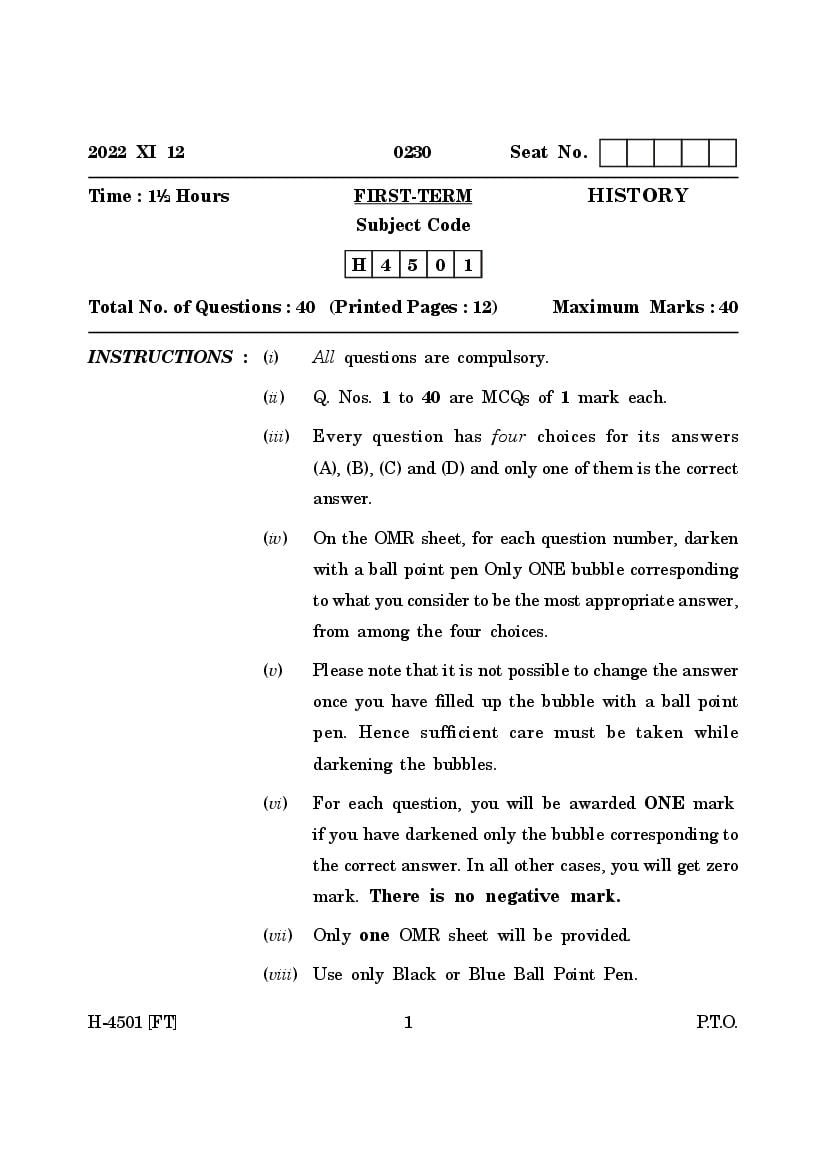
Time : 1½ Hours FIRST-TERM HISTORY
Subject Code
H 4 5 0 1
Total No. of Questions : 40 (Printed Pages : 12) Maximum Marks : 40
INSTRUCTIONS : (i) All questions are compulsory.
(ii) Q. Nos. 1 to 40 are MCQs of 1 mark each.
(iii) Every question has four choices for its answers
(A), (B), (C) and (D) and only one of them is the correct
answer.
(iv) On the OMR sheet, for each question number, darken
with a ball point pen Only ONE bubble corresponding
to what you consider to be the most appropriate answer,
from among the four choices.
(v) Please note that it is not possible to change the answer
once you have filled up the bubble with a ball point
pen. Hence sufficient care must be taken while
darkening the bubbles.
(vi) For each question, you will be awarded ONE mark
if you have darkened only the bubble corresponding to
the correct answer. In all other cases, you will get zero
mark. There is no negative mark.
(vii) Only one OMR sheet will be provided.
(viii) Use only Black or Blue Ball Point Pen.
H-4501 [FT] 1 P.T.O.
Page 2
from the sites in ................................
(A) Gujarat
(B) Rajasthan
(C) Haryana
(D) Afghanistan
2. Archaeologist have found evidence of a ploughed field in the Harappan site
at ................................
(A) Shortughai
(B) Dholavira
(C) Kalibangan
(D) Banawali
3. One of the most distinctive feature of the Harappan cities was the carefully
planned ...............................
(A) Wells
(B) Drainage system
(C) Roads
(D) Agriculture
4. In the Harappan site, a large rectangular tank in a courtyard surrounded
by a corridor is called the ...........................
(A) Residential house
(B) Warehouse
(C) Great bath
(D) Citadel
H-4501 [FT] 2
Page 3
amongst the harappans by studying the ..............................
(A) Subsistence strategies
(B) Sealings
(C) Domestic architecture
(D) Burials
6. A tiny settlement in the Harappa exclusively devoted to the craft production
was ....................................
(A) Cholistan
(B) Shortughai
(C) Kalibangan
(D) Chanhudaro
7. In the Harappan civilisation, Nageshwar and Balakot were specialised centres
that produced ..............................
(A) Gold objects
(B) Terracotta artefacts
(C) Shell objects
(D) Stone artefacts
8. In the Harappan civilisation, archaeological finds suggest that Oman
supplied ..............................
(A) Copper
(B) Lapis Lazuli
(C) Carnelian
(D) Shells
H-4501 [FT] 3 P.T.O.
Page 4
stone called ...................................
(A) Lapis Lazuli
(B) Quartz
(C) Carnelian
(D) Chert
10. In 1924, the announcement of the discovery of a new civilisation in the
Indus valley was made by .................................
(A) Daya Ram Sahni
(B) S.N. Roy
(C) John Marshall
(D) Alexander Cunningham
11. The two earliest scripts, Brahmi and Kharosthi have been deciphered by ........
(A) Kushanas
(B) Harishena
(C) Megasthenes
(D) James Prinsep
12. Between the sixth and the fourth centuries BCE, the most powerful
Mahajanapada was .....................................
(A) Kuru
(B) Magadha
(C) Avanti
(D) Kosala
H-4501 [FT] 4
Page 5
surfaces was .......................................
(A) Mahapadma Nanda
(B) Ajatasatru
(C) Asoka
(D) Bimbisara
14. The language of the Prayaga Prashasti was .............................
(A) Pali
(B) Sanskrit
(C) Prakrit
(D) Tamil
15. The inscriptions on grants of land were made and recorded in the early
centuries are found on the ....................................
(A) Coins
(B) Copper plates
(C) Precious stones
(D) Stone plates
16. According to the Jaina teachings, the cycle of birth and rebirth is shaped
through ........................................
(A) Dharma
(B) Karma
(C) Sangha
(D) Chaityas
H-4501 [FT] 5 P.T.O.
Page 6
(A) Mahavamsa
(B) Dipavamsa
(C) Jatakas
(D) Sutta Pitaka
18. The first woman to be ordained as a bhikkhuni was ............................
(A) Maya
(B) Gajalakshmi
(C) Mahapajapati Gotami
(D) Shalabhanjika
19. The symbol, ‘wheel’ stood for the first sermon of the Buddha delivered at .......
(A) Sanchi
(B) Kusinara
(C) Lumbini
(D) Sarnath
20. A tall structure built over the central shrine of temple is called ..................
(A) Garbhagriha
(B) Shikhara
(C) Stupa
(D) Caves
H-4501 [FT] 6
Page 7
...............................
(A) Andal
(B) Nirguna
(C) Saguna
(D) Nayanars
22. The Lingayats of the 12th century in Karnataka had revered wandering
monks called ..................................
(A) Nalayira
(B) Jangama
(C) Sufis
(D) Karaikkal
23. The Kabirpanth in Varanasi and elsewhere in Uttar Pradesh preserved
the .............................
(A) Kabir Bijak
(B) Kabir Granthavali
(C) Adi Granth Sahib
(D) Ulatbansi
24. Baba Guru Nanak proposed a simple way to connect to the Divine Name
through hymns called ....................................
(A) Rabab
(B) Mardana
(C) Shabad
(D) Sangat
H-4501 [FT] 7 P.T.O.
Page 8
devotee of ..................................
(A) Shiva
(B) Krishna
(C) Vardhaman Mahavir
(D) Linga
26. The ruins at Hampi were brought to light in 1800 by .........................
(A) James Ferguson
(B) Abdur Razzaq
(C) Colonel Colin Mackenzie
(D) Nicolo de Conti
27. In the Vijayanagara Empire, local communities of merchants called Kudirai
Chettis were trading in .......................................
(A) Horses
(B) Elephants
(C) Precious stones
(D) Textiles
28. Krishnadeva Raya founded a Suburban township near Vijayanagara called
...................................
(A) Thanjavur
(B) Nagalapuram
(C) Belur
(D) Hoysalas
H-4501 [FT] 8
Page 9
(A) Orissa
(B) Bijapur
(C) Hampi
(D) Penukonda
30. A major political innovation of the Vijayanagara Empire was the system
of ...............................
(A) Yavana
(B) Samanta
(C) Amara-Nayaka
(D) Iqta
31. One of the most prominent water works among the ruins of Vijayanagara
was ..........................................
(A) Tungabhadra
(B) Hiriya Canal
(C) Kaveri
(D) Krishna
32. The sixteenth-century Portuguese traveller in the Vijayanagara Empire who
described houses was ..................................
(A) Nikitin
(B) Duarte Barbosa
(C) Fernao Nuniz
(D) Domingo Paes
H-4501 [FT] 9 P.T.O.
Page 10
in the Vijayanagara Empire is called the .................................
(A) Lotus Mahal
(B) Royal Centre
(C) Mahanavami Dibba
(D) Audience hall
34. The Vijayanagara kings claimed to rule on behalf of the God .......................
(A) Brihadishvara
(B) Shiva
(C) Vitthala
(D) Virupaksha
35. In the Vijayanagara Empire, the presence of the temple from a distance is
noticed due to .....................................
(A) Mandapas
(B) Halls
(C) Gopurams
(D) Carved Pillars
36. The non-resident cultivators who cultivated lands elsewhere in the Mughal
Empire were called ...................................
(A) Raiyat
(B) Pahi-Kashta
(C) Muzarian
(D) Khud-Kashta
H-4501 [FT] 10
Page 11
the region of ....................................
(A) Delhi
(B) Bengal
(C) Agra
(D) Punjab
38. In the Mughal Empire, the Bhils reserved autumn and winter season for ............
(A) Hunting
(B) Cultivation
(C) Fishing
(D) Gathering
39. The Zamindars held extensive personal lands in the Mughal Empire called
...................................
(A) Pargana
(B) Subha
(C) Jagirs
(D) Milkiyat
40. The Revenue Collectors in the Mughal state were called ............................
(A) Daftar
(B) Sanad
(C) Amil-guzar
(D) Qilachas
H-4501 [FT] 11 P.T.O.
Page 12
Document Details
| Board / Org | Goa Board |
| Exam | Class 12 |
| Type | Question Paper |
| Pages | 12 |
| Updated | 24 Sep 2026 |