AHSEC HS 2nd Year Question Paper 2019 Sociology
Finished viewing? Save it for later —
Download AHSEC HS 2nd Year Question Paper 2019 Sociology (PDF · 8 pages)About AHSEC HS 2nd Year Question Paper 2019 Sociology
AHSEC HS 2nd Year Question Paper 2019 Sociology is available here for free download. Published by Assam Board for Class 12, this question paper can be viewed online or downloaded as a PDF (8 pages). Candidates preparing for Class 12 can use AHSEC HS 2nd Year Question Paper 2019 Sociology to understand the exam pattern, the type of questions asked, and the overall difficulty level.
Frequently Asked Questions
How can I download AHSEC HS 2nd Year Question Paper 2019 Sociology?
Open this page and click the Download button to save AHSEC HS 2nd Year Question Paper 2019 Sociology as a PDF. It is completely free on AglaSem Docs.
Is AHSEC HS 2nd Year Question Paper 2019 Sociology free to download?
Yes. AHSEC HS 2nd Year Question Paper 2019 Sociology can be viewed online and downloaded as a PDF free of cost on AglaSem Docs.
How many pages does AHSEC HS 2nd Year Question Paper 2019 Sociology have?
AHSEC HS 2nd Year Question Paper 2019 Sociology contains 8 pages, which you can read online or download together as a single PDF.
Where can I find more Class 12 study material?
You can find more Class 12 question papers, sample papers, syllabus, and answer keys on AglaSem Docs.
AHSEC HS 2nd Year Question Paper 2019 Sociology – Text
Read the full text of this question paper below — useful to quickly search, copy and reference the content online without downloading the PDF.
📄 View text version (8 pages)
Page 1
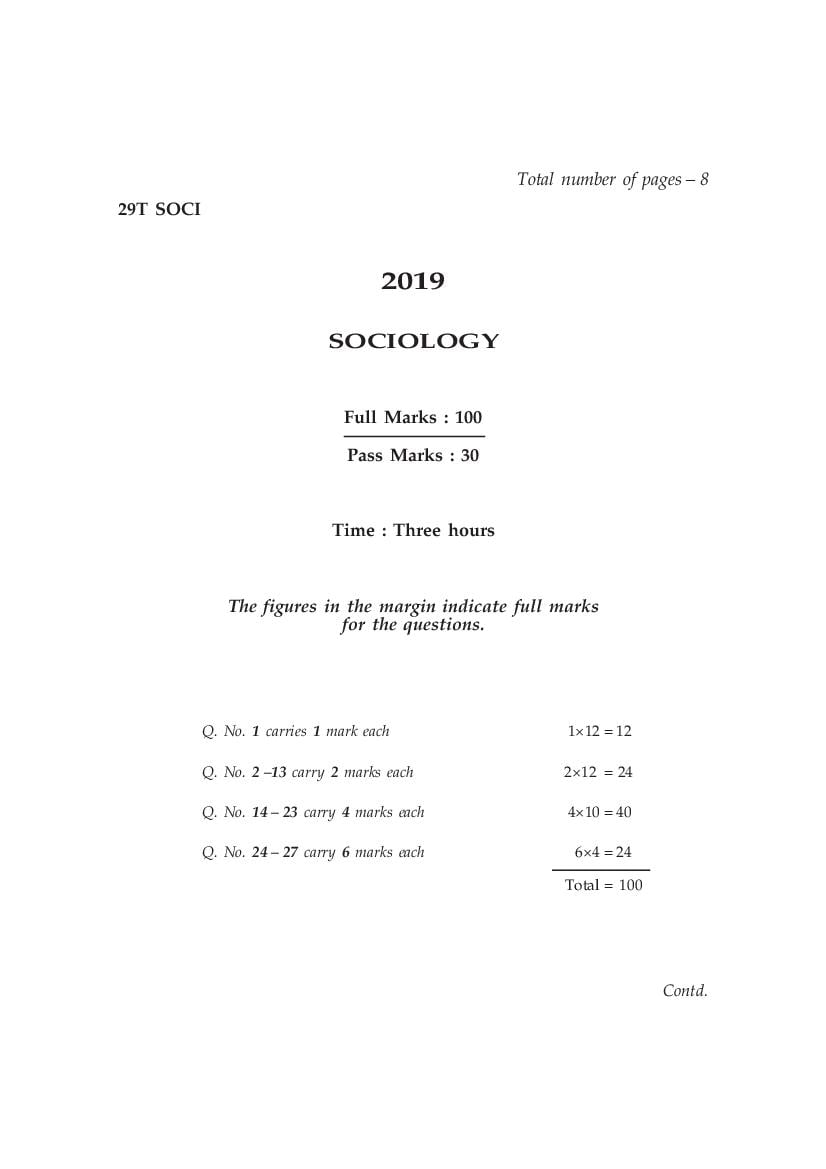
29T SOCI
2019
SOCIOLOGY
Full Marks : 100
Pass Marks : 30
Time : Three hours
The figures in the margin indicate full marks
for the questions.
Q. No. 1 carries 1 mark each 1×12 = 12
Q. No. 2 –13 carry 2 marks each 2×12 = 24
Q. No. 14 – 23 carry 4 marks each 4×10 = 40
Q. No. 24 – 27 carry 6 marks each 6×4 = 24
Total = 100
Contd.
Page 2
Ó¬˘1 õ∂ùü¸˜”˝√ 1 ά◊M√1 ø√˚˛± –
(a) What is infant mortality rate ?
ø˙q1 ˜‘Ó≈”¬…1 ˝±1 ˜±ÀÚ øfl¬∑
(b) Who put forward the occupational theory of Caste ?
ʱøÓ¬1 ¬ı‘øM˚˛±Rfl¬ ø¸X√√±ôLÀȬ± Œfl¬±ÀÚ ’±·¬ıϬˇ±˝◊ø¢∑
(c) In which year, India introduced National Family Planning
Programme ?
Œfl¬±Ú‰¬ÚÓ¬ ˆ¬±1Ó¬¬ı¯∏«˝◊ 1±©Üòœ˚˛ ¬Ûø1˚˛±˘ ¬Ûø1fl¬äÚ± ’±“‰¬øÚ ¬ı˘¬ı» fl¬ø1ø¢∑
(d) Who formed the All India Scheduled Caste Federation ?
¸¬ı«ˆ¬±1Ó¬œ˚˛ ’Ú≈¸”ø‰¬Ó¬ ʱøÓ¬ ¬Ûø1¯∏ Œfl¬±ÀÚ ·Í¬Ú fl¬ø1ø¢∑
(e) What is ‘dominant Caste’ ?
√õ∂ˆ¬±ª˙±˘œ ʱøÓ¬ ˜±ÀÚ øfl¬∑
(f) What is Structural Change ?
¸—1‰¬Ú±Rfl¬ ¬Ûø1¬ıÓ«¬Ú øfl¬∑
(g) Srinivas suggested that while ‘lower castes’ sought to be
Sanskritised, ‘upper castes’ sought to be ——————. (Fill in the gaps)
¿øÚ¬ı±À¸ Δfl¬ø¢ Œ˚ ø˚¸˜˚˛Ó¬ ëøÚ•ß Ê±øÓ¬À˚˛í ¸—¶®‘Ó¬fl¬1Ì1 ¬ÛÔ Δ˘ø¢ ëÎ◊¬2‰¬ ʱøÓ¬À˚˛í
Œ¸˝◊ ¸˜˚˛Ó¬ —————— ’Ú≈fl¬1Ì fl¬ø1ø¢º [‡±˘œ ͬ±˝◊ ¬Û”1Ì fl¬1±]
(h) What is the full form of ‘ICDS’ ?
ICDS - 1 ¸•Û”Ì« 1+¬Û øfl¬∑√
(i) Write one negative Consequence of Green Revolution.
Œ¸Î◊¬Êø¬ı¬Ûvª1 ¤È¬± Ÿ¡Ì±Rfl¬ Ù¬˘±Ù¬˘ Î◊¬À~‡ fl¬1±º
29T SOCI [2]
Page 3
Î◊¬M1¬Û”¬ı ˆ¬±1Ó¬1 ¤È¬± ÊÚʱøÓ¬1 Ú±˜ Î◊¬À~‡ fl¬1±º
(k) —————— Movement was a struggle of sharecroppers in Bengal and
in Bihar that took place in the year 1946. (Fill in the blanks)
1946 ‰¬ÚÓ¬ ¬ı—· ’±1n∏ ø¬ı˝±1Ó¬ ’±øÒ˚˛±1 Œ‡øÓ¬˚˛fl¬¸fl¬À˘ fl¬1± ’±Àμ±˘ÚøȬ1 Ú±˜
’±ø¢——————º [‡±˘œ ͬ±˝◊ ¬Û”1Ì fl¬1±]
(l) Mention a social responsibility of the Panchayat System.
¬Û=±˚˛Ó¬ ¬ı…ª¶ö±1 ¤È¬± ¸±˜±øÊfl¬ ±ø˚˛Q Î◊¬À~‡ fl¬1±º
2. Write two importance of study of demography. 2
ÊÚ¸—‡…± ’Ò…˚˛Ú1 ≈Ȭ± &1n∏ Q ø˘‡±º
3. Define Social Institution and write one example. 2
¸±˜±øÊfl¬ ¸—¶ö±1 ¸—:± ø˚˛± ’±1n∏ ¤È¬± Î◊¬±˝1Ì ø˘‡±º
4. What is the difference between matrilined and matriarchal family. 2
˜±Ó‘¬¬ı—˙œ˚˛ ’±1n∏ ˜±Ó‘¬√õ∂Ò±Ú ¬Ûø1˚˛±˘1 ˜±Ê1 ¬Û±Ô«fl¬…ÀȬ± øfl¬ ø˘‡±º
5. Define ‘Communalism’ with one example. 2
Î◊¬±˝1̸˝ ¸±•x±ø˚˛fl¬Ó¬±¬ı±1 ¤È¬± ¸—:± ø˚˛±º
6. Write two features of Caste System in India. 2
ˆ¬±1Ó¬¬ı¯∏«1¬ ¬Ê±øÓ¬¬ı…ª¶ö±1 ≈Ȭ± Δ¬ıø˙©Ü… ø˘‡±º
7. Write two Powers delegated to the Panchayats in India. 2
ˆ¬±1Ó¬¬ı¯∏«Ó¬ ¬¬¬Û=±˚˛Ó¬ ¬ı…ª¶ö±1 ˝±Ó¬Ó¬ Ôfl¬± ≈Ȭ± 鬘Ӭ±1 ø¬ı¯∏À˚˛ ø˘‡±º
29T SOCI [3] Contd.
Page 4
’±Ò≈øÚfl¬œfl¬1Ì1 ≈Ȭ± fl¬±1fl¬ Î◊¬À~‡ fl¬1±º
9. Write two functions of Political Parties in a democracy. 2
·ÌÓ¬LaÓ¬ 1±ÊÕÚøÓ¬fl¬ ˘1 ≈Ȭ± fl¬±˚« ø˘‡±º
10. What is environmental movement ? Give one example. 2
¬¬Ûø1À¬ı˙Ó¬±øLafl¬ ’±Àμ±˘Ú øfl¬∑ ¤È¬± Î◊¬±˝1Ì ø˚˛±º
11. Write two Social functions of family. 2
¬Ûø1˚˛±˘1 ≈Ȭ± ¸±˜±øÊfl¬ fl¬±˚« ø˘‡±º
12. Define Social Stratification and give one example of Social Stratification.
2
¸±˜±øÊfl¬ ô¶1œfl¬1Ì1 ¸—:± ’±1n∏ ¸±˜±øÊfl¬ ô¶1œfl¬1Ì1 ¤È¬± Î◊¬±˝1Ì ø˚˛±º
13. What is a reform movement ? Mention one reform movement of India.
2
¬¸—¶®±1 ’±Àμ±˘Ú øfl¬∑ ˆ¬±1Ó¬1 ¤È¬± ¸—¶®±1 ’±Àμ±˘Ú Î◊¬À~‡ fl¬1±º
14. Write four causes of change in the family system of India.
4
ˆ¬±1Ó¬œ˚˛ ¬Ûø1˚˛±˘ ¬ı…¬ı¶ö±Ó¬ ¬Ûø1¬ıÓ«¬Ú ’Ú± ‰¬±ø1Ȭ± fl¬±1fl¬1 ø¬ı¯∏À˚˛ ø˘‡±º
Write what changes do you see in the caste system at present.
4
¬ıÓ«¬˜±Ú ʱøÓ¬¬ı…ª¶ö±1 øfl¬ ¬Ûø1¬ıÓ«¬ Ú Œø‡Â±, ø˘‡±º
29T SOCI [4]
Page 5
¶§ÊÚ ¬¬ÛX√√øÓ¬1 fl¬±˚« ¸˜”˝ 1 ø¬ı¯∏À˚˛ ø˘‡±º
Write the salient features of Social Class.
4
¸±˜±øÊfl¬ Œ|Ìœ1 Δ¬ıø˙©Ü… ¸˜”˝ ø˘‡±º
16. What is the meaning of Mass media ? What are its wide variety of forms ?
4
ë·Ì˜±Ò…˜í ˜±ÀÚ øfl¬ ¬¬ı≈ʱ∑ ·Ì˜±Ò…˜1 ø¬ıøˆ¬iß √õ∂fl¬±1 ¸˜”˝ ø˘‡±º
Write a brief note on the Dalit Movement in India.
4
ˆ¬±1Ó¬¬ı¯∏«1 ëø˘Ó¬ ’±Àμ±˘Ú1í ø¬ı¯∏À˚˛ ‰¬˜≈Õfl¬ ø˘‡±º
17. Write briefly about the National Family Welfare Programme. 4
‰¬˜≈Õfl¬ 1±©Üòœ˚˛ ¬Ûø1˚˛±˘ fl¬˘…±Ì fl¬±˚«…¸”‰¬œ1 ø¬ı¯∏À˚˛ ø˘‡±º
18. Write four conditions necessary for the success of democracy. 4
·ÌÓ¬La1 ¸Ù¬˘Ó¬±1 ¬ı±À¬ı ‰¬±ø1Ȭ± ¬ı…ª¶ö±ª˘œ ø˘‡±º
What is regionalism ? What are the causes of growth of regionalism ? 4
’±=ø˘fl¬Ó¬±¬ı± øfl¬∑ ’±=ø˘fl¬Ó¬±¬ı± ·øϬˇ Î◊¬Í¬±1 fl¬±1Ì ¸˜”˝ øfl¬∑
29T SOCI [5] Contd.
Page 6
4
Î◊¬±1œfl¬1Ì ÚœøÓ¬1 ‰¬±ø1Ȭ± Δ¬ıø˙©Ü… ø˘‡±º
Write in brief the impact of globalisation in India. 4
ˆ¬±1Ó¬¬ı¯∏«Ó¬ Œ·±˘fl¬œfl¬1Ì1 √õ∂ˆ¬±ª ¸•ÛÀfl«¬ ‰¬˜≈Õfl¬ ø˘‡±º
20. Write the differences between Social demography and formal
demography. 4
¬¸±˜±øÊfl¬ ÊÚ¸±—ø‡…fl¬Ó¬N ’±1n∏ ’±Ú≈ᬱøÚfl¬ ÊÚ¸±—ø‡…fl¬Ó¬N1 ˜±Ê1 ¬Û±Ô«fl¬…¸˜”˝ ø˘‡±º
21. Write four features of Communalism. 4
¸±•x±ø˚˛fl¬Ó¬±¬ı±1 ‰¬±ø1Ȭ± Δ¬ıø˙©Ü… ø˘‡±º
22. What are the Constitutional Provisions for the minorities and cultural
diversity in India ? 4
¸—‡…±˘‚≈ ’±1n∏ ¸±—¶®‘øÓ¬fl¬ ø¬ıø‰¬SÓ¬±1 ¸μˆ«¬ Ó¬ ˆ¬±1Ó¬œ˚˛ ¸—ø¬ıÒ±ÀÚ ’±·¬ıÀϬˇ±ª± Î◊¬¬Û˚≈Mê ¬ı…ª¶ö±
¸•ÛÀfl«¬ ø˘‡±º
Justify ‘caste is a closed Stratification.’
4
ëʱøÓ¬ ¤fl¬ ¬ıg¬ ô¶1œfl¬1Ìí ø˝‰¬±À¬Û ø¬ı‰¬±1 fl¬1±º
23. Mention four remedies of Casteism. 4
ʱøÓ¬¬ı± ”1œfl¬1Ì1 ‰¬±ø1Ȭ± Î◊¬¬Û±˚˛ Î◊¬À~‡ fl¬1±º
29T SOCI [6]
Page 7
Indian Society. 2+4=6
¸—¶®‘Ó¬fl¬1Ì1 ¸—:± ø˚˛±º ¸—¶®‘Ó¬fl¬1ÀÌ ˆ¬±1Ó¬œ˚˛ ¸˜±ÊÕ˘ fl¬øϬˇ˚˛±˝◊ ’Ú± ¬Ûø1¬ıÓ«¬ Ú¸˜”˝ 1 ø¬ı¯∏À˚˛
ø˘‡±º
25. Discuss the Malthusian Theory of Population Growth. 6
˜±˘Ô±Â1 ÊÚ¸—‡…± ¬ı‘øX√√1 Ó¬NÀȬ± ’±À˘±‰¬Ú± fl¬1±º
26. Write a note on Untouchability. 6
’¶Û‘˙…Ó¬±1 ø¬ı¯∏À˚˛ ¤È¬± ŒÈ¬±fl¬± ø˘‡±º
27. Discuss the Social Problems of the Scheduled Castes. 6
’Ú≈¸”ø‰¬Ó¬ ʱøÓ¬1 ¸±˜±øÊfl¬ ¸˜¸…±À¬ı±1 ’±À˘±‰¬Ú± fl¬1±º
“Indian Society is a Plural Society.’ — Justify the statement. 6
ë눬±1Ó¬œ˚˛¸˜±Ê ¤‡Ú ¬ıUÒ±øˆ¬øM¬fl¬ ¸˜±Êºíí Î◊¬øMêÀȬ± ø¬ı‰¬±1 fl¬1±º
———— ×————
29T SOCI [7]
Page 8
Document Details
| Board / Org | Assam Board |
| Exam | Class 12 |
| Type | Question Paper |
| Pages | 8 |
| Updated | 09 Jun 2026 |