CUSAT CAT 2016 Question Paper Geology
Finished viewing? Save it for later —
Download CUSAT CAT 2016 Question Paper Geology (PDF · 31 pages)About CUSAT CAT 2016 Question Paper Geology
CUSAT CAT 2016 Question Paper Geology is available here for free download. Published by Cochin University for CUSAT Common Admission Test, this question paper can be viewed online or downloaded as a PDF (31 pages). Candidates preparing for CUSAT Common Admission Test can use CUSAT CAT 2016 Question Paper Geology to understand the exam pattern, the type of questions asked, and the overall difficulty level.
Frequently Asked Questions
How can I download CUSAT CAT 2016 Question Paper Geology?
Open this page and click the Download button to save CUSAT CAT 2016 Question Paper Geology as a PDF. It is completely free on AglaSem Docs.
Is CUSAT CAT 2016 Question Paper Geology free to download?
Yes. CUSAT CAT 2016 Question Paper Geology can be viewed online and downloaded as a PDF free of cost on AglaSem Docs.
How many pages does CUSAT CAT 2016 Question Paper Geology have?
CUSAT CAT 2016 Question Paper Geology contains 31 pages, which you can read online or download together as a single PDF.
Where can I find more CUSAT Common Admission Test study material?
You can find more CUSAT Common Admission Test question papers, sample papers, syllabus, and answer keys on AglaSem Docs.
CUSAT CAT 2016 Question Paper Geology – Text
Read the full text of this question paper below — useful to quickly search, copy and reference the content online without downloading the PDF.
📄 View text version (31 pages)
Page 1
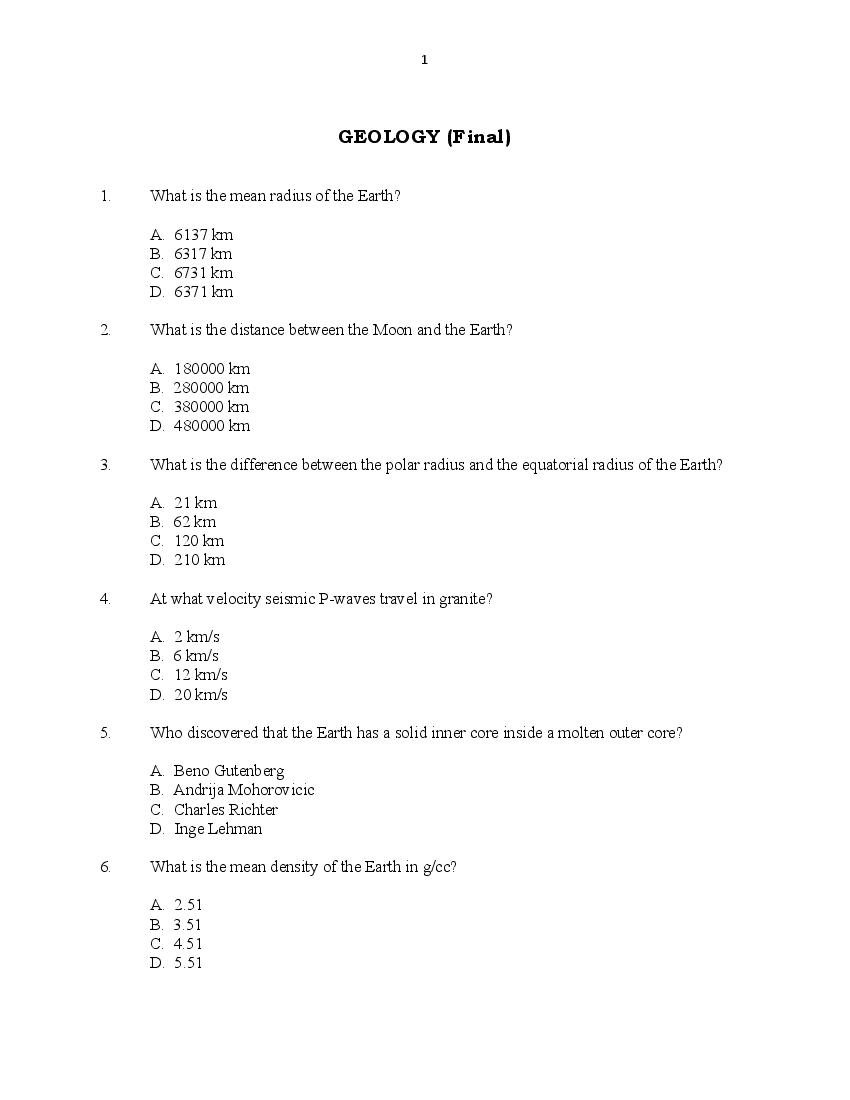
GEOLOGY (Final)
1. What is the mean radius of the Earth?
A. 6137 km
B. 6317 km
C. 6731 km
D. 6371 km
2. What is the distance between the Moon and the Earth?
A. 180000 km
B. 280000 km
C. 380000 km
D. 480000 km
3. What is the difference between the polar radius and the equatorial radius of the Earth?
A. 21 km
B. 62 km
C. 120 km
D. 210 km
4. At what velocity seismic P-waves travel in granite?
A. 2 km/s
B. 6 km/s
C. 12 km/s
D. 20 km/s
5. Who discovered that the Earth has a solid inner core inside a molten outer core?
A. Beno Gutenberg
B. Andrija Mohorovicic
C. Charles Richter
D. Inge Lehman
6. What is the mean density of the Earth in g/cc?
A. 2.51
B. 3.51
C. 4.51
D. 5.51
Page 2
7. Which of the following is the most dominant mineral in granite?
A. Quartz
B. Feldspar
C. Hornblende
D. Biotite
8. To measure which of the following, a contact goniometer is used?
A. Optical angle of minerals
B. Hardness of minerals
C. Reflectance of minerals
D. Interfacial angle of crystals
9. Match the twin law/type with the appropriate mineral
1. Brazil a. Plagioclase
2. Iron cross b. Gypsum
3. Manebach c. Quartz
4. Pericline d. Pyrite
5. Swallo-tail e. Orthoclase
A. 1a-2b-3c-4d-5e
B. 1a-2c-3e-4d-5b
C. 1c-2b-3a-4e-5b
D. 1c-2d-3e-4a-5b
10. Which of the following can not become a twin axis?
A. 2-fold symmetry axis
B. 3-fold symmetry axis
C. 4-fold symmetry axis
D. 6-fold symmetry axis
Page 3
11. Match the twin law/type with the appropriate crystal system.
1. Dauphine a. Isometric
2. Iron-cross b. Tetragonal
3. Genticulated c. Monoclinic
4. Pericline d. Trigonal
5. Swallo-tail e. Triclinic
A. 1a-2b-3c-4d-5e
B. 1a-2b-3d-4e-5c
C. 1d-2a-3e-4b-5c
D. 1d-2a-3b-4e-5c
12. Which of the following minerals has the highest content of iron in it?
A. Magnetite
B. Hematite
C. Ilmenite
D. Wustite
13. Which of the following is not an ore of copper?
A. Pyrite
B. Chalcopyrite
C. Malachite
D. Azurite
14. Which of the following rocks hosts diamond?
A. Carbonatite
B. Komatiite
C. Lamprophyre
D. Lamproite
15. What is the interfacial angle between two adjacent faces of a hexagonal prism (in
degrees) ?
A. 30
B. 60
C. 120
D. 180
Page 4
16. What is the Si:O ratio in single chain inosilicates?
A. 1 : 2
B. 1 : 3
C. 1:4
D. 2:7
17. Which among the following is not a cyclosilicate?
A. Beryl
B. Cordierite
C. Epidote
D. Tourmaline
18. Which of the following is not a metamorphic mineral?
A. Kyanite
B. Sillimanite
C. Fayalite
D. Graphite
19. Which of the following is characteristically formed at convergent plate margins?
A. Andesites
B. Basalts
C. Pillow lavas
D. Tholeiites
20. Which are the two common minerals in amphibolites?
A. Actinolite and tremolite
B. Amphibole and pyroxene
C. Hornblende and plagioclase
D. Ortho and clino amphiboles
21. Which of the following is a landform formed by the coalescing of alluvial fans?
A. Cuesta
B. Fjord
C. Bajada
D. Delta
Page 5
22. Which of the following indicates an abrupt inflection of the longitudinal profile of a
stream?
A. Pivot point
B. Inflection point
C. Knick point
D. Escarpment
23. What is the depth of the abyssal plain?
A. 1-3 km
B. 3-6 km
C. 6-9 km
D. 8-10 km
24. Which of the following refers specifically to glacial melting and removal of materials?
A. Corrosion
B. Corrasion
C. Ablation
D. Deflation
25. Which of the following geomorphic features represents the sea-ward end of a deeply
excavated glacial trough valley?
A. Kettle
B. Moraine
C. Hogback
D. Fjord
26. To which of the following terms the models of Airy and of Pratt are related to?
A. anatexis
B. isostacy
C. peneplanation
D. charnockitization
27. Which is not a carbonate mineral?
A. aragonite
B. barite
C. strontianite
D. witherite
Page 6
Page 7
28. Match the chemical group with the appropriate mineral.
1. Oxide a. Monazite
2. Sulphide b. Ilmenite
3. Sulphate c. Anhydrite
4. Phosphate d. Siderite
5. Carbonate e. Cinnabar
A. 1b-2e-3c-4a-5d
B. 1a-2c-3e-4d-5b
C. 1b-2c-3a-4e-5b
D. 1c-2d-3e-4a-5b
29. Match the mineral with the appropriate family/group
1. Nepheline a. Feldspar
2. Omphacite b. Feldspathoid
3. Sanidine c. Pyroxene
4. Anthophyllite d. Amphibole
5. Uvarovite e. Garnet
A. 1a-2c-3b-4d-5e
B. 1a-2c-3d-4e-5b
C. 1b-2c-3a-4d-5e
D. 1b-2d-3e-4a-5c
30. Match the twin law/type with the appropriate mineral.
1. Brazil a. Plagioclase
2. Iron cross b. Gypsum
3. Manebach c. Quartz
4. Pericline d. Pyrite
5. Swallo-tail e. Orthoclase
A. 1a-2b-3c-4d-5e
B. 1a-2c-3d-4d-5b
C. 1c-2b-3a-4e-5b
D. 1c-2d-3e-4a-5b
31. Which of the following is not a solid solution pair?
A. magnetite-ilmenite
B. quartz-cristobalite
Page 8
C. enstatite-diopside
D. actinolite-tremolite
32. Match the mineral with the appropriate family/group
1. Sodalite a. Nesosilicate
2. Hypersthene b. Cyclosilicate
3. Fuchsite c. Phyllosilicate
4. Tourmaline d. Inosilicate
5. Fayalite e. Tectosilicate
A. 1a-2c-3b-4d-5e
B. 1a-2c-3d-4e-5b
C. 1e-2d-3c-4b-5a
D. 1b-2d-3e-4a-5c
33. Match the minerals with the appropriate optical property
1. Quartz a. dichroism
2. Zircon b. low relief
3. Almandine c. high relief
4. Tourmaline d. twinkling
5. Calcite e. complete extinction throughout rotation
A. 1b-2c-3d-4a-5e
B. 1b-2c-3e-4a-5d
C. 1e-2d-3c-4a-5b
D. 1b-2d-3e-4a-5c
34. Which of the following is the basis for deciding the optic sign of a uniaxial mineral?
A. whether the e-ray or o-ray coincides with the c-axis
B. relative velocity of e-ray and o-ray
C. position of acute and obtuse bisectrices
D. relativerelief of the mineral
Page 9
35. Match the mineral with the appropriate optical class
1. Spinel a. uniaxial positive
2. Zircon b. uniaxial negative
3. Tourmaline c. biaxial positive
4. Muscovite d. biaxial negative
5. Gypsum e. isotropic
A. 1c-2a-3b-4d-5e
B. 1c-2a-3b-4e-5d
C. 1e-2a-3b-4d-5c
D. 1e-2a-3b-4c-5d
36. Which is the correct arrangement of minerals with their decreasing density?
A. Magnetite - Native gold - Bartite-Cinnabar
B. Native gold - Cinnabar - Barite – Magnetite
C. Native gold – Cinnabar –Magnetite –Barite
D. Cinnabar – Native gold –Magnetite – Barite
37. Match the ore minerals with the corresponding metals in them
1. Malachite a. iron
2. Magnetite b. copper
3. Manghanite c. manganese
4. Smithsonite d. zinc
5. Galena e. lead
A. 1c-2a-3b-4d-5e
B. 1b-2a-3c-4d-5e
C. 1e-2a-3b-4d-5c
D. 1e-2a-3b-4c-5d
38. Which property imparts cat’s eye status to gemstones?
A. dispersion
B. internal reflection
C. chatoyancy
D. birefringence
Page 10
39. In which crsytal system the mineral halite crystallises?
A. isometric
B. tetragonal
C. hexagonal
D. monoclinic
40. With which of the following, the mineral rutile is polymorphous?
A. Ilmenite
B. anatase
C. titanite
D. pseudorutile
41. For which of the following minerals the type locality belongs to Kerala?
A. sillimanite
B. monazite
C. chrysoberyl
D. cheralite
42. Match the industrial minerals with the corresponding uses
1. barite a. gemstone
2. kyanite b. insulator
3. gypsum c. cement industry
4. vermiculite d. refractory
5. chrysoberyl e. drilling mud
A. 1c-2d-3b-4e-5a
B. 1e-2d-3c-4b-5a
C. 1e-2c-3b-4d-5a
D. 1e-2d-3b-4c-5a
43. Validate the correctness of the given statements
1. An isometric mineral can never be pleochroic
2. All dichroic minerals are biaxial
3. All opaque minerals are isotropic
4. No 2V can be measured for Tetragonal minerals
A. Statements 1 and 2 are correct, other two are incorrect
B. Statements 1 and 3 are correct, other two are incorrect
Page 11
C. Statements 2 and 4 are correct, other two are incorrect
D. Statements 1 and 4 are correct, other two are incorrect
44. Which of the following is not a basic quality of a mineral to form a placer deposit?
A. high hardness
B. metallic nature
C. resistance to weathering
D. high specific gravity
45. Match the economic mineral deposit with their main process of formation.
1. Ilmenite a. early magmatic segregates
2. Bauxite b. pegmatitic
3. Tourmaline c. hydrothermal
4. Chromite d. residual deposit
5. Copper e. placer
A. 1a-2d-3b-4e-5c
B. 1e-2a-3b-4d-5c
C. 1e-2d-3b-4a-5c
D. 1a-2e-3b-4d-5c
46. Which are the three most valuable mineral wealth produced by India in recent years?
A. Coal, petroleum, and iron ore
B. Coal, gold and copper
C. Coal, gold and ilmenite
D. Copper, iron ore and gold
47. For which of the mineral deposit India is the largest producer in the world?
A. coal
B. iron ore
C. gold
D. kyanite
48. Which of the following is the term used to refer to a confining bed that retards but does
not prevent the flow of water to or from an adjacent bed?
A. aquifer
B. aquifuge
C. aquiclude
D. aquitard
Page 12
49. What is the position of the perched water with respect to the water table?
A. just below the main water table
B. at same level as the water table
C. above the water table
D. either above or below the water table
50. What happens to the pH of groundwater when affected by marine incursion?
A. remains unchanged
B. increases
C. decreases
D. may either increase or decrease
51. In which of the terrains you can see sink-holes?
A. badlands
B. karst
C. lagoons
D. coral islands
52. How much percentage of the Earths’s crust is made up of sedimentary rocks?
A. 5%
B. 10%
C. 20%
D. 30%
53. To which category of rocks the ‘pyroclastics’ belong to?
A. sedimentary
B. volcanic
C. plutonic
D. metamorphic
54. What is the minimum extent of a batholith in map?
A. 20 sq km
B. 50 sq km
C. 100 sq km
D. 200 sq km
Page 13
55. What is the name given to short irregular dykes that extent from a pluton margin into the
country rocks?
A. stocks
B. bosses
C. roof pendants
D. apophyses
56. What is the major constituent of a holohyaline rock?
A. crystal
B. fossil
C. glass
D. secondary minerals
57. Which of the following is made up chiefly of subhedral grains?
A. phaneric
B. panidiomorphic
C. allotriomorphic
D. hypidiomorphic
58. Which minerals are involved in diabasic texture?
A. quartz and feldspar
B. plagioclase and orthoclase
C. diposide and hypersthenes
D. augite and plagioclase
59. What name to be given to a plutonic rock with 20% quartz, 60% plagioclase, 15 %
microcline and 5% biotite?
A. granite
B. granodiorite
C. diorite
D. syenite
60. In terms of the content of which mineral lherzolite differs from websterite?
A. olivine
B. orthopyroxene
C. clinopyroxene
D. hornblende
Page 14
Page 15
61. What is the plutonic equivalent of latite?
A. syenite
B. diorite
C. granodiorite
D. monzonite
62. What is the eutectic composition in the Diopside-Anorthite system?
A. An58 & Di 42
B. An42 & Di 58
C. An52 & Di 48
D. An48 & Di 52
63. Which of the rock can have the lowest content of silica?
A. carbonatite
B. kimberlite
C. lamprophyre
D. komatiite
64. Match the rock types with their corresponding place of occurrence
1. AmbaDongar a. Rhyloite
2. Sithampundi b. Anorthosite
3. Arsikere c. Granite
4. Putteti d. Syenite
5. Malani e. Carbonatite
A. 1e-2c-3b-4d-5a
B. 1a-2c-3e-4d-5b
C. 1c-2b-3a-4e-5b
D. 1e-2b-3c-4d-5a
65. What is the common range of silica (SiO2 wt.%) in basalts?
A. 35-42
B. 45-52
C. 55-62
D. 65-72
Page 16
66. Which rocks dominate the ophiolite complexes?
A. sedimentary
B. felsic and intermediate
C. mafic and intermediate
D. mafic and ultramafic
67. Which of the following terms refer to melting of crustal rocks?
A. metasomatism
B. differentiation
C. anatexis
D. partial melting
68. What is the diameter of ‘medium sand’ sediment?
A. 0.25 -0.50 mm
B. 0.50 -1.00 mm
C. 1.00 -2.00 mm
D. 2.00 -5.00 mm
69. What is the main chemical constituent of chert?
A. carbonates
B. silica
C. carbonaceous matter
D. biogenic matter
70. Which of the following is the most abundant in the Earth?
A. sandstones
B. mud rocks
C. carbonate rocks
D. carbonaceous rocks
71. What is the size range of microsparites?
A. 0.002 – 0.004 mm
B. 0.004 – 0.006 mm
C. 0.006 – 0.008 mm
D. 0.008 – 0.01 mm
Page 17
72. Which of the following terms refer to the parent rock from which a metamorphic rock is
derived?
A. provenance
B. protolith
C. source
D. facies
73. What is the lower temperature limit of metamorphism?
A. 100°C
B. 200°C
C. 300°C
D. 400°C
74. While describing which of the rock type the terms leucosome and nesosome are used?
A. carbonatite
B. kimberlite
C. lamprophyre
D. migmatite
75. Which pyroxene is typically seen in eclogites?
A. hypersthenes
B. augite
C. spodumene
D. omphacite
76. With which of these systems incongruent melting is associated?
A. Binary eutectic
B. Ternary eutectic
C. Solid solution
D. Peritectic
77. In which kind of rocks the mineral graphite is commonly seen?
A. sedimentary
B. volcanic
C. plutonic
D. metamorphic
Page 18
78. What is the product of high-grade metamorphism of shell-limestone?
A. Carbonatite
B. metapelite
C. khondalite
D. marble
79. Which of the following is not likely a metabasalt?
A. chlorite schist
B. amphibolites
C. mafic granulite
D. khondalite
80. Which of the following is a sedimentary structure produced by algal growth?
A. bioturbation
B. convolute lamination
C. stromatolites
D. graptolites
81. The term lacustrine corresponds to
A. glacial
B. stream
C. ocean
D. lake
82. In which of the following systems separate solidus and liquidus are present?
A. Binary eutectic
B. Ternary eutectic
C. Solid solution
D. Peritectic
83. What is the name given on map of metamorphic terrain to a line connecting points of first
appearance of a new mineral?
A. isoline
B. isograd
C. isograde
D. facies
Page 19
84. Which of the following is an ultramafic volcanic rock?
A. preridotite
B. dunite
C. tholeiitic basalt
D. komatiite
85. What is the characteristic petrographic feature of lamprophyres?
A. corona texture
B. layered structure
C. presence of olivine / pyroxene phenocrysts
D. presence of mica/ amphibole phenocrysts
86. What is the chief mineral in anorthosite?
A. anorthite
B. orthoclase
C. plagioclase
D. anorthoclase
87. The term kelphitic texture involves
A. corona with garnet or olivine
B. intergrowth of quartz and feldspar
C. rock melting
D. liquid immiscibility
88. Which of the following is a product of contact metamorphism?
A. charnockite
B. khondalite
C. hornfels
D. tektite
89. What is the common cause of origin of halite?
A. metamorphism
B. volcanism
C. sedimentation
D. evaporation
Page 20
90. Name the material produced along faults by rock crushing
A. Pseudotachylite
B. mylonite
C. gouge
D. slickeside
91. Myrmekite is an intergrowth between
A. Quartz and orthoclase
B. Quartz and plagioclase
C. Biotite and hornblende
D. Olivine and pyroxene
92. What property of a sediment/sedimentary rock is indicated by the term ‘sorting’?
A. Cementation
B. Compaction
C. Grain-size variation
D. Sphericity and roundness
93. Which is the correct order of increasing grade of metamorphism?
A. zeolite facies - albite-epidote facies- hornblende-hornfels facies - pyroxene
hornfels facies
B. albite-epidote facies- hornblende-hornfels facies - pyroxene-hornfels facies –
zeolite facies
C. albite-epidote facies- zeolite facies - hornblende-hornfels facies - pyroxene
hornfels facies
D. zeolite facies -albite-epidote facies - pyroxene hornfels facies - hornblende-hornfels
facies
94. Which of the following is not likely a metapelite?
A. Chlorite schist
B. Muscovite- garnet schist
C. Cordierite gneiss
D. Khondalite
Page 21
95. In the rocks of which geologic era the fossil graptolites occur ?
A. Paleozoic
B. Mesozoic
C. Cenozoic
D. Precambrian
96. What is the process of origin of skarn?
A. Metamorphism
B. Metasomatism
C. Evaporation
D. Diagenesis
97. Which of the following ores is chiefly mined from alluvial placers?
A. Monazite
B. Ilmenite
C. Cassiterite
D. Zircon
98. Which ore contribute maximum to the titanium production?
A. Titanite
B. Rutile
C. Ilmenite
D. Perovskite
99. Which of the following is stable at highest temperature?
A. Andalusite
B. Sillimanite
C. Kyanite
D. Staurolite
100. For which of these minerals the exploration is done based on its fluorescence property?
A. Nonazite
B. Uraninite
C. Scheelite
D. Diamond
Page 22
101. Which metal is extracted from the mineral wolframite?
A. Tin
B. Tungston
C. Tantalum
D. Platinum
102. With which type of rocks primary platinum ores are associated?
A. Felsic rocks
B. Aalkaline rocks
C. Ultramafic rocks
D. Intermediate rocks
103. What is the major constituent of tuff?
A. Microfossils
B. Skeletal remains
C. Volcanic ash
D. Large boulders
104. In describing the geometry of which structure we use the term ‘hinge’?
A. Fold
B. Fault
C. Joint
D. Foliation
105. In which situation the plunge and pitch of a lineation will be of same amount?
A. If the plain containing the lineation is vertical
B. If the lineation is parallel to the dip of the plane containing it
C. If the lineation is at 45° to the dip of the plane
D. If the lineation is at 45° to the strike of the plane
106. What is the name given to a fold with inter-limb angle of 25°?
A. Gentle
B. Open
C. Close
D. Tight
Page 23
107. In which type of fold the limbs are parallel?
A. Parallel folds
B. Similar folds
C. Concentric folds
D. Isoclinal folds
108. Which is not a rock seen associated with a fault plane?
A. Conglomerate
B. Breccia
C. Gouge
D. Pseudotachylite
109. A plane is dipping 45° towards N 60° W? What is its hade?
A. 30°
B. 40°
C. 45°
D. 60°
110. What is the apparent dip towards NW direction for a plane dipping 14° towards north?
A. 8°
B. 10°
C. 12°
D. 16°
111. Where do you observe plumose structure?
A. Along ductile shears
B. Along axial planes of folds
C. Along joint surfaces
D. Along bedding planes in slate
112. Which rock is produced commonly seen along ductile shear zones?
A. Gouge
B. Cataclasite
C. Fault breccia
D. Mylonite
Page 24
113. Which of the structures are seen along rift valleys?
A. Horst
B. Graben
C. Thrust
D. Duplex
114. Boudins can be classed as
A. planar structures
B. linear structures
C. folds
D. faults
115. What is the name of the unconformity separating older crystalline rocks and younger
sedimentary rocks?
A. Angular unconformity
B. Disconformity
C. Nonconformity
D. Hiatus
116. What does a passive continental margin represent?
A. Divergent plate margin
B. Convergent plate margin
C. Conservative plate margin
D. Ancient rift
117. When did the break of the Gondwanaland started?
A. Late Carboniferous
B. Early Triassic
C. LateTriassic
D. Early Jurassic
118. Which of the following groups of the Vindhyans has associated diamondiferous
conglomerates?
A. Semri
B. Rewa
C. Kaimur
D. Bhnader
Page 25
Page 26
119. Which of the following is not a Proterozoic basin?
A. Kaladgi
B. Chattisgargh
C. Pranhita-Godavari
D. Mannar
120. Which of the following conglomerates is damondiferous?
A. Bengarapalle
B. Tattekkrere
C. Hiriyur
D. Vengad
121. Which is the northern hemispheric counterpart of Gondwanaland?
A. Pangea
B. Rodinia
C. Laurasia
D. Panthalassa
122. What is the approximate number of trilobite species recognized so far?
A. 2000
B. 5000
C. 10000
D. 20000
123. To which phylum ammonoids belong to?
A. Protozoa
B. Coelentera
C. Mollusca
D. Arthropoda
124. To which phylum, the class ‘Crustacea’ belongs to?
A. Protozoa
B. Coelentera
C. Mollusca
D. Arthropoda
Page 27
125. Which of the following is a hominid fossil?
A. Sivatherium
B. Brahmatherium
C. Ramapithecus
D. Stegodon
126. Which of the following is not an ammonoid?
A. Orthoceras
B. Phylloceras
C. Ceratites
D. Goniatites
127. What is the term denoting the contact between a septum with the inner surface of the
shell-wall of a cephalopod?
A. Septal line
B. Siphuncle
C. Suture line
D. Shell line
128. The boundary between Pleogene and Neogene is around:
A. 13Ma
B. 23 Ma
C. 33 Ma
D. 43 Ma
129. Which of the following is the correct arrangement in terms decreasing geologic age?
A. Kurnools – Talchirs – Quilon beds – Siwaliks – Karewas
B. Talchirs – Kurnools – Quilon beds – Siwaliks – Karewas
C. Kurnoolss – Talchirs – Quilon beds – Karewas – Siwaliks
D. Kurnools – Umia beds – Talchirs – Siwaliks – Karewas
130. The floral assemblage in a geological unit includes
A. all plant and animal fossil
B. plant fossils alone
C. animal fossils alone
D. spores and pollens alone
Page 28
131. What kind of fossils the Gondwana sediments contain?
A. Plant fossils only
B. Plant and animal fossils
C. Animal fossils only
D. No fossils
132. Which of the following was formed essentially in fresh water environment?
A. Cudduppahs
B. Vindhyans
C. Dharwars
D. Siwaliks
133. What do you mean by the term para-amphibolite?
A. Parent rock of an amphibolite
B. Amphibolite derived from igneous rock
C. Amphibolite derived from sedimentary rock
D. Amphibolite with paragonite
134. Which of the magmatic series show iron enrichment in the intermediate members?
A. Tholeiitic
B. Calc-alkali
C. Alkali
D. Transitional
135. Who introduced the concept of silica-saturation in igneous rocks?
A. N.L.Bowen
B. G.W.Tyrell
C. S.J.Shand
D. I.S.Carmichael
136. Which of the following is a hypermelanic rock?
A. Anorthosite
B. Amphibolite
C. Dunite
D. Carbonatite
Page 29
137. Which of these is geologically the youngest geomorphic feature?
A. Himalayas
B. Aravallis
C. Vindhyans
D. Easternghats
138. To which group the mineral pigeonite belongs to?
A. Olivine
B. Pyroxene
C. Amphibole
D. Mica
139. To which family the rock ‘shonkinite’ belongs to?
A. Granite
B. Diorite
C. Gabbro
D. Syenite
140. Dolomitic limestone differs from limestone in having
A. more Ca
B. more Mg
C. more Mn
D. more Si
141. What is the colour generally shown by the mineral amethyst?
A. Brown
B. Green
C. Red
D. Violet
142. Which of the following exhibits silky lustre?
A. Corundum
B. Diamond
C. Chrysotile
D. Opal
Page 30
143. Which of the following is not a monomineralic rock?
A. Anorthosite
B. Amphibolite
C. Albitite
D. Dunite
144. To which of these the term CIPW is associated with?
A. Ground water quality
B. Metamorphic facies
C. Chemistry of igneous rocks
D. Diagenesis of sedimentary rocks
145. Which of the following represents longest duration?
A. Archean
B. Proterozoic
C. Paleozoic
D. Phanerozoic
146. In which rock nepheline is commonly seen?
A. Granite
B. Diorite
C. Gabbro
D. Syenite
147. What does the term Paleoproterozoic represent?
A. Before Proterozoic
B. Between Paleozoic and Proterozoic
C. Early Proterozoic
D. Late Proterozoic
148. When did the most of the banded iron formations form?
A. Archean
B. Proterozoic
C. Paleozoic
D. Mesozoic
Page 31
149. How thick are the Siwalik sediments?
A. 1 km
B. 3 km
C. 5km
D. 7 km
150. Match the names of geologists with their fields study.
1. Bowen a. Economic Geology
2. Ramsay b. Metamorphic Petrology
3. Eskola c. Structural Geology
4. Pettijohn d. Sedimentary Petrology
5. Lindgren e. Igneous Petrology
A. 1e-2c-3b-4d-5a
B. 1a-2c-3e-4d-5b
C. 1c-2b-3a-4e-5b
D. 1e-2b-3c-4d-5a
***
Document Details
| Board / Org | Cochin University |
| Exam | CUSAT Common Admission Test |
| Type | Question Paper |
| Pages | 31 |
| Updated | 22 Jul 2026 |