CUSAT CAT 2016 Question Paper MCA LE
Finished viewing? Save it for later —
Download CUSAT CAT 2016 Question Paper MCA LE (PDF · 32 pages)About CUSAT CAT 2016 Question Paper MCA LE
CUSAT CAT 2016 Question Paper MCA LE is available here for free download. Published by Cochin University for CUSAT Common Admission Test, this question paper can be viewed online or downloaded as a PDF (32 pages). Candidates preparing for CUSAT Common Admission Test can use CUSAT CAT 2016 Question Paper MCA LE to understand the exam pattern, the type of questions asked, and the overall difficulty level.
Frequently Asked Questions
How can I download CUSAT CAT 2016 Question Paper MCA LE?
Open this page and click the Download button to save CUSAT CAT 2016 Question Paper MCA LE as a PDF. It is completely free on AglaSem Docs.
Is CUSAT CAT 2016 Question Paper MCA LE free to download?
Yes. CUSAT CAT 2016 Question Paper MCA LE can be viewed online and downloaded as a PDF free of cost on AglaSem Docs.
How many pages does CUSAT CAT 2016 Question Paper MCA LE have?
CUSAT CAT 2016 Question Paper MCA LE contains 32 pages, which you can read online or download together as a single PDF.
Where can I find more CUSAT Common Admission Test study material?
You can find more CUSAT Common Admission Test question papers, sample papers, syllabus, and answer keys on AglaSem Docs.
CUSAT CAT 2016 Question Paper MCA LE – Text
Read the full text of this question paper below — useful to quickly search, copy and reference the content online without downloading the PDF.
📄 View text version (32 pages)
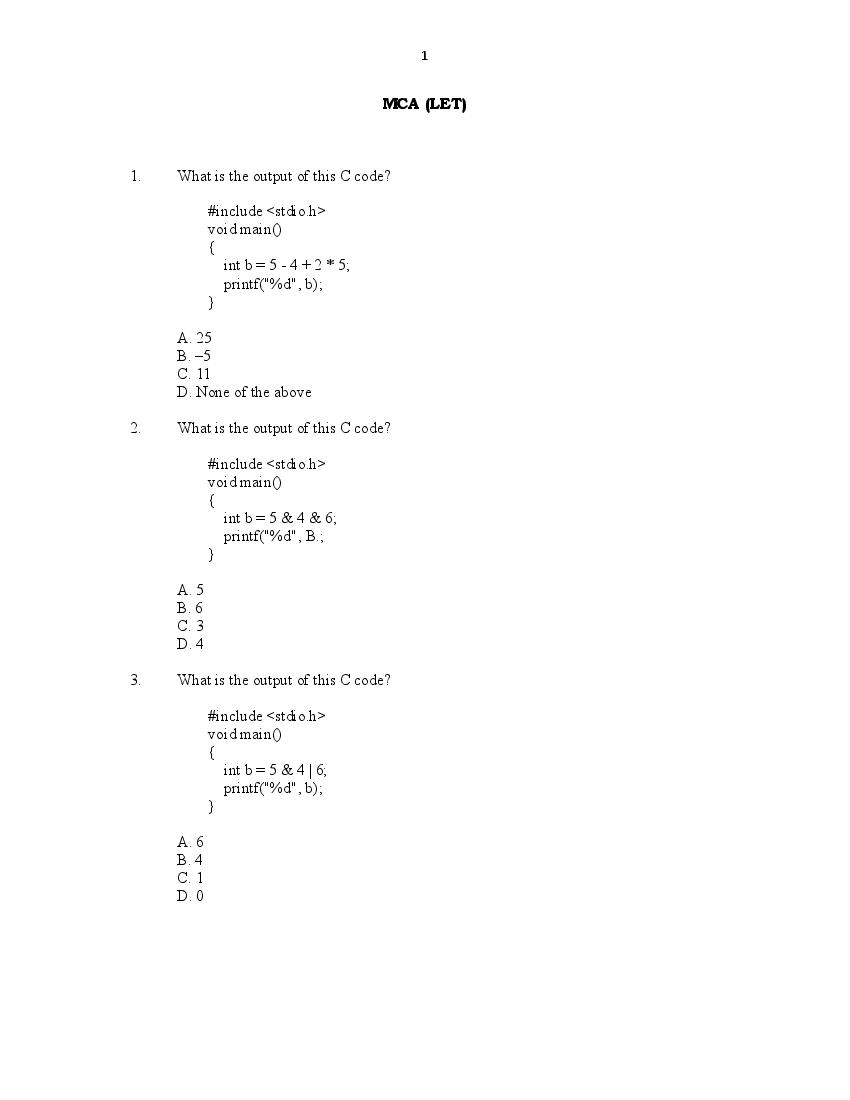
Page 1
MCA (LET)
1. What is the output of this C code?
#include <stdio.h>
void main()
{
int b = 5 - 4 + 2 * 5;
printf("%d", b);
}
A. 25
B. –5
C. 11
D. None of the above
2. What is the output of this C code?
#include <stdio.h>
void main()
{
int b = 5 & 4 & 6;
printf("%d", B.;
}
A. 5
B. 6
C. 3
D. 4
3. What is the output of this C code?
#include <stdio.h>
void main()
{
int b = 5 & 4 | 6;
printf("%d", b);
}
A. 6
B. 4
C. 1
D. 0
Page 2
4. The decoded instruction is stored in ______ .
A. IR
B. PC
C. Registers
D. MDR
5. The instruction -> Add LOCA,R0 does,
A. Adds the value of LOCA to R0 and stores in the temp register
B. Adds the value of R0 to the address of LOCA
C. Adds the values of both LOCA and R0 and stores it in R0
D. Adds the value of LOCA with a value in accumulator and stores it in R0
6. Which registers can interact with the secondary storage?
A. MAR
B. PC
C. IR
D. R0
7. Switch statement accepts
A. int
B. char
C. long
D. All of the above
8. What is the output of this C code?
#include <stdio.h>
int main()
{
int i = 0;
for (i++; i == 1; i = 2)
printf("In for loop ");
printf("After loop\n");
}
A. In for loop after loop
B. After loop
C. Compile time error
D. Undefined behaviour
Page 3
9. What is the output of this C code?
#include <stdio.h>
void main()
{
char *str = "";
do
{
printf("hello");
} while (str);
}
A. Nothing
B. Run time error
C. Varies
D. Hello is printed infinite times
10. What is the output of this C code?
#include <stdio.h>
void main()
{
int i = 0;
if (i == 0)
{
printf("Hello");
continue;
}
}
A. Hello is printed infinite times
B. Hello
C. Varies
D. Compile time error
Page 4
11. What is the output of this C code?
#include <stdio.h>
void foo();
int main()
{
void foo(int);
foo(1);
return 0;
}
void foo(int i)
{
printf("2 ");
}
A. 2
B. Compile time error
C. Depends on the compiler
D. 1 2
12. Comment on the output of this C code:
#include <stdio.h>
int main()
{
int i;
for (i = 0;i < 5; i++)
int a = i;
printf("%d", a);
}
A. a is out of scope when printf is called
B. Redeclaration of a in same scope throws error
C. Syntax error in declaration of a
D. No errors, program will show the output 5
13. Property which allows to produce different executable for different platforms in C is
called
A. File inclusion
B. Selective inclusion
C. Conditional compilation
D. Recursive macros
Page 5
14. What is the output of this C code?
#include <stdio.h>
void main()
{
m();
m();
}
void m()
{
static int x = 5;
x++;
printf("%d", x);
}
A. 6 7
B. 6 6
C. 5 5
D. 5 6
15. What is the output of this C code?
#include <stdio.h>
int main()
{
int i = 10;
void *p = &i;
printf("%d\n", (int)*p);
return 0;
}
A. Compile time error
B. Segmentation fault/runtime crash
C. 10
D. Undefined behaviour
Page 6
16. What is the output of this C code?
#include <stdio.h>
int main()
{
int i = 97, *p = &i;
foo(&i);
printf("%d ", *p);
}
void foo(int *p)
{
int j = 2;
p = &j;
printf("%d ", *p);
}
A. 2 97
B. 2 2
C. Compile time error
D. Segmentation fault/code crash
17. What does your class can hold?
A. data
B. functions
C. Both (A) and (B)
D. None of the above
18. How many specifiers are present in access specifiers in class?
A. 1
B. 2
C. 3
D. 4
19. Constructors are used to
A. initalize the objects
B. construct the data members
C. Both (A) and (B)
D. None of the above
20. Which of the following permits function overloading on C++?
A. type
B. number of arguments
C. Both (A) and (B)
Page 7
D. None of the above
21. Which of these following members are not accessed by using direct member access
operator?
A. public
B. private
C. protected
D. Both (A) and (B)
22. Which operator works only with integer variables?
A. increment
B. decrement
C. Both (A) and (B)
D. None of the above
23. Where is the derived class is derived from?
A. derived
B. base
C. Both (A) and (B)
D. None of the above
24. Pick out the correct statement.
A. A derived class’s constructor cannot explicitly invokes its base class’s constructor.
B. A derived class’s destructor cannot invoke its base class’s destructor.
C. A derived class’s destructor can invoke its base class’s destructor.
D. None of the above
25. Which of the following is/are ‘derived class’ inherited?
A. members
B. functions
C. Both (A) and (B)
D. None of the above
26. Which class is used to design the base class?
A. abstract class
B. derived class
C. base class
D. None of the above
27. Which is used to create a pure virtual function ?
A. $
B. =0
C. &
Page 8
D. !
28. Which is also called as abstract class?
A. virtual function
B. pure virtual function
C. derived class
D. None of the above
29. Which rule will not affect the friend function?
A. private and protected members of a class cannot be accessed from outside
B. private and protected member can be accessed anywhere
C. Both (A) and (B)
D. None of the above
30. What is the syntax of friend function?
A. friend class1 Class2;
B. friend class;
C. friend class
D. None of the above
31. Which of the following operators can’t be overloaded?
A. ::
B. +
C. –
D. [ ]
32. How to declare operator function?
A. operator operatorSign
B. operator
C. operatorSign
D. None of the above
33. Which symbol is used to create multiple inheritance?
A. Dot
B. Comma
C. Dollar
D. None of the above
34. Which of the following advantages we lose by using multiple inheritance?
A. Dynamic binding
B. Polymorphism
C. Both (A) and (B)
D. None of the above
Page 9
Page 10
35. What will happen when the structure is declared?
A. it will not allocate any memory
B. it will allocate the memory
C. it will be declared and initialized
D. None of the above
36. The declaration of structure is also called as:
A. sructure creator
B. structure signifier
C. structure specifier
D. None of the above
37. Which one of the following is a set of one or more attributes taken collectively to
uniquely identify a record?
A. Candidate key
B. Sub key
C. Super key
D. Foreign key
38. Consider attributes ID , CITY and NAME . Which one of this can be considered as a
super key ?
A. NAME
B. ID
C. CITY
D. CITY, ID
39. Under what condition a proper subset of a super key would become a candidate key?
A. No proper subset is a super key
B. All subsets are super keys
C. Subset is a super key
D. Each subset is a super key
40. A _____ is a property of the entire relation, rather than of the individual tuples in
which each tuple is unique.
A. Rows
B. Key
C. Attribute
D. Fields
Page 11
41. Which one of the following cannot be taken as a primary key?
A. Id
B. Register number
C. Dept_id
D. Street
42. An attribute in a relation is a foreign key if the _______ key from one relation is used
as an attribute in that relation.
A. Candidate
B. Primary
C. Super
D. Sub
43. Which one of the following is a procedural language?
A. Domain relational calculus
B. Tuple relational calculus
C. Relational algebra
D. Query language
44. The_____ operation allows the combining of two relations by merging pairs of tuples,
one from each relation, into a single tuple.
A. Select
B. Join
C. Union
D. Intersection
45. The _______operation performs a set union of two “similarly structured” tables
A. Union
B. Join
C. Product
D. Intersect
46. The most commonly used operation in relational algebra for projecting a set of tuple
from a relation is
A. Join
B. Projection
C. Select
D. Union
Page 12
47. The _______ operator takes the results of two queries and returns only rows that
appear in both result sets.
A. Union
B. Intersect
C. Difference
D. Projection
48. A ________ is a pictorial depiction of the schema of a database that shows the
relations in the database, their attributes, and primary keys and foreign keys.
A. Schema diagram
B. Relational algebra
C. Database diagram
D. Schema flow
49. The _________ provides a set of operations that take one or more relations as input
and return a relation as an output.
A. Schematic representation
B. Relational algebra
C. Scheme diagram
D. Relation flow
50. Which one of the following is used to define the structure of the relation ,deleting
relations and relating schemas?
A. DML(Data Manipulation Langauge)
B. DDL(Data Definition Langauge)
C. Query
D. Relational Schema
51. Create table employee (name varchar ,id integer). What type of statement is this?
A. DML
B. DDL
C. View
D. Integrity constraint
52. Select * from employee. What type of statement is this?
A. DML
B. DDL
C. View
D. Integrity constraint
Page 13
53. The basic data type char(n) is a _____ length character string and varchar(n) is _____
length character.
A. Fixed, equal
B. Equal, variable
C. Fixed, variable
D. Variable, equal View Answer
54. To remove a relation from an SQL database, we use the ______ command.
A. Delete
B. Purge
C. Remove
D. Drop table
55. Insert into instructor values (10211, ’Smith’, ’Biology’, 66000); What type of
statement is this?
A. Query
B. DML
C. Relational
D. DDL
56. Updates that violate __________ are disallowed.
A. Integrity constraints
B. Transaction control
C. Authorization
D. DDL constraints
57. Which of the following creates a virtual relation for storing the query?
A. Function
B. View
C. Procedure
D. None of the above
58. Updating the value of the view
A. Will affect the relation from which it is defined
B. Will not change the view definition
C. Will not affect the relation from which it is defined
D. Cannot determine
Page 14
59. Which of the following is used at the end of the view to reject the tuples which do not
satisfy the condition in where clause?
A. With
B. Check
C. With check
D. All of the above
60. For the view Create view instructor_info as select ID, name, building from instructor,
department where instructor.dept name= department.dept name; If we insert tuple into
the view as insert into instructor info values (’69987’, ’White’, ’Taylor’); What will
be the values of the other attributes in instructor and department relations?
A. Default value
B. Null
C. Error statement
D. 0
61. What is an operating system?
A. collection of programs that manages hardware resources
B. system service provider to the application programs
C. link to interface the hardware and application programs
D. All of the above
62. To access the services of operating system, the interface is provided by the
A. system calls
B. APIs
C. library functions
D. assembly instructions
63. Which one of the following is not true?
A. kernel is the program that constitutes the central core of the operating system
B. kernel is the first part of operating system to load into memory during booting
C. kernel is made of various modules which can not be loaded in running operating
system
D. kernel remains in the memory during the entire computer session
64. The main function of the command interpreter is
A. to get and execute the next user-specified command
B. to provide the interface between the API and application program
C. to handle the files in operating system
D. None of the above
Page 15
65. Operating Systems do the resource management via
A. time division multiplexing
B. space division multiplexing
C. Both (A) and (B)
D. None of the above
66. If a process fails, most operating system write the error information to a
A. log file
B. another running process
C. new file
D. None of the above
67. The systems which allows only one process execution at a time, are called
A. uniprogramming systems
B. uniprocessing systems
C. unitasking systems
D. None of the above
68. In operating system, each process has its own
A. address space and global variables
B. open files
C. pending alarms, signals and signal handlers
D. All of the above View Answer
69. In Unix, which system call creates the new process?
A. fork
B. create
C. new
D. None of the above
70. A process can be terminated due to
A. normal exit
B. fatal error
C. killed by another process
D. All of the above
71. What is the ready state of a process?
A. when process is scheduled to run after some execution
B. when process is unable to run until some task has been completed
C. when process is using the CPU
Page 16
D. None of the above
Page 17
72. What is interprocess communication?
A. communication within the process
B. communication between two process
C. communication between two threads of same process
D. None of the above
73. A set of processes is under ‘deadlock’ if
A. each process is blocked and will remain so forever
B. each process is terminated
C. all processes are trying to kill each other
D. None of the above
74. Which system call returns the process identifier of a terminated child?
A. wait
B. exit
C. fork
D. get
75. The address of the next instruction to be executed by the current process is provided
by the
A. CPU registers
B. program counter
C. process stack
D. pipe
76. Which module gives control of the CPU to the process selected by the short-term
scheduler?
A. dispatcher
B. interrupt
C. scheduler
D. None of the above
77. The processes that are residing in main memory and are ready and waiting to execute
are kept on a list called
A. job queue
B. ready queue
C. execution queue
D. process queue
Page 18
78. The interval from the time of submission of a process to the time of completion is
termed as
A. waiting time
B. turnaround time
C. response time
D. throughput
79. Which scheduling algorithm allocates the CPU first to the process that requests the
CPU first?
A. first-come, first-served scheduling
B. shortest job scheduling
C. priority scheduling
D. None of the above
80. In priority scheduling algorithm
A. CPU is allocated to the process with highest priority
B. CPU is allocated to the process with lowest priority
C. equal priority processes can not be scheduled
D. None of the above
81. In priority scheduling algorithm, when a process arrives at the ready queue, its
priority is compared with the priority of
A. all process
B. currently running process
C. parent process
D. init process
82. Concurrent access to shared data may result in
A. data consistency
B. data insecurity
C. data inconsistency
D. None of the above
83. The segment of code in which the process may change common variables, update
tables, write into files is known as
A. program
B. critical section
C. non – critical section
D. synchronizing
Page 19
84. An un-interruptible unit is known as
A. single
B. atomic
C. static
D. None of the above
85. The TestAndSet instruction is executed
A. after a particular process
B. periodically
C. atomically
D. None of the above
86. Semaphore is a/an _______ to solve the critical section problem.
A. hardware for a system
B. special program for a system
C. integer variable
D. None of the above
87. A reusable resource is one
A. that can be used by one process at a time and is not depleted by that use
B. that can be used by more than one process at a time
C. that can be shared between various threads
D. None of the above
88. Which of the following condition is required for deadlock to be possible?
A. mutual exclusion
B. a process may hold allocated resources while awaiting assignment of other
resources
C. no resource can be forcibly removed from a process holding it
D. All of the above
89. The circular wait condition can be prevented by
A. defining a linear ordering of resource types
B. using thread
C. using pipes
D. All of the above
90. In contiguous memory allocation
A. each process is contained in a single contiguous section of memory
B. all processes are contained in a single contiguous section of memory
C. the memory space is contiguous
Page 20
D. None of the above
91. Physical memory is broken into fixed-sized blocks called ________.
A. frames
B. pages
C. backing store
D. None of the above
92. Logical memory is broken into blocks of the same size called _________.
A. frames
B. pages
C. backing store
D. None of the above
93. The __________ is used as an index into the page table.
A. frame bit
B. page number
C. page offset
D. frame offset
94. The ________ can be turned off by the CPU before the execution of critical
instruction sequences that must not be interrupted.
A. nonmaskable interrupt
B. blocked interrupt
C. maskable interrupt
D. None of the above
95. The __________ is used by device controllers to request service.
A. nonmaskable interrupt
B. blocked interrupt
C. maskable interrupt
D. None of the above
96. The interrupt vector contains
A. the interrupts
B. the memory addresses of specialized interrupt handlers
C. the identifiers of interrupts
D. the device addresses
97. Division by zero, accessing a protected or non existent memory address, or attempting
to execute a privileged instruction from user mode are all categorized as ________.
A. errors
B. exceptions
Page 21
C. interrupt handlers
D. All of the above
98. The reason for the implementation of the cache memory is
A. To increase the internal memory of the system
B. The difference in speeds of operation of the processor and memory
C. To reduce the memory access and cycle time
D. All of the above
99. The effectiveness of the cache memory is based on the property of ________.
A. Locality of reference
B. Memory localisation
C. Memory size
D. None of the above
100. The temporal aspect of the locality of reference means
A. That the recently executed instruction won’t be executed soon
B. That the recently executed instruction is temporarily not referenced
C. That the recently executed instruction will be executed soon again
D. None of the above
101. If a = b and b = c, then a = c, then this property is called
A. Reflexive
B. Transitive
C. Trichotomy
D. symmetric
102. If a > b and b > a, then
A. a b
B. a b
C. cannot be evaluated
D. impossible
103. The product of complex numbers (4,3) and (5,-6) is
A. (18,3)
B. (18,‒3)
C. (38,9)
D. (38,‒9)
Page 22
/2
5
104. cos xdx is
0
A.
15
8
B.
15
8
C.
15
5
D.
2
4 1 2 0 t t
105. If A = and B = then A B
9 0 7 1
6 0
A.
1 1
6 16
B.
1 1
6 16
C.
1 1
0 6
D.
1 1
106. If tan A cot B , then A B
A. 0o
B. 45o
C. 90o
D. 180o
Page 23
x
107. The period of the function sin is
3
A.
B. 2
C. 4
D. 6
108. An object moved in a circular path of radius 21m such that it made an angle of 30o.
What is the distance (in meter) covered by the object?
A. 11
B. 21
C. 31
D. 41
f x h f x
109. The function f x lt is called derivative with respect to x,
h a h
then a
A. 0
B. x
C.
D.
110. If f x x 2 2 x 10, then f ' 2 ?
A. 10
B. 12
C. 14
D. 16
111. Consider the velocity of the car . What is the acceleration when
t 2?
A. 28
B. 30
C. 32
D. 34
112. A conical tent has base radius 7 m and height 24 m. How many meters of cloth 10 m
wide will be required to make it?
A. 110
B. 240
C. 55
D. 96
Page 24
d 3 x2
113.
dx
e ?
A. e x
2
B. e3x
2
C. 6 xe3 x
2
D. 6e3 x
2
114. f : R R and g : R R are given by f ( x) x 2 and g ( x) x 4 . Then
fo g (x) is
2
A. x 2
B. x 2 x 2
2
C. x 8x 16
2
D. x 8x 14
115. If 2 x 32, then x
A. 2
B. 3
C. 4
D. 5
116. The probability of occurrence of two events A and B simultaneous is
A. P(A) + P(B)
B. P(AB)
C. P(AB)
D. P(A).P(B)
2
117. If i + 2 is a root of x 4 x 0 then is
A. 5
B. 5
C. 10
D. 2
Page 25
2
118. The remainder when 3x x 2 is divided by x 1 is
A. 2
B. –2
C. 3
D. 0
119. log104+log1025 =
A. 2
B. 3
C. 4
D. 5
120. The lines x 0, y 0 and x y 1 form a triangle of area
A. 1
1
B.
2
1
C.
3
1
D.
2
121. What is the value of x in the exponential equation 9 e 2 x 4 10 ?
A. 2
B. 3
C. 4
D. 5
Page 26
Directions (Qn. Nos. 122 – 125) : In each series, look for the degree and direction of
change between the numbers. In other words, do the numbers increase or decrease, and
by how much.
122. Look at this series: 2, 1, (1/2), (1/4), ... What number should come next?
A. (1/3)
B. (1/8)
C. (2/8)
D. (1/16)
123. Look at this series: 7, 10, 8, 11, 9, 12, ... What number should come next?
A. 7
B. 10
C. 12
D. 13
124. Look at this series: 36, 34, 30, 28, 24, ... What number should come next?
A. 20
B. 22
C. 23
D. 26
125. Look at this series: 53, 53, 40, 40, 27, 27, ... What number should come next?
A. 12
B. 14
C. 27
D. 53
126. 1.Tanya is older than Eric. 2.Cliff is older than Tanya. 3.Eric is older than Cliff. If the
first two statements are true, the third statement is
A. true
B. false
C. uncertain
D.None of the above
127. Blueberries cost more than strawberries.
Blueberries cost less than raspberries.
Raspberries cost more than strawberries and blueberries.
If the first two statements are true, the third statement is
A. True
B. False
Page 27
C. Uncertain
D. None of the above
128. All the trees in the park are flowering trees.
Some of the trees in the park are dogwoods.
All dogwoods in the park are flowering trees.
If the first two statements are true, the third statement is
A. true
B. False
C. uncertain
D. None of the above
129. Mara runs faster than Gail. Lily runs faster than Mara. Gail runs faster than Lily.
If the first two statements are true, the third statement is
A. true
B. false
C. uncertain
D. None of the above
130. Apartments in the Riverdale Manor cost less than apartments in The Gaslight
Commons. Apartments in the Livingston Gate cost more than apartments in the The
Gaslight Commons. Of the three apartment buildings, the Livingston Gate costs the
most. If the first two statements are true, the third statement is
A. true
B. false
C. uncertain
D. None of the above
131. Four defensive football players are chasing the opposing wide receiver, who has the
ball. Calvin is directly behind the ball carrier. Jenkins and Burton are side by side
behind Calvin. Zeller is behind Jenkins and Burton. Calvin tries for the tackle but
misses and falls. Burton trips. Which defensive player tackles the receiver?
A. Burton
B. Zeller
C. Jenkins
D. Calvin
Direction (Qn. Nos. 132 – 135): Study the series and fill up the missing.
132. 8, 10, 14, 18, __, 34, 50, 66
A. 24
B. 23
C. 25
Page 28
D. 26
2 1 2 1
133. , 1 , 2, 2 , 3 , __, __
3 3 3 3
2
A. 3,
3
2
B. 4, 4
3
2
C. 3, 4
3
2
D. 4, 3
3
134. C–2, E–3, G–4, I–5, __
A. H–6
B. J–8
C. K–6
D. L–7
135. R U X A D ?
A. E
B. F
C. G
D. H
136. Find out which of the figures (1), (2), (3) and (4) can be formed from the pieces given
in figure (X).
A. 1
B. 2
C. 3
Page 29
D. 4
137. Find out which of the figures (1), (2), (3) and (4) can be formed from the pieces given
in figure (X).
A. 1
B. 2
C. 3
D. 4
138. Find out which of the figures (1), (2), (3) and (4) can be formed from the pieces given
in figure (X).
A. 1
B. 2
C. 3
D. 4
139. Find out which of the figures (1), (2), (3) and (4) can be formed from the pieces given
in figure (X).
A. 1
B. 2
C. 3
D. 4
Page 30
140. Find out which of the figures (1), (2), (3) and (4) can be formed from the pieces given
in figure (X).
A. 1
B. 2
C. 3
D. 4
141. Find out which of the figures (1), (2), (3) and (4) can be formed from the pieces given
in figure (X).
A. 1
B. 2
C. 3
D. 4
142. In a certain code, PAPER is written as SCTGW, how is MOTHER written in that
code?
A. ORCLGW
B. PQVJGT
C. PQXJJT
D. PQXKJV
143. If DIAMOND is coded as VQYMKLV, how is FEMALE coded?
A. TUMYNU
B. UVNZOV
C. UVNYNV
D. TVNYNV
Page 31
Direction (Qn. Nos. 144 and 145): In the following three are similar and one is
different. Which one?
144. A. Deuce
B. Pitch
C. Crease
D. Stump
145. A. Iron
B. Mercury
C. Copper
D. Silver
Direction (Qn. Nos. 146 – 150): In each of the following questions, select a figure
from amongst the four alternatives, which when placed in the blank space of figure (X)
would complete the pattern.
146. Identify the figure that completes the pattern.
(X) (1) (2) (3) (4)
A. 1
B. 2
C. 3
D. 4
147. Identify the figure that completes the pattern.
(X) (1) (2) (3) (4)
A. 1
B. 2
C. 3
D. 4
Page 32
148. Identify the figure that completes the pattern.
(X) (1) (2) (3) (4)
A. 1
B. 2
C. 3
D. 4
149. Identify the figure that completes the pattern.
(X) (1) (2) (3) (4)
A. 1
B. 2
C. 3
D. 4
150. Identify the figure that completes the pattern.
(X) (1) (2) (3) (4)
A. 1
B. 2
C. 3
D. 4
***
Document Details
| Board / Org | Cochin University |
| Exam | CUSAT Common Admission Test |
| Type | Question Paper |
| Pages | 32 |
| Updated | 22 Jul 2026 |