TN 11th Question Paper 2022 Chemistry
Finished viewing? Save it for later —
Download TN 11th Question Paper 2022 Chemistry (PDF · 12 pages)About TN 11th Question Paper 2022 Chemistry
TN 11th Question Paper 2022 Chemistry is available here for free download. Published by Tamil Nadu Board for Class 11, this question paper can be viewed online or downloaded as a PDF (12 pages). Candidates preparing for Class 11 can use TN 11th Question Paper 2022 Chemistry to understand the exam pattern, the type of questions asked, and the overall difficulty level.
Frequently Asked Questions
How can I download TN 11th Question Paper 2022 Chemistry?
Open this page and click the Download button to save TN 11th Question Paper 2022 Chemistry as a PDF. It is completely free on AglaSem Docs.
Is TN 11th Question Paper 2022 Chemistry free to download?
Yes. TN 11th Question Paper 2022 Chemistry can be viewed online and downloaded as a PDF free of cost on AglaSem Docs.
How many pages does TN 11th Question Paper 2022 Chemistry have?
TN 11th Question Paper 2022 Chemistry contains 12 pages, which you can read online or download together as a single PDF.
Where can I find more Class 11 study material?
You can find more Class 11 question papers, sample papers, syllabus, and answer keys on AglaSem Docs.
TN 11th Question Paper 2022 Chemistry – Text
Read the full text of this question paper below — useful to quickly search, copy and reference the content online without downloading the PDF.
📄 View text version (12 pages)
Page 1
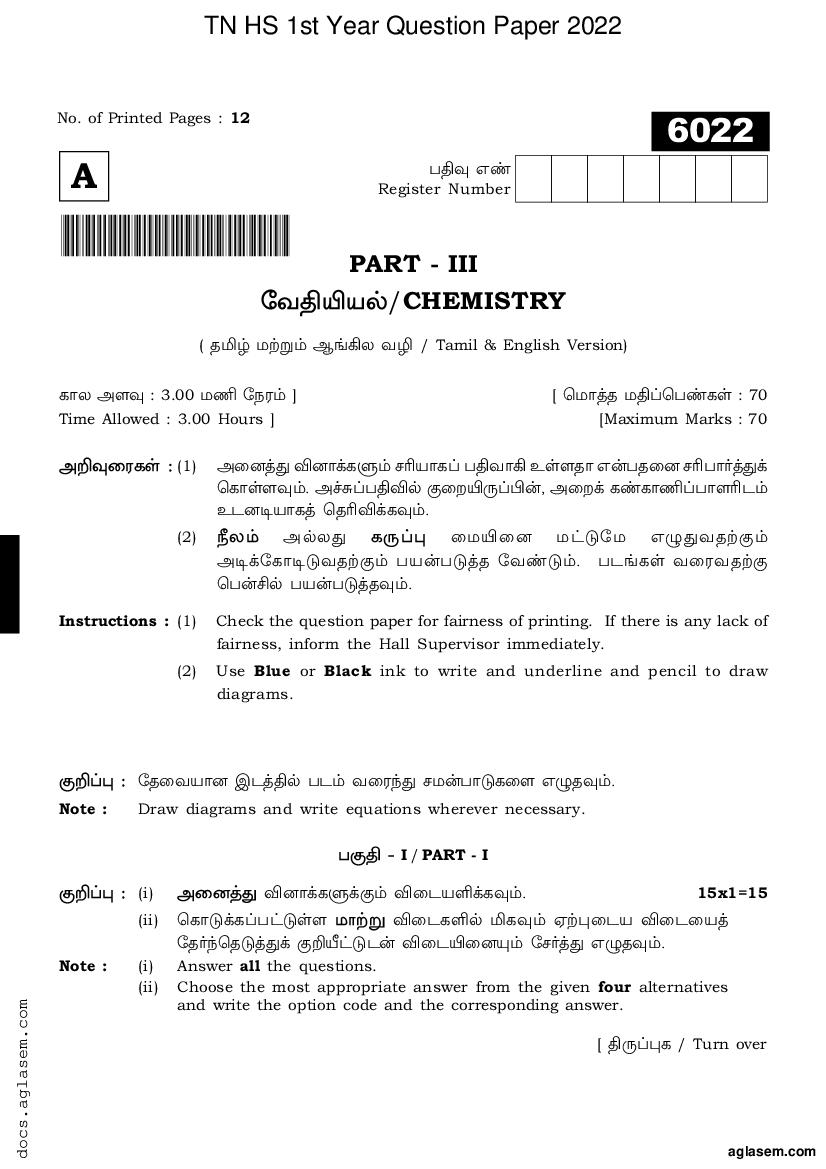
6022
£vÄ Gs
A Register Number
!6022IstYearChemistry!
PART - III
÷Áv°¯À/CHEMISTRY
( uªÌ ©ØÖ® B[Q» ÁÈ / Tamil & English Version)
Põ» AÍÄ : 3.00 ©o ÷|µ® ] [ ö©õzu ©v¨ö£sPÒ : 70
Time Allowed : 3.00 Hours ] [Maximum Marks : 70
AÔÄøµPÒ : (1) AøÚzx ÂÚõUPЮ \›¯õP¨ £vÁõQ EÒÍuõ GߣuøÚ \›£õºzxU
öPõÒÍÄ®. Aa_¨£vÂÀ SøÓ°¸¨¤ß, AøÓU PsPõo¨£õÍ›h®
EhÚi¯õPz öu›ÂUPÄ®.
(2) }»® AÀ»x P¸¨¦ ø©°øÚ ©mk÷© GÊxÁuØS®
AiU÷PõikÁuØS® £¯ß£kzu ÷Ásk®. £h[PÒ ÁøµÁuØS
ö£ß]À £¯ß£kzuÄ®.
Instructions : (1) Check the question paper for fairness of printing. If there is any lack of
fairness, inform the Hall Supervisor immediately.
(2) Use Blue or Black ink to write and underline and pencil to draw
diagrams.
SÔ¨¦ : ÷uøÁ¯õÚ ChzvÀ £h® Áøµ¢x \©ß£õkPøÍ GÊuÄ®.
Note : Draw diagrams and write equations wherever necessary.
£Sv & I / PART - I
SÔ¨¦ : (i) AøÚzx ÂÚõUPÐUS® Âøh¯ÎUPÄ®. 15x1=15
(ii) öPõkUP¨£mkÒÍ ©õØÖ ÂøhPÎÀ ªPÄ® Hئøh¯ Âøhø¯z
÷uº¢öukzxU SÔ±mkhß Âøh°øÚ²® ÷\ºzx GÊuÄ®.
Note : (i) Answer all the questions.
(ii) Choose the most appropriate answer from the given four alternatives
and write the option code and the corresponding answer.
[ v¸¨¦P / Turn over
Page 2
1. ¤ßÁ¸ÁÚÁØÖÒ Gx A¼L£õmiU {øÓÄØÓ øím÷µõPõº£ÚõS® ?
(A) C9H18 (B) C8H14
(C) C8H18 (D) CøÁ¯øÚzx®
Which of the following is aliphatic saturated hydrocarbon ?
(a) C9H18 (b) C8H14
(c) C8H18 (d) All of the above
2. \©÷©õ»õÀ NaCl ©ØÖ® KCl Pøµ\ÀPÒ u¯õ›UP¨£mhÚ. NaCl Pøµ\¼ß
EøÓ{ø» −28C GÛÀ KCl Pøµ\¼ß Gvº£õºUP¨£k® EøÓ{ø» ©v¨¦ :
(A) −18C (B) −28C (C) 08C (D) −48C
Equimolal aqueous solutions of NaCl and KCl are prepared. If the freezing point
of NaCl is −28C, the freezing point of KCl solution is expected to be :
(a) −18C (b) −28C (c) 08C (d) −48C
3. BÀøPÀ öuõSvPÎß +I ÂøÍÂß \›¯õÚ J¨¥mk Á›ø\ :
(A) −C(CH3)3 > −CH(CH3)2 > −CH2CH3 > −CH3
(B) −CH3 > −CH2CH3 > −CH(CH3)2 > −C(CH3)3
(C) −CH2CH3 > −CH3 > −C(CH3)3 > −CH(CH3)2
(D) −CH(CH3)2 > −C(CH3)3 > −CH2CH3 > −CH3
The correct relative order of +I effect of alkyl groups is :
(a) −C(CH3)3 > −CH(CH3)2 > −CH2CH3 > −CH3
(b) −CH3 > −CH2CH3 > −CH(CH3)2 > −C(CH3)3
(c) −CH2CH3 > −CH3 > −C(CH3)3 > −CH(CH3)2
(d) −CH(CH3)2 > −C(CH3)3 > −CH2CH3 > −CH3
4. 08C ©ØÖ® 1 atm AÊzuzvÀ 7.5 g Áõ² 5.6 L PÚ AÍøÁ AøhzxU öPõÒЮ
GÛÀ A¢u Áõ² :
(A) CO (B) NO (C) CO2 (D) N2O
7.5 g of a gas occupies a volume of 5.6 L at 08C and 1 atm pressure. The gas
is :
(a) CO (b) NO (c) CO2 (d) N2O
A
Page 3
5. TØÖ : ÷©õ÷Úõ ÷í÷»õ AŸßPÎÀ, G»Umµõß PÁºö£õ¸Ò £v½mk
ÂøÚ Bºz÷uõ ©ØÖ® £õµõ Ch[PÎÀ {PÌQÓx.
Põµn® : íõ»áß AqÁõÚx Áøͯ Q꼀 }UQ.
(A) TØÖ \› BÚõÀ Põµn® uÁÖ.
(B) TØÖ ©ØÖ® Põµn® Cµsk® \›. ÷©¾® Põµn©õÚx TØÔØS \›¯õÚ
ÂÍUP® BS®.
(C) TØÖ ©ØÖ® Põµn® Cµsk® uÁÖ.
(D) TØÖ ©ØÖ® Põµn® Cµsk® \›. BÚõÀ Põµn©õÚx TØÔØS \›¯õÚ
ÂÍUP©À».
Assertion : In monohaloarenes, electrophilic substitution occurs at ortho and
para positions.
Reason : Halogen atom is a ring deactivator.
(a) Assertion is true but reason is false.
(b) Both assertion and reason are true and reason is the correct explanation of
assertion.
(c) Both assertion and reason are false.
(d) Both assertion and reason are true but reason is not the correct explanation
of assertion.
6. ¤ßÁ¸® AÍÃkPÎÀ ö£õ¸sø© \õµõ £s¦ :
(A) GßuõÀ¤ (B) {øÓ
(C) {øÓ/PÚAÍÄ (D) PÚAÍÄ
The intensive property among the quantities below is :
(a) enthalpy (b) mass
mass
(c) (d) volume
volume
A [ v¸¨¦P / Turn over
Page 4
7. RÌUPshÁØÔÀ Gx \›¯õÚ TØÖ AÀ» ?
(A) ÂøÚ³UQ¯õÚx •ß÷ÚõUS ©ØÖ® ¤ß÷ÚõUS ÂøÚPøÍ \© AÍÂÀ
£õvUS®.
(B) \©{ø»°À EÒÍ J¸ Aø©¨¤ØS Q &ß ©v¨¦ G¨÷£õx® \©{ø»
©õÔ¼ø¯ Âh SøÓÁõP C¸US®.
(C) öÁ¨£{ø»°øÚ ö£õ¸zx \©{ø» ©õÔ¼ ©v¨¦PÒ ©õÖ£k®.
(D) ÂøÚ°ß C¸ £UPzv¼¸¢x® \©{ø»°øÚ Aøh¯»õ®.
Which one of the following is incorrect statement ?
(a) presence of catalyst affects both the forward reaction and reverse reaction
to the same extent.
(b) for a system at equilibrium Q is always less than the equilibrium constant.
(c) equilibrium constant varies with temperature.
(d) equilibrium can be attained from either side of the reaction.
8. ö£õ¸zxP.
(1) −NO2 (i) ¦µ¨ø£À
(2) −OCH3 (ii) Aª÷Úõ
(3) −CH2−CH2−CH3 (iii) «zuõUê
(4) −NH2 (iv) ø|m÷µõ
(A) (1)-(iii), (2)-(ii), (3)-(iv), (4)-(i)
(B) (1)-(iii), (2)-(iv), (3)-(i), (4)-(ii)
(C) (1)-(iv), (2)-(iii), (3)-(i), (4)-(ii)
(D) (1)-(ii), (2)-(i), (3)-(iv), (4)-(iii)
Match the following :
(1) −NO2 (i) Propyl
(2) −OCH3 (ii) Amino
(3) −CH2−CH2−CH3 (iii) Methoxy
(4) −NH2 (iv) Nitro
(a) (1)-(iii), (2)-(ii), (3)-(iv), (4)-(i)
(b) (1)-(iii), (2)-(iv), (3)-(i), (4)-(ii)
(c) (1)-(iv), (2)-(iii), (3)-(i), (4)-(ii)
(d) (1)-(ii), (2)-(i), (3)-(iv), (4)-(iii)
A
Page 5
9. ì÷£õkªß Gߣx RÌUPsh G¢u Põµ E÷»õPzvß PÛ© ‰»® BS® ?
(A) ¼zv¯® (B) ÷\õi¯® (C) ¸¥i¯® (D) ö£õmhõ]¯®
Spodumene is the mineral source for which of the following alkali metal ?
(a) Lithium (b) Sodium (c) Rubidium (d) Potassium
10. RÌUPõs£ÚÁØÖÒ Gx AvP£m\ }÷µØÓ BØÓø»U öPõskÒÍx ?
(A) BaCl2 (B) MgCl2 (C) SrCl2 (D) CaCl2
Which of the following has highest hydration energy ?
(a) BaCl2 (b) MgCl2 (c) SrCl2 (d) CaCl2
11. i›i¯® EmP¸ __________ öPõskÒÍx.
(A) 1p+2n (B) 1p+0n (C) 1p+1n (D) 2p+1n
Tritium nucleus contains :
(a) 1p+2n (b) 1p+0n (c) 1p+1n (d) 2p+1n
12. ¤ßÁ¸ÁÚÁØÔÀ Gx øh¯õ Põ¢uzußø© öPõshx ?
(A) O22− (B) O+
2
(C) O2 (D) CÁØÔÀ HxªÀø»
Which one of the following is diamagnetic ?
2−
(a) O2 (b) O+
2
(c) O2 (d) None of these
A [ v¸¨¦P / Turn over
Page 6
13. ªß¦»zvÀ {Ó©õø»U ÷PõkPÒ ¤›øP¯øh²® ÂøÍÄ :
(A) Põ®¨hß ÂøÍÄ (B) ^©ß ÂøÍÄ
(C) ìhõºU ÂøÍÄ (D) ©øÓzuÀ ÂøÍÄ
Splitting of spectral lines in an electric field is called :
(a) Compton effect (b) Zeeman effect
(c) Stark effect (d) Shielding effect
14. A®÷©õÛ¯õ SkøÁ ©ØÖ® HCl SkøÁ Cµsk® J¸ }sh SÇõ´ ÁÈ÷¯
CønUP¨£mk Cµsk® J÷µ ÷|µzvÀ vÓUP¨£kQßÓÚ. öÁsoÓ
A®÷©õÛ¯® S÷Íõøµk Áøͯ® •uß •u¼À G[S E¸ÁõQßÓx ?
(A) A®÷©õÛ¯õ SkøÁ¯¸QÀ
(B) SÇõ°ß |k¨£Sv°À
(C) SÇõ°ß •Ê }Ízv¾® •Êø©¯õP
(D) øímµáß S÷Íõøµk SkøÁ¯¸QÀ
A bottle of ammonia and a bottle of HCl connected through a long tube are opened
simultaneously at both ends. The white ammonium chloride ring will be first
formed :
(a) near the ammonia bottle
(b) at the centre of the tube
(c) throughout the length of the tube
(d) near the hydrogen chloride bottle
15. ©ØÖ® BQ¯øÁ :
(A) JÎ_ÇØÖ® ©õØÓø©¨¦ (B) EhÛø\Ä Aø©¨¦PÒ
(C) Á\ Aø©¨¦PÒ (D) C¯[S \©{ø» ©õØÔ¯®
and are :
(a) optical isomers (b) resonating structures
(c) conformers (d) tautomers
A
Page 7
£Sv & II / PART - II
SÔ¨¦ : GøÁ÷¯Ý® BÖ ÂÚõUPÐUS Âøh¯ÎUPÄ®. ÂÚõ Gs 24 &US
Pmhõ¯©õP Âøh¯ÎUPÄ®. 6x2=12
Note : Answer any six questions. Question No. 24 is Compulsory.
16. Qµõ® \©õÚ {øÓ – Áøµ¯ÖUPÄ®.
Define Gram equivalent mass.
17. L &BØÓÀ ©mhzvÀ Põn¨£k® AvP£m\ G»UmµõßPÎß GsoUøPø¯
PnUQkP.
Calculate the maximum number of electrons that can be accommodated in L
shell.
18. ‰ßÖ ÁøP¯õÚ \P¨¤øn¨¦ øímøµkPøÍ SÔ¨¤kP.
Mention the three types of covalent hydrides.
19. ußÛaø\ ö\¯À•øÓUPõÚ {£¢uøÚPÒ ¯õøÁ ?
What are the conditions for the spontaneity of a process ?
20. öÁ¨£zvß SÔ±mk |øh•øÓø¯ ÂÍUSP.
Explain sign convention of heat.
21. \©{ø» ©õÔ¼ ©v¨¦, K C =
[NH3 ]4 [O2 ]5 öPõsh J¸ \©{ø» ÂøÚUPõÚ
[NO]4 [H2O]6
uS¢u \©ß ö\´¯¨£mh ÷Áv\©ß£õmøh u¸P.
Give a balanced chemical equation for the equilibrium reaction for which the
4 5
equilibrium constant is given by expression K C =
[ NH3 ] [ O2 ]
.
[NO]4 [H2O]6
A [ v¸¨¦P / Turn over
Page 8
22. ""I÷\õ÷hõÛU Pøµ\ÀPÒ'' GÝ® ö\õØ£uzøu Áøµ¯ÖUPÄ®.
Define the term “isotonic solution”.
23. GzvÀ S÷Íõøµøh GÆÁõÖ Dz÷uÚõP ©õØÖÁõ´ ?
How will you convert ethyl chloride to ethane ?
24. ¤ßÁ¸® ÂøÚPøÍ §ºzv ö\´P.
250ᑻC
(i) C6H5Cl+2NH3
50 atm
→
Duº
(ii) C6H5Cl+2Na+Cl−C6H5
→
∆
Complete the following reactions
250ᑻC
(i) C6H5Cl+2NH3
50 atm
→
Ether
(ii) C6H5Cl+2Na+Cl−C6H5
∆
→
£Sv & III / PART - III
SÔ¨¦ : GøÁ÷¯Ý® BÖ ÂÚõUPÐUS Âøh¯ÎUPÄ®. ÂÚõ Gs 33 &US
Pmhõ¯©õP Âøh¯ÎUPÄ®. 6x3=18
Note : Answer any six questions. Question No. 33 is compulsory.
25. ÷Põimh uÛ©[PÎß BUêá÷ÚØÓ Gsøn PnUQkP.
(i) CO2 (ii) H2 SO4
Calculate the oxidation number of underlined elements.
(i) CO2 (ii) H2 SO4
26. G»Umµõß |õmh® – Áøµ¯ÖUPÄ®.
Define electron affinity.
A
Page 9
27. hõÀhÛß £Sv AÊzu Âvø¯ TÖP.
State Dalton Law of partial pressures.
28. J¨¦ B AÊzuU SøÓÄ ©v¨¤¼¸¢x J¸ Pøµö£õ¸Îß ÷©õ»õº {øÓø¯
PnUQh EuÄ® Áõ´¨£õmiøÚ GÊxP.
Write the formula to calculate the molar mass of a solute from relative lowering
of vapour pressure values.
29. HF ‰»UTÖ E¸Áõuø» Bº¤mhõÀ ÷©Øö£õ¸¢xuÀ ‰»® ÂÁ›UPÄ®.
Describe the formation of HF molecule by orbital overlap.
30. JÎ _ÇØ] ©õØÔ¯® GßÓõÀ GßÚ ?
What is meant by optical isomerism ?
31. P¸UPÁº ©ØÖ® G»Umµõß PÁº ö£õ¸mPÐUQøh÷¯ EÒÍ ÷ÁÖ£õkPÒ
‰ßÔøÚ u¸P.
Give any three differences between nucleophiles and electrophiles.
32. Gzv½øÚ Sκ¢u Põµ® P»¢u ö£õmhõ]¯® ö£º©õ[P÷Úmkhß ÂøÚ¨&
£kzx®÷£õx {PÌÁx ¯õx ?
What happens when ethylene is passed through cold dilute alkaline potassium
permanganate ?
33. NH 3 , N2 ©ØÖ® H2 BQ¯ÁØÔß \©{ø»a ö\ÔÄPÒ •øÓ÷¯ 1.8×10 −2 M,
1.2×10⁻² M ©ØÖ® 3×10⁻² M. N2 ©ØÖ® H2 &¼¸¢x NH3 E¸ÁõS® ÂøÚUS
\©{ø» ©õÔ¼°ß ©v¨¤øÚU PõsP.
The equilibrium concentrations of NH 3 , N 2 and H 2 are 1.8×10 −2 M,
1.2×10⁻² M and 3×10⁻² M respectively. Calculate the equilibrium constant for
the formation of NH3 from N2 and H2.
A [ v¸¨¦P / Turn over
Page 10
£Sv & IV / PART - IV
SÔ¨¦ : AøÚzx ÂÚõUPÐUS® Âøh¯ÎUPÄ®. 5x5=25
Note : Answer all the questions.
34. (A) (i) n=4 &US \õzv¯©õÚ Bº¤mhõÀPÎß GsoUøP ¯õx ?
ø|mµáÛß G»Umµõß Aø©¨¦ ©ØÖ® Bº¤mhõÀ Áøµ£hzvøÚ
(ii)
GÊxP.
AÀ»x
(B) A¯Û BµzvøÚ PshÔ²® £õ¼[ •øÓ°øÚ ÂÁ›UPÄ®.
(a) (i) How many orbitals are possible for n=4 ?
(ii)Write the electronic configuration and orbital diagram for nitrogen.
OR
(b) Describe the Pauling method for the determination of ionic radius.
35. (A) (i) ö£›¼¯zvß •µs£mh £s¦PÐUS Põµn® GßÚ ?
(ii) ö£›¼¯®, AUSk®£zvÀ EÒÍ ¤Ó uÛ©[Pμ¸¢x ÷ÁÖ£k®
H÷uÝ® ‰ßÖ £s¦PøÍU TÖP.
AÀ»x
(B) AP BØÓ¼ß ]Ó¨¤¯À¦PøÍ ÂÍUSP.
(a) (i) What are the reasons for the anomalous properties of Beryllium ?
(ii) Give any three properties of Beryllium that are different from other
elements of the group.
OR
(b) Explain the characteristics of internal energy.
36. (A) öPõv{ø» HØÓ ©v¨¦Pμ¸¢x Pøµö£õ¸Îß ÷©õ»õº {øÓø¯
GÆÁõÖ PnUQkÁõ´ ?
AÀ»x
(B) Áøµ¯ÖUPÄ® :
(i) ¤øn¨¦ }Í®
(ii) ¤øn¨¦U ÷Põn®
(iii) ¤øn¨¦ BØÓÀ
(a) How will you determine the molar mass of solute from elevation of boiling
point ?
OR
(b) Define :
(i) Bond length
(ii) Bond angle
(iii) Bond enthalpy
A
Page 11
37. (A) G»Umµõß PÁºußø© ©v¨¤¼¸¢x \P¨¤øn¨¤À HØ£k® A¯Ûz
ußø©°øÚ GÆÁõÖ {ºn°¨£õ´ ?
AÀ»x
(B) ¤ßÁ¸® ÷\º©[PÐUS IUPAC •øÓ°À ö£¯›kP.
(i)
(ii) CH3−O−CH3
(iii)
(iv) CH2=CH−CH=CH2
(v)
(a) How will you determine the ionic character in covalent bond using
electronegativity values ?
OR
(b) Give the IUPAC names of the following compounds.
(i)
(ii) CH3−O−CH3
(iii)
(iv) CH2=CH−CH=CH2
(v)
A [ v¸¨¦P / Turn over
Page 12
38. (A) ö£ß^Û¼¸¢x RÌUPsh ÷\º©[PøÍ GÆÁõÖ u¯õ›¨£õ´ ?
(i) ø|m÷µõ ö£ß^ß
(ii) ö£ß^ß \À£õÛU Aª»®
(iii) BHC
AÀ»x
(B) (A) GßÓ Gί BÀRß HCl Ehß ÂøÚ¦›¢x ÷\º©® (B) &Iz u¸QÓx.
÷©¾® (B) BÚx A®÷©õÛ¯õÄhß ÂøÚ¦›¢x C2H7N GßÓ ‰»UTÖ
Áõ´¨£õmiøÚ Eøh¯ (C) &Iz u¸QÓx. (C) &¯õÚx Põºø£»ªß ÂøÚUS
Em£kQÓx. (A), (B) ©ØÖ® (C) &IU PshÔP.
(a) How will you prepare the following compounds from benzene ?
(i) nitrobenzene
(ii) benzene sulphonic acid
(iii) BHC
OR
(b) Simplest alkene (A) reacts with HCl to form compound (B). Compound (B)
reacts with ammonia to form compound (C) of molecular formula C2H7N.
Compound (C) undergoes carbylamine test. Identify (A), (B) and (C).
-o0o-
A
Document Details
| Board / Org | Tamil Nadu Board |
| Exam | Class 11 |
| Type | Question Paper |
| Pages | 12 |
| Updated | 30 Apr 2026 |