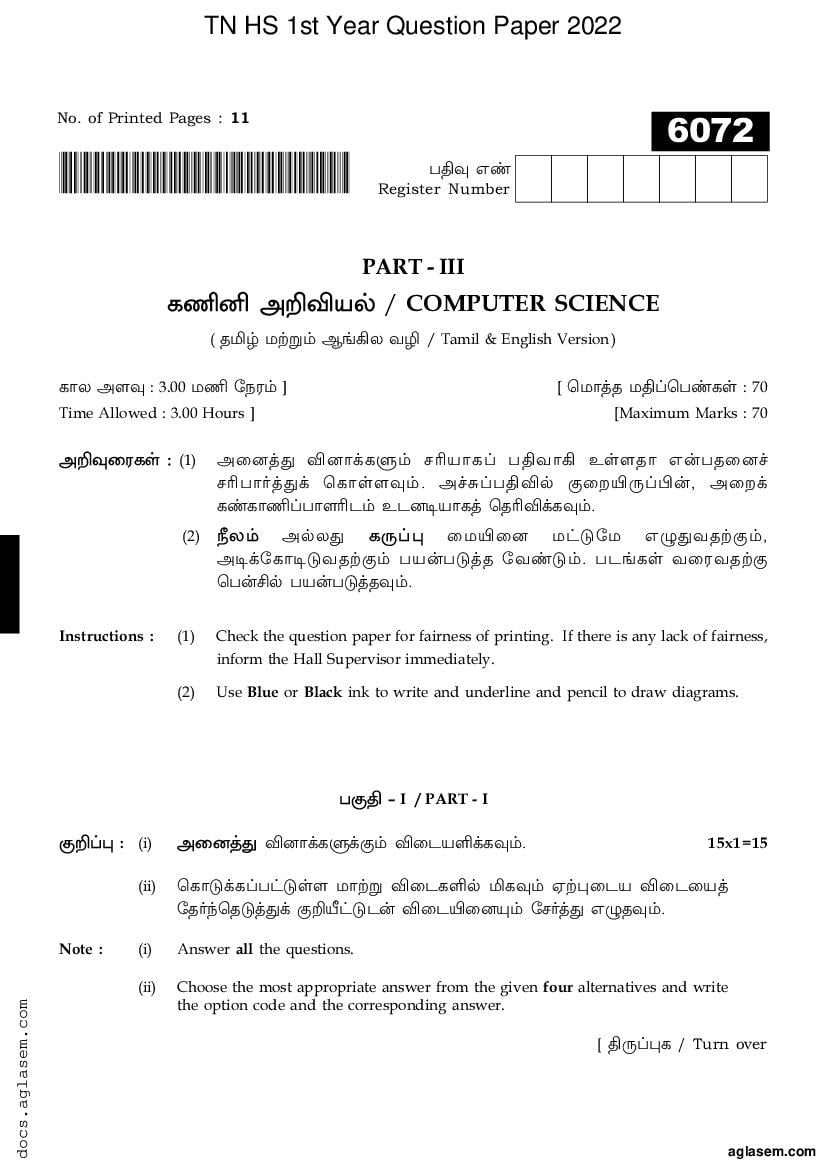
TN 11th Question Paper 2022 Computer Science
Finished viewing? Save it for later —
Download TN 11th Question Paper 2022 Computer Science (PDF · 11 pages)About TN 11th Question Paper 2022 Computer Science
TN 11th Question Paper 2022 Computer Science is available here for free download. Published by Tamil Nadu Board for Class 11, this question paper can be viewed online or downloaded as a PDF (11 pages). Candidates preparing for Class 11 can use TN 11th Question Paper 2022 Computer Science to understand the exam pattern, the type of questions asked, and the overall difficulty level.
Frequently Asked Questions
How can I download TN 11th Question Paper 2022 Computer Science?
Open this page and click the Download button to save TN 11th Question Paper 2022 Computer Science as a PDF. It is completely free on AglaSem Docs.
Is TN 11th Question Paper 2022 Computer Science free to download?
Yes. TN 11th Question Paper 2022 Computer Science can be viewed online and downloaded as a PDF free of cost on AglaSem Docs.
How many pages does TN 11th Question Paper 2022 Computer Science have?
TN 11th Question Paper 2022 Computer Science contains 11 pages, which you can read online or download together as a single PDF.
Where can I find more Class 11 study material?
You can find more Class 11 question papers, sample papers, syllabus, and answer keys on AglaSem Docs.
TN 11th Question Paper 2022 Computer Science – Text
Read the full text of this question paper below — useful to quickly search, copy and reference the content online without downloading the PDF.
📄 View text version (11 pages)
Page 1
6072
!6072IstYearComputerScience! £vÄ Gs
Register Number
PART - III
PoÛ AÔ¯À / COMPUTER SCIENCE
( uªÌ ©ØÖ® B[Q» ÁÈ / Tamil & English Version )
Põ» AÍÄ : 3.00 ©o ÷|µ® ] [ ö©õzu ©v¨ö£sPÒ : 70
Time Allowed : 3.00 Hours ] [Maximum Marks : 70
AÔÄøµPÒ : (1) AøÚzx ÂÚõUPЮ \›¯õP¨ £vÁõQ EÒÍuõ GߣuøÚa
\›£õºzxU öPõÒÍÄ®. Aa_¨£vÂÀ SøÓ°¸¨¤ß, AøÓU
PsPõo¨£õÍ›h® EhÚi¯õPz öu›ÂUPÄ®.
(2) }»® AÀ»x P¸¨¦ ø©°øÚ ©mk÷© GÊxÁuØS®,
AiU÷PõikÁuØS® £¯ß£kzu ÷Ásk®. £h[PÒ ÁøµÁuØS
ö£ß]À £¯ß£kzuÄ®.
Instructions : (1) Check the question paper for fairness of printing. If there is any lack of fairness,
inform the Hall Supervisor immediately.
(2) Use Blue or Black ink to write and underline and pencil to draw diagrams.
£Sv – I / PART - I
SÔ¨¦ : (i) AøÚzx ÂÚõUPÐUS® Âøh¯ÎUPÄ®. 15x1=15
(ii) öPõkUP¨£mkÒÍ ©õØÖ ÂøhPÎÀ ªPÄ® Hئøh¯ Âøhø¯z
÷uº¢öukzxU SÔ±mkhß Âøh°øÚ²® ÷\ºzx GÊuÄ®.
Note : (i) Answer all the questions.
(ii) Choose the most appropriate answer from the given four alternatives and write
the option code and the corresponding answer.
Page 2
1. G¢u Po¨ö£õÔ uø»•øÓ°À J¸[Qøn¢u _ØÖPÒ £¯ß£kzu¨£mhx ?
(A) ‰ßÓõ® (B) •u»õ® (C) |õßPõ® (D) Cµshõ®
Which generation of computer used IC’s ?
(a) Third (b) First (c) Fourth (d) Second
2. 11012 &US {PµõÚ £vÚõÖ{ø» ©v¨¦ Gx ?
(A) F (B) D (C) B (D) E
For 11012 the Hexadecimal equivalent is :
(a) F (b) D (c) B (d) E
3. ¤ßÁ¸ÁÚÁØÔÀ Gx ~sö\¯¼°ß £õP® AÀ» ?
(A) ÷Pa {øÚÁP® (B) Pou Hµna ö\¯»P®
(C) £v÷Ák (D) Pmk¨£õmhP®
Which of the following is not a part of the microprocessor unit ?
(a) Cache Memory (b) ALU
(c) Register (d) Control Unit
4. ¤ßÁ¸ÁÚÁØÔÀ Gx JØøÓ £¯Úº C¯UP Aø©¨¦ ?
(A) Linux (B) MS-DOS (C) UNIX (D) Windows
Which of the following is single user operating system ?
(a) Linux (b) MS-DOS (c) UNIX (d) Windows
Page 3
5. ¤ßÁ¸ÁÚÁØÖÒ Gx JmkÁuØPõÚ PmhøÍ ?
(A) Edit → Paste (B) View → Paste
(C) File → Paste (D) ÷©ØTÔ¯ AøÚzx®
Which command is used to ‘Paste’ ?
(a) Edit → Paste (b) View → Paste
(c) File → Paste (d) All of the above
6. C1 Gߣx ö£õ´ ©ØÖ® C2 Gߣx ö©´ GÛÀ C¯UP¨£k® Tmk _ØÖ Gx ?
1. if C1
2. S1
3. else
4. if C2
5. S2
6. else
7. S3
(A) S2 (B) S3
(C) S1 (D) CÁØÔÀ HxªÀø»
If C1 is false and C2 is true, the compound statement
1. if C1
2. S1
3. else
4. if C2
5. S2
6. else
7. S3
executes :
(a) S2 (b) S3
(c) S1 (d) None
Page 4
7. C++ &ø¯ E¸ÁõUQ¯Áº ¯õº ?
(A) ¤À ÷Pmì (B) \õº»ì £õ÷£ä
(C) ÷áºß ìmöµÍìmµ¨ (D) _¢uº ¤aø\
Who developed C++ ?
(a) Bill Gates (b) Charles Babbage
(c) Bjarne Stroustrup (d) Sundar Pichai
8. C++ &À GzuøÚ ÁøP¯õÚ uµÂÚ[PÒ EÒÍÚ ?
(A) 3 (B) 5 (C) 2 (D) 4
How many categories of data types are available in C++ ?
(a) 3 (b) 5 (c) 2 (d) 4
9. for(int i=1; i<10; i++) GßÓ ©hUS GzuøÚ •øÓ C¯[S® ?
(A) 11 (B) 9 (C) 0 (D) 10
How many times the following loop will be executed ?
for(int i=1; i<10; i++)
(a) 11 (b) 9 (c) 0 (d) 10
10. int x=10;
int main( )
{
int x =100;
cout << :: x;
}
÷©÷» EÒÍ {µ¼ß öÁαk ¯õx ?
(A) 100 (B) x (C) ::x (D) 10
int x=10;
int main( )
{
int x =100;
cout << :: x;
}
The output for the above snippet is :
(a) 100 (b) x (c) ::x (d) 10
Page 5
11. CÁØÖÒ Gx J÷µ uµÂÚzøua ÷\º¢u ©õÔPÎß vµmk ©ØÖ® AøÚzx
EÖ¨¦PøͲ® J÷µ ö£õx¨ ö£¯µõÀ SÔ¨¤h C¯¾® ?
(A) array (B) int (C) class (D) float
Which of the following is the collection of variables of the same type that are
referenced by a common name ?
(a) array (b) int (c) class (d) float
12. ""J¸•øÓ GÊxuÀ £»•øÓ £¯ß£kzxuÀ'' Guß ‰»® {øÓ÷ÁØÓ¨£kQÓx ?
(A) ©õØÓ® (B) uµÄ ªøPø©
(C) öuõSzuÀ (D) ©Ö£¯ÚõUP®
“Write once and use it multiple time” can be achieved by :
(a) Modification (b) Redundancy
(c) Composition (d) Reusability
13. __________ CÚUSÊÁõÚx SÔ¨¤mh ö\¯À£õmøh ö\´¯ EuÄ®
ö\¯ØTÓõS®.
(A) Inline ö\¯ØTÖPÒ (B) uµÄ EÖ¨¦PÒ
(C) EÖ¨¦ ö\¯ØTÖPÒ (D) Cøn¯ÁÈa ö\¯ØTÖPÒ
The functions that perform specific tasks in a class is called :
(a) Inline functions (b) Data members
(c) Member functions (d) Online functions
Page 6
14. RÌUPshÁØÔÀ Gx ö\¯À•øÓ, £°Ø] ©ØÖ® ©v¨¦hß öuõhº¦øh¯x ?
(A) |a_ {µÀPÒ (B) Po¨ö£õÔ |ßöÚÔ
(C) E›ø©°À»õ |P»õUP® (D) {µÀPÒ
Which of the following deals with procedures, practices and values ?
(a) Virus (b) Computer ethics
(c) Piracy (d) Programs
15. ¤ßÁ¸ÁÚÁØÔÀ Gx ÷ukö£õÔ AÀ» ?
(A) Bßmµõ´m (B) ¤[ (C) ¯õT (D) TSÒ
Which is not a search engine ?
(a) Android (b) Bing (c) Yahoo (d) Google
£Sv & II / PART - II
SÔ¨¦ : GøÁ÷¯Ý® BÖ ÂÚõUPÐUS Âøh¯ÎUPÄ®. AÁØÔÀ ÂÚõ Gs
24 &US Pmhõ¯® Âøh¯ÎUPÄ®. 6x2=12
Note : Answer any six of the following questions. Question No. 24 is compulsory.
16. uÛ |£º Po¨ö£õÔPξ® ©ØÖ® øP¨÷£] \õuÚ[Pξ® £¯ß£kzu¨£k®
¤µ£»©õÚ C¯UP Aø©¨¦ ]»ÁØøÓU TÖP.
Name some of the popular operating systems used in personal computers and
Mobile devices.
17. (44)10 &I C¸{ø» GsnõP ©õØÖP.
Convert (44)10 into Binary number.
Page 7
18. ö\¢uµ £oUSÔ GßÓõÀ GßÚ ?
What are called Standard Icons ?
19. ö|Ô•øÓ – Áøµ¯ÖUPÄ®.
Define Algorithms.
20. C¸ £›©õn Aoø¯ AÔÂUS® öuõh›¯ø» GÊxP.
What is the syntax to declare two-dimensional array ?
21. ö\¯ØTÖ £oªS¨¦ GßÓõÀ GßÚ ?
What is Function Overloading ?
22. u¸ÂUP¨£mh CÚUSÊ Hß \Uv Áõ´¢u CÚUSÊ GßÖ P¸u¨£kQÓx ?
Why derived class is called ‘Power Packed Class’ ?
23. TSCII GßÓõÀ GßÚ ?
What is TSCII ?
24. Void uµÄ ÁøP°ß •UQ¯zxÁ[PÒ ¯õøÁ ?
What are the importance of void data type ?
Page 8
£Sv & III / PART - III
SÔ¨¦ : HuõÁx BÖ ÂÚõUPÐUS Âøh¯ÎUPÄ®. AÁØÔÀ ÂÚõ Gs. 33 &US
Pmhõ¯® Âøh¯ÎUPÄ®. 6x3=18
Note : Answer any six of the following questions. Question No. 33 is compulsory.
25. ö\¯»õUP¨£k® uµÂß AP»zvß Ai¨£øh°À ~sö\¯¼°ß ÁøPPøÍ
ÂÍUSP.
Explain about classification of Microprocessors based on the Data Width.
26. BÓõÁx uø»•øÓ°ß ußø©Pøͨ £ØÔ GÊxP.
Write the characteristics of sixth generation computers.
27. Case &£S¨£õ´Ä GßÓõÀ GßÚ ?
What is Case-analysis ?
28. ]Ó¨¦a ö\õØPÒ GßÓõÀ GßÚ ? ]Ó¨¦a ö\õØPøÍ SÔ¨ö£¯ºPÍõP
£¯ß£kzu»õ©õ ?
What are Keywords ? Can keywords be used as identifiers ?
29. öÁØÖU TØÖ ©ØÖ® TmkU TØÖ GßÓõÀ GßÚ ?
What is a null statement and compound statement ?
30. Switch TØÔß PmhøÍ öuõhøµ GÊv Auß £¯ßPøͨ £mi¯¼kP.
Write the syntax and the purposes of switch statement.
Page 9
31. £¯Úº Áøµ¯Özu ö\¯ØTÖPÒ – SÔ¨¦ ÁøµP.
Write a note on User-defined functions.
32. ö|Ô•øÓ ]UPÀ GßÓõÀ GßÚ ? AÁØÖÒ ]»ÁØøÓ¨ £mi¯¼kP.
What are ethical issues ? List some of them.
33. for ©hUøP öPõsk 1 •uÀ 10 Áøµ EÒÍ GsPÎß öuõhº Tmhø» öÁΰk®
C++ {µÀ GÊxP.
Write a C++ program to sum the numbers from 1 to 10 using ‘for’ loop.
£Sv & IV / PART - IV
SÔ¨¦ : AøÚzx ÂÚõUPÐUS® Âøh¯ÎUPÄ®. 5x5=25
Note : Answer all the questions.
34. (A) uµÄ ©ØÖ® uPÁø» ÂÍUSP.
AÀ»x
(B) ROM &ß ÁøPPøͨ £ØÔ ÂÍUP©õP GÊxP.
(a) Explain Data and Information.
OR
(b) Explain the types of ROM.
35. (A) Âs÷hõì C¯UP Aø©¨¤ß £»ÁøP¯õÚ £v¨¦PøÍ ÂÁ›UPÄ®.
AÀ»x
(B) J¸ Gsoß ÁºUP ‰»zøu (Square Root) PnUQkÁuØPõÚ ö|Ô•øÓø¯
GÊxP.
(a) Explain the versions of windows operating system.
OR
(b) Write the specification of an algorithm for computing the square root of a
number.
Page 10
36. (A) ¤øÇPÎß ÁøPPøÍ ÂÁ›UPÄ®.
AÀ»x
(B) £»ÁÈ Qøͤ›¨¦U (Switch) TØøÓ GkzxUPõmkhß ÂÍUSP.
(a) Explain the types of errors.
OR
(b) Explain multi-way branch statement (switch) with a suitable example.
37. (A) ©hUQß £SvPøÍ ÂÍUSP.
(a) Explain the parts of a Loop.
AÀ»x /OR
(B) ¤ßÁ¸® {µ¼ß öÁαmøh GÊxP.
(b) Find the output of following program.
#include<iostream>
using namespace std;
int main( )
{
int num[10], even=0, odd=0;
for(int i=0; i<10; i++)
{
cout<<“\n Enter Number”<<i+1<<“=”;
cin>>num[i];
if(num[i]%2==0)
++even;
else
++odd;
}
cout<<“\n There are”<<even<<“Even Numbers”;
cout<<“\n There are”<<odd<<“Odd Numbers”;
}
Page 11
38. (A) C++ {µ¼¾ÒÍ ¤øÇPøÍ ¤øÇ v¸zu® ö\´P.
(a) Debug the following C++ program :
Output
----------------
15
14
13
Program :
----------------
%include(iostream.h)
#include<conio.h>
Class A
{
public;
int a1,a2:a3;
Void getdata[ ]
{
a1=15;
a2=13;a3=13;
}
}
Class B :: public A( )
{
PUBLIC
voidfunc( )
{
int b1:b2:b3;
A::getdata[ ];
b1=a1;
b2=a2;
a3=a3;
cout<<b1<<’\t’<<b2<<’t\’<<b3;
}
void main( )
{
clrscr( )
B der;
der1:func( );
getch( );
}
AÀ»x /OR
(B) ö£õ¸Ò ÷|õUS {µ»õUPzvß |ßø©PøÍ GÊxP.
(b) Explain the advantages of object oriented programming.
-o0o-
Document Details
| Board / Org | Tamil Nadu Board |
| Exam | Class 11 |
| Type | Question Paper |
| Pages | 11 |
| Updated | 30 Apr 2026 |