DUET 2021 Question Paper Ph.D in Microbiology
Finished viewing? Save it for later —
Download DUET 2021 Question Paper Ph.D in Microbiology (PDF · 10 pages)About DUET 2021 Question Paper Ph.D in Microbiology
DUET 2021 Question Paper Ph.D in Microbiology is available here for free download. Published by NTA for DUET, this question paper can be viewed online or downloaded as a PDF (10 pages). Candidates preparing for DUET can use DUET 2021 Question Paper Ph.D in Microbiology to understand the exam pattern, the type of questions asked, and the overall difficulty level.
Frequently Asked Questions
How can I download DUET 2021 Question Paper Ph.D in Microbiology?
Open this page and click the Download button to save DUET 2021 Question Paper Ph.D in Microbiology as a PDF. It is completely free on AglaSem Docs.
Is DUET 2021 Question Paper Ph.D in Microbiology free to download?
Yes. DUET 2021 Question Paper Ph.D in Microbiology can be viewed online and downloaded as a PDF free of cost on AglaSem Docs.
How many pages does DUET 2021 Question Paper Ph.D in Microbiology have?
DUET 2021 Question Paper Ph.D in Microbiology contains 10 pages, which you can read online or download together as a single PDF.
Where can I find more DUET study material?
You can find more DUET question papers, sample papers, syllabus, and answer keys on AglaSem Docs.
DUET 2021 Question Paper Ph.D in Microbiology – Text
Read the full text of this question paper below — useful to quickly search, copy and reference the content online without downloading the PDF.
📄 View text version (10 pages)
Page 1
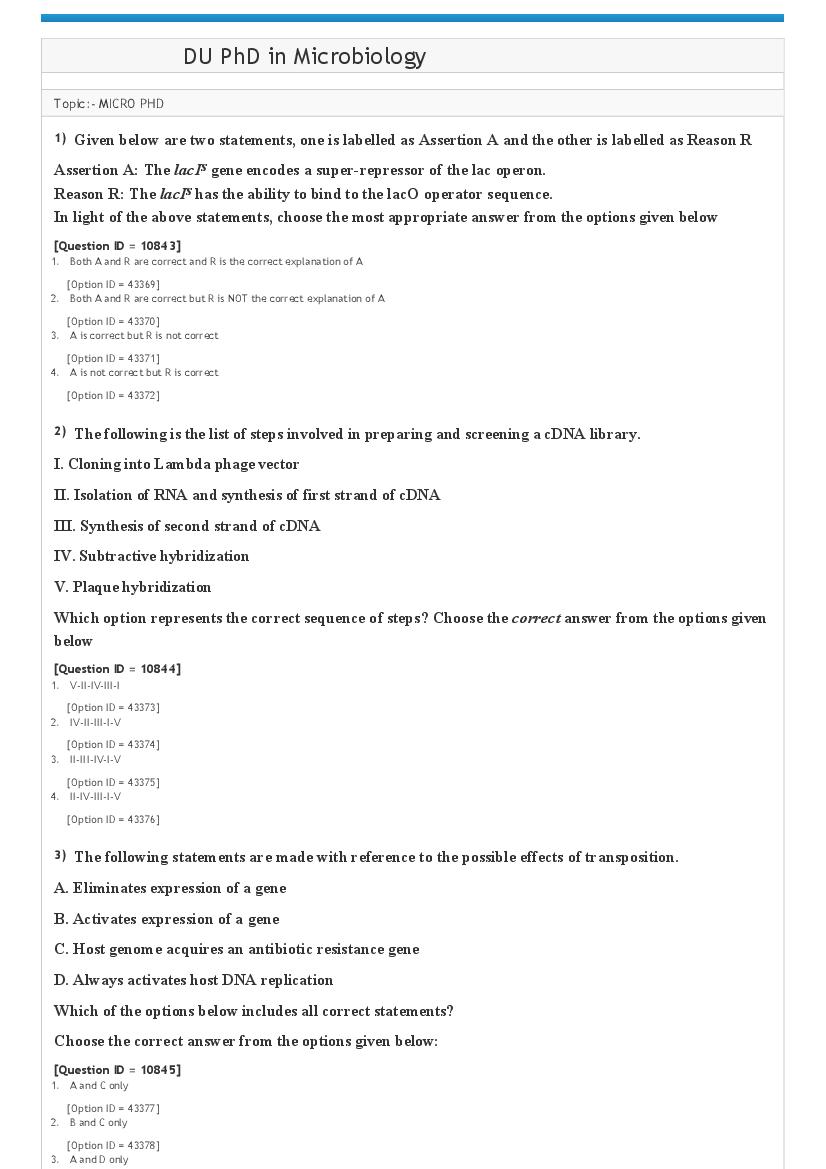
Topic:‐ MICRO PHD
1) Given below are two statements, one is labelled as Assertion A and the other is labelled as Reason R
Assertion A: The lacIs gene encodes a superrepressor of the lac operon.
Reason R: The lacIs has the ability to bind to the lacO operator sequence.
In light of the above statements, choose the most appropriate answer from the options given below
[Question ID = 10843]
1. Both A and R are correct and R is the correct explanation of A
[Option ID = 43369]
2. Both A and R are correct but R is NOT the correct explanation of A
[Option ID = 43370]
3. A is correct but R is not correct
[Option ID = 43371]
4. A is not correct but R is correct
[Option ID = 43372]
2) The following is the list of steps involved in preparing and screening a cDNA library.
I. Cloning into Lambda phage vector
II. Isolation of RNA and synthesis of first strand of cDNA
III. Synthesis of second strand of cDNA
IV. Subtractive hybridization
V. Plaque hybridization
Which option represents the correct sequence of steps? Choose the correct answer from the options given
below
[Question ID = 10844]
1. V‐II‐IV‐III‐I
[Option ID = 43373]
2. IV‐II‐III‐I‐V
[Option ID = 43374]
3. II‐III‐IV‐I‐V
[Option ID = 43375]
4. II‐IV‐III‐I‐V
[Option ID = 43376]
3) The following statements are made with reference to the possible effects of transposition.
A. Eliminates expression of a gene
B. Activates expression of a gene
C. Host genome acquires an antibiotic resistance gene
D. Always activates host DNA replication
Which of the options below includes all correct statements?
[Question ID = 10845]
1. A and C only
[Option ID = 43377]
2. B and C only
[Option ID = 43378]
3. A and D only
Page 2
4. A, B and C only
[Option ID = 43380]
4) Which of the following statements made with regards to DNA replication are true?
A. Replication of the circular bacterial chromosome initiates bidirectionally from a single origin.
B. Replication of all plasmids initiates bidirectionally from a single origin.
C. Chromosomes in eukaryotes typically have multiple origins.
D. Replication in all archaea initiates bidirectionally from a single origin.
[Question ID = 10846]
1. A, B and C only
[Option ID = 43381]
2. A, C and D only
[Option ID = 43382]
3. A and C only
[Option ID = 43383]
4. A and D only
[Option ID = 43384]
5) Choose the most suitable option matching the antibiotic inhibitor of translation listed in Column A with the correct
consequence from among those listed in Column B
Column A Column B
A. Cycloheximide I. Inhibits the binding of aminoacyl‐tRNA to the A‐site
B. Tetracycline II. Prevents translocation of A‐site tRNA to P‐site
C. Erythromycin III. Blocks exit of growing polypeptide chain from the ribosome
D. Hygromycin B IV. Inhibits peptidyl transferase activity
[Question ID = 10847]
1. A‐I, B‐IV, C‐III, D‐II
[Option ID = 43385]
2. A‐II, B‐III, C‐IV, D‐I
[Option ID = 43386]
3. A‐III, B‐I, C‐IV, D‐II
[Option ID = 43387]
4. A‐IV, B‐I, C‐III, D‐II
[Option ID = 43388]
6) Given below are two statements, one is labelled as Assertion A and the other is labelled as Reason R
Assertion A: The RNA polymerase core enzyme can synthesize RNA against a DNA template.
Reason R: The sigma factor in the RNA polymerase holoenzyme is responsible for promoter recognition and ensures that
transcription initiates at specific sites.
In light of the above statements, choose the most appropriate answer from the options given below
[Question ID = 10848]
1. Both A and R are correct and R is the correct explanation of A
[Option ID = 43389]
2. Both A and R are correct but R is NOT the correct explanation of A
[Option ID = 43390]
3. A is correct but R is not correct
[Option ID = 43391]
4. A is not correct but R is correct
[Option ID = 43392]
7) Which of the following statements made with regards to bacterial DNA polymerases are true?
A. DNA Pol III is the primary replicative polymerase
B. DNA Pol I plays no role in replication and is involved in DNA repair
Page 3
D. DNA Pol I and DNA Pol III have proof‐reading ability
[Question ID = 10849]
1. A, C and D only
[Option ID = 43393]
2. A, B and D only
[Option ID = 43394]
3. A and D only
[Option ID = 43395]
4. A and C only
[Option ID = 43396]
8) Choose the most suitable option matching the chemical mutagen listed in Column A with its property from among those
listed in Column B
Column A Column B
A. Nitrous Acid I. Alkylating agent
B. 5‐bromouracil II. Intercalating agent
C. Ethylmethane sulfonate III. Oxidative deamination
D. Acridine orange IV. Base analog
[Question ID = 10850]
1. A‐I, B‐IV, C‐II, D‐III [Option ID = 43397]
2. A‐III, B‐IV, C‐I, D‐II [Option ID = 43398]
3. A‐IV, B‐I, C‐III, D‐II [Option ID = 43399]
4. A‐III, B‐IV, C‐II, D‐I [Option ID = 43400]
9) What is the correct sequence of steps from those listed below when sequencing a vertebrate genome?
I. Assembly of sequence reads
II. Pulsed field gel electrophoresis
III. Subclone library
IV. Shotgun sequencing
V. BAC library
Choose the correct answer from the options given below
[Question ID = 10851]
1. II‐V‐III‐IV‐I
[Option ID = 43401]
2. V‐II‐III‐IV‐I
[Option ID = 43402]
3. V‐III‐II‐IV‐I
[Option ID = 43403]
4. II‐V‐IV‐III‐I
[Option ID = 43404]
10)
[Question ID = 10852]
1. A and C only
[Option ID = 43405]
2. B and C only
Page 4
3. A and D only
[Option ID = 43407]
4. B and D only
[Option ID = 43408]
11) Given below are two statements, one is labelled as Assertion A and the other is labelled as Reason R
Assertion A: In somatic cell nuclear transfer – based cloning of animals, the offspring do not acquire any genetic traits of the
mother who provided the egg.
Reason R: The egg that is used for the process is enucleate.
In light of the above statements, choose the most appropriate answer from the options given below
[Question ID = 10853]
1. Both A and R are correct and R is the correct explanation of A
[Option ID = 43409]
2. Both A and R are correct but R is NOT the correct explanation of A
[Option ID = 43410]
3. A is correct but R is not correct
[Option ID = 43411]
4. A is not correct but R is correct
[Option ID = 43412]
12) Choose the most suitable option matching the enzyme listed in Column A with its application from among those listed in
Column B
Column A Column B
A. Phu DNA polymerase I. Homopolymeric tailing
B. DNA Polymerase I II. Random priming
C. Klenow III. Gene amplification
D. Terminal deoxynucleotidyl transferase IV. Nick translation
[Question ID = 10854]
1. A‐I, B‐IV, C‐II, D‐III [Option ID = 43413]
2. A‐III, B‐IV, C‐I, D‐II [Option ID = 43414]
3. A‐IV, B‐I, C‐III, D‐II [Option ID = 43415]
4. A‐III, B‐IV, C‐II, D‐I [Option ID = 43416]
13) When carbohydrates are being metabolized, TCA cycle intermediates are replenished by production of oxaloacetate
where pyruvate carboxylase and phosphoenol pyruvate carboxylase are used. Of these, pyruvate carboxylase catalyses
oxaloacetate synthesis by coupling conversion of one ATP to ADP. On the other hand, PEP carboxylase activity is equivalent
to sum of two enzymatic reactions catalysed by:[Question ID = 10855]
1. Pyruvate dehydrogenase and Pyruvate kinase [Option ID = 43417]
2. Pyruvate kinase and Pyruvate carboxylase [Option ID = 43418]
3. PEP carboxykinase and Pyruvate carboxylase [Option ID = 43419]
4. PEP carboxykinase and Pyruvate kinase [Option ID = 43420]
14) Louis Pasteur observed that sudden addition of oxygen to a previously anaerobic culture of yeast during grape juice
fermentation resulted in decrease in the rate of glucose consumption. This was termed as ‘Pasteur effect’. This effect can
be counteracted by addition of:[Question ID = 10856]
1. Sodium azide [Option ID = 43421]
2. Oligomycin [Option ID = 43422]
3. 2,4‐dinitrophenol [Option ID = 43423]
4. Carbon monoxide [Option ID = 43424]
15) Choose the most suitable option matching the vitamin coenzyme listed in Column A with its corresponding enzyme from
among those listed in Column B
Column A Column B
A. Biotin I. α‐ketoglutarate dehydrogenase
B. Thiamine II. Methionine synthase
C. Pyridoxal‐5‐phosphate III. Pyruvate carboxylase
D. Methyl cobalamin IV. Transaminases
Page 5
1. A‐II, B‐I, C‐IV, D‐III
[Option ID = 43425]
2. A‐IV, B‐II, C‐I, D‐III
[Option ID = 43426]
3. A‐III, B‐I, C‐IV, D‐II
[Option ID = 43427]
4. A‐I, B‐IV, C‐III, D‐II
[Option ID = 43428]
16) Which of the following proteins of the bacterial divisome complex are like tubulin and actin?[Question ID = 10858]
1. FtsZ and ZipA [Option ID = 43429]
2. FtsA and FtsK [Option ID = 43430]
3. FtsZ and FtsA [Option ID = 43431]
4. FtsW and FtsA [Option ID = 43432]
17) Given below are two statements, one is labelled as Assertion A and the other is labelled as Reason R
Assertion A: Pyruvate kinase assay can be simplified by coupling it with lactate dehydrogenase.
Reason R: It is easier to spectrophotometrically measure lactic acid than pyruvic acid as former can be converted to a
coloured compound.
In light of the above statements, choose the most appropriate answer from the options given below
[Question ID = 10859]
1. Both A and R are correct and R is the correct explanation of A
[Option ID = 43433]
2. Both A and R are correct but R is NOT the correct explanation of A
[Option ID = 43434]
3. A is correct but R is not correct
[Option ID = 43435]
4. A is not correct but R is correct
[Option ID = 43436]
18) Given below are two statements, one is labelled as Assertion A and the other is labelled as Reason R
Assertion A: A protein with a pI of 6.5 could be purified by anion exchange chromatography using Q
Sepharosein 20mM Tris HCl buffer, pH 9.
Reason R: At pH < pI, proteins are protonated while at pH > pI, proteins are deprotonated.
In light of the above statements, choose the most appropriate answer from the options given below
[Question ID = 10860]
1. Both A and R are correct and R is the correct explanation of A
[Option ID = 43437]
2. Both A and R are correct but R is NOT the correct explanation of A
[Option ID = 43438]
3. A is correct but R is not correct
[Option ID = 43439]
4. A is not correct but R is correct
[Option ID = 43440]
19) What will be the molar concentration of an acid with molecular mass 50g and specific gravity of 2 g/ml, if the acid is
75% pure?[Question ID = 10861]
1. 30M [Option ID = 43441]
2. 20M [Option ID = 43442]
3. 15M [Option ID = 43443]
4. 40M [Option ID = 43444]
20) Tunicamycin, an antibiotic, specifically inhibits which of the following steps during bacterial cell wall synthesis?
[Question ID = 10862]
1. Transfer of Lipid II to the outside of membrane [Option ID = 43445]
2. Polymerization of peptidoglycan chain [Option ID = 43446]
3. Formation of bactoprenol‐NAM pentapeptide [Option ID = 43447]
4. Inhibits both D‐alanine racemase and D‐alanine ligase [Option ID = 43448]
21) You have isolated a compound from a plant extract that inhibits three different lipase isozymes from Bacillus subtilis.
You are interested in understanding the nature of inhibition and therefore you determined the kinetic parameters.
Page 6
With 5mM inhibitor
Lipases Km (mM) Vmax (µmole/mg/min) Molecular mass (kDa)
Km(mM) Vmax (µmole/mg/min)
Lip1 15 15 20 15 30
Lip2 20 10 20 5 50
Lip3 25 15 10 10 60
On the basis of turnover number (K<sub>cat</sub>), isozymes can be arranged as:
[Question ID = 10863]
1. Lip3 > Lip2 > Lip1
[Option ID = 43449]
2. Lip1 > Lip3 > Lip2
[Option ID = 43450]
3. Lip1 = Lip3 > Lip2
[Option ID = 43451]
4. Lip1 > Lip2 = Lip3
[Option ID = 43452]
22) You have isolated a compound from a plant extract that inhibits three different lipase isozymes from Bacillus subtilis.
You are interested in understanding the nature of inhibition and therefore you determined the kinetic parameters.
Observe the following data and answer the question below:
With 5mM inhibitor
Lipases Km(mM) Vmax (µmole/mg/min) Molecular mass (kDa)
Km (mM) Vmax (µmole/mg/min)
Lip1 15 15 20 15 30
Lip2 20 10 20 5 50
Lip3 25 15 10 10 60
On the basis of catalytic efficiency, the most efficient isozyme is
[Question ID = 10864]
1. Lip3
[Option ID = 43453]
2. Lip2
[Option ID = 43454]
3. Lip1
[Option ID = 43455]
4. Lip3 = Lip1
[Option ID = 43456]
23) You have isolated a compound from a plant extract that inhibits three different lipase isozymes from Bacillus subtilis.
You are interested in understanding the nature of inhibition and therefore you determined the kinetic parameters.
Observe the following data and answer the question below:
With 5mM inhibitor
Lipases Km(mM) Vmax (µmole/mg/min) Molecular mass (kDa)
Km (mM) Vmax (µmole/mg/min)
Lip1 15 15 20 15 30
Lip2 20 10 20 5 50
Lip3 25 15 10 10 60
Analysing the inhibitor data, select the correct statement(s) from the following:
A. Inhibition of only Lip1 can be overcome by increasing the substrate concentration.
B. Mode of inhibition is non‐competitive for Lip 2 and competitive for Lip 3.
C. Mode of inhibition is competitive in Lip1 and uncompetitive in Lip3.
D. Inhibition of Lip 2 and Lip 3 are irreversible.
Page 7
1. A and C only
[Option ID = 43457]
2. A and D only
[Option ID = 43458]
3. A, C and D only
[Option ID = 43459]
4. C and D only
[Option ID = 43460]
24) A bacterial suspension resulting in 400 mg dry cell weight/L showed an absorbance of 1 OD at 600nm in a 1 cm
cuvette. What will be the cell density of a suspension that showed 0.3 OD at 600nm in a 3 cm cuvette?[Question ID =
10866]
1. 40 mg dry weight/L [Option ID = 43461]
2. 13.5 mg dry weight/L [Option ID = 43462]
3. 30 mg dry weight/L [Option ID = 43463]
4. 25.5 mg dry weight/L [Option ID = 43464]
25) Fermentative bacteria have little or no α‐ketoglutarate dehydrogenase activity and therefore have a block in citric
acid cycle. Under these conditions, which of the following enzyme activities are induced to synthesize succinyl CoA?
[Question ID = 10867]
1. Fumarate reductase
[Option ID = 43465]
2. Succinic dehydrogenase
[Option ID = 43466]
3. Malic enzyme
[Option ID = 43467]
4. Malate dehydrogenase
[Option ID = 43468]
26) Match the genetic defects listed in Column A with the correct clinical manifestations from among those listed in Column
B
Column A Column B
A. Mutation in Cytokine receptor I. Normal levels of Ig and CD4 lymphocytes, CD4 cell functionally defective, recurrent
gamma chain infections
B. Mutations in RAG‐1 and RAG‐2 II. Severe recurrent infections, survival of children only in pathogen free environment
III. History of recurrent infections, Ab response decreased, gamma‐globulin injections
C. Mutations in JAK‐3 and ZAP‐70
needed
IV. Impairment of functions of T and B cell, affecting both HI and CMI, intact NK cells
D. Wiscott‐Aldrich syndrome (WAS)
function and innate response
[Question ID = 10868]
1. A‐I, B‐II, C‐III, D‐IV [Option ID = 43469]
2. A‐IV, B‐II, C‐III, D‐I [Option ID = 43470]
3. A‐I, B‐IV, C‐II, D‐III [Option ID = 43471]
4. A‐II, B‐IV, C‐I, D‐III [Option ID = 43472]
27) Identify the correct statement about autoimmune disease and their general features.
[Question ID = 10869]
1. Grave’s disease involves TSH receptor on the thyroid cells resulting in auto‐antibodies stimulating production of T3 and T4 resulting in persistent
stimulation of thyroid gland.
[Option ID = 43473]
2. Goodpasture’s syndrome involves acetylcholine receptor on muscle cell at neuromuscular junction in which blocking auto‐antibodies interfere in
neurotransmission leading to muscular weakness.
[Option ID = 43474]
3. Pernicious anaemia involves intrinsic factors expressed on gastric cells in which auto‐antibodies bind to intrinsic factor and inhibit absorption of
Vitamin B12.
[Option ID = 43475]
4. Systemic lupus erythematosus involves myelin basic protein from myelin sheath of nerve cells in which activated self‐reactive cells cross blood‐brain
barrier resulting in demyelination leading to neurological diseases.
[Option ID = 43476]
28) Which one of these statements is false?[Question ID = 10870]
Page 8
2. IL‐6 is produced by macrophage and functions in terminal differentiation of B cells. [Option ID = 43478]
3. IL‐13 is produced by lymphocytes and functions in Th1 differentiation. [Option ID = 43479]
4. TNF‐alpha is produced by macrophage and functions as pro‐inflammatory cytokine. [Option ID = 43480]
29) The monoclonal antibody Tocilizumab which is mainly used against rheumatoid arthritis and has also been against CoV‐2
with some success, works by:[Question ID = 10871]
1. Binding to IL‐6 and blocking its interaction with IL6 receptor [Option ID = 43481]
2. Binding to IL‐6 receptor and blocking its interaction with IL6 [Option ID = 43482]
3. Down‐regulating expression of IL6 in macrophage [Option ID = 43483]
4. Blocking release of IL6 from macrophage [Option ID = 43484]
30) Match the SV40 viral proteins in Column A with their correct roles in SV40 replication from among those listed in
Column B
Column A Column B
A. Large T Antigen I. Link up lagging strand fragments after primer removal and fill in synthesis
B. RNase H II. Initial recognition of the viral replication origin
C. DNA Ligase III. Stabilization of unwound DNA in the replication bubble at initiation, and within replication forks
D. RP‐A IV. Removal of primers
[Question ID = 10872]
1. A‐II, B‐IV, C‐I, D‐III [Option ID = 43485]
2. A‐IV, B‐II, C‐III, D‐I [Option ID = 43486]
3. A‐I, B‐IV, C‐II, D‐III [Option ID = 43487]
4. A‐III, B‐II, C‐I, D‐IV [Option ID = 43488]
31) A typical feature of Ebola virus infection is that:[Question ID = 10873]
1. Virus is very quickly cleared from body as soon as the symptoms disappear [Option ID = 43489]
2. Virus is not cleared from body and is present for long periods always with typical symptoms [Option ID = 43490]
3. Virus is not cleared from body and is present for long periods even after symptoms of disease are gone [Option ID = 43491]
4. Even though virus is not cleared, virus is never detected in any of the body secretions after symptoms have disappeared [Option ID = 43492]
32) Which one of these is not a necessary feature in a virus which is to be used as a gene therapy vector?[Question ID =
10874]
1. The virus must be able to enter the desired human cell. [Option ID = 43493]
2. It must be possible to generate recombinant forms of the virus that are deleted for one or more essential functions. [Option ID = 43494]
3. Virus must be able to replicate in the host. [Option ID = 43495]
4. The virus should deliver its genetic material to the nucleus in the form of DNA. [Option ID = 43496]
33) Which of these is not an evidence for a DNA intermediate in retroviral replication?[Question ID = 10875]
1. Infection can be prevented by inhibitors of RNA synthesis added during the first 8‐12 hours after exposure of the cells to the virus, but not later
[Option ID = 43497]
2. Formation of virions is sensitive to actinomycin D [Option ID = 43498]
3. Infection of cells by RSV confers stably inheritable changes to the cells appearance and growth properties [Option ID = 43499]
4. Presence of retroelements in host genome [Option ID = 43500]
34) The CCR5 is termed as co‐receptor for HIV‐1 virus because:[Question ID = 10876]
1. It is smaller in size than HIV‐1 receptor CD4 [Option ID = 43501]
2. It does not play a major role in HIV‐1 attachment and entry in cell [Option ID = 43502]
3. It is not expressed in all the cells [Option ID = 43503]
4. Its role in HIV‐1 attachment and entry was discovered later than role of CD‐4 [Option ID = 43504]
35) Horizontal gene transfer (HGT) is the non‐sexual movement of genetic information between genomes. Which of these
statements is incorrect?[Question ID = 10877]
1. Incoming DNA or RNA can replace existing genes, or can introduce new genes into a genome [Option ID = 43505]
2. HGT has been detected to occur in a number of cases involving eukaryotes [Option ID = 43506]
3. The genes acquired by HGT do not have any clear functional or ecological implications for their new host [Option ID = 43507]
4. Ancient HGT events can provide useful clues to organismal relationships [Option ID = 43508]
36) The virulence of two different microbial pathogens:[Question ID = 10878]
1. Can never be compared [Option ID = 43509]
2. Can always be compared [Option ID = 43510]
3. Can be compared only if they are lethal [Option ID = 43511]
4. Can be compared if they produce similar lesions [Option ID = 43512]
37) The Koch’s postulates for the 21st century which relies on detection of pathogen‐ associated nucleic acid sequence,
were suggested by:[Question ID = 10879]
1. Fredricks and Relman [Option ID = 43513]
2. David Baltimore [Option ID = 43514]
3. Vincent Racaniello [Option ID = 43515]
4. Stahl and Sattley [Option ID = 43516]
Page 9
that produces a pencillin‐binding protein (PBP2a) with low affinity for β‐lactam antibiotics?
[Question ID = 10880]
1. mecA
[Option ID = 43517]
2. mecB
[Option ID = 43518]
3. mrsA
[Option ID = 43519]
4. mrsB
[Option ID = 43520]
39) In an ethanol fermentation plant, yeast cells are grown in a medium having a glucose concentration of 270 g/l.
Calculate the maximum theoretical concentration of ethanol at the end of the fermentation run, assuming no maintenance
requirement by cells.[Question ID = 10881]
1. 76.5 g/l [Option ID = 43521]
2. 138 g/l [Option ID = 43522]
3. 180 g/l [Option ID = 43523]
4. 229.5 g/l [Option ID = 43524]
40) In a bioreactor system where the agitator is handling Penicillium chrysogenum mycelium, the oxygen mass transfer rate
constant (KLa) would be[Question ID = 10882]
1. Proportional to broth viscosity [Option ID = 43525]
2. Inversely proportional to broth viscosity [Option ID = 43526]
3. Proportional to the square root of broth viscosity [Option ID = 43527]
4. Inversely proportional to the square root of broth viscosity [Option ID = 43528]
41) The conversion of penicillin G to 6‐aminopenicillanic acid (6‐APA) is done by which of the following enzymes?[Question
ID = 10883]
1. Succinate dehydrogenase [Option ID = 43529]
2. Penicillin G acylase (PGA) [Option ID = 43530]
3. Penicillinase [Option ID = 43531]
4. Versatile peroxidase (VP) [Option ID = 43532]
42) The Monod Batch kinetic equation gives a correlation between which of the following parameters? (µ is specific growth
rate; µmax is maximum specific growth rate; Ks is substrate utilization constant and S is substrate concentration)[Question ID
= 10884]
1. µ and µmax [Option ID = 43533]
2. Ks and µmax [Option ID = 43534]
3. µ and Ks [Option ID = 43535]
4. µ, µmax, Ks and S [Option ID = 43536]
43) Which of the following is an ideal bioreactor operation to obtain kinetic parameters of growth and product formation?
[Question ID = 10885]
1. Batch fermentation [Option ID = 43537]
2. Fed‐batch fermentation [Option ID = 43538]
3. Continuous stirred tank reactor (CSTR) [Option ID = 43539]
4. Plug flow reactor [Option ID = 43540]
44) To achieve high cellular biomass in a Fed‐batch fermentation process, which of the following feeding strategies should
be applied without substrate limitation or substrate inhibition?[Question ID = 10886]
1. Linear feeding of concentrated substrate [Option ID = 43541]
2. Constant feeding of concentrated substrate [Option ID = 43542]
3. Exponential feeding of concentrated substrate [Option ID = 43543]
4. Exponential feeding of concentrated biomass [Option ID = 43544]
45) In paper whitening, which of the following enzyme is used to decrease chlorine demand in the pulp and paper
industry?[Question ID = 10887]
1. Cellulase [Option ID = 43545]
2. Xylanase [Option ID = 43546]
3. Carbonic anhydrases [Option ID = 43547]
4. Asparaginase [Option ID = 43548]
46) Chemolithotrophs are used in which of the following processes?[Question ID = 10888]
1. Biopanning [Option ID = 43549]
2. Biopulping [Option ID = 43550]
3. Bioleaching [Option ID = 43551]
4. Biobleaching [Option ID = 43552]
47) The chemosynthetic microorganisms are generally found in which of the following habitats?[Question ID = 10889]
Page 10
2. Polluted lakes having high phosphate salt [Option ID = 43554]
3. Lakes with high sodium chloride content [Option ID = 43555]
4. River polluted with pulp and paper industry effluents [Option ID = 43556]
48) The ‘Sarcina sickness’ by Pedicoccus cerevisiae is generally caused by eating or drinking of which of the following
fermented products?
[Question ID = 10890]
1. Contaminated Beer
[Option ID = 43557]
2. Contaminated Cheese
[Option ID = 43558]
3. Contaminated flavored sausages
[Option ID = 43559]
4. Contaminated flavored yogurt
[Option ID = 43560]
49) The spoilage of low acid foods leading to “Sulfide stinker” is caused by which of the following microorganisms?
[Question ID = 10891]
1. Desulfotomaculum nigrificans
[Option ID = 43561]
2. Sulfolobus acidocaldarius
[Option ID = 43562]
3. Clostridium acetobutylicum
[Option ID = 43563]
4. Sulfolobus islandicus
[Option ID = 43564]
50) Which of the following microorganisms is predominantly found in dried milk powder?
[Question ID = 10892]
1. Flavobacterium columnare
[Option ID = 43565]
2. Cladosporium pseudocladosporioides
[Option ID = 43566]
3. Thermoduric streptococci
[Option ID = 43567]
4. Clostridium sporogenes
[Option ID = 43568]
Document Details
| Board / Org | NTA |
| Exam | DUET |
| Type | Question Paper |
| Pages | 10 |
| Language | english |
| Updated | 30 Apr 2026 |