DUET 2021 Question Paper Ph.D in Physics
Finished viewing? Save it for later —
Download DUET 2021 Question Paper Ph.D in Physics (PDF · 10 pages)About DUET 2021 Question Paper Ph.D in Physics
DUET 2021 Question Paper Ph.D in Physics is available here for free download. Published by NTA for DUET, this question paper can be viewed online or downloaded as a PDF (10 pages). Candidates preparing for DUET can use DUET 2021 Question Paper Ph.D in Physics to understand the exam pattern, the type of questions asked, and the overall difficulty level.
Frequently Asked Questions
How can I download DUET 2021 Question Paper Ph.D in Physics?
Open this page and click the Download button to save DUET 2021 Question Paper Ph.D in Physics as a PDF. It is completely free on AglaSem Docs.
Is DUET 2021 Question Paper Ph.D in Physics free to download?
Yes. DUET 2021 Question Paper Ph.D in Physics can be viewed online and downloaded as a PDF free of cost on AglaSem Docs.
How many pages does DUET 2021 Question Paper Ph.D in Physics have?
DUET 2021 Question Paper Ph.D in Physics contains 10 pages, which you can read online or download together as a single PDF.
Where can I find more DUET study material?
You can find more DUET question papers, sample papers, syllabus, and answer keys on AglaSem Docs.
DUET 2021 Question Paper Ph.D in Physics – Text
Read the full text of this question paper below — useful to quickly search, copy and reference the content online without downloading the PDF.
📄 View text version (10 pages)
Page 1
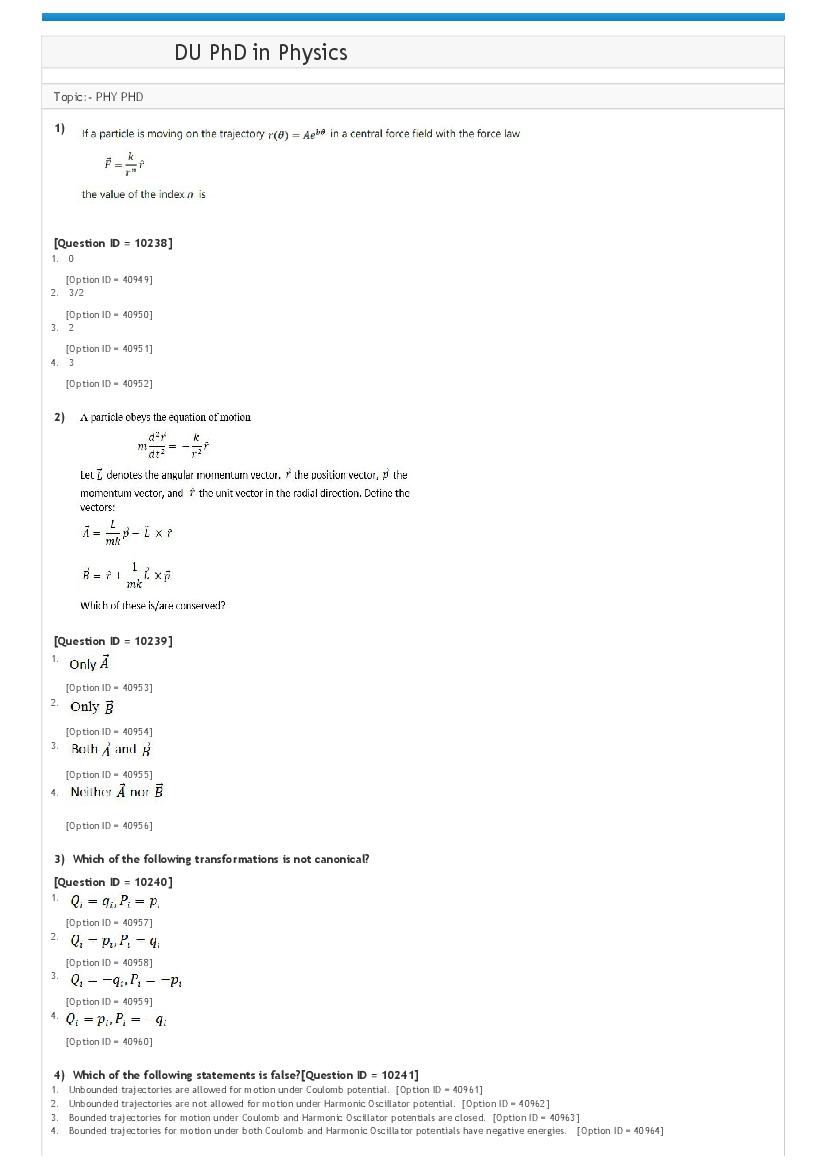
Topic:‐ PHY PHD
1)
[Question ID = 10238]
1. 0
[Option ID = 40949]
2. 3/2
[Option ID = 40950]
3. 2
[Option ID = 40951]
4. 3
[Option ID = 40952]
2)
[Question ID = 10239]
1.
[Option ID = 40953]
2.
[Option ID = 40954]
3.
[Option ID = 40955]
4.
[Option ID = 40956]
3) Which of the following transformations is not canonical?
[Question ID = 10240]
1.
[Option ID = 40957]
2.
[Option ID = 40958]
3.
[Option ID = 40959]
4.
[Option ID = 40960]
4) Which of the following statements is false?[Question ID = 10241]
1. Unbounded trajectories are allowed for motion under Coulomb potential. [Option ID = 40961]
2. Unbounded trajectories are not allowed for motion under Harmonic Oscillator potential. [Option ID = 40962]
3. Bounded trajectories for motion under Coulomb and Harmonic Oscillator potentials are closed. [Option ID = 40963]
4. Bounded trajectories for motion under both Coulomb and Harmonic Oscillator potentials have negative energies. [Option ID = 40964]
Page 2
[Question ID = 10242]
1.
[Option ID = 40965]
2.
[Option ID = 40966]
3.
[Option ID = 40967]
4.
[Option ID = 40968]
6)
[Question ID = 10243]
1.
[Option ID = 40969]
2.
[Option ID = 40970]
3.
[Option ID = 40971]
4.
[Option ID = 40972]
7) The 3‐dimensional anisotropic oscillator described by the Hamiltonian
What are the minimum energy and its corresponding number of degeneracy?[Question ID = 10244]
1. 3ћω and 1 [Option ID = 40973]
2. 3ћω and 2 [Option ID = 40974]
3. 4ћω and 1 [Option ID = 40975]
4. 4ћω and 2 [Option ID = 40976]
8) Consider a particle whose normalized wave function is
Ψ(x)=Nx(L− x) for 0<x<L =0
elsewhere
What are the values of <x> and <x2 > ?
[Question ID = 10245]
Page 3
[Option ID = 40977]
2.
[Option ID = 40978]
3.
[Option ID = 40979]
4.
[Option ID = 40980]
9) Consider the Hamiltonian given by 3x3 matrix.
Which of the following values of α is correct such that H doesn’t form a complete set of commuting operator.
[Question ID = 10246]
1.
[Option ID = 40981]
2.
[Option ID = 40982]
3.
[Option ID = 40983]
4.
[Option ID = 40984]
10) The wave function of a particle is given as
Ψ(x)=Acos(kx) + Bsin(kx)
where A, B and k are constants. What should be the form of the potential and value of energy if it is a solution of Schrodinger
equation?
[Question ID = 10247]
1. Potential V(x)=0, Energy=
[Option ID = 40985]
2. Potential V(x)=1, Energy=
[Option ID = 40986]
3. Potential V(x)=x, Energy=
[Option ID = 40987]
4. Potential V(x)=‐x, Energy=
[Option ID = 40988]
11) If Lx and y denote the x and y components of the angular momentum operator and the position operator, respectively, the
value of the commutator, [Lx,y] is
[Question ID = 10248]
1.
[Option ID = 40989]
2.
[Option ID = 40990]
3.
[Option ID = 40991]
4.
[Option ID = 40992]
12) A system consists of two particles of spin 1 and spin 1/2 each. The possible spin of the combined system is[Question ID = 10249]
1. 1 and 1/2 [Option ID = 40993]
2. 3/2 and 1/2 [Option ID = 40994]
3. 3/2 and 1 [Option ID = 40995]
4. 1/2 and 0 [Option ID = 40996]
Page 4
depletion layer width at T = 300 K is[Question ID = 10250]
1. 0.259 μm [Option ID = 40997]
2. 0.493 μm [Option ID = 40998]
3. 0.987 μm [Option ID = 40999]
4. 1.21 μm [Option ID = 41000]
14) In a FET, as VGS is changed from ‐1V to ‐1.5V keeping VDS constant, ID drops from 7 mA to 5 mA. The transconductance of the
FET is[Question ID = 10251]
1. 4 mA/V [Option ID = 41001]
2. 0.8 mA/V [Option ID = 41002]
3. 24 mA/V [Option ID = 41003]
4. 0.96 mA/V [Option ID = 41004]
15) A CE amplifier has the following parameters: hie= 1100 Ω, hre= 2.5x10‐4, hfe= 50 and ho e= 25 μΩ. If the load and source
resistance are 1k Ω, the current gain is[Question ID = 10252]
1. 48.78 [Option ID = 41005]
2. 1.92 [Option ID = 41006]
3. 0.0487 [Option ID = 41007]
4. 2.00 [Option ID = 41008]
16) An 8‐bit successive approximation type ADC uses a clock frequency of 1 MHz. The conversion time is[Question ID = 10253]
1. 255 μsec [Option ID = 41009]
2. 127 μsec [Option ID = 41010]
3. 8 μsec [Option ID = 41011]
4. 1 μsec [Option ID = 41012]
17) Find the voltage gain for the following circuit
[Question ID = 10254]
1. – 10
[Option ID = 41013]
2. – 25
[Option ID = 41014]
3. – 60
[Option ID = 41015]
4. – 40
[Option ID = 41016]
18) In a frequency modulated signal, if the frequency deviation is 60 kHz and the modulating frequency is 5 kHz, the modulation
index is[Question ID = 10255]
1. 65 [Option ID = 41017]
2. 55 [Option ID = 41018]
3. 24 [Option ID = 41019]
4. 12 [Option ID = 41020]
19) If the probability that a problem will be solved by three students is 1/2, 1/3 and 1/6, then what is the probability that the
problem will be solved?[Question ID = 10256]
1. 13/18 [Option ID = 41021]
2. 1/36 [Option ID = 41022]
3. 1/18 [Option ID = 41023]
4. 18/13 [Option ID = 41024]
20) Find the eigenvalues of 4A‐1 + 3A + 2I where I is identity matrix and
[Question ID = 10257]
1. 1, 1/4
[Option ID = 41025]
2. 7, 28
[Option ID = 41026]
3. 9, 15
[Option ID = 41027]
4. 9, 36
Page 5
21) Consider a matrix , with the elements p > 0, q >0 ,r> 0,and s> 0. Which of the following is correct:
[Question ID = 10258]
1. All the eigenvalues of M are real and distinct, such that there is at least one positive eigenvalue.
[Option ID = 41029]
2. All the eigenvalues of M are real, but not distinct, such that there is only positive eigenvalue.
[Option ID = 41030]
3. All the eigenvalues of M are real, but not distinct, such that there isonly negative eigenvalue.
[Option ID = 41031]
4. The eigenvalues of M are complex (having both non‐zero real and imaginary parts), distinct, such that there is at least one positive eigenvalue.
[Option ID = 41032]
22)
[Question ID = 10259]
1. Both M and N.
[Option ID = 41033]
2. Only M.
[Option ID = 41034]
3. Only N.
[Option ID = 41035]
4. Neither M nor N.
[Option ID = 41036]
23)
[Question ID = 10260]
1.
[Option ID = 41037]
2.
[Option ID = 41038]
3.
[Option ID = 41039]
4.
[Option ID = 41040]
24) Which one is the most general form of 2 x 2 unitary, unimodular matrix:
[Question ID = 10261]
1.
[Option ID = 41041]
2.
[Option ID = 41042]
3.
[Option ID = 41043]
4.
[Option ID = 41044]
25)
Page 6
1. (3/4)NkB
[Option ID = 41045]
2. (3/2)NkB
[Option ID = 41046]
3. (5/2)NkB
[Option ID = 41047]
4. (9/4)NkB
[Option ID = 41048]
26) Consider an isolated system of 3 non‐interacting indistinguishable bosons in equilibrium. Each particle can be in any of three
states, all non‐degenerate, of energies 0, ε, and 2ε. If the total energy of the system is 3ε, its entropy is
[Question ID = 10263]
1. kB ln 2
[Option ID = 41049]
2. kB ln 3
[Option ID = 41050]
3. kB ln 9
[Option ID = 41051]
4. kB ln 10
[Option ID = 41052]
27)
[Question ID = 10264]
1.
[Option ID = 41053]
2.
[Option ID = 41054]
3.
[Option ID = 41055]
4.
[Option ID = 41056]
28)
[Question ID = 10265]
1.
[Option ID = 41057]
2.
[Option ID = 41058]
3.
[Option ID = 41059]
4.
[Option ID = 41060]
29) An electron of rest mass‐energy MeV and total energy 10 MeV is made to collide with another electron at rest in the
laboratory frame. The total energy W (in MeV) in the center‐of‐mass frame is
[Question ID = 10266]
1. Zero
[Option ID = 41061]
2. 3.28
[Option ID = 41062]
3. 10
[Option ID = 41063]
4. 10.511
[Option ID = 41064]
Page 7
and enters a region where there is a uniform magnetic field B in a direction perpendicular to the direction of motion of the particle.
After a time , the speed v of the particle and the distance d from the slit are (assuming non‐relativistic motion)
[Question ID = 10267]
1.
[Option ID = 41065]
2.
[Option ID = 41066]
3.
[Option ID = 41067]
4.
[Option ID = 41068]
31)
[Question ID = 10268]
1.
[Option ID = 41069]
2.
[Option ID = 41070]
3.
[Option ID = 41071]
4.
[Option ID = 41072]
32) Consider a gas of free electrons acting as a perfectly conducting fluid. For a finite current density j, due to the motion of the
electrons with drift velocity v , the rate of variation of the magnetic field B with time would be given by
[Question ID = 10269]
1. ∇ ×( v × B)
[Option ID = 41073]
2. j ×[ B ×(∇ × v)]
[Option ID = 41074]
3. ∇ ×( j × B)
[Option ID = 41075]
4. v ×[ j ×(∇ × B)]
[Option ID = 41076]
33)
[Question ID = 10270]
1. |E'| = 1 , |B'| = √2
[Option ID = 41077]
2. |E'| = 2 , |B'| = 1
[Option ID = 41078]
3. |E'| = √2 , |B'| = √2
[Option ID = 41079]
Page 8
[Option ID = 41080]
34) Consider an isotropic but inhomogeneous medium, of conductivity σ and dielectric permittivity ε. In order that a stationary
current flows in the medium, there needs to be a distribution of charge with density ϱ related to the electric field E as
[Question ID = 10271]
1. ϱ = E ⋅ ∇ (ε/σ)
[Option ID = 41081]
2. ϱ = E ⋅ ∇ (σ/ε)
[Option ID = 41082]
3.
[Option ID = 41083]
4.
[Option ID = 41084]
35)
Consider a line of equidistant ions of R with alternative charges equal to ±q. The potential energy in units of is
[Question ID = 10272]
1. log2
[Option ID = 41085]
2. −2log2
[Option ID = 41086]
3. log3
[Option ID = 41087]
4. 2log3
[Option ID = 41088]
36) A Josephson junction consists of two superconductors separated by a very thin insulating layer. When a DC voltage of 1.5 μV is
applied across the junction, an AC current is produced of frequency (in Hz) [Question ID = 10273]
1. 2.253x10⁸ [Option ID = 41089]
2. 4.253x10⁸ [Option ID = 41090]
3. 7.253x10⁸ [Option ID = 41091]
4. 8.25x10⁸ [Option ID = 41092]
37) The period of Bloch oscillation for a one‐dimensional crystal having lattice period ‘a’ is
[Question ID = 10274]
1.
[Option ID = 41093]
2.
[Option ID = 41094]
3.
[Option ID = 41095]
4.
[Option ID = 41096]
38) The intrinsic carrier concentration of Si at 300 K is 1.5 x 10¹⁶ atoms/m3. If the sample is doped with 1023 phosphorous atoms/m3,
what is the position of Fermi level relative to the intrinsic level. (Boltzmann Const. k= 8.62x10‐5 eV/K)[Question ID = 10275]
1. 0.406 eV, below EF [Option ID = 41097]
2. 0.216 eV, below EV [Option ID = 41098]
3. 0.406 eV, above EF [Option ID = 41099]
4. 0.216 eV, above EV [Option ID = 41100]
39)
[Question ID = 10276]
1.
Page 9
2.
[Option ID = 41102]
3.
[Option ID = 41103]
4.
[Option ID = 41104]
40) The number of atoms (of radius r) per unit area of the plane (010) of a simple cubic crystal is[Question ID = 10277]
1. 1/4r2 [Option ID = 41105]
2. 1/8r2 [Option ID = 41106]
3. 1/2r2 [Option ID = 41107]
4. 1/3r2 [Option ID = 41108]
41)
[Question ID = 10278]
1.
[Option ID = 41109]
2.
[Option ID = 41110]
3.
[Option ID = 41111]
4.
[Option ID = 41112]
42) In nuclear reactions the mass number, A, is typically conserved. This indirectly implies the conservation of[Question ID = 10279]
1. Charge [Option ID = 41113]
2. Baryon number [Option ID = 41114]
3. Energy [Option ID = 41115]
4. Mass [Option ID = 41116]
43) If an electron is confined within a nucleus whose diameter is 10‐14 m, its minimum kinetic energy will be[Question ID = 10280]
1. 51 MeV [Option ID = 41117]
2. 56 MeV [Option ID = 41118]
3. 61 MeV [Option ID = 41119]
4. 66 MeV [Option ID = 41120]
44) A certain odd parity shell‐model state can hold up to a maximum of 16 nucleons. The possible l and j value of such a state
would be[Question ID = 10281]
1. l=4; j=7/2 [Option ID = 41121]
2. l=3; j=7/2 [Option ID = 41122]
3. l=4; j=9/2 [Option ID = 41123]
4. l=3; j=5/2 [Option ID = 41124]
45) C14 → N14 + e‐ + anti‐neutrino is an example of[Question ID = 10282]
1. Fermi Transition [Option ID = 41125]
2. Forbidden Transition [Option ID = 41126]
3. Mixed Transition [Option ID = 41127]
4. Gamow‐Teller Transition [Option ID = 41128]
46) How many distinct spin orbitals can be constructed for a two electron system using the single electron spin orbitals “α" and “β"?
[Question ID = 10283]
1. 1
[Option ID = 41129]
2. 3
[Option ID = 41130]
3. 4
[Option ID = 41131]
Page 10
[Option ID = 41132]
47)
[Question ID = 10284]
1. Natural broadening and Doppler broadening
[Option ID = 41133]
2. Natural broadening only
[Option ID = 41134]
3. Doppler broadening only
[Option ID = 41135]
4. Instrumental resolution only
[Option ID = 41136]
48) The orbitals for the molecular configuration σ2σ is :[Question ID = 10285]
1. 2Σ+ [Option ID = 41137]
2. 3Σ+, 3Σ‐[Option ID = 41138]
3. 1Σ+ [Option ID = 41139]
4. 1Σ‐ [Option ID = 41140]
49) The rotational constant of a lighter isotope of a molecule will be[Question ID = 10286]
1. same [Option ID = 41141]
2. smaller [Option ID = 41142]
3. higher [Option ID = 41143]
4. zero [Option ID = 41144]
50) If line broadening in a laser system is 500 Hz, the corresponding coherence length would be
[Question ID = 10287]
1. 6.0 cm
[Option ID = 41145]
2. 6.0 m
[Option ID = 41146]
3. 6 Km
[Option ID = 41147]
4. 600 Km
[Option ID = 41148]
Document Details
| Board / Org | NTA |
| Exam | DUET |
| Type | Question Paper |
| Pages | 10 |
| Language | english |
| Updated | 30 Apr 2026 |