GATE 2026 Syllabus for GG
Finished viewing? Save it for later —
Download GATE 2026 Syllabus for GG (PDF · 5 pages)About GATE 2026 Syllabus for GG
GATE 2026 Syllabus for GG is available here for free download. Published by IIT for GATE, this syllabus can be viewed online or downloaded as a PDF (5 pages). Candidates preparing for GATE can use GATE 2026 Syllabus for GG to understand the exam pattern, the type of questions asked, and the overall difficulty level.
Frequently Asked Questions
How can I download GATE 2026 Syllabus for GG?
Open this page and click the Download button to save GATE 2026 Syllabus for GG as a PDF. It is completely free on AglaSem Docs.
Is GATE 2026 Syllabus for GG free to download?
Yes. GATE 2026 Syllabus for GG can be viewed online and downloaded as a PDF free of cost on AglaSem Docs.
How many pages does GATE 2026 Syllabus for GG have?
GATE 2026 Syllabus for GG contains 5 pages, which you can read online or download together as a single PDF.
Where can I find more GATE study material?
You can find more GATE question papers, sample papers, syllabus, and answer keys on AglaSem Docs.
GATE 2026 Syllabus for GG – Text
Read the full text of this syllabus below — useful to quickly search, copy and reference the content online without downloading the PDF.
📄 View text version (5 pages)
Page 1
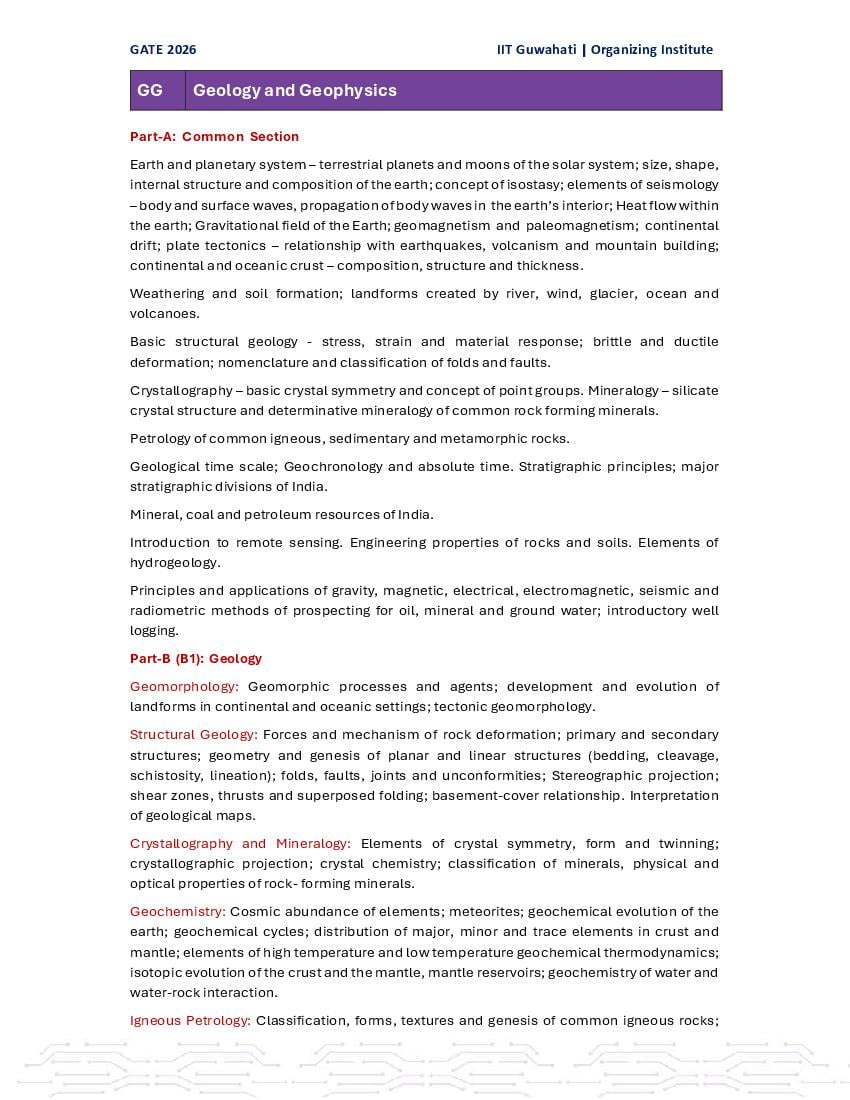
GG Geology and Geophysics
Part-A: Common Section
Earth and planetary system – terrestrial planets and moons of the solar system; size, shape,
internal structure and composition of the earth; concept of isostasy; elements of seismology
– body and surface waves, propagation of body waves in the earth’s interior; Heat flow within
the earth; Gravitational field of the Earth; geomagnetism and paleomagnetism; continental
drift; plate tectonics – relationship with earthquakes, volcanism and mountain building;
continental and oceanic crust – composition, structure and thickness.
Weathering and soil formation; landforms created by river, wind, glacier, ocean and
volcanoes.
Basic structural geology - stress, strain and material response; brittle and ductile
deformation; nomenclature and classification of folds and faults.
Crystallography – basic crystal symmetry and concept of point groups. Mineralogy – silicate
crystal structure and determinative mineralogy of common rock forming minerals.
Petrology of common igneous, sedimentary and metamorphic rocks.
Geological time scale; Geochronology and absolute time. Stratigraphic principles; major
stratigraphic divisions of India.
Mineral, coal and petroleum resources of India.
Introduction to remote sensing. Engineering properties of rocks and soils. Elements of
hydrogeology.
Principles and applications of gravity, magnetic, electrical, electromagnetic, seismic and
radiometric methods of prospecting for oil, mineral and ground water; introductory well
logging.
Part-B (B1): Geology
Geomorphology: Geomorphic processes and agents; development and evolution of
landforms in continental and oceanic settings; tectonic geomorphology.
Structural Geology: Forces and mechanism of rock deformation; primary and secondary
structures; geometry and genesis of planar and linear structures (bedding, cleavage,
schistosity, lineation); folds, faults, joints and unconformities; Stereographic projection;
shear zones, thrusts and superposed folding; basement-cover relationship. Interpretation
of geological maps.
Crystallography and Mineralogy: Elements of crystal symmetry, form and twinning;
crystallographic projection; crystal chemistry; classification of minerals, physical and
optical properties of rock- forming minerals.
Geochemistry: Cosmic abundance of elements; meteorites; geochemical evolution of the
earth; geochemical cycles; distribution of major, minor and trace elements in crust and
mantle; elements of high temperature and low temperature geochemical thermodynamics;
isotopic evolution of the crust and the mantle, mantle reservoirs; geochemistry of water and
water-rock interaction.
Igneous Petrology: Classification, forms, textures and genesis of common igneous rocks;
Page 2
magmatic differentiation; binary and ternary phase diagrams; major and trace elements as
monitors of partial melting and magma evolutionary processes. Mantle plumes, hotspots
and large igneous provinces.
Sedimentology: Texture, structure and sedimentary processes; petrology of common
sedimentary rocks; Sedimentary facies and environments, cyclicities in sedimentary
succession; provencance and basin analysis. Important sedimentary basins of India.
Metamorphic Petrology: Structures and textures of metamorphic rocks. Physico-chemical
conditions of metamorphism and concept of metamorphic facies, grade and baric types;
chemographic projections; metamorphism of pelitic, mafic and impure carbonate rocks;
role of bulk composition including fluids in metamorphism; thermobarometry and
metamorphic P- T-t paths, and their tectonic significance.
Paleobiology: Diversity of life through time, mass extinctions- causes and effects;
taphonomy- processes of fossilization. Taxonomy. Morphology and functional morphology
of invertebrates (bivalves, brachiopods, gastropods, echinoids, ammonites); microfossils
(foraminifera, ostracoda, conodonts, bryozoa); Vertebrate paleonology (Equus, Probicidea,
Human); Paleobotany (plant, spores, pollens). Basic concepts of ecology/paleoecology;
classification - ecological and taxonomic schemes (diversity and richness). Fossils and
paleoenvironments.
Stratigraphy: Principles of stratigraphy and concepts of correlation; Lithostratigraphy,
biostratigraphy and chronostratigraphy. Principles of sequence stratigraphy and
applications. Stratigraphy of peninsular and extra-peninsular India. Boundary problems in
Indian stratigraphy.
Resource Geology: Ore-mineralogy; ore forming processes vis-à-vis ore-rock association
(magmatic, hydrothermal, sedimentary, supergene and metamorphogenic ores); fluid
inclusions as ore genetic tools. Coal and petroleum geology; marine mineral resources.
Prospecting and exploration of economic mineral deposits - sampling, ore reserve
estimation, geostatistics, mining methods. Ore dressing and mineral economics.
Distribution of mineral, fossil and nuclear fuel deposits in India.
Global Tectonics: Plate motions, driving mechanisms, plate boundaries, supercontinent
cycles.
Applied Geology: Physico-mechanical properties of rocks and soils; rock index tests;
Rock failure criteria (Mohr-Coulomb, Griffith and Hoek-Brown criteria); shear strength of
rock discontinuities; rock mass classifications (RMR and Q Systems); in-situ stresses;
rocks as construction materials; geological factors in the construction of engineering
structures including dams, tunnels and excavation sites. Analysis of slope stability.
Natural hazards (landslide, volcanic, seismogenic, coastal) and mitigation. Principles of
climate change.
Hydrogeology: Groundwater flow and exploration, well hydraulics and water quality.
Basic Principles of Remote Sensing: energy sources and radiation principles, atmospheric
absorption, interaction of energy with earth’s surface, aerial-photo interpretation,
multispectral remote sensing in visible, infrared, thermal IR and microwave regions, digital
processing of satellite images. GIS – basic concepts, raster and vector mode operations.
Page 3
Part-B (B2): Geophysics
Solid-Earth Geophysics: The earth as a planet; different motions of the earth; gravity field of
the earth, Clairaut’s theorem, size and shape of earth; geomagnetic field, paleomagnetism;
Geothermics and heat flow; seismology and interior of the earth; variation of density,
velocity, pressure, temperature, electrical and magnetic properties of the earth.
Geodesy: Gravitational Field of the Earth; Geoid; Ellipsoid; Geodetic Reference Systems;
Datum; Everest (1830) and WGS 84 (1984) systems; GPS and DGPS; Levelling and Surveying.
Earthquake Seismology: Elements of elasticity theory- stress and strain tensors,
Generalized Hooke’s Law; Body and Surface Waves; Rotational, dilatational, irrorational and
equivolumnal waves. Reflection and refraction of elastic waves; Inhomogenous and
evanescent waves and bounded waves; Eikonal Equation and Ray theory; earthquakes-
causes and measurements, magnitude and intensity, focal mechanisms; earthquake
quantification, source characteristics, seismotectonics and seismic hazards; digital
seismographs, Earthquake statistics, wave propogation in elastic media, quantifying
earthquake source from seismological data. Elements of Seismic Tomography.
Potential and Time Varying Fields: Scalar and vector potential fields; Laplace, Maxwell and
Helmholtz equations for solution of different types of boundary value problems in Cartesian,
cylindrical and spherical polar coordinates; Green’s theorem; Image theory; integral
equations in potential and time-varying field theory.
Gravity Methods: Absolute and relative gravity measurements; Gravimeters; Land, airborne,
shipborne and bore-hole gravity surveys; Tensorial Gravity sensors and surveys; various
corrections for gravity data reduction – free air, Bouguer and isostatic anomalies; density
estimates of rocks; regional and residual gravity separation; principle of equivalent stratum;
data enhancement techniques, upward and downward continuation; derivative maps,
wavelength filtering; preparation and analysis of gravity maps; gravity anomalies and their
interpretation – anomalies due to geometrical and irregular shaped bodies, depth rules,
calculation of mass.
Magnetic Methods: Elements of Earth’s magnetic field, units of measurement, magnetic
susceptibility of rocks and measurements, magnetometers and magnetic gradiometers,
Land, airborne and marine magnetic and magnetic gradiometer surveys, Various corrections
applied to magnetic data, IGRF, Reduction to Pole transformation, Poisson’s relation of
gravity and magnetic potential field, preparation of magnetic maps, upward and downward
continuation, magnetic anomalies due to geometrical and irregular shaped bodies; Image
processing concepts in processing of magnetic anomaly maps; Depth rules; Interpretation
of processed magnetic anomaly data; derivative, analytic signal and Euler Depth Solutions.
Applications of gravity and magnetic methods for mineral and oil exploration.
Electrical Methods: Conduction of electricity through rocks, electrical conductivities of
metals, non- metals, rock forming minerals and different rocks, concepts of D.C. resistivity
measurement and depth of investigation; Apparent Resistivity and Apparent Chargeability,
Concept of Negative Apparent Resistivity and Negative Apparent Chargeability; Theory of
Reciprocity, Sounding and Profiling, Various electrode arrangements, application of linear
filter theory, Sounding curves over multi-layered earth, Dar-Zarrouk parameters, reduction of
layers, Triangle of anisotropy, interpretation of resistivity field data, Principles of equivalence
and suppression, self-potential method and its origin; Electrical Resitivity Tomography
(ERT); Induced polarization, time and frequency domain IP measurements; interpretation
Page 4
and applications of SP, resistivity and IP data sets for ground-water exploration, mineral
exploration, environmental and engineering applications.
Electromagnetic Methods: Geo-electromagnetic spectrum; Biot Savart’s Law; Maxwell’s
Equation, Helmotz Equation, Basic concept of EM induction in the earth, Skin-depth, elliptic
polarization, in-phase and quadrature components, phasor diagrams; Response function
and response parameters; Ground and Airborne Methods, measurements in different
source- receiver configurations; Earth’s natural electromagnetic methods-tellurics,
geomagnetic depth sounding and magnetotellurics; Electromagnetic profiling and
Sounding, Time domain EM method; EM scale modelling, processing of EM data and
interpretation; Ground Penetrating Radar (GPR) Methods; Effect of conducting overburden;
Geological applications including groundwater, mineral environmental and hydrocarbon
exploration.
Seismic Methods: Elastic properties of earth materials; Reflection, refraction and CDP
surveys; land and marine seismic sources, generation and propagation of elastic waves,
velocity – depth models, geophones, hydrophones, digital recording systems, digital
formats, field layouts, seismic noise and noise profile analysis, optimum geophone
grouping, noise cancellation by shot and geophone arrays, 2D, 3D and 4D seismic data
acquisition, processing and interpretation; CDP stacking charts, binning, filtering, static
and dynamic corrections, Digital seismic data processing, seismic deconvolution and
migration methods, attribute analysis, bright and dim spots, seismic stratigraphy, high
resolution seismics, VSP, AVO, multi-component seismics and seismic interferometry.
Reservoir geophysics: Rock Physics and Petrophysics, Geophysical Survey Design.
Geophysical Signal Processing: Sampling theorem, Nyquist frequency, aliasing, Fourier
series, periodic waveform, Fourier and Hilbert transform, Z-transform and wavelet
transform; power spectrum, delta function, auto correlation, cross correlation, convolution,
deconvolution, principles of digital filters, windows, poles and zeros.
Geophysical Well Logging: Principles and techniques of geophysical well-logging, SP,
resistivity, induction, gamma ray, neutron, density, sonic, temperature, dip meter, caliper,
nuclear magnetic resonance- longitudinal and transverse relaxation, CPMG sequence,
porosity characterization, cement bond logging, micro-logs. Pulsed Neutron Devices and
Spectroscopy Multi-Array and Triaxial Induction Devices; Quantitative evaluation of
formations from well logs; Logging while drilling; High angle and horizontal wells; Clay
Quantification; Lithology and Porosity Estimation; Saturation and Permeability Estimation;
application of bore hole geophysics in ground water, mineral and oil exploration.
Radioactive Methods: Prospecting and assaying of mineral (radioactive and non-radioactive)
deposits, half-life, decay constant, radioactive equilibrium, G M counter, scintillation detector,
semiconductor devices, application of radiometric for exploration, assaying and
radioactive waste disposal.
Geophysical Inversion: Basic concepts of forward and inverse problems, Ill-posedness of
inverse problems, condition number, non-uniqueness and stability of solutions; L1, L2 and
Lp norms, over determined, underdetermined and mixed determined inverse problems,
quasi- linear and non-linear methods including Tikhonov’s regularization method, Singular
Value Decomposition, Backus-Gilbert method, simulated annealing, genetic algorithms,
swarm intelligence, machine learning and artificial neural networks. Statistics of misfit and
Page 5
likelihood, Bayesian construction of posterior probabilities, sparsity promoting L1
optimization. Ambiguity and uncertainty in geophysical interpretation.
Document Details
| Board / Org | IIT |
| Exam | GATE |
| Type | Syllabus |
| Pages | 5 |
| Updated | 24 Sep 2026 |