AP DEECET 2018 Question Paper Social Studies (Telugu)
Finished viewing? Save it for later —
Download AP DEECET 2018 Question Paper Social Studies (Telugu) (PDF · 50 pages)About AP DEECET 2018 Question Paper Social Studies (Telugu)
AP DEECET 2018 Question Paper Social Studies (Telugu) is available here for free download. Published by APSCHE for Andhra Pradesh Diploma in Elementary Education Common Entrance Test, this question paper can be viewed online or downloaded as a PDF (50 pages). Candidates preparing for Andhra Pradesh Diploma in Elementary Education Common Entrance Test can use AP DEECET 2018 Question Paper Social Studies (Telugu) to understand the exam pattern, the type of questions asked, and the overall difficulty level.
Frequently Asked Questions
How can I download AP DEECET 2018 Question Paper Social Studies (Telugu)?
Open this page and click the Download button to save AP DEECET 2018 Question Paper Social Studies (Telugu) as a PDF. It is completely free on AglaSem Docs.
Is AP DEECET 2018 Question Paper Social Studies (Telugu) free to download?
Yes. AP DEECET 2018 Question Paper Social Studies (Telugu) can be viewed online and downloaded as a PDF free of cost on AglaSem Docs.
How many pages does AP DEECET 2018 Question Paper Social Studies (Telugu) have?
AP DEECET 2018 Question Paper Social Studies (Telugu) contains 50 pages, which you can read online or download together as a single PDF.
Where can I find more Andhra Pradesh Diploma in Elementary Education Common Entrance Test study material?
You can find more Andhra Pradesh Diploma in Elementary Education Common Entrance Test question papers, sample papers, syllabus, and answer keys on AglaSem Docs.
AP DEECET 2018 Question Paper Social Studies (Telugu) – Text
Read the full text of this question paper below — useful to quickly search, copy and reference the content online without downloading the PDF.
📄 View text version (50 pages)
Page 1
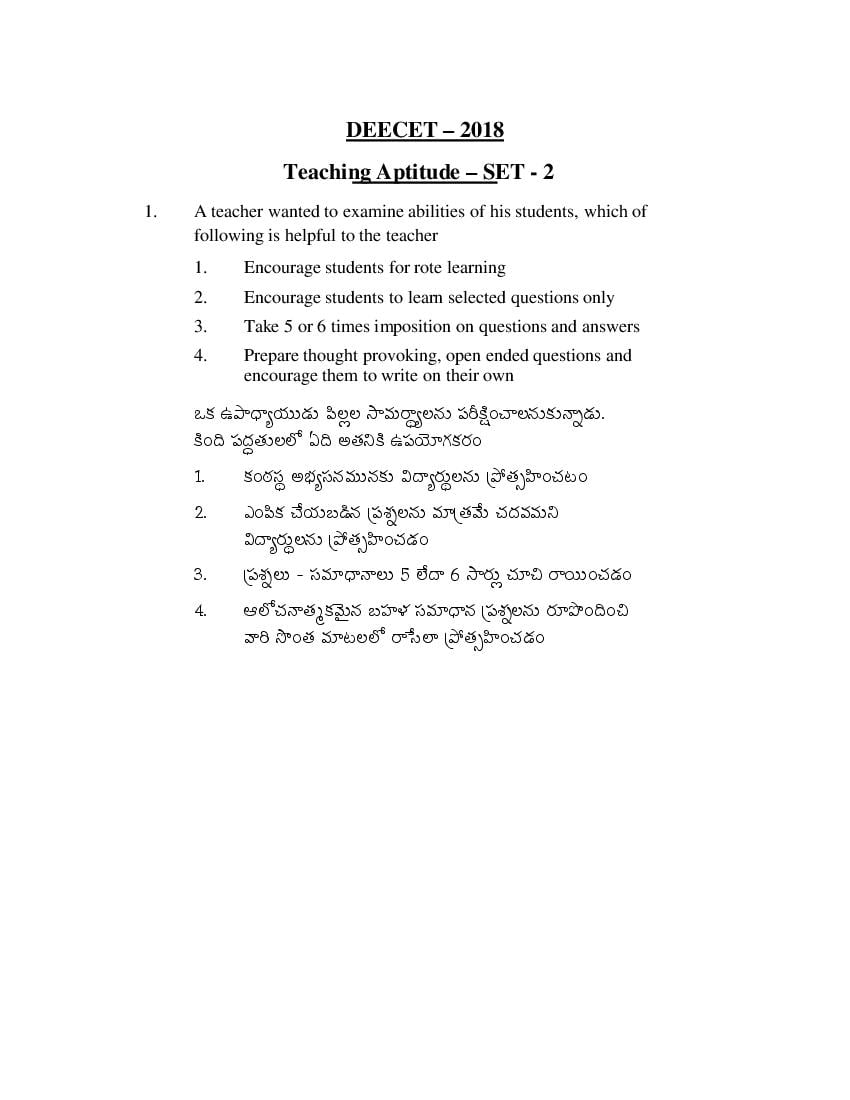
Teaching Aptitude – SET - 2
1. A teacher wanted to examine abilities of his students, which of
following is helpful to the teacher
1. Encourage students for rote learning
2. Encourage students to learn selected questions only
3. Take 5 or 6 times imposition on questions and answers
4. Prepare thought provoking, open ended questions and
encourage them to write on their own
Page 2
Schools Education
1. Formative and Summative Assessment
2. Spatial Assessment
3. Open book type Assessment
4. Work integrated Assessment
3. RTE – 2009 Act related to
1. Teacher’s salaries
2. Adult Education
3. Free and Compulsory Education to 6 to 14 years
age group children
4. Right to Information Act
RTE – 2009
Page 3
Which of the following do you adopt
a) Encourage to ask questions
b) Encourage to think logically
c) Encourage to do experiments and to draw conclusions
d) Encourage the children to follow others
1. a and b
2. b and c
3. a, b and d
4. a, b and c
a)
b)
c)
d)
1. a b
2. b c
3. a, b d
4. a, b c
Page 4
What should you do?
1. Let the intelligent students learn by their own
2. Give more stress on homework
3. Re-teach the same lesson
4. Find the reason for backwardness in learning and teach
them accordingly
Page 5
6. Choose the correct answer
A) Kandukuri Veresalingam Panthulu
B) Dayananda Sarswathi
C) Raja Rama Mohan Rai
D) Jandhyala Papaiah Sastri
1. All are poets
2. All are stage actors
3. A, B, C are social workers
4. A and D are poets and social workers
A)
B)
C)
D)
A, B, C
A D
Page 6
1. Lala Lajapathi Rai
2. Bipin Chandrapal
3. Rajagopala Chari
4. Mowlana Abul Kalam Azad
8. The vitamin obtained from Sun light is
1. A - Vitamin
2. B - Vitamin
3. C - Vitamin
4. D - Vitamin
1. A-
2. B-
3. C-
4. D-
Page 7
1. Tennis
2. Shuttle
3. Cricket
4. Taekwondo
10. “Belum Caves” are located in the district
1. Kurnool
2. Visakhapatnam
3. Srikakulam
4. Guntur
Page 8
11. Read the following passage and choose the correct answer to the
questions (11-12).
Wilma Rudolph was born in a poor family in Tennessee.
At the age of four, she had pneumonia with scarlet fever which
left her paralyzed with polio. She had to wear a brace and the
doctor said she would never put her foot on earth. She accepted the
doctor’s words reluctantly. Wilma said, ‘I want to be the fastest
runner in the world.
This passage is about:
1. the duties of a doctor
2. the adverse effects of polio on girls in Andhra Pradesh
3. the determination of Wilma Rudolph
4. the relationship between polio and pneumonia.
12. Choose the word that cannot be the synonym of the word,
‘reluctantly’.
1. hesitantly
2. unwillingly
3. involuntarily
4. confidently
13. No sooner had I put the phone down than it rang again.
Choose the sentence that gives the same meaning as the above
sentence.
1. I had hardly put the phone down when it rang again.
2. As soon as the phone rang, I had hardly put the phone again.
3. The phone rang because I hardly put the phone again.
4. The phone did not ring again so I put the phone down.
Page 9
1. Educational qualifications
2. Age and date of birth
3. Contact details
4. The details of village corps
15. Shall I carry this bag for you?
This sentence expresses:
1. an obligation
2. a possibility
3. an offer
4. some advice
Page 10
16.
17.
18.
19.
Page 11
Page 12
21.
22.
23.
Page 13
25.
26.
27.
Page 14
29.
30.
Page 15
3 7
31. The reciprocal of is
8 13
3 7
8 13
104
1.
21
104
2.
21
21
3.
104
21
4.
104
x y
32. If 1 ( x, y 0) then the value of x 3 y3 is
y x
x y
1 ( x, y 0) x3 y3
y x
1. 1
2. 1
3. 0
1
4.
2
Page 16
number of edges of a cube is
1. 1:2
2. 2:1
3. 1:3
4. 1:4
34. One of the following is not a random experiment
1. Tossing a coin
2. Rolling a dice
3. Choosing a card from deck of 52 cards
4. Throwing a stone from the roof of a building
35. The number of terms in Arithmetic Progression 10, 7, 4, … 62 is
1. 25
2. 23
3. 24
4. 26
Page 17
If a b=7 ab = 18 a 3 b3
1. 180
2. 721
3. 72
4. 721
1 1
37. The value of is
51 61
1 1
51 61
1
1.
11
2
2.
11
3. 11
4. 1
3 1
38. The cost of 2 m. of cloth is Rs. 583 then the cost of 1 m. cloth is
4 2
(in Rupees)
3 1
2 1
4 2
1. 212
2. 318
3. 424
1
4. 141
3
Page 18
of a Parallelogram taken in order then the value of “P” is
A(6, 1), B (8, 2), C(9, 4) D(P,3)
“P”
1. 23
2. 15
3. 8
4. 7
40. One of the following sides does not belong to the sides of
right angled triangle
1. 9, 12, 15
2. 5, 7, 9
3. 300, 400, 500
4. 2, 5 , 1
Page 19
(Biology)
41. Example for flexible bone
1. Back bone
2. Cartilage
3. Joints
4. Muscles
42. Special roots in parasitic plants are called
1. Haustoria
2. Fibrous roots
3. Tap roots
4. Parasitic roots
Page 20
1. Nostoc
2. Virus
3. Bacteria
4. Earthworm
44. Universal recipients are
1. ‘AB’ blood group people
2. ‘B’ blood group people
3. ‘O’ blood group people
4. ‘A’ blood group people
1. ‘AB’
2. ‘B’
3. ‘O’
4. ‘A’
Page 21
1. Lipase
2. Tripsin
3. Pepsin
4. Peptidases
Page 22
Physical Science
46. The image formed in a pinhole Camera is
1. Erected image
2. Inverted image
3. Enlarged image
4. Image doesn’t form
47. In a chemical change
1. Colour change may take place
2. New smell may take place
3. New products may be produced
4. All the above
Page 23
around the Sun is
1. Meteor
2. Comet
3. Asteroid
4. Satellite
49. If atomic masses of hydrogen, sulphur and oxygen are
1, 32 and 16 respectively. The molecular mass of
sulphuric acid (H2SO4) is
1. 98 units
2. 49 units
3. 97 units
4. 82 units
(H2SO4)
Page 24
1. Ohm’s law
2. Faraday’s law
3. Junction law
4. Loops law
Page 25
51. Match the following
i) River Godavari a) Amar Kantak
ii) River Krishna b) Multai
iii) River Narmada c) Nasik
iv) River Tapati d) Mahabaleswar
i – a, ii – b, iii – c, iv - d
i – c, ii – d, iii – a, iv - b
i – c, ii – d, iii – b, iv - a
i – d, ii – c, iii – a, iv - b
a) i)
b) ii)
c) iii)
d) iv)
i – a, ii – b, iii – c, iv - d
i – c, ii – d, iii – a, iv - b
i – c, ii – d, iii – b, iv - a
i – d, ii – c, iii – a, iv - b
Page 26
1. Sardar Vallbh Bhai Patel
2. Jawaharlal Nerhu
3. Dr. B.R. Ambedkar
4. Dr. Babu Rajendra Prasad
53. The winds that blow from sub tropical high pressure belt to
sub polar low pressure belt are
1. Polar winds
2. Prevailing western lies
3. Trade winds
4. Eastern lies
Page 27
1. Erasmus
2. Machiavelli
3. Rousseau
4. Montesque
55. The district of Andhra Pradesh which is famous for
Mica Production is:
1. Srikakulam
2. Vizianagaram
3. S.P.S.R. Nellore
4. Prakasam
Page 28
in India is
1. Andhra Pradesh
2. Bihar
3. West Bengal
4. Uttar Pradesh
57. In 1764 A.D, Nawab Anwaruddin khan of Arcot was defeated by
1. The British army
2. The Dutch army
3. The French army
4. The Portuguese army
Page 29
1. Arctic Ocean
2. Atlantic Ocean
3. Pacific Ocean
4. Indian Ocean
59. Which among the following had brought about great
changes in the lives of early people?
1. The discovery of fire
2. Nomadic life
3. Drawing pictures on walls in caves
4. Gathering food
Page 30
1. Alwars were the devotees of Vishnu, and
Nayanars were the devotees of Shiva
2. Alwars were the devotees of shiva and Nayanars
were the devotees of vishnu
3. Alwars and Nayanars were the devotees of Vishnu
4. Alwars and Nayanars were the devotees of Shiva
Page 31
(SOCIAL STUDIES SET-1 – 61-100)
61. Father of History
1. Aristotle
2. Socrates
3. Cicero
4. Herodotus
62. Harappa Civilization was discovered in the year.
1. 1921 AD
2. 1927 AD
3. 1937 AD
4. 1947 AD
Page 32
1. Bimbisara
2. Ajatasatru
3. Prasena Jittu
4. Udayana
64. The verse which mentions about the four fold division of varnas
in Rigveda
1. Purusha Sukta
2. Bhagavadgeta
3. Stree Suktam
4. Dharma Suktam
Page 33
1. Ashokha
2. Bindusara
3. Samudragupta
4. Chandragupta Mourya
66. Qutubminar construction work was started by
1. Iltutmish
2. Ghiyas-ud-din Balbon
3. Mohammad – bin - Tughlaq
4. Qutub – ud-din-Aibak
Page 34
1. Aliya Ramaraya
2. Devaraya Second
3. Saluva Narasimharaya
4. Sri Krishna Devaraya
68. The word “Homo” belongs to the language
1. English
2. Russian
3. German
4. Latin
Page 35
1. Land between two rivers
2. Peninsula
3. Island
4. Land with hills
70. Golden age in the history of Rome
1. Augustas period
2. Caesar period
3. Lepidus period
4. Antony Period
Page 36
appears mainly
1. Thousand and one Nights
2. Two thousand and one Nights
3. Four thousands and one Nights
4. Seven Thousand and one Nights
72. The code of law that was promulgated by Chenghis Khan
1. Yasa
2. Jasa
3. Sasa
4. Aayesa
Page 37
1. Karal Marx
2. Sam Simmon
3. Purio
4. Prodan
74. It was agreed to establish SAARC (South Asian Association
for Regional Co-operation) in the year
1. 1981
2. 1982
3. 1984
4. 1985
Page 38
1. Marshal
2. Edwin Cannan
3. A.C. Pigou
4. Adam Smith
76. “Micro Economics” is derived from the word
1. Society
2. Distribution
3. Mikros
4. Marginal
Page 39
1. Surplus budget
2. Deficit budget
3. Balanced budget
4. Fiscal deficit
78. The concept of “price demand elasticity” was developed by
1. Robbins
2. Keynes
3. Marshall
4. Giffen
Page 40
1. Perfect competition
2. Monopoly
3. Monopolistic competition
4. Duopoly
80. The Marginal productivity theory of Distribution was
systematically evaluated by
1. J.B. Clark
2. M.L. Jhingan
3. H.L. Ahuja
4. H.S Agarwal
Page 41
1. D. R. Gadgil
2. Dr. V. K. R. V. Rao
3. P. C. Mahlnobis
4. M. L. Seth
82. The National population policy was announced on
1. April 1976
2. April 1975
3. April 1974
4. April 1977
Page 42
1. Primary sector
2. Secondary sector
3. Tertiary sector
4. Private sector
84. Founder of modern Microfinance system
1. Mohammad Iqbal
2. Mohammad Rafiq
3. Mohammad Yunas
4. Mohammad Lateef
Page 43
1. Amartyasen
2. William .S. Gand
3. Norman Borlaug
4. M.L. Dantwala
86. The first industrial policy resolution of India was declared on
1. 6-4-1948
2. 6-4-1949
3. 6-4-1947
4. 6-4-1946
Page 44
Tourism sector
1. Tamil Nadu
2. Bihar
3. Madhya Pradesh
4. Andhra Pradesh
88. The constituent Assembly adopted the Indian constitution on
1. 1946 January - 26
2. 1947 November - 26
3. 1949 November - 26
4. 1950 January - 26
Page 45
1. II part
2. III part
3. IV part
4. I part
90. Which Article of the Indian constitution abolished the untouchability
1. Article - 16
2. Article - 14
3. Article - 18
4. Article - 17
Page 46
1. Speaker of Lok Sabha
2. Prime Minister
3. President of India
4. Vice - President
92. Who acts as the leader of the Parliament
1. President of India
2. Prime Minister
3. Speaker of Lok Sabha
4. Vice - President
Page 47
1. Rajya Sabha, Lok Sabha
2. Rajya Sabha, Lok Sabha, State Legislature
3. Rajya Sabha, Lok Sabha, Prime Minister
4. President of India, Rajya Sabha, Lok Sabha
94. “Judicial review” borrowed from
1. Britain
2. U.S.A
3. France
4. Canada
Page 48
1. President of India
2. Prime Minister
3. Governor of the State
4. Vice - President
96. According to whom “Political science begins and ends with the
State”
1. J. W. Garner
2. R. G. Gettle
3. Appadorai
4. Socrates
Page 49
1. Plato
2. Aristotle
3. Thomas Hobbes
4. Socrates
98. The first Political Scientist who used the word “State”
1. Aristotle
2. Machiavelli
3. Thomas Hobbes
4. Plato
99. According to Plato, the population of ideal State is
1. 10,000
2. 8,000
3. 5,040
4. 4,050
Page 50
1. McIver
2. T.E. Holland
3. H.J. Laski
4. John Locke
Document Details
| Board / Org | APSCHE |
| Exam | Andhra Pradesh Diploma in Elementary Education Common Entrance Test |
| Type | Question Paper |
| Pages | 50 |
| Updated | 22 Jul 2026 |