DUET 2021 Question Paper Ph.D in Plant Molecular Biology and Biotechnology
Finished viewing? Save it for later —
Download DUET 2021 Question Paper Ph.D in Plant Molecular Biology and Biotechnology (PDF · 5 pages)About DUET 2021 Question Paper Ph.D in Plant Molecular Biology and Biotechnology
DUET 2021 Question Paper Ph.D in Plant Molecular Biology and Biotechnology is available here for free download. Published by NTA for DUET, this question paper can be viewed online or downloaded as a PDF (5 pages). Candidates preparing for DUET can use DUET 2021 Question Paper Ph.D in Plant Molecular Biology and Biotechnology to understand the exam pattern, the type of questions asked, and the overall difficulty level.
Frequently Asked Questions
How can I download DUET 2021 Question Paper Ph.D in Plant Molecular Biology and Biotechnology?
Open this page and click the Download button to save DUET 2021 Question Paper Ph.D in Plant Molecular Biology and Biotechnology as a PDF. It is completely free on AglaSem Docs.
Is DUET 2021 Question Paper Ph.D in Plant Molecular Biology and Biotechnology free to download?
Yes. DUET 2021 Question Paper Ph.D in Plant Molecular Biology and Biotechnology can be viewed online and downloaded as a PDF free of cost on AglaSem Docs.
How many pages does DUET 2021 Question Paper Ph.D in Plant Molecular Biology and Biotechnology have?
DUET 2021 Question Paper Ph.D in Plant Molecular Biology and Biotechnology contains 5 pages, which you can read online or download together as a single PDF.
Where can I find more DUET study material?
You can find more DUET question papers, sample papers, syllabus, and answer keys on AglaSem Docs.
DUET 2021 Question Paper Ph.D in Plant Molecular Biology and Biotechnology – Text
Read the full text of this question paper below — useful to quickly search, copy and reference the content online without downloading the PDF.
📄 View text version (5 pages)
Page 1
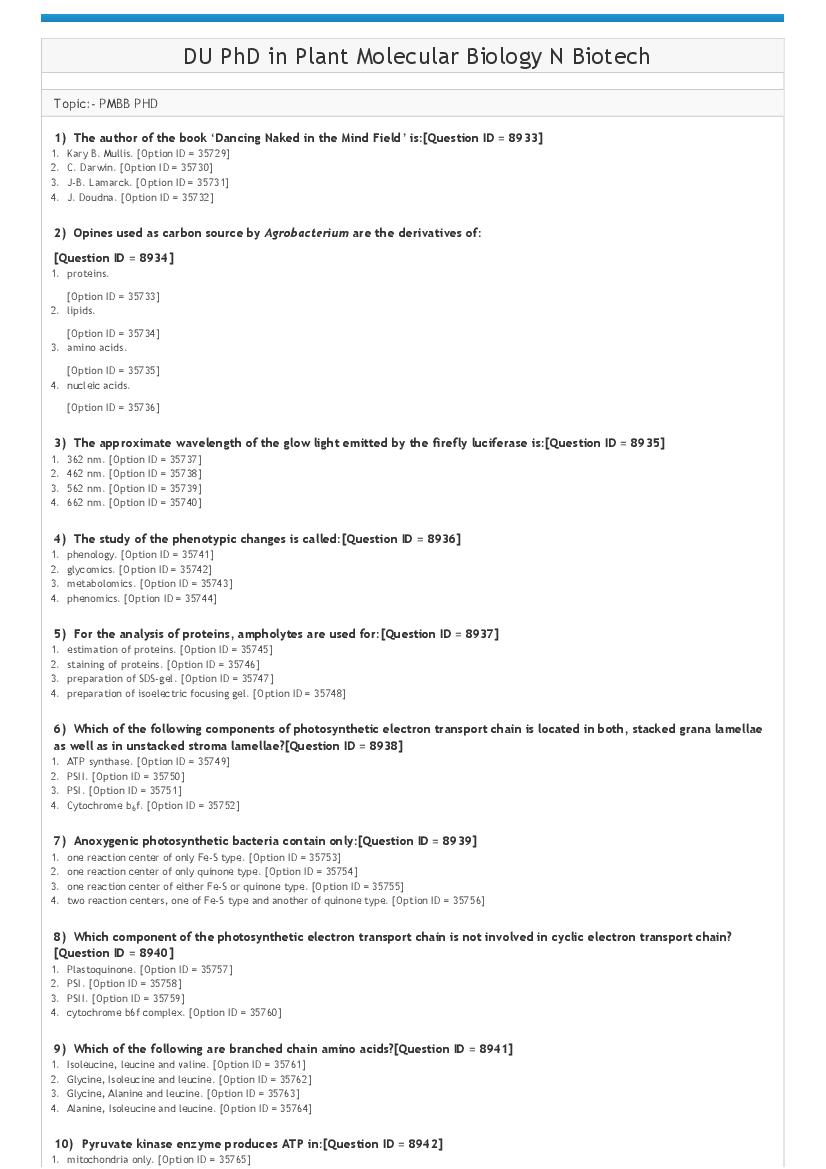
Topic:‐ PMBB PHD
1) The author of the book ‘Dancing Naked in the Mind Field’ is:[Question ID = 8933]
1. Kary B. Mullis. [Option ID = 35729]
2. C. Darwin. [Option ID = 35730]
3. J‐B. Lamarck. [Option ID = 35731]
4. J. Doudna. [Option ID = 35732]
2) Opines used as carbon source by Agrobacterium are the derivatives of:
[Question ID = 8934]
1. proteins.
[Option ID = 35733]
2. lipids.
[Option ID = 35734]
3. amino acids.
[Option ID = 35735]
4. nucleic acids.
[Option ID = 35736]
3) The approximate wavelength of the glow light emitted by the firefly luciferase is:[Question ID = 8935]
1. 362 nm. [Option ID = 35737]
2. 462 nm. [Option ID = 35738]
3. 562 nm. [Option ID = 35739]
4. 662 nm. [Option ID = 35740]
4) The study of the phenotypic changes is called:[Question ID = 8936]
1. phenology. [Option ID = 35741]
2. glycomics. [Option ID = 35742]
3. metabolomics. [Option ID = 35743]
4. phenomics. [Option ID = 35744]
5) For the analysis of proteins, ampholytes are used for:[Question ID = 8937]
1. estimation of proteins. [Option ID = 35745]
2. staining of proteins. [Option ID = 35746]
3. preparation of SDS‐gel. [Option ID = 35747]
4. preparation of isoelectric focusing gel. [Option ID = 35748]
6) Which of the following components of photosynthetic electron transport chain is located in both, stacked grana lamellae
as well as in unstacked stroma lamellae?[Question ID = 8938]
1. ATP synthase. [Option ID = 35749]
2. PSII. [Option ID = 35750]
3. PSI. [Option ID = 35751]
4. Cytochrome b6f. [Option ID = 35752]
7) Anoxygenic photosynthetic bacteria contain only:[Question ID = 8939]
1. one reaction center of only Fe‐S type. [Option ID = 35753]
2. one reaction center of only quinone type. [Option ID = 35754]
3. one reaction center of either Fe‐S or quinone type. [Option ID = 35755]
4. two reaction centers, one of Fe‐S type and another of quinone type. [Option ID = 35756]
8) Which component of the photosynthetic electron transport chain is not involved in cyclic electron transport chain?
[Question ID = 8940]
1. Plastoquinone. [Option ID = 35757]
2. PSI. [Option ID = 35758]
3. PSII. [Option ID = 35759]
4. cytochrome b6f complex. [Option ID = 35760]
9) Which of the following are branched chain amino acids?[Question ID = 8941]
1. Isoleucine, leucine and valine. [Option ID = 35761]
2. Glycine, Isoleucine and leucine. [Option ID = 35762]
3. Glycine, Alanine and leucine. [Option ID = 35763]
4. Alanine, Isoleucine and leucine. [Option ID = 35764]
10) Pyruvate kinase enzyme produces ATP in:[Question ID = 8942]
1. mitochondria only. [Option ID = 35765]
Page 2
3. cytosol only. [Option ID = 35767]
4. cytosol and chloroplasts. [Option ID = 35768]
11) Which of the following enzymes senses the level of sugars to regulate photosynthesis?[Question ID = 8943]
1. Hexokinase 1. [Option ID = 35769]
2. Fructokinase 1. [Option ID = 35770]
3. Phosphofructokinase 1. [Option ID = 35771]
4. Fructose 1,6 phosphatase. [Option ID = 35772]
12) Which of the following enzymes is involved in generation of heat?[Question ID = 8944]
1. Cytochrome oxidase. [Option ID = 35773]
2. NADH dehydrogenase. [Option ID = 35774]
3. Succinate dehydrogenase. [Option ID = 35775]
4. Alternative oxidase. [Option ID = 35776]
13) Addition of the 5’ terminal nucleotide to mRNA is catalyzed by:[Question ID = 8945]
1. guanylyl‐transferase. [Option ID = 35777]
2. adenylyl‐transferase. [Option ID = 35778]
3. adenylyl cyclase. [Option ID = 35779]
4. uridylyl‐transferase. [Option ID = 35780]
14) Proteasomes are involved in degradation of polypeptides marked with:[Question ID = 8946]
1. ubiquitin moiety. [Option ID = 35781]
2. phosphate group. [Option ID = 35782]
3. sulfhydryl group. [Option ID = 35783]
4. methyl group. [Option ID = 35784]
15) Somatic hypermutation occurs in:[Question ID = 8947]
1. T cells. [Option ID = 35785]
2. B cells. [Option ID = 35786]
3. stem cells. [Option ID = 35787]
4. all somatic cells. [Option ID = 35788]
16) At least, one of the chloroplast RNA polymerases involved in mRNA synthesis is like:[Question ID = 8948]
1. RNA polymerase I. [Option ID = 35789]
2. RNA polymerase II. [Option ID = 35790]
3. RNA polymerase III. [Option ID = 35791]
4. bacterial RNA polymerase. [Option ID = 35792]
17) Half‐life of Carbon‐14 is:[Question ID = 8949]
1. 2.7 years. [Option ID = 35793]
2. 87.5 years. [Option ID = 35794]
3. 432.2 years. [Option ID = 35795]
4. 5730 years. [Option ID = 35796]
18) In the cAMP pathway, the breakdown of cAMP is catalyzed by: [Question ID = 8950]
1. phosphodiesterase. [Option ID = 35797]
2. adenylyl cyclase. [Option ID = 35798]
3. phospholipase D. [Option ID = 35799]
4. phosphotransferase. [Option ID = 35800]
19) Which plant hormone involves histidine kinase (two‐component) signaling system?[Question ID = 8951]
1. ABA. [Option ID = 35801]
2. GA. [Option ID = 35802]
3. Ethylene. [Option ID = 35803]
4. Auxin. [Option ID = 35804]
20) The enzyme that catalyzes the X‐p to X conversion is known as a:[Question ID = 8952]
1. kinase. [Option ID = 35805]
2. phosphatase. [Option ID = 35806]
3. reductase. [Option ID = 35807]
4. phospholipase. [Option ID = 35808]
21) Which of the molecular probes is used for staining mitochondria?[Question ID = 8953]
1. FITC. [Option ID = 35809]
2. Fura‐2. [Option ID = 35810]
3. DAPI. [Option ID = 35811]
4. Rhodamine 123. [Option ID = 35812]
22) Guard cells of stomata are closed by loss of turgor pressure because of efflux of: [Question ID = 8954]
1. K+ and Cl‐. [Option ID = 35813]
2. HCO3‐ and Br‐. [Option ID = 35814]
Page 3
4. Mg2+ and NO3‐. [Option ID = 35816]
23) ABI1 and ABI2 are the genes involved in:[Question ID = 8955]
1. ABA signaling. [Option ID = 35817]
2. ABA biosynthesis. [Option ID = 35818]
3. ABA degradation. [Option ID = 35819]
4. ABA transport. [Option ID = 35820]
24) In which of the following does Brefeldin A (BFA) block the intracellular protein transport?[Question ID = 8956]
1. ER, Golgi apparatus to endosome. [Option ID = 35821]
2. Mitochondria, ER to nucleus. [Option ID = 35822]
3. ER, chloroplast to mitochondria. [Option ID = 35823]
4. Chloroplast, Golgi apparatus to mitochondria. [Option ID = 35824]
25) ‘Patch‐clamp’ and ‘two‐electrode voltage clamp’ are the experimental methodologies for studying functional analysis
of:[Question ID = 8957]
1. cytoskeletal proteins. [Option ID = 35825]
2. ion channels. [Option ID = 35826]
3. transcription factors. [Option ID = 35827]
4. enzymes. [Option ID = 35828]
26) Nucleosome is involved in:[Question ID = 8958]
1. DNA packaging. [Option ID = 35829]
2. RNA packaging. [Option ID = 35830]
3. Protein transport. [Option ID = 35831]
4. DNA recombination. [Option ID = 35832]
27) Mike Bevan is credited with the construction of which of the following plasmid vectors?[Question ID = 8959]
1. pBIN19. [Option ID = 35833]
2. pBR322. [Option ID = 35834]
3. pUC8. [Option ID = 35835]
4. pPZP. [Option ID = 35836]
28) In the trp operon, tryptophan is a:[Question ID = 8960]
1. repressor. [Option ID = 35837]
2. co‐repressor. [Option ID = 35838]
3. inducer. [Option ID = 35839]
4. activator. [Option ID = 35840]
29) Haustoria are:[Question ID = 8961]
1. swollen glandular structures formed during differentiation of necrotrophic fungi. [Option ID = 35841]
2. regions in the root, where fungal cells multiply. [Option ID = 35842]
3. invaginated structures responsible for extracting plant nutrients by biotrophic fungi. [Option ID = 35843]
4. vascular structures responsible for injecting toxins by necrotrophic fungi. [Option ID = 35844]
30) Viroids are:[Question ID = 8962]
1. viruses, which can cause disease in association with bacteria. [Option ID = 35845]
2. viruses, which can cause disease in association with fungi. [Option ID = 35846]
3. autonomously replicating DNA molecules which can cause disease. [Option ID = 35847]
4. autonomously replicating RNA molecules which can cause disease. [Option ID = 35848]
31) An example of a volatile signalling compound in plants is:[Question ID = 8963]
1. methyl jasmonate. [Option ID = 35849]
2. oxalic acid. [Option ID = 35850]
3. pyruvic acid. [Option ID = 35851]
4. acetosyringone. [Option ID = 35852]
32) Which of the following acts as an intermediate in the defense signalling pathway for salicylic acid?[Question ID = 8964]
1. Camalexin. [Option ID = 35853]
2. JAR1. [Option ID = 35854]
3. ETR1. [Option ID = 35855]
4. NPR1. [Option ID = 35856]
33) Which of the following enzymes catalyzes a rate‐limiting step in the biosynthesis of terpenoids?[Question ID = 8965]
1. Phenylalanine ammonia lyase. [Option ID = 35857]
2. Pyruvate lyase. [Option ID = 35858]
3. Hydroxymethyl glutaryl CoA reductase. [Option ID = 35859]
4. Chalcone synthase. [Option ID = 35860]
34) An important constituent of Reactive Oxygen Species (ROS) in plants is:[Question ID = 8966]
1. nitric oxide. [Option ID = 35861]
2. hydrogen peroxide. [Option ID = 35862]
Page 4
4. leghemoglobin. [Option ID = 35864]
35) A naturally rich source of cytokinins is:[Question ID = 8967]
1. wheat grains. [Option ID = 35865]
2. coconut water. [Option ID = 35866]
3. prunes. [Option ID = 35867]
4. dates. [Option ID = 35868]
36) Insectivorous plants grow in:[Question ID = 8968]
1. nitrogen rich soil. [Option ID = 35869]
2. nitrogen deficient soil. [Option ID = 35870]
3. potassium deficient soil. [Option ID = 35871]
4. carbohydrate rich soil. [Option ID = 35872]
37) Increased genetic diversity arising during tissue culture is due to:[Question ID = 8969]
1. maternal effect. [Option ID = 35873]
2. temporal modification. [Option ID = 35874]
3. somaclonal variation. [Option ID = 35875]
4. culture shock. [Option ID = 35876]
38) Somatic recombination is observed during:[Question ID = 8970]
1. light perception. [Option ID = 35877]
2. colour perception. [Option ID = 35878]
3. antibody generation. [Option ID = 35879]
4. gametogenesis. [Option ID = 35880]
39) Brassinosteroids were first reported in:
[Question ID = 8971]
1. Arabidopsis thaliana.
[Option ID = 35881]
2. Brassica napus.
[Option ID = 35882]
3. Brassica juncea.
[Option ID = 35883]
4. Phaseolus vulgaris.
[Option ID = 35884]
40) Which of the following DNA binding proteins interacts with DNA in a sequence specific manner?[Question ID = 8972]
1. Histone H3. [Option ID = 35885]
2. DNA polymerase. [Option ID = 35886]
3. C2‐H2 Zinc Finger. [Option ID = 35887]
4. RNA polymerase. [Option ID = 35888]
41) During DNA sequencing, what will heterozygous single nucleotide substitution look like on an electropherogram?
[Question ID = 8973]
1. Two peaks of equal height at the same position. [Option ID = 35889]
2. One peak twice the height of those around it. [Option ID = 35890]
3. Two peaks in the same position, one twice the height of the other. [Option ID = 35891]
4. Three peaks of equal height at the same position. [Option ID = 35892]
42) Which statement best describes the main distinction between the origin of the two classes of small regulatory RNAs:
siRNA and miRNA?[Question ID = 8974]
1. siRNAs originate within the cell cytoplasm; miRNAs originate from the cell genome. [Option ID = 35893]
2. siRNAs originate from dsRNA; miRNAs originate from ssRNA. [Option ID = 35894]
3. miRNAs are expressed whenever siRNAs are unable to appropriately degrade RNA sequences. [Option ID = 35895]
4. miRNAs are processed from dsRNA viruses; siRNAs are processed from ssRNA viruses. [Option ID = 35896]
43) During siRNA‐mediated gene silencing in human cell lines, the RNA‐induced Silencing Complex (RISC) is composed of
which of the following proteins?[Question ID = 8975]
1. DICER1, TRBP and AGO2. [Option ID = 35897]
2. DICER1, TRBP and AGO1. [Option ID = 35898]
3. DROSHA and DGCR8. [Option ID = 35899]
4. DICER, DROSHA and AGO1. [Option ID = 35900]
44) The expression levels of a gene can be monitored using the following techniques:[Question ID = 8976]
1. Southern hybridization, quantitative RT‐PCR. [Option ID = 35901]
2. Semi‐quantitative RT‐PCR, nuclear run‐on assay. [Option ID = 35902]
3. Southern hybridization, nuclear run‐on assay. [Option ID = 35903]
4. Quantitative PCR, DNase footprinting assay. [Option ID = 35904]
Page 5
1. protein and protein. [Option ID = 35905]
2. DNA and protein. [Option ID = 35906]
3. DNA and RNA. [Option ID = 35907]
4. DNA and DNA. [Option ID = 35908]
46) Homopolymer tailing of cDNA can be achieved with:
[Question ID = 8978]
1. Klenow polymerase.
[Option ID = 35909]
2. Terminal deoxynucleotidyl transferase.
[Option ID = 35910]
3. T4 DNA ligase.
[Option ID = 35911]
4. Taq DNA polymerase.
[Option ID = 35912]
47) Which of the following is employed for end‐labeling of DNA using T4 polynucleotide kinase?
[Question ID = 8979]
1. α‐P32 UTP.
[Option ID = 35913]
2. γ‐P32 dATP.
[Option ID = 35914]
3. β‐P32 dATP.
[Option ID = 35915]
4. α‐P32 dATP.
[Option ID = 35916]
48) Which of the following file formats contain both DNA sequence and base quality scores?[Question ID = 8980]
1. FASTA. [Option ID = 35917]
2. FASTQ. [Option ID = 35918]
3. GFF. [Option ID = 35919]
4. BAM. [Option ID = 35920]
49) The commonly used BLAST sequence search tool performs:[Question ID = 8981]
1. pairwise local alignment. [Option ID = 35921]
2. pairwise global alignment. [Option ID = 35922]
3. multiple local alignment. [Option ID = 35923]
4. multiple global alignment. [Option ID = 35924]
50) Which of the following algorithms can be used to search a protein database?[Question ID = 8982]
1. BLASTn. [Option ID = 35925]
2. BLASTx. [Option ID = 35926]
3. tBLASTn. [Option ID = 35927]
4. mFOLD. [Option ID = 35928]
Document Details
| Board / Org | NTA |
| Exam | DUET |
| Type | Question Paper |
| Pages | 5 |
| Language | english |
| Updated | 30 Apr 2026 |