Page 1
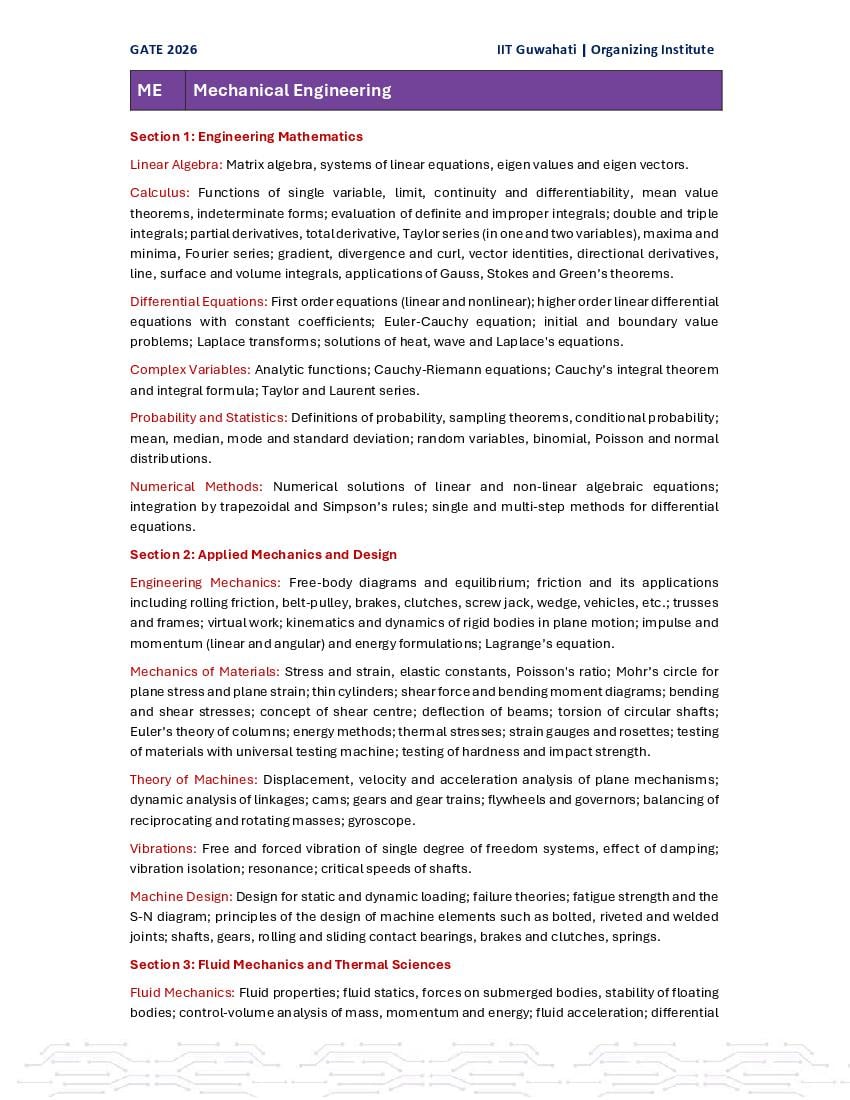
GATE 2026 IIT Guwahati | Organizing Institute ME Mechanical Engineering Section 1: Engineering Mathematics Linear Algebra: Matrix algebra, systems of linear equations, eigen values and eigen vectors. Calculus: Functions of single variable, limit, continuity and differentiability, mean value theorems, indeterminate forms; evaluation of definite and improper integrals; double and triple integrals; partial derivatives, total derivative, Taylor series (in one and two variables), maxima and minima, Fourier series; gradient, divergence and curl, vector identities, directional derivatives, line, surface and volume integrals, applications of Gauss, Stokes and Green’s theorems. Differential Equations: First order equations (linear and nonlinear); higher order linear differential equations with constant coefficients; Euler-Cauchy equation; initial and boundary value problems; Laplace transforms; solutions of heat, wave and Laplace's equations. Complex Variables: Analytic functions; Cauchy-Riemann equations; Cauchy’s integral theorem and integral formula; Taylor and Laurent series. Probability and Statistics: Definitions of probability, sampling theorems, conditional probability; mean, median, mode and standard deviation; random variables, binomial, Poisson and normal distributions. Numerical Methods: Numerical solutions of linear and non-linear algebraic equations; integration by trapezoidal and Simpson’s rules; single and multi-step methods for differential equations. Section 2: Applied Mechanics and Design Engineering Mechanics: Free-body diagrams and equilibrium; friction and its applications including rolling friction, belt-pulley, brakes, clutches, screw jack, wedge, vehicles, etc.; trusses and frames; virtual work; kinematics and dynamics of rigid bodies in plane motion; impulse and momentum (linear and angular) and energy formulations; Lagrange’s equation. Mechanics of Materials: Stress and strain, elastic constants, Poisson's ratio; Mohr’s circle for plane stress and plane strain; thin cylinders; shear force and bending moment diagrams; bending and shear stresses; concept of shear centre; deflection of beams; torsion of circular shafts; Euler’s theory of columns; energy methods; thermal stresses; strain gauges and rosettes; testing of materials with universal testing machine; testing of hardness and impact strength. Theory of Machines: Displacement, velocity and acceleration analysis of plane mechanisms; dynamic analysis of linkages; cams; gears and gear trains; flywheels and governors; balancing of reciprocating and rotating masses; gyroscope. Vibrations: Free and forced vibration of single degree of freedom systems, effect of damping; vibration isolation; resonance; critical speeds of shafts. Machine Design: Design for static and dynamic loading; failure theories; fatigue strength and the S-N diagram; principles of the design of machine elements such as bolted, riveted and welded joints; shafts, gears, rolling and sliding contact bearings, brakes and clutches, springs. Section 3: Fluid Mechanics and Thermal Sciences Fluid Mechanics: Fluid properties; fluid statics, forces on submerged bodies, stability of floating bodies; control-volume analysis of mass, momentum and energy; fluid acceleration; differential
Page 2
GATE 2026 IIT Guwahati | Organizing Institute equations of continuity and momentum; Bernoulli’s equation; dimensional analysis; viscous flow of incompressible fluids, boundary layer, elementary turbulent flow, flow through pipes, head losses in pipes, bends and fittings; basics of compressible fluid flow. Heat Transfer: Modes of heat transfer; one dimensional heat conduction, resistance concept and electrical analogy, heat transfer through fins; unsteady heat conduction, lumped parameter system, Heisler's charts; thermal boundary layer, dimensionless parameters in free and forced convective heat transfer, heat transfer correlations for flow over flat plates and through pipes, effect of turbulence; heat exchanger performance, LMTD and NTU methods; radiative heat transfer, Stefan- Boltzmann law, Wien's displacement law, black and grey surfaces, view factors, radiation network analysis Thermodynamics: Thermodynamic systems and processes; properties of pure substances, behavior of ideal and real gases; zeroth and first laws of thermodynamics, calculation of work and heat in various processes; second law of thermodynamics; thermodynamic property charts and tables, availability and irreversibility; thermodynamic relations. Applications: Power Engineering: Air and gas compressors; vapour and gas power cycles, concepts of regeneration and reheat. I.C. Engines: Air-standard Otto, Diesel and dual cycles. Refrigeration and air-conditioning: Vapour and gas refrigeration and heat pump cycles; properties of moist air, psychrometric chart, basic psychrometric processes. Turbomachinery: Impulse and reaction principles, velocity diagrams, Pelton-wheel, Francis and Kaplan turbines; steam and gas turbines. Section 4: Materials, Manufacturing and Industrial Engineering Engineering Materials: Structure and properties of engineering materials, phase diagrams, heat treatment, stress-strain diagrams for engineering materials. Casting, Forming and Joining Processes: Different types of castings, design of patterns, moulds and cores; solidification and cooling; riser and gating design. Plastic deformation and yield criteria; fundamentals of hot and cold working processes; load estimation for bulk (forging, rolling, extrusion, drawing) and sheet (shearing, deep drawing, bending) metal forming processes; principles of powder metallurgy. Principles of welding, brazing, soldering and adhesive bonding. Machining and Machine Tool Operations: Mechanics of machining; basic machine tools; single and multi-point cutting tools, tool geometry and materials, tool life and wear; economics of machining; principles of non-traditional machining processes; principles of work holding, jigs and fixtures; abrasive machining processes; NC/CNC machines and CNC programming. Metrology and Inspection: Limits, fits and tolerances; linear and angular measurements; comparators; interferometry; form and finish measurement; alignment and testing methods; tolerance analysis in manufacturing and assembly; concepts of coordinate-measuring machine (CMM). Computer Integrated Manufacturing: Basic concepts of CAD/CAM and their integration tools; additive manufacturing. Production Planning and Control: Forecasting models, aggregate production planning, scheduling, materials requirement planning; lean manufacturing. Inventory Control: Deterministic models; safety stock inventory control systems. Operations Research: Linear programming, simplex method, transportation, assignment, network flow models, simple queuing models, PERT and CPM.