TN 11th Question Paper 2022 History
Finished viewing? Save it for later —
Download TN 11th Question Paper 2022 History (PDF · 11 pages)About TN 11th Question Paper 2022 History
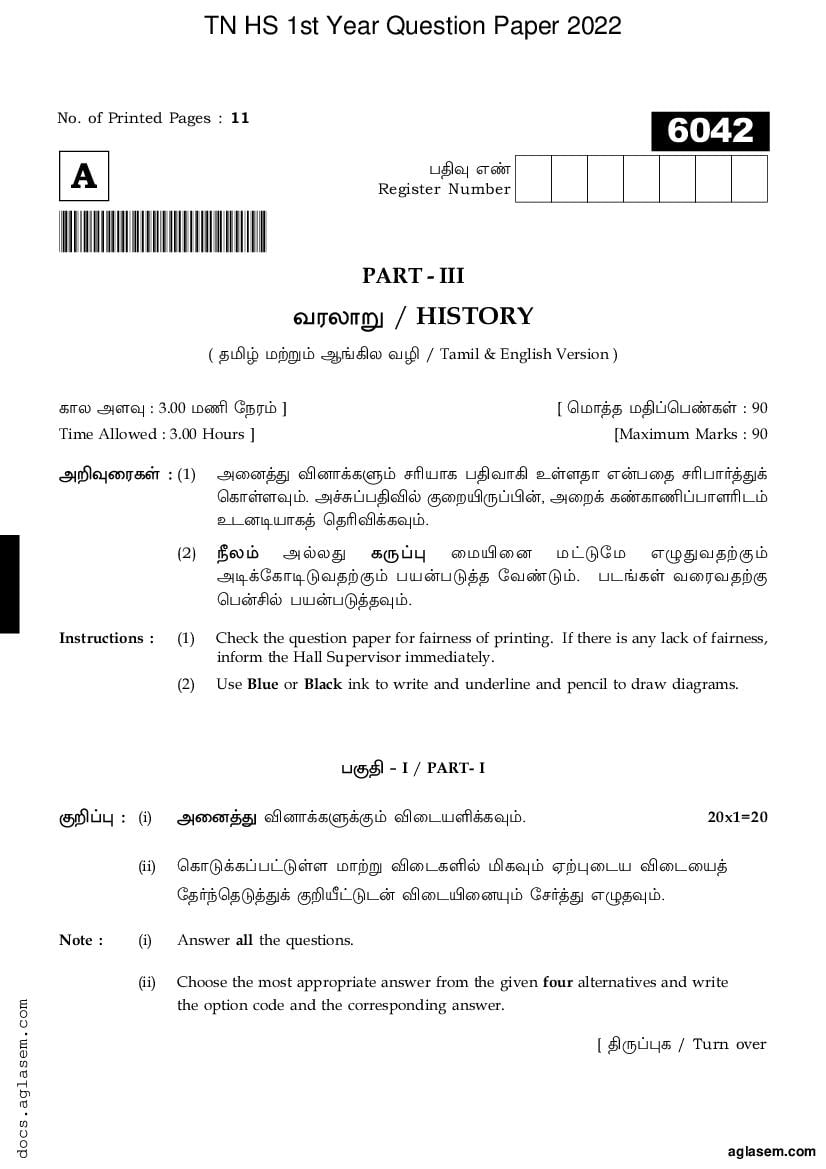
TN 11th Question Paper 2022 History is available here for free download. Published by Tamil Nadu Board for Class 11, this question paper can be viewed online or downloaded as a PDF (11 pages). Candidates preparing for Class 11 can use TN 11th Question Paper 2022 History to understand the exam pattern, the type of questions asked, and the overall difficulty level.
Frequently Asked Questions
How can I download TN 11th Question Paper 2022 History?
Open this page and click the Download button to save TN 11th Question Paper 2022 History as a PDF. It is completely free on AglaSem Docs.
Is TN 11th Question Paper 2022 History free to download?
Yes. TN 11th Question Paper 2022 History can be viewed online and downloaded as a PDF free of cost on AglaSem Docs.
How many pages does TN 11th Question Paper 2022 History have?
TN 11th Question Paper 2022 History contains 11 pages, which you can read online or download together as a single PDF.
Where can I find more Class 11 study material?
You can find more Class 11 question papers, sample papers, syllabus, and answer keys on AglaSem Docs.
TN 11th Question Paper 2022 History – Text
Read the full text of this question paper below — useful to quickly search, copy and reference the content online without downloading the PDF.
📄 View text version (11 pages)
Page 1
6042
£vÄ Gs
A Register Number
!6042IstYearHistory!
PART - III
Áµ»õÖ / HISTORY
( uªÌ ©ØÖ® B[Q» ÁÈ / Tamil & English Version )
Põ» AÍÄ : 3.00 ©o ÷|µ® ] [ ö©õzu ©v¨ö£sPÒ : 90
Time Allowed : 3.00 Hours ] [Maximum Marks : 90
AÔÄøµPÒ : (1) AøÚzx ÂÚõUPЮ \›¯õP £vÁõQ EÒÍuõ Gߣøu \›£õºzxU
öPõÒÍÄ®. Aa_¨£vÂÀ SøÓ°¸¨¤ß, AøÓU PsPõo¨£õÍ›h®
EhÚi¯õPz öu›ÂUPÄ®.
(2) }»® AÀ»x P¸¨¦ ø©°øÚ ©mk÷© GÊxÁuØS®
AiU÷PõikÁuØS® £¯ß£kzu ÷Ásk®. £h[PÒ ÁøµÁuØS
ö£ß]À £¯ß£kzuÄ®.
Instructions : (1) Check the question paper for fairness of printing. If there is any lack of fairness,
inform the Hall Supervisor immediately.
(2) Use Blue or Black ink to write and underline and pencil to draw diagrams.
£Sv & I / PART- I
SÔ¨¦ : (i) AøÚzx ÂÚõUPÐUS® Âøh¯ÎUPÄ®. 20x1=20
(ii) öPõkUP¨£mkÒÍ ©õØÖ ÂøhPÎÀ ªPÄ® Hئøh¯ Âøhø¯z
÷uº¢öukzxU SÔ±mkhß Âøh°øÚ²® ÷\ºzx GÊuÄ®.
Note : (i) Answer all the questions.
(ii) Choose the most appropriate answer from the given four alternatives and write
the option code and the corresponding answer.
[ v¸¨¦P / Turn over
Page 2
1. P[Põ÷u GÊv¯ ¡À __________.
(A) £õskµ[P ©Põzª¯® (B) ©Ý\›u®
(C) ©xµõ Âᯮ (D) B•Uu©õÀ¯uõ
__________ was composed by Gangadevi.
(a) Panduranga Mahatmiyam (b) Manucharitram
(c) Madura Vijayam (d) Amuktamalyada
2. P›Põ»ß __________ ©PÚõÁõº.
(A) CÍg÷\mö\ßÛ (B) ö\[Psnß
(C) Av¯©õß (D) Pk[÷Põ
Karikala was the son of __________.
(a) Ilanjetchenni (b) Sengannan
(c) Athiyaman (d) Kadungo
3. ©µõzv¯ ©ßÚº ]Áõâ°ß \©Põ»zuÁº __________ BÁõº.
(A) `ºuõì (B) Cµõ©õÚ¢uº (C) xUPõµõ® (D) «µõ£õ´
__________ was the contemporary of the Maratha ruler Shivaji.
(a) Surdas (b) Ramananda (c) Tukaram (d) Mirabai
4. Aáõu \z¸ÄUS® ¦zu¸USªøh÷¯¯õÚ \¢v¨ø£U SÔ¨¤k® ö£Ízu ¡À
__________ BS®.
(A) PÀ£`zvµ® (B) ^ÁP]¢uõ©o
(C) \©Ú£» _zuõ (D) Aa\µ[P`zvµ®
__________ is the Buddhist text that makes a reference to Ajathashatru’s meeting
of Buddha.
(a) Kalpasutra (b) Jivakasinthamani
(c) Samannaphala sutta (d) Acharrangasutra
A
Page 3
5. AzøÁu® GßÝ® uzxÁzøu C¢x ©uzvØS ÁÇ[Q¯Áº __________.
(A) Cµõ©õÚ¢uº (B) Bv \[Pµº (C) ø\u߯º (D) Cµõ©õÝáº
__________ provided Hinduism with a philosophic Doctrine of Advaita.
(a) Ramananda (b) Adi Sankara (c) Chaitanya (d) Ramanuja
6. A÷\õPµx ysPÎÀ EÒÍ ¤µõª GÊzxUPÐUS ö£õ¸Ò Psk¤izuÁº
__________.
(A) \º áõß ©õºåÀ (B) uõ©ì \õshºì
(C) ÂÀ¼¯® ÷áõßì (D) ÷á®ì ¤›ßö\¨
Brahmi script in Ashoka’s pillar inscription was deciphered by __________.
(a) Sir John Marshal (b) Thomas Saunders
(c) William Jones (d) James Prinsep
7. £õøͯUPõµº •øÓ •uß•u¼À __________ ÷£µµ\õÀ |øh•øÓ¨£kzu¨&
£mhx.
(A) PõPv¯ (B) Âᯠ|Pº (C) öíõ´\õÍ (D) £õªÛ
The Palayakkarar system was originally practised in __________ Kingdom.
(a) Kakatiya (b) Vijayanagar (c) Hoysala (d) Bahmani
8. Cì»õª¯ \‰PzvÚ›ß \©¯ «Ð¸ÁõUPzøu ÷|õUP©õPU öPõsi¸¢u C¯UP®
__________ BS®.
(A) A¼Pº C¯UP® (B) v÷¯õ£¢z C¯UP®
(C) Áõíõ¤ C¯UP® (D) AP©v¯õ C¯UP®
The aim of the __________ was the religious regeneration of the Muslim Community.
(a) Aligarh Movement (b) Deoband Movement
(c) Wahhabi Movement (d) Ahmadiya Movement
A [ v¸¨¦P / Turn over
Page 4
9. ÿµõ©õÝẠ¤Ó¢u Fº __________.
(A) ÿö£¸®¦yº (B) Põg]¦µ®
(C) D÷µõk (D) v¸Áµ[P®
The Birth Place of Sri Ramanujar was __________.
(a) Sriperumbudur (b) Kancheepuram
(c) Erode (d) Thiruvarangam
10. AU£µx {v {ºÁõP® __________ {ºÁõP •øÓø¯¨ ¤ß£ØÔ Aø©UP¨£mhx.
(A) öåºåõ (B) £õ£º
(C) C¨µõî® ÷»õi (D) íú©õ³ß
The fiscal administration of Akbar was largely based on __________.
(a) Sher Shah (b) Babur
(c) Ibrahim Lodi (d) Humayun
11. Áõ›_ E›ø© CǨ¦U öPõÒøP°ß£i B[Q÷»¯ Aµ_hß CønUP¨£mh
•uÀ ©õPõn® __________.
(A) áõß] (B) |õU§º (C) \uõµõ (D) AÁz
__________ was the first state to fall under the policy of Doctrine of Lapse.
(a) Jhansi (b) Nagpur (c) Satara (d) Oudh
12. ÷Áu¨£õhÀPÎß •UQ¯ öuõS¨¤ß ö£¯º __________.
(A) Bµs¯[PÒ (B) ¤µõ©n[PÒ
(C) E£{hu[PÒ (D) \®îøuPÒ
The main collection of vedic hymns are called __________.
(a) Aranyakas (b) Brahmanas
(c) Upanishads (d) Samhitas
A
Page 5
13. £À»ÁºPÎß •UQ¯ xøÓ•P |Pµ® __________.
(A) ©õ©À»¦µ® (B) yzxUSi
(C) ö\ßøÚ (D) £õsia÷\›
__________ was an important seaport of the Pallavas.
(a) Mamallapuram (b) Thoothukudi
(c) Chennai (d) Pondichery
14. C¢v¯õÂÀ ^ºv¸zu[PÒ £ØÔ¯ £» P¸zxUPÒ ÷uõßÔ¯ •uÀ ©õPõn®
__________ BS®.
(A) £®£õ´ (B) £g\õ¨ (C) ö©mµõì (D) Á[PõÍ®
__________ was the first province where several ideas of reforms originated.
(a) Bombay (b) Punjab (c) Madras (d) Bengal
15. ö£õ¸zxP.
(1) £øh •Põ® (i) £øh Ãk
(2) ¦ÓUPõÁÀ £øhPÒ (ii) ush |õ¯P®
(3) uø»Áº (iii) {ø»¨£øh
(4) £øhzuÍ£v (iv) £øh•u¼
(A) (1)-(ii), (2)-(i), (3)-(iii), (4)-(iv)
(B) (1)-(i), (2)-(iii), (3)-(iv), (4)-(ii)
(C) (1)-(ii), (2)-(iii), (3)-(i), (4)-(iv)
(D) (1)-(iv), (2)-(ii), (3)-(i), (4)-(iii)
Match the following :
(1) Cantonments (i) Padaividu
(2) Military outposts (ii) Dandanayagam
(3) Captain (iii) Nilai Padai
(4) Commander-in-Chief (iv) Padaimudali
(a) (1)-(ii), (2)-(i), (3)-(iii), (4)-(iv)
(b) (1)-(i), (2)-(iii), (3)-(iv), (4)-(ii)
(c) (1)-(ii), (2)-(iii), (3)-(i), (4)-(iv)
(d) (1)-(iv), (2)-(ii), (3)-(i), (4)-(iii)
A [ v¸¨¦P / Turn over
Page 6
16. __________ C¢v¯õÂÀ B[Q÷»¯›ß BvUP® Esø©°À {ÖÁ¨£hU
Põµn©õÚ ÷£õµõS®.
(A) £U\õº ÷£õº (B) ¤Íõ]¨ ÷£õº
(C) Á¢uÁõ]¨ ÷£õº (D) •u»õ® Pº|õhP¨ ÷£õº
__________ was the real foundation for British dominion in India.
(a) Battle of Buxar (b) Battle of Plassey
(c) Wandiwash war (d) First Carnatic war
17. öPhõ __________ CÀ EÒÍx.
(A) uõ´»õ¢x (B) ©÷»]¯õ (C) P®÷£õi¯õ (D) ][P¨§º
“Kedah” is in __________.
(a) Thailand (b) Malaysia (c) Cambodia (d) Singapore
18. TØÖ : £õ£º •u»õ® £õÛ¨£m ÷£õ›À öÁØÔ ö£ØÓõº.
Põµn® : £õ£º ¥µ[Q¨ £øhø¯ ÷£õ›À £¯ß£kzvÚõº.
(A) TØÖ \›, Põµn® TØÔß \›¯õÚ ÂÍUP® BS®
(B) TØÖ uÁÖ, Põµn•® uÁÖ
(C) TØÖ \›, Põµn® TØÔß \›¯õÚ ÂÍUP® AÀ»
(D) TØÖ uÁÖ, Põµn® \›
Assertion (A) : Babur won the first Battle of Panipat.
Reason (R) : Babur used artillery in the battle.
(a) (A) is correct, (R) is the correct explanation of (A).
(b) (A) and (R) are wrong.
(c) (A) is correct, (R) is not the correct explanation of (A).
(d) (A) is wrong, (R) is correct.
A
Page 7
19. GÊzxPÒ AÔ•P©õÁuØS •¢øu¯ Põ»Pmh® __________ GÚ¨£kQÓx.
(A) £Ç[PØPõ»® (B) Áµ»õØÖUS •¢øu¯ Põ»®
(C) ¦v¯ PØPõ»® (D) Áµ»õØÖUPõ»®
The period before the development of script is called __________.
(a) Palaeolithic (b) Pre-historic
(c) Neolithic (d) Historic
20. 1857 &B® Bsk ¦µm]°ß÷£õx C¢v¯õÂß PÁºÚº&öáÚµ»õP C¸¢uÁº
__________ BÁõº.
(A) ªs÷hõ (B) hÀöíÍ] (C) öÁÀö»ì¼ (D) PõÛ[
__________ was the Governor General of India when the great Rebellion of 1857
broke out.
(a) Minto (b) Dalhousie (c) Wellesley (d) Canning
£Sv & II / PART - II
SÔ¨¦ : GøÁ÷¯Ý® HÊ ÂÚõUPÐUS Âøh¯ÎUPÄ®. ÂÚõ Gs 30 &US
Pmhõ¯©õP Âøh¯ÎUPÄ®. 7x2=14
Note : Answer any seven questions briefly. Question No. 30 is compulsory.
21. ]¢x |õP›Pzvß ÃÌa]UPõÚ Põµn[PøÍU TÖP.
Mention the reasons for the decline of Indus Civilisation.
22. öásm AÁìuõøÁ¨ £ØÔ GÊxP.
Write about the Zend Avesta.
23. £sh©õØÖ •øÓø¯ ÂÍUSP.
Explain Barter System.
24. uµõ¨ £ØÔ GÊxP.
Write a note on “tarafs”.
A [ v¸¨¦P / Turn over
Page 8
25. AøÚÁøµ²® EÒÍhUQ¯ ©u©õP øÁnÁzøu ©õØÔ¯ µõ©õÝá›ß
£[PΨ¤øÚU SÔ¨¤kP.
Point out the contribution of Ramanujar in making Vaishnavism more inclusive.
26. £õsi¯ Aµ]ß «uõÚ ©õ¼U Põ§›ß £øhö¯k¨¤ß ÂøÍÄPÒ ¯õøÁ ?
What were the results of Malik Kafur’s invasion of Pandyan Kingdom ?
27. £Uv C¯UPzvÀ µÂuõêß £[QøÚ¨ £ØÔ }º AÔÁÚ ¯õøÁ ?
What do you know about the contribution of Ravidas to the Bhakti Movement ?
28. BÐ|º uõ©ì ©ß÷Óõ £ØÔ ]Ö SÔ¨¦ ÁøµP.
Write a note on Governor Thomas Munro.
29. \‰P ^ºv¸zuzvØS Cµõáõµõ® ÷©õPßµõ°ß £[PΨ¦PÒ ¯õøÁ ?
Write the contributions of Raja Ram Mohan Roy to Social Reforms.
30. B[Q» µõqÁ AvPõ› }À SÔzx SÔ¨¦ ÁøµP.
Write a note on the British Military General Neill.
£Sv & III / PART - III
SÔ¨¦ : GøÁ÷¯Ý® HÊ ÂÚõUPÐUS Âøh¯ÎUPÄ®. ÂÚõ Gs 40 &US
Pmhõ¯©õP Âøh¯ÎUPÄ®. 7x3=21
Note : Answer any seven questions. Question No. 40 is compulsory.
31. íµ¨£õ ö£õ¸ÍõuõµzxUS¨ £[PÎzu øPÂøÚz u¯õ›¨¦ SÔzx GÊxP.
Write about the craft production of Harappan Economy.
32. ›U÷Áu Põ» \‰P¨¤›ÄPøÍ ÷Põimk PõmkP.
Highlight the social divisions in the Rig Vedic Period.
33. P[øPa \©öÁΰÀ GÊ¢u |Pµ[PÎß ÷uõØÓzxUPõÚ PõµoPøͨ £S¨£õ´Ä
ö\´P.
Analyse the factors responsible for the rise of towns and cities in the Ganges
Plains.
A
Page 9
34. \[P Põ»zvÀ uªÌ {»zvß I¢x vønPÒ ¯õøÁ ?
What are the five eco-zones of the Tamil land during Sangam Age ?
35. Cµõ÷á¢vµ ÷\õÇß ""Phõµ® öPõshõß'' GÚ AøÇUP¨£kÁx Hß ?
Why was Rajendra Chola called “Kadaram Kondan” ?
36. ©µõzv¯›ß GÊa]UPõÚ Põµn[PÒ ¯õøÁ ?
Narrate the causes for the rise of the Marathas.
37. Cµmøh Bm] •øÓ SÔzx GÊxP.
Write about “Dual System”.
38. 1857 &B® Bsk ¦µm]°ß ÂøÍÄPÒ ¯õøÁ ?
What are the effects of the Great Rebellion of 1857 ?
39. _Áõª Â÷ÁPõÚ¢uº SÔzx SÔ¨¦ ÁøµP.
Write a short note on Swamy Vivekananda.
40. uªÌ|õk öuõÀ¼¯À xøÓ¯õÀ |hzu¨£mh RÇi APÇõ´Ä SÔzu ]Ö SÔ¨¦
ÁøµP.
Write a short note on the Keeladi Excavations conducted by Department of
Archaeology in Tamil Nadu.
£Sv & IV / PART - IV
SÔ¨¦ : AøÚzx ÂÚõUPÐUS® Âøh¯ÎUPÄ®. 7x5=35
Note : Answer all the questions.
41. (A) vmhªh¨£mh |Pµ[PÍõÚ íµ¨£õ, ö©õíg\uõ÷µõ £ØÔ GÊxP.
AÀ»x
(B) C¢v¯õÂÀ ö£Ízu® ÃÌa] Aøh¢uuØPõÚ Põµn[PÒ ¯õøÁ ?
(a) Write about the planned towns of Harappa and Mohenjo-Daro.
OR
(b) Account for the decline of Buddhism in India.
A [ v¸¨¦P / Turn over
Page 10
42. (A) £À»ÁºPÎß ÁoP® ©ØÖ® P¨£À \õº¢u ö\¯À£õkPøͨ £ØÔ
ÂÁõvUPÄ®.
AÀ»x
(B) £Uv C¯UPzvß ]Ó¨¤¯À¦PøÍ Á›ø\¨£kzxP.
(a) Discuss the Trade and Maritime activity in Pallava Kingdom.
OR
(b) List out the salient features of the Bhakti Movement.
43. (A) ]Áõâ°ß CµõqÁ öÁØÔPÒ £ØÔ²® ¥á¨§¸US GvµõÚ ÷©õuÀ
£ØÔ²® GÊxP.
AÀ»x
(B) öÁÀö»ì¼ AÔ•P¨£kzv¯ xøn¨ £øhz vmhzvøÚ¨ £ØÔ
ÂÁ›UPÄ®.
(a) Highlight the Military conquests and confrontation against Bijapur of Shivaji.
OR
(b) Explain the Subsidiary Alliance introduced by Lord Wellesley.
44. (A) \[P Põ»®, \[P Põ»zøuz öuõhº¢x EhÚi¯õP Á¢u Põ»zøua ÷\º¢u
ÁoPºPÒ ©ØÖ® öuõø»yµ ÁoP® £ØÔ ÂÍUSP.
AÀ»x
(B) Áµ»õØÖUS •¢øu¯ C¢v¯õ SÔzx ÂÍUSP.
(a) Attempt an account of traders and their long distance trade during the
Sangam and the immediate Post-Sangam Period.
OR
(b) Describe Pre-historic India.
45. (A) 1806 &B® Bsiß ÷Á¿º ¦µm]UPõÚ Põµn[PøͲ® ÷£õUQøÚ²®
ÂÁ›UPÄ®.
AÀ»x
(B) C¢v¯õÂÀ QÔìuÁ ©u¨£µ¨£õͺPÒ BØÔ¯ £oPøÍ ÂÍUSP.
(a) Describe the causes and course of the Vellore Revolt of 1806.
OR
(b) Discuss the role played by Christian missionaries in India.
A
Page 11
46. (A) ö£õ.B.•. BÓõ® ¡ØÓõsiÀ HØ£mh AÔÄ ©»ºa]UPõÚ Põµn[PÒ
¯õøÁ ?
AÀ»x
(B) öPõkUP¨£mh C¢v¯ Áøµ£hzvÀ AU£º ÷£µµ]À RÌPsh Ch[PøÍU
SÔUPÄ®.
(i) ¥hõº (ii) AP©x |Pº (iii) ©xøµ
(iv) Põ諺 (v) J›\õ
(a) Discuss the causes of intellectual awakening in the sixth century BCE.
OR
(b) On the given outline map of India mark the following places from Akbar’s
Empire.
(i) Bidar (ii) Ahmadnagar (iii) Madurai
(iv) Kashmir (v) Orissa
47. (A) B[Q÷»¯ºPÒ Bm]UPõ»zvÀ Siø© ©ØÖ® }v {ºÁõP[PÎÀ
HØ£kzu¨£mh ^ºv¸zu[Pøͨ £ØÔ Â›ÁõP GÊxP.
AÀ»x
(B) £õ£›ß Áµ»õØÔÀ |h¢u •UQ¯ {PÌÄPÒ H÷uÝ® I¢vøÚ Põ»U÷PõmiÀ
Áøµ¢x PõmkP.
(a) Write about the reforms in Civil and Judicial Administration during the
British Rule in India.
OR
(b) Draw a Time-line for any five important events of Babur’s life.
-o0o-
A [ v¸¨¦P / Turn over
Document Details
| Board / Org | Tamil Nadu Board |
| Exam | Class 11 |
| Type | Question Paper |
| Pages | 11 |
| Updated | 30 Apr 2026 |