MAHA SET 2026 Paper II Philosophy Set A Question Paper
Finished viewing? Save it for later —
Download MAHA SET 2026 Paper II Philosophy Set A Question Paper (PDF · 32 pages)About MAHA SET 2026 Paper II Philosophy Set A Question Paper
MAHA SET 2026 Paper II Philosophy Set A Question Paper is available here for free download. Published by Maharashtra Exams for MAHA SET, this question paper can be viewed online or downloaded as a PDF (32 pages). Candidates preparing for MAHA SET can use MAHA SET 2026 Paper II Philosophy Set A Question Paper to understand the exam pattern, the type of questions asked, and the overall difficulty level.
Frequently Asked Questions
How can I download MAHA SET 2026 Paper II Philosophy Set A Question Paper?
Open this page and click the Download button to save MAHA SET 2026 Paper II Philosophy Set A Question Paper as a PDF. It is completely free on AglaSem Docs.
Is MAHA SET 2026 Paper II Philosophy Set A Question Paper free to download?
Yes. MAHA SET 2026 Paper II Philosophy Set A Question Paper can be viewed online and downloaded as a PDF free of cost on AglaSem Docs.
How many pages does MAHA SET 2026 Paper II Philosophy Set A Question Paper have?
MAHA SET 2026 Paper II Philosophy Set A Question Paper contains 32 pages, which you can read online or download together as a single PDF.
Where can I find more MAHA SET study material?
You can find more MAHA SET question papers, sample papers, syllabus, and answer keys on AglaSem Docs.
MAHA SET 2026 Paper II Philosophy Set A Question Paper – Text
Read the full text of this question paper below — useful to quickly search, copy and reference the content online without downloading the PDF.
📄 View text version (33 pages)
Page 1
MAHA SET 2026 Paper
II Philosophy Set A
Question Paper
EXAM YEAR TYPE
MAHA SET 2026 Question Paper
Notes · Sample Papers · Previous Year Papers · Mock Tests
Page 2
. s e
em l a
as fafafafafafafafafafafafafafafafafafafafafafafafafafafafafafafafafafafafafafafafafafafafafaf
afafafafafafafafafafafafafafafafafafafafafafafafafafafafafafafafafafafafafafafafafafafafafafafafafafafafafafafafafafafafafa a g
afafafafafafafafafafafafafafafafafafafafafafafafafafafafafafafafafafafafafafafafafafafafafafafafafafafafafafafafafafafafafa
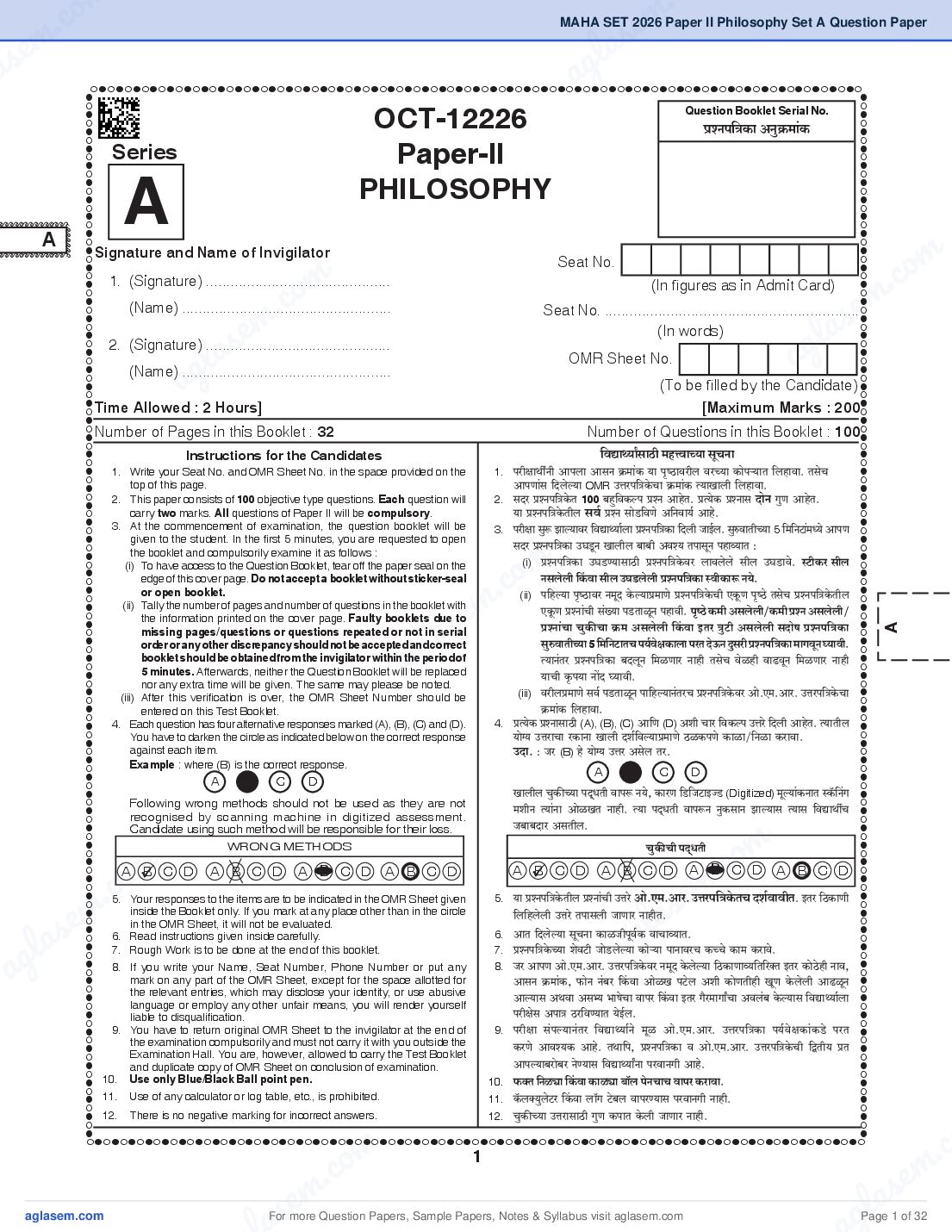
OCT-12226 Question Booklet Serial No.
àíZn{ÌH$m AZwH«$_m§H$
Series Paper-II
A PHILOSOPHY
m
CCCCCCCCCCCCCC
CCCCCC
A
om co
Signature and Name of Invigilator
.
CCCCCCCCCCCCCC
Seat No.
.c e m
1. (Signature) ............................................. (In figures as in Admit Card)
(Name) ...................................................
e m l a s
Seat No. ..............................................................
l a s (In words)
a g
ag
2. (Signature) .............................................
OMR Sheet No.
(Name) ...................................................
(To be filled by the Candidate)
Time Allowed : 2 Hours] [Maximum Marks : 200
Number of Pages in this Booklet : 32 Number of Questions in this Booklet : 100
Instructions for the Candidates {dÚmÏ`mªgmR>r _hÎdmÀ`m gyMZm
1. Write your Seat No. and OMR Sheet No. in the space provided on the 1.narjmWvZr Amnbm AmgZ H«$_m§H$ `m n¥îR>mdarb daÀ`m H$monè`mV {bhmdm. VgoM
top of this page. AmnUm§g {Xboë`m OMR CÎman{ÌHo$Mm H«$_m§H$ Ë`mImbr {bhmdm.
2. This paper consists of 100 objective type questions. Each question will 2. gXa àíZn{ÌHo$V 100 ~hþ{dH$ën àíZ AmhoV. àË`oH$ àíZmg XmoZ JwU AmhoV.
carry two marks. All questions of Paper II will be compulsory. `m àíZn{ÌHo$Vrb gd© àíZ gmoS>{dUo A{Zdm`© Amho.
3. At the commencement of examination, the question booklet will be 3. narjm gwê$ Pmë`mda {dÚmÏ`m©bm àíZn{ÌH$m {Xbr OmB©b. gwédmVrÀ`m 5 {_{ZQ>m_
§ Ü`o AmnU
m
given to the student. In the first 5 minutes, you are requested to open
co
the booklet and compulsorily examine it as follows :
gXa àíZn{ÌH$m CKSy>Z Imbrb ~m~r Adí` VnmgyZ nhmì`mV :
.
(i) To have access to the Question Booklet, tear off the paper seal on the (i) àíZn{ÌH$m CKS>Ê`mgmR>r àíZn{ÌHo$da bmdbobo grb CKS>mdo. ñQ>rH$a grb
em
edge of this cover page. Do not accept a booklet without sticker-seal Zgbobr {H§$dm grb CKS>bobr àíZn{ÌH$m ñdrH$mê$ Z`o.
or open booklet.
s
(ii) n{hë`m n¥îR>mda Z_yX Ho$ë`mà_mUo àíZn{ÌHo$Mr EHy$U n¥îR>o VgoM àíZn{ÌHo$Vrb
a
(ii) Tally the number of pages and number of questions in the booklet with
l
EHy$U àíZm§Mr g§»`m nS>VmiyZ nhmdr. n¥îR>o H$_r Agbobr/H$_r àíZ Agbobr/
the information printed on the cover page. Faulty booklets due to
g
A
missing pages/questions or questions repeated or not in serial àíZm§Mm MwH$sMm H«$_ Agbobr {H§$dm BVa ÌwQ>r Agbobr gXmof àíZn{ÌH$m
a
order or any other discrepancy should not be accepted and correct gwédmVrÀ`m 5 {_{ZQ>mVM n`©dojH$mbm naV XoD$Z Xwgar àíZn{ÌH$m _mJdyZ ¿`mdr.
booklet should be obtained from the invigilator within the period of Ë`mZ§Va àíZn{ÌH$m ~XbyZ {_iUma Zmhr VgoM doihr dmT>dyZ {_iUma Zmhr
5 minutes. Afterwards, neither the Question Booklet will be replaced `mMr H¥$n`m Zm|X ¿`mdr.
nor any extra time will be given. The same may please be noted.
(iii) After this verification is over, the OMR Sheet Number should be (iii) darbà_mUo gd© nS>VmiyZ nm{hë`mZ§VaM àíZn{ÌHo$da Amo.E_.Ama. CÎman{ÌHo$Mm
entered on this Test Booklet. H«$_m§H$ {bhmdm.
4. Each question has four alternative responses marked (A), (B), (C) and (D). 4. àË`oH$ àíZmgmR>r (A), (B), (C) Am{U (D) Aer Mma {dH$ën CÎmao {Xbr AmhoV. Ë`mVrb
You have to darken the circle as indicated below on the correct response `mo½` CÎmamMm aH$mZm Imbr Xe©{dë`mà_mUo R>iH$nUo H$mim/{Zim H$amdm.
against each item. CXm. : Oa (B) ho `mo½` CÎma Agob Va.
Example : where (B) is the correct response.
A B C D
A B C D
Imbrb MwH$sÀ`m nX²²YVr dmnê$ Z`o, H$maU {S>{OQ>mBÁS> (Digitized) _yë`m§H$ZmV ñH°${Z§J
Following wrong methods should not be used as they are not
_erZ Ë`m§Zm AmoiIV Zmhr. Ë`m nX²YVr dmnê$Z ZwH$gmZ Pmë`mg Ë`mg {dÚmWuM
m
recognised by scanning machine in digitized assessment.
c. o
Candidate using such method will be responsible for their loss. O~m~Xma AgVrb.
m
wrong methods MwH$sMr nX²²YVr
c. o e m
A
B C D A B C D A B C D A B C D A
B C D A B C D A B C D A B C D
em
5. Your responses to the items are to be indicated in the OMR Sheet given 5.
la s
`m àíZn{ÌHo$Vrb àíZm§Mr CÎmao Amo.E_.Ama. CÎman{ÌHo$VM Xe©dmdrV. BVa {R>H$mUr
las ag
inside the Booklet only. If you mark at any place other than in the circle {b{hbobr CÎmao Vnmgbr OmUma ZmhrV.
in the OMR Sheet, it will not be evaluated.
g
6. Read instructions given inside carefully. 6. AmV {Xboë`m gyMZm H$miOrnyd©H$ dmMmì`mV.
a
7. Rough Work is to be done at the end of this booklet. 7. àíZn{ÌHo$À`m eodQ>r OmoS>boë`m H$moè`m nmZmdaM H$ÀMo H$m_ H$amdo.
8. If you write your Name, Seat Number, Phone Number or put any 8. Oa AmnU Amo.E_.Ama. CÎman{ÌHo$da Z_yX Ho$boë`m {R>H$mUmì`{V{aŠV BVa H$moR>ohr Zmd,
mark on any part of the OMR Sheet, except for the space allotted for AmgZ H«$_m§H$, \$moZ Z§~a {H§$dm AmoiI nQ>ob Aer H$moUVrhr IyU Ho$bobr AmT>iyZ
the relevant entries, which may disclose your identity, or use abusive
language or employ any other unfair means, you will render yourself
Amë`mg AWdm Agä` ^mfoMm dmna {H§$dm BVa J¡a_mJmªMm Adb§~ Ho$ë`mg {dÚmÏ`m©bm
liable to disqualification. narjog AnmÌ R>a{dÊ`mV `oB©b.
9. You have to return original OMR Sheet to the invigilator at the end of 9. narjm g§në`mZ§Va {dÚmÏ`m©Zo _yi Amo.E_.Ama. CÎman{ÌH$m n`©dojH$m§H$S>o naV
the examination compulsorily and must not carry it with you outside the
Examination Hall. You are, however, allowed to carry the Test Booklet
H$aUo Amdí`H$ Amho. VWm{n, àíZn{ÌH$m d Amo.E_.Ama. CÎman{ÌHo$Mr {ÛVr` àV
and duplicate copy of OMR Sheet on conclusion of examination. Amnë`m~amo~a ZoÊ`mg {dÚmÏ`mªZm nadmZJr Amho.
10. Use only Blue/Black Ball point pen. 10. \$ŠV {Ziçm {H§$dm H$miçm ~m°b noZMmM dmna H$amdm.
11. Use of any calculator or log table, etc., is prohibited. 11. H°$bŠ`wboQ>a {H§$dm bm°J Q>o~b dmnaÊ`mg nadmZJr Zmhr.
c
12. There is no negative marking for incorrect answers. 12. MwH$sÀ`m CÎmamgmR>r JwU H$nmV Ho$br OmUma Zmhr.
m .
fafafafafafafafafafafafafafafafafafafafafafafafafafafafafafafafafafafafafafafafafafafafafafaf
c. o e m
1
m a s
se
For more Question Papers, Sample Papers, Notes & Syllabus visit
g l Page 1 of 32
Page 3
For more Question Papers, Sample Papers, Notes & Syllabus visit Page 2 of 32
Page 4
. s e
em l a
as a g
Philosophy
Paper II
Xe©ZemñÌ
o m
m
àíZn{ÌH$m II
. c
.co [Maximum Marks : 200em
m Hundred (100) multiple choice questions. Each question las
Time Allowed : 120 Minutes]
s e g
l a a
Note : This Paper contains
ag
carrying Two (2) marks. Attempt All questions.
gyMZm : `m àíZn{ÌHo$V e§^a (100) ~hþ{dH$ën àíZ {Xbobo AmhoV. àË`oH$ àíZmbm XmoZ (2) JwU AmhoV.
gd© àíZ gmoS>dm.
1. The law of continuity from the highest 1. na_moÀM Vo {ZåZ n`ªVÀ`m gmVË`mMm {Z`_
to the lowest was established in the VÎdkmZmV ________ `m§Zr ñWm{nV Ho$bm.
philosophy of
(A) XoH$mV©
m
c. o (B) pñnZmoPm
(A) Descartes
em (C) bm`pãZP
(B) Spinoza
(C) Leibnitz
l a s
(D) Locke
a g (D) bm°H$
2. According to spinoza, every 2. pñnZmoPmà{UV VÎdkmZmMr nÕVr ________
determination is Amho.
(A) positive (A) gH$mamË_H$
(B) real knowledge (B) gË` kmZ
m
c. o
(C) negation (C) {ZfoY
o m(D) Illusion m
. c
(D) ^«_
s e
s em 3. John Locke rejects the concept of l a
la ZmH$maVmV.ag
3. Om°Z bm°H$ ________ hr g§H$ënZm
ag (A) God
(A) B©œa
(B) Innate ideas
(B) CnOV H$ënZm
(C) Matter (C) ^m¡{VH$ Ðì`
(D) Empirical knowledge (D) AmZw^{dH$ kmZ
m . c
3
c. o s e m
m a
se
For more Question Papers, Sample Papers, Notes & Syllabus visit
g l
Page 3 of 32
Page 5
because he believes that all ideas Agm {dídmg Amho H$s gd© H$ënZm
(A) Are derived from sensory
(A) B§{Ð`mZw^dmVyZ CËnÞ hmoVmV
experience
(B) CnOV Am{U _ZmV nwd©ApñVËdmV
(B) Are innate and pre existing in the
mind AgVmV
(C) Represent independent realities (C) ñd`§^y VÎdm§Mo à{V{Z{YËd H$aVmV
(D) Are nothing but illusions (D) \$ŠV ^«_ AgVmV
5. What is the basis of all motion, 5. hoJobÀ`m _VmZwgma JVr, {dH$mg-à{H«$`m
progress development and growth Am{U g_¥Õr `m§Mm AmYma H$moUVm ?
according to Hegel ?
(A) {díbofU
(A) Analysis
(B) Refutation (B) I§S>Z
(C) Rejection (C) dO©Z
(D) Negation (D) ZmH$maUo
6. For Husserl, what is the wonder of all 6. øygob©À`m _Vo, gdm©{YH$ {dñ_`H$mar H$m`
wonders ? AgVo ?
(A) Mind (A) _Z
(B) Intuitions (B) A§V:ñ\y$Vu
(C) Essences (C) gmaVÎdo
(D) Subjectivity (D) {df`r^md
7. Things encountered by Dasein in the 7. S>mPmB©ZZm AZw^d `oUmè`m OJmVrb dñVy§Zm
world are characterized by Heidegger hm`S>oJa H$m` åhUVmV ?
as
(A) CnH$aUo
(A) Equipment
(B) _mZgKQ>ZmemñÌr` dñVw
(B) Phenomenological Objects
(C) Thing-in-itself (C) dñVwVËd/ñdñWgÎmm
(D) Being-for-itself (D) ñdohVwH$ gÎmm
4
For more Question Papers, Sample Papers, Notes & Syllabus visit Page 4 of 32
Page 6
. s e
em l a
as a g
8. According to Sartre, man is 8. gmÌ©À`m _Vo, _mUyg hm AgVmo _______.
(A) Facticity (A) VÏ`mË_H$Vm
m
co
(B) Transcendence (B) AVrVVm
m
(C) Facticity andoTranscendence
m .
c. (C) VÏ`mË_H$Vm d AVrVVm
se
s emwithout Transcendence g l a
a
(D) Facticity (D) AVrVVm{da{hV VÏ`mË_H$Vm
g l a
a general framework of reality
9. Dewey’s 9. S>çwBªÀ`m dmñVdmÀ`m gd©gmYmaU Mm¡H$hrZ
consists in his attempt to Ë`mÀ`m Zo_Š`m H$moUË`m à`ËZmMm g_mdoe
(A) Disintegrate human knowledge AgVmo ?
and activity
(A) _mZdr kmZ d {H«$`m {d^mOZ
(B) Reintegrate human knowledge
and activity (B) _mZdr kmZ d {H«$`m nwZaoH$mË_rH$aU
(C) Disintegrate knowledge and
o m(C) kmZ d dmñVd {d^mOZ
reality
m.c (D) kmZ, gË` d dmñVd Ë`m§Mo
(D) Integrate knowledge, truth and
s e
l a
ag
reality EH$mË_rH$aU
10. In Nietzsche’s philosophy, the will to 10. {ZËeoÀ`m VÎdkmZmVrb gÎmmg§nmXZmMr BÀN>m
power has its expression in the H$emV à{V{~§{~V Pmbr Amho ?
(A) Slave morality (A) Jwbm_-Z¡{VH$Vm
(B) Master morality (B) _mbH$-Z¡{VH$Vm
m
c. o
(C) Master and slave morality (C) _mbH$ d Jwbm_-Z¡{VH$Vm
m
c. o (D) No morality (D) A-Z¡{VH$Vm
s e m
s em 11. Which of the following is not a cardinal la
Imbrbn¡H$s gH$moUVm _w»` gX² JwU Zmhr ?
la a
11.
ag virtue ?
(A) ehmUnU
(A) Wisdom
(B) Y¡`©
(B) Courage
(C) Temperance (C) g§`_
(D) Goodness (D) ew^Ëd
m . c
5
c. o s e m
m a
se
For more Question Papers, Sample Papers, Notes & Syllabus visit
g l Page 5 of 32
Page 7
means
(A) CƒV_ _mZdr ew^
(A) Highest human good
(B) Ho$di ^m¡{VH$ gwI
(B) Only physical pleasure
(C) Democracy (C) bmoH$emhr
(D) Satisfaction of desires (D) BÀN>m g_mYmZ
13. The dictum “Duty’s for Duty’s Sake” 13. “ H$V©ì`mgmR>r H$V©ì` ” ho gyÌ `m§Moer g§~§YrV
belongs to Amho
(A) Kant (A) H$m§Q>
(B) Spencer (B) ñnoÝga
(C) Moore (C) _ya
(D) Hume (D) øy_
14. “An act or rule of action is right if and 14. “ EImXr H¥$Vr {H§$dm H¥$Vr{df`H$ {Z`_ VoìhmM
only if it promotes at least as great a `mo½` R>aVmo, Ooìhm Ë`mÛmao Aew^mnojm Vm¡b{ZH$
balance of good over evil” is the view
ÑîQ>çm ew^mMr {Z{_©Vr A{YH$ hmoV AgVo” hm
held by
ÑîQ>rH$moZ `m§Mm Amho _________.
(A) Kant
(A) H$m§Q>
(B) Mill
(B) {_b
(C) Spencer (C) ñnoÝga
(D) Hobbes (D) hm°ãO
15. The term “Moral Philosophy” is derived 15. “ Z¡{VH$ VÎdkmZ” (_m°ab {\$bm°gm°\$s) ho nX
from the term Á`mVyZ ì`wËnÝZ Pmbo Amho Vo nX åhUOo
(A) Magnet (A) _°½ZoQ>
(B) Material (B) _Q>o[a`b
(C) Mortal (C) _m°Q>©b
(D) Mores (D) _moag
6
For more Question Papers, Sample Papers, Notes & Syllabus visit Page 6 of 32
Page 8
. s e
em l a
as a g
16. Which term is/are distributed in an ‘A’ 16. ‘A’ {dYmZmV H$moUVo/H$moUVr nX/nXo ì`mßV
proposition ?
AgVo/AgVmV ?
(A) Subject term only
m
co
(A) \$ŠV CÔoenX
m and predicate .
(B) Predicate term only
(C) Both subjectoterm
.c (B) \$ŠV {dYo`nX
e m
m
esubject term nor predicate l a s
s
term
l a
(C) CÔoenX Am{U {dYo`nX XmoÝhr
ag
g
(D) Neither
aterm (D) CÔoenXhr Zmhr {H§$dm {dYo`nXhr Zmhr
17. According to the traditional square 17. nma§n[aH$ {dYmZ {damoYmZwgma Oa E {dYmZ
of opposition, which of the following AgË` Agob Va nwT>rbn¡H$s H$moUVr
propositions must be True, if an E
{dYmZo/{dYmZ gË`M AgVmV/AgVo ?
proposition is False ?
(A) A Am{U I
m
(A) A and I
c. o (B) I Am{U O
em (C) A Am{U O
(B) I and O
(C) A and O
l a s
(D) I only a g (D) \$ŠV I
18. Which of the following is not a rule of 18. nwT>rbn¡H$s H$moUVm d¡Y {Zê$nm{YH$ g§{dYmZmMm
valid categorical syllogism ? {Z`_ Zmhr ?
(A) Middle term must be distributed at (A) _Ü`nX AmYma{dYmZm§V EH$XmVar
m
least once in the premises ì`mßV AgboM nm{hOo
m c. o
c. o (B) From m
(B) XmoZ ZH$mamWu {dYmZm§VyZ H$moUVmM
{ZîH$f© {ZKVseZmhr
two negative premises no
em l a
s
conclusion is drawn
l a g
a fdmMr {dYmZm§VyZ H$moUVmM
ag
(C) XmoZ {deo
(C) From two particular premises no
conclusion is drawn {ZîH$f© {ZKV Zmhr
(D) Oa EImXo nX AmYma{dYmZmV ì`mßV
(D) If the term is distributed in the
premises it must be distributed in
Agob Va {ZîH$f© {dYmZmVhr ì`mßVM
the conclusion also Agbo nm{hOo
m . c
7
c. o s e m
m a
se
For more Question Papers, Sample Papers, Notes & Syllabus visit
g l Page 7 of 32
Page 9
following argument : p ∨ q
p ∨ q
~p
~p
∴q
∴q
(A) d¡H$pënH$ g§dmŠ` AZw_mZ
(A) Disjunctive syllogism
(B) Hypothetical syllogism (B) gmonm{XH$ g§dmŠ` AZw_mZ
(C) Simplification (C) gabrH$aU
(D) Addition (D) d¥{ÕH$aU
20. Which of the following is not a 20. nwT>rbn¡H$s H$moUVo {dYmZ-\$bZ Zmhr ?
propositional function ?
(A) Hx⋅Ny
(A) Hx⋅Ny
(B) Ha⋅Na
(B) Ha⋅Na
(C) Hx ⊃ Nx (C) Hx ⊃ Nx
(D) Hx (D) Hx
21. Consider the following statements 21. gm§»`Xe©ZmVrb ‘ nwéfm ’ {df`rMr Imbrb
about the Purus,a of Sānˋ khya system. {dYmZo {dMmamV ¿`m.
a. Purus,a knows everything a. nwéf gd©H$mhr OmUVmo
b. Purus,a is one
b. nwéf EH$ Amho
c. Purus,as are many
c. nwéf AZoH$ AmhoV
d. Purus,a is witness consciousness
d. nwéf ho gm{jM¡VÝ` Amho
e. Purus,a undergoes transmigration
e. nwéf EH$m XohmVyZ Xwgè`m XohmV OmVmo
f. Purus,a is inactive
f. nwéf {ZpîH«$` Amho
Which of the above statements are
true ? darbn¡H$s H$moUVr {dYmZo gË` AmhoV ?
(A) a, b, d (A) a, b, d
(B) c, d, f (B) c, d, f
(C) d, e, f (C) d, e, f
(D) a, b, e (D) a, b, e
8
For more Question Papers, Sample Papers, Notes & Syllabus visit Page 8 of 32
Page 10
. s e
em l a
as a g
22. According to Nyāya the conventions 22. Ý`m`Xe©ZmZwgma eãX-AW© g§~§YmMo g§Ho$V
about word-meaning relation are
(A) emídV, A-{Z{_©V AmhoV
(A) Eternal, uncreated
om
(B) \$ŠV B©œa{Z{_©V AmhoV
(B) Created only by God
m
(C) \$ŠV _mZd{Z{_©V AmhoV
. c
co (D) H$mhr ~m~VrV B©œa{Z{_©V, H$mhr ~m~VrV m
(C) Created only by human beings
. e
m as
(D) Created in some cases by God,
s e _mZd{Z{_©V AmhoV
g l
a
in some cases by human beings
g l to Advaita-Vedānta what a
a
23. According
appears in dream ?
23. AÛ¡V doXm§VmZwgma ñdßZmV Oo àH$Q> hmoVo
(A) Is not real at all (A) Vo A{O~mV gV² ZgVo
(B) Belongs to the realm of reality of
appearance (Pratibhāsa) (B) Vo àm{V^m{gH$ gÎmoV O_m hmoVo
(C) Belongs to the empirical reality
(Vyavahāra) (C) Vo ì`mdhm[aH$ gÎmoV O_m hmoVo
m(D) Vo nma_m{W©H$ AWm©Zo gV² AgVo
(D) Is real in ultimate sense
(Paramārtha)
c. o
-
s em 24. àm_mÊ` Am{U Aàm_mÊ`mÀ`m ~m~VrV
l a
24. Pūrva-Mi mām . sā system accepts
the following approach to Validity
(Prāmān, ya) and Invalidity a g nyd©_r_m§gmXe©Z Imbrb ÑpîQ>H$moZmMm
ñdrH$ma H$aVo
(Aprāmān, ya)
(A) Intrinsic Validity and Extrinsic
(A) ñdV: àm_mÊ` Am{U naV: Aàm_mÊ`
Invalidity
(B) Extrinsic Validity and Extrinsic
Invalidity (B) naV: àm_mÊ` Am{U naV: Aàm_mÊ`
(C) Intrinsic Validity and Intrinsic
m
(C) ñdV: àm_mÊ` Am{U ñdV: Aàm_mÊ`
o
Invalidity
m c
(D) naV: àm_mÊ` Am{U. ñdV: Aàm_mÊ`
c. o
(D) Extrinsic Validity and Intrinsic
em
Invalidity
em 25. The term anirvacani-ya in s
25. AÛ¡V doXm§VmÀ`mlan[a^mfoZwgma ‘A{Zd©MZr`’
las g
g `m nXmMm a
a
Advaita-Vedānta terminology means AW© hmoVmo _________.
(A) Unreal (A) AgV²
(B) Inexpressible in language (B) Oo ^mfoV ì`ŠV H$aVm `oUma Zmhr Ago
(C) Neither real nor unreal (C) Oo gV² hr Zmhr, AgV² hr Zmhr
(D) Indefinable (D) Aì`m»`o`
m . c
9
c. o s e m
m a
se
For more Question Papers, Sample Papers, Notes & Syllabus visit
g l
Page 9 of 32
Page 11
the domain of applied philosophy ? Zr{VemñÌmÀ`m H$joV g_m{dîQ> Zmhr ?
(A) philosophy of education (A) {ejUmMo VËdkmZ
(B) philosophical counseling (B) VmpËdH$ g_wnXoeZ
(C) philosophy of technology (C) V§ÌkmZmMo VËdkmZ
(D) philosophical logic (D) VmpËdH$ VH©$emñÌ
27. Which of the following statements 27. V§ÌkmZ Am{U V§Ì `m§À`mVrb g§~Y§ Imbrbn¡H$s
describes the relationship between H$moUË`m {dYmZmVyZ CÎm_ arVrZo ì`ŠV hmoVmo ?
technology and technique in the best
manner ? (A) V§ÌkmZ d V§Ì EH$_oH$m§nmgyZ {^ÝZ
(A) technology and technique are ZmhrV
indistinguishable
(B) V§ÌkmZ d V§Ì {^Þ AgyZ EH$_oH$m§er
(B) technology and technique are
distinguishable but necessarily A{Zdm`©nUo {ZJS>rV AmhoV
linked (C) V§ÌkmZ d V§Ì gX¥e JmoîQ>rMm {ZX}e
(C) technology and technique denote
H$aVmV
the similar things
(D) technology and technique are (D) V§ÌkmZ d V§Ì {^Þhr ZmhrV d Ë`m§Zm
indistinguishable and inseparable doJiohr H$aVm `oV Zmhr
28. Which of the following questions 28. _m{hVr V§ÌkmZmÀ`m Zr{VemñÌmÀ`m H$joV
may fall in the domain of ethics of Imbrbn¡H$s H$moUË`m àíZmMm g_mdoe hmoD$
information technology ? eH$Vmo ?
(A) is stealing a computer immoral ? (A) g§JUH$mMr Mmoar H$aUo AZ¡{VH$ Amho H$m ?
(B) is hacking a computer immoral ? (B) g§JUH$ h°H$ H$aUo AZ¡{VH$ Amho H$m ?
(C) is sharing information using a (C) g§JUH$mMm dmna H$ê$Z _m{hVr BVam§Zm
computer immoral ? nmR>dUo AZ¡{VH$ Amho H$m ?
(D) is expressing negative thoughts (D) g§JUH$mMm dmna H$ê$Z ZH$mamË_H$ {dMma
using a computer immoral ? ì`ŠV H$aUo AZ¡{VH$ Amho H$m ?
10
For more Question Papers, Sample Papers, Notes & Syllabus visit Page 10 of 32
Page 12
. s e
em l a
as a g
29. Environmental ethics in a broad sense, 29. ì`mnH$ AWm©Zo n`m©daUmMo Zr{VemñÌ
is a sub-division of Imbrbn¡H$s H$emMm Cn{d^mJ Amho ?
m
co
(A) biomedical ethics (A) O¡d-d¡ÚH$s` Zr{VemñÌ
.c om e m .
e
(B) bioethics
m (B) O¡d Zr{VemñÌ
l a s
a s
l ethics ag
ag
(C) business (C) ì`mnma {df`H$ Zr{VemñÌ
(D) professional ethics (D) ì`mdgm{`H$ Zr{VemñÌ
30. Which of the following is not a 30. O¡d Zr{VemñÌmÀ`m g§X^m©V Imbrbn¡H$s
foundational ethical assumption in H$moUVo nm`m^yV Z¡{VH$ J¥hrVH$ Zmhr Ago
m
bioethics ? åhUVm `oB©b ?
c. o (A) ñdm`ÎmVoMm AmXa
em
(A) respect for autonomy
l a s
(B) maximization of welfare
a g (B) OmñVrV OmñV H$ë`mUH$maH$Vm
(C) social justice (C) gm_m{OH$ Ý`m`
(D) minimization of benefit (D) H$_rVH$_r \$m`XoeranUm
31. According to Swami Vivekananda, 31. ñdm_r {ddoH$mZ§Xm§À`m åhUÊ`mZwgma,
Ho$dbVÎd Ooìhm OJÐÿn hmoVo, m
.co
Absolute becomes the universe by
mpassing through
Voìhm H$emVyZ
. co OmVo ?
e m
em (A) Space, Time and Motion la s
las ag
(A) {XH²$, H$mb d JVr
ag (B) Space, Time and Causation (B) {XH²$, H$mb d H$m`©H$maU^md
(C) World, Motion and Causation (C) Xw{Z`m, JVr d H$m`©H$maU^md
(D) Universe, Motion and Causation (D) OJ, JVr d H$m`©H$maU^md
m . c
11
c. o s e m
m a
se
For more Question Papers, Sample Papers, Notes & Syllabus visit
g l
Page 11 of 32
Page 13
o o
maintained by Iqbal ? Zmhr ?
(A) God has chosen us as his (A) B©ûdamZo Amnë`mbm à{V{Z{Y åhUyZ
representative {ZdS>bo Amho
(B) We are trustee of free personality (B) AmnU _wŠV ì`pŠV_ËdmMo {dûdñV
AmhmoV
(C) The ego cannot remain in
complete isolation; it needs the (C) ñd gd©ñdr EH$Q>m amhÿ eH$V Zmhr; Ë`mbm
world Xw{Z`oMr JaO AgVo
(D) Each ego is windowless monad (D) àË`oH$ ñd JdmjhrZ {MXUy AgVmo
33. Tagore and Radhakrishnan, taking 33. na§naoMm AmYma KoV Q>mJmoa d amYmH¥$îUZ `m§Zr
recourse to tradition propounded H$moUVm {gX²Ym§V _m§S>bm ?
(A) Atheism (A) {ZarûdadmX
(B) Humanism (B) _mZddmX
(C) Scepticism (C) g§e`dmX
(D) Agnosticism (D) Ako`dmX
34. Which of the following are academic 34. Imbrbn¡H$s H$moUVo VÎdk AH$mX_r` hmoV ?
philosophers ?
(A) _hmË_m Jm§Yr, BŠ~mb d lrAa{d§X
(A) Mahatma Gandhi, Iqbal and
Aurobindo (B) BŠ~mb, Ho$. gr. ^Q²>Q>mMm`© d
(B) Iqbal, K. C. Bhattacharya and Oo. H¥$îU_yVu
J. Krishnamurti
(C) BŠ~mb, Ho$. gr. ^Q²>Q>mMm`© d
(C) Iqbal, K. C. Bhattacharya and
g. amYmH¥$îUZ
S. Radhakrishnan
(D) Mahatma Gandhi, Iqbal and (D) _hmË_m Jm§Yr, BŠ~mb d
S. Radhakrishnan g. amYmH¥$îUZ
12
For more Question Papers, Sample Papers, Notes & Syllabus visit Page 12 of 32
Page 14
. s e
em l a
as a g
35. K. C. Bhattacharya conceives 35. Ho$. gr. ^Q²>Q>mMm`mªÀ`m g§H$ënZoZwgma
philosophy as the self-evident VÎdkmZ åhUOo H$emMo ñd`§{gX²Y {ddoMZ
elaboration of the hmo` ?
m
om
(A) Self-transcending Reality (A) ñd-AVrV dmñVd
. co
.c e m
m
(B) Self-evident
e
(B) ñd`§{gX²Y
l a s
a s ag
gl
(C) Self (C) ñd
(D)a“Noumenal Self” (D) “ Zm°{_Zb ñd”
36. According to Plato, the growth of state ßboQ>moÀ`m _Vo, amÁ`mMm {dH$mg ________
36.
needs to be compatible with `mÀ`mer gwg§JV Agbm nm{hOo.
(A) The four classes (A) Mma dJ©
(B) The philosopher ruler (B) VËdk amÁ`H$Vm©
m
(C) Totality
c. o (C) g_pîQ>
e m (D) EH$Vm
s
(D) Unity
g l a
a
37. Locke’s political philosophy starts
with the claim that human beings are,
37. bm°H$À`m amOH$s` VËdkmZmMm Ama§^ `m
Xmì`mZo hmoVmo H$s _mZdàmUr ho ñd^mdV: M
by nature one another’s EH$_oH$mMo {H§$dm EH$_oH$mer
(A) Equals (A) g_mZ AgVmV
(B) Unequals (B) Ag_mZ AgVmV
m
(C) Compatriots (C) Xoe~ÝYy AgVmV
m co .
co
(D) Slaves (D) Xmg AgVmV
. e m
em 38. Marx transformed the Hegelian conflict l a s_Yrb g§Kfm©Mo n[adV©Z
las 38.
ag `mV H$aVmo.
hoJobàUrV H$ënZm§
ag between ideas into _mŠg© ______
(A) North-South divide (A) CÎma-X{jU {d^mJUr
(B) Capitalist society (B) ^m§S>dbemhr g_mO
(C) Cultural antagonisms (C) gm§ñH¥${VH$ nañna {damoY
(D) Social wars (D) gm_m{OH$ `wÕo
m . c
13
c. o s e m
m a
se
For more Question Papers, Sample Papers, Notes & Syllabus visit
g l
Page 13 of 32
Page 15
argues that human beings are equal in g_mZ AgVmV Agm `wpŠVdmX Imbrbn¡H$s
certain sorts of moral ability ? H$moUVm VËdk H$aVmo ?
(A) John Locke (A) Om°Z bm°H$
(B) Bernard Williams (B) ~Zm©S>© {d{b`åg
(C) John Rawls (C) Om°Z am°ëg
(D) Charles Taylor (D) Mmëg© Q>oba
40. Rawls is of the view that the principle 40. am°ëgMm Agm ÑpîQ>H$moZ Amho H$s Cn`mo{JVoMo
of utility is ______ with the conception VËd g_mZm§_Yrb gm_m{OH$ ghH$m`m©À`m
of social cooperation among equals. g§H$ënZoer ______ AgVo.
(A) Homogenous (A) gOmVr`
(B) Proportionate (B) à_mUera
(C) Incompatible (C) {dg§JV
(D) Compatible (D) gwg§JV
41. If “Perception is the only source of 41. “ àË`j ho EH$_od à_mU ” Agë`mZo
knowledge” then
(A) gwI/H$m_ ho OrdZmMo EH$_od CX²{XîQ>
(A) Pleasure is the only goal of life AgVo
(B) Pleasure and pains are impossible (B) gwIXw:I AeŠ` AgVmV
(C) Pleasures are natural (C) gwIo ñdm^m{dH$ AgVmV
(D) Pleasures are inevitable (D) gwIo AQ>i AgVmV
42. Distinction between “need to kill” and 42. “ _maÊ`mMr JaO ” d “ _maÊ`mMr BÀN>m” øm
“will to kill” is maintained by XmohmoVrb ^oX H$moUr ñnîQ> Ho$bm ?
(A) J. Krishnamurti (A) Oo. H¥$îU_yVu
(B) B. R. Ambedkar (B) ^r. am. Am§~oS>H$a
(C) K. C. Bhattacharya (C) Ho$. gr. ^Q²>Q>mMm`©
(D) M. N. Roy (D) E_. EZ. am°`
14
For more Question Papers, Sample Papers, Notes & Syllabus visit Page 14 of 32
Page 16
. s e
em l a
as a g
43. Buddhism is characterized by the 43. ~m¡X²Y_VmÀ`m d¡{eîQ>çnyU© g§H$ënZm åhUOo
concepts of
(A) {^ŠIy d g§K
m
(A) Bikkhu and sangha
co
(B) ~wX²{Yàm_mÊ` d g_mO
om .
(B) Rationality and society
.c e m
s
(C) Y_© d ZrVr
m a
(C) Dharma and Neeti
s e g l
l a
(D) Law of Karma and Rebirth
g
(D) H$_©{gX²Ym§V d nwZO©Ý_
a
a of the following is not a “Yama”
44. Which 44. Imbrbn¡H$s H$moUmMm g_mdoe nV§Obr_wZtZr
stated by Patañjali ? “ `_mV ” Ho$bobm Zmhr ?
.
(A) Ahimsā (A) A{h§gm
(B) Satya (B) gË`
m
c. o (D) AñVo`
(C) Styāna (C) ñË`mZ
(D) Asteya
s em
45. The concept of Nis.kāma Karma g l a
ais like 45. ‘ {ZîH$m_ H$_©’ hr g§H$ënZm H$emgmaIr Amho ?
(A) Kant’s deontological ethics (A) H$m§Q>Mo H$V©ì`dmXr Zr{VemñÌ
(B) Mill’s utilitarianism (B) {_bMm Cn`wŠVVmdmX
(C) Nietzsche’s Eternal Recurrence (C) {ZËeoMo {Ma§VZ nwZamdV©Z
(D) Bentham’s hedonism (D) ~|W_Mm gwIdmX
o m
m c
H$s. H$moUmg AW© d
c. 46.o According to Frege, which of the 46. \«o$JÀ`m _Vo, Imbrbn¡m
e
em following has sense and reference ? {ZX}eZ AgVmVla?s
las ag
ag (A) Names (A) Zm_o
(B) Sentences (B) {dYmZo
(C) Names and sentences (C) Zm_o d {dYmZo
(D) Thoughts (D) {dMma
m . c
15
c. o s e m
m a
se
For more Question Papers, Sample Papers, Notes & Syllabus visit
g l
Page 15 of 32
Page 17
is a representative dictum of
(A) gd©gmYmaU g_OwVtMm dmñVddmX
(A) Commonsense Realism
(B) ^m¡{VH$dmX
(B) Materialism
(C) Idealism (C) {MX²dmX
(D) Naive Realism (D) ^m~S>m dmñVddmX
48. According to Ayer, the most important 48. E`aÀ`m _Vo, VÎdkmZmMr gdm©V _hËdmMr IyU
identity marker of Philosophy is åhUOo
(A) Philosophical Method (A) VÎdkmZnÕVr
(B) Philosophical Problems (B) VÎdkmZmË_H$ g_ñ`m
(C) Philosophical Theories (C) VÎdkmZmË_H$ CnnÎmr
(D) Empirical approach (D) AmZw^{dH$ ÑpîQ>H$moU
49. According to Ryle, the term ‘carnivorous 49. amBbÀ`m _Vo, ‘ _m§g^jH$ Jm`r ZgVmV’ øm
cows’ in the expression ‘carnivorous eãXg§hVrVrb ‘ _m§g^jH$ Jm`r ’ hr g§km
cows do not exist’ refers to a H$moUm~m~V Amho ?
(A) Subject (A) CÔoí`
(B) Predicate (B) {dYo`
(C) Verb (C) {H«$`mnX
(D) Non-real entities (D) A-dmñV{dH$ nXmW©
50. According to Later Wittgenstein, 50. CÎmaH$mbrZ {dQ²>JoÝñQ>mBZZwgma, H$mV}{eAZ
Cartesian doubt is a g§e` H$gm AgVmo ?
(A) Violation of rules of language (A) ^mfoMo {Z`_ _moS>Umam
(B) Genuine universal doubt (B) Añgb d¡{œH$ g§e`
(C) Extension of rules of language (C) ^mfoÀ`m {Z`_m§Mo {dñVmaê$n
(D) Method to arrive at certainty (D) emœVrgmR>rMr nÕVr
16
For more Question Papers, Sample Papers, Notes & Syllabus visit Page 16 of 32
Page 18
. s e
em l a
as a g
51. The view justified by Kautilya is 51. H$m¡{Q>ë`mZo g_W©Z Ho$bobo _V
(A) The interest of the state overrides (A) Z¡{VH$ {Z`_m§nojm amÁ`mMo {hV daMT>
m
the rules of morality
co
AgVo
.c om
(B) The rules of morality override the (B) amÁ`mÀ`m {hVmnojm Z¡{VH$ {Z`_ daMT>
e m .
e m
interest of the state AgVmV
l a s
l a s a g
ag
(C) The rules of morality have no place (C) amÁ`mÀ`m YmoaUmV Z¡{VH$ {Z`_m§Zm
in the state policy H$mhr ñWmZ Zmhr
(D) The king is the sole authority of the (D) amOm hm amÁ`mÀ`m YmoaUm§Mm gd}gdm©
state policy AgVmo
52. According to Kautilya, the fourfold H$m¡{Q>ë`mÀ`m _VmZwgma A_mË`m§À`m
52.
test for the selection of officials
m
{ZdS>rgmR>r Agboë`m MVw{d©Y H$gmoQ>rV
co g_m{dîQ> AgUmao KQ>H$
(Amatyas) contains
(A) Virtue, wealth, desire and fear
m.
s e
a
(B) Discipline, wealth, desire and
l
(A) gX²JwU, YZ, H$m_Zm d ^`
a g
fear
(C) Virtue, temptation, desire and (B) AZwemgZ, YZ, H$m_Zm d ^`
fear
(C) gX²JwU, _moh, H$m_Zm d ^`
(D) Virtue, wealth, selflessness and
fear (D) gX²JwU, YZ, {Z…ñdmWunUm d ^`
53. The philosophy of fundamental 53. _yb^yV hŠH$m§Mo VËËdkmZ ho Zoh_rM
m
rights is often linked to the
co ì`ŠVrÀ`m
ì`ŠVrÀ`m à{VîR>oÀ`m H$ënZoer OmoS>bo OmVo,
m nwT>rbn¡H$s H$moUVo Z¡{VH$ .VËËd
c. o ethical principle underscores the
concept of human dignity. Which
m
em significance of human dignity ? la se ao{IV H$aVo ?
à{VîR>oMo _hËËd AYmo
l as g
(A) gmd©^am¡_Ëd
ag (A) autonomy
(B) benevolence (B) namonH$ma
(C) non-maleficence (C) A-hmZrH$maH$
(D) justice (D) Ý`m`
m . c
17
c. o s e m
m a
se
For more Question Papers, Sample Papers, Notes & Syllabus visit
g l
Page 17 of 32
Page 19
Kautilya’s theory of State ? amÁ`{df`H$ CnnËVrg§X^m©V ~amo~a Amho ?
(A) King’s relation to his subjects must (A) amOmMo àOoer AgUmao g§~Y
§ AË`§V H$R>mao
be very strict
Agbo nm{hOoV
(B) King’s relation to his subjects must
(B) amOmMo àOoer AgUmao g§~§Y AË`§V
be very lenient
_mX©dnyU© Agbo nm{hOoV
(C) King is not concerned with his
subjects (C) amOmMm àOoer H$mhrEH$ g§~§Y ZgVmo
(D) There is no proper theory of king- (D) amOm-àOm g§~§Ym{df`r AW©emñÌmV
subjects relation in Arthashastra Zo_H$s CnnËVr AmT>iV Zmhr
55. Gandhi described ‘swadeshi’ as 55. Jm§YtZr ‘ ñdXoer’ Mo dU©Z __________
Ago Ho$bo Amho.
(A) only a vow
(A) Ho$di d«V
(B) only a nature’s law
(B) Ho$di {ZgJ©{Z`_
(C) only a duty
(C) Ho$di H$V©ì`
(D) a vow, a nature’s law as well as
a duty (D) d«V, {ZgJ©{Z`_ VgoM H$V©ì`
56. According to Robert Nozick, the 56. am~Q>© Zm°{PH$À`m _VmZwgma _mb_Îmo~m~VMm
subject of justice in holdings consists Ý`m` `m {df`mV _________ _wÔo `oVmV.
of _________ themes.
(A) VrZ
(A) Three
(B) XmoZ
(B) Two
(C) Four (C) Mma
(D) Social and political (D) gm_m{OH$ d amOH$s`
18
For more Question Papers, Sample Papers, Notes & Syllabus visit Page 18 of 32
Page 20
. s e
em l a
as a g
57. According to Isaiah Berlin, the positive 57. Bgm`m ~{b©ZÀ`m _Vo ñdV:À`m/Mr
sense of “liberty” desires from a human ________ hmoÊ`mÀ`m _mZdmÀ`m BÀN>oVyZ
beings wish to be his/her own. “ ñdmV§Í`m ” Mm gH$mamË_H$ AW© {ZînÞ hmoVmo.
(A) Authority
m
(A) A{YH$mar
. c om
.co
(B) Rational guide (B) ~m¡{ÕH$ _mJ©Xe©H$
s e m
s em g la
la
(C) Moral guide (C) Z¡{VH$ _mJ©Xe©H$
g a
a
(D) Master (D) _mbH$
58. The first significant theoretical analysis ñÌrÀ`m g_mZ hŠH$m§gmR>rÀ`m Xmì`m§Mo àW_
58.
of women’s claim for equal rights has gmW© g¡Õm§{VH$ {díbofU `m§Zr Ho$bo Amho
been done by
(A) {g_m°Z-Xr-~wdm
(A) Simone de Beauvoir
(B) S>m`Zm Hy$b
(B) Diana Coole
m
.co (D) _¡ar dm¡bñQ>moZH«$mâQ>
(C) Simone Veil (C) {g_m°Z dob
m
(D) Mary Wollstonecraft
59. Which of the following concepts is as
e
indispensable for an analysis ofg
l 59. {b§J^mdmVrb Ag_mZVoÀ`m {díbofUmH$[aVm
gender inequality ?
a Imbrbn¡H$s H$moUVr g§H$ënZm An[ahm`©
Amho ?
(A) Gender injustice
(A) qbJ^mdmVrb AÝ`m`
(B) Patriarchy (B) {nV¥gÎmm
(C) Explicit misogyny (C) CKS> ñÌrÛof
m
c. o
(D) Culture (D) g§ñH¥$Vr
m
c. 60.o Who among the following denounces nmíMmË` amOH$s` na§enm
s ë`m nma§n[aH$ CnojoMr
em the traditional neglect of minority cultures
60. aoV Aëng§»`m§H$
g§ñH¥$VrÀ`m hmoVlaAgbo
las agH$s H$moU H$aVmo ?
ag in the Western political tradition ? {Z§Xm Imbrbn¡
(A) Will Kymlicka (A) {db {H$åbrH$m
(B) Rousseau (B) ê$gmo
(C) John Rawls (C) Om°Z am°ëg
(D) Amartya Sen (D) A_Ë`© goZ
m . c
19
c. o s e m
m a
se
For more Question Papers, Sample Papers, Notes & Syllabus visit
g l
Page 19 of 32
Page 21
air is regulated by the opposite ________ `m {damoYr VËdm§Zr Ho$bo OmVo.
principles of
(A) A§Yma Am{U àH$me
(A) Darkness and light
(B) Ob Am{U A¾r
(B) Water and fire
(C) Rarefication and condensation (C) {dabrH$aU Am{U KZrH$aU
(D) Contraction and expansion (D) AmH§w$MZ Am{U àgmaU
62. Which of the following is not the view 62. nwT>rbn¡H$s H$moUVo _V J°ma²{J`mgMo Zmhr ?
of Gorgias ? (A) H$mhrM ApñVËdmV Zmhr
(A) Nothing exists
(B) Oar ApñVËd ApñVËdmV Agbo Var Vo
(B) Even if existence exists, it cannot
OmUVm `oV Zmhr
be known
(C) Oar ApñVËd ApñVËdmV Agbo Var
(C) Even if existence exists, something
can be known H$mhr Var OmUVm `oVo
(D) Even if it could be known, it (D) Oar Vo ApñVËd OmUVm Ambo, Var Vo
cannot be communicated g§ào{fV H$aVm `oV Zmhr
63. Plato’s theory of form was his answer 63. ßboQ>moMr AmH$ma Mr Cnn{Îm nwT>rbn¡H$s
to which of the following ? H$moUmbm {Xbobo CÎma Amho ?
(A) Skepticism of sophists (A) gmo{\$ñQ>m§Mm g§e`dmX
(B) Socratic egoism (B) gm°H«o${Q>gMm ñdmW©dmX
(C) Dualism (C) Û¡VdmX
(D) The question of meaning of life (D) OrdZmÀ`m AWm©g§~§Yr àý
64. Which of the following is the most 64. A°[añQ>m°Q>bÀ`m B©œamÀ`m g§H$ënZo g§~§Yr
appropriate description of Aristotle’s nwT>rbn¡H$s H$moUVo dU©Z gdm©V `mo½` Amho ?
concept of God ?
(A) ewÕ AmH$ma Am{U nyU© eŠ`Vm
(A) Pure form and perfect potentiality
(B) Pure matter and perfect (B) ewÕ Ðì` Am{U nyU© eŠ`Vm
potentiality
(C) ewÕ AmH$ma Am{U nyU© dmñV{dH$Vm
(C) Pure form and perfect actuality
(D) Pure matter and perfect actuality (D) ewÕ Ðì` Am{U nyU© dmñV{dH$Vm
20
For more Question Papers, Sample Papers, Notes & Syllabus visit Page 20 of 32
Page 22
. s e
em l a
as a g
65. St. Thomas Aquinas gives how many 65. g|Q> Wm°_g A°¹$mZ`g `m§Zr B©œamÀ`m
proofs for the existence of god ? ApñVËdmÀ`m {gÕrgmR>r {H$Vr `w{º$dmX
m
{Xbo AmhoV ?
om . co
(A) Two
.c (A) XmoZ
e m
em l a s
s
(B) Seven
g
gla a
(B) gmV
(C)aThree
(C) VrZ
(D) Five (D) nmM
66. The two fundamental ethical values that 66.Imbrbn¡H$s H$moUVr _yb^yV Z¡{VH$ _yë`o
omAmhoV ?
support the acceptance of euthanasia BÀN>m_aUmÀ`m ñdrH$m`©VogmR>r AmYma^yV
.c
are
e m
(A) freedom and wellbeing
l a s (A) ñdmV§Í` d H$ë`mU
(B) autonomy and freedom a g (B) ñdm`ÎmVm d ñdmV§Í`
(C) autonomy and wellbeing (C) ñdm`ÎmVm d H$ë`mU
(D) autonomy and sanctity of life (D) ñdm`ÎmVm d OrdZmMr n{dÌVm
mZm gmYZ_yë`
Z¡g{J©H$ àUmbtÀ`m ~m~VrVoË`m§
m
67. The belief in non-instrumental value of 67.
c
. ?
c. o natural systems is known as Zmhr øm YmaUobm H$m`måhUVmV
s e
s em (A) anthropocentrism la
gla ag
(A) _mZdH|$ÐdmX
a (B) ecocentrism (B) n`m©daUH|$ÐdmX
(C) psychocentrism (C) _mZgH|$ÐdmX
(D) theocentrism (D) B©ídaH|$ÐdmX
m . c
21
c. o s e m
m a
se
For more Question Papers, Sample Papers, Notes & Syllabus visit
g l
Page 21 of 32
Page 23
context of environmental ethics ? Imbrbn¡H$s H$moUVo {dYmZ gË` Amho ?
(A) different entities in nature must (A) {ZgJm©Vrb {d{dY KQ>H$m§Mo gmYZ_yë`
have the same instrumental
value
EH$ g_mZ AgVo
(B) {ZgJm©Vrb {d{dY KQ>H$m§Mo gmYZ_yë`
(B) different entities in nature may
have different instrumental value doJdoJbo Agy eH$Vo
(C) economic value is different from (C) Am{W©H$ _yë` ho gmYZ _yë`mnojm {^Þ
instrumental value Amho
(D) scientific value is different from (D) d¡km{ZH$ _yë` ho gmYZ_yë`mnojm {^Þ
instrumental value Amho
69. The primary responsibility of journalists 69. _mÜ`_m§À`m Zr{VemñÌmÀ`m g§X^m©V nÌH$mam§Mr
in the context of media ethics is àmW{_H$ O~m~Xmar Agmdr
(A) maximizing profits for media (A) _mÜ`_ g§ñWm§Zm OmñVrV OmñV Z\$m
organizations
{_bdyZ XoUo
(B) providing unbiased and accurate
information (B) {Z:njnmVr d AMyH$ _mhrVr nwadUo
(C) promoting sensationalism to attract (C) Xe©H$m§Zm AmH${f©V H$aÊ`mgmR>r
viewership Ib~b OZH$Vobm àmoËgmhZ XoUo
(D) aligning with political ideologies (D) amOH$s` {dMmaYmam§er OwbdyZ KoUo
70. What role does critical thinking play in 70. VmpÎdH$ g_wnXoeZm_Ü`o {M{H$ËgH$ {dMmamMr
the philosophical counselling process ? ^y{_H$m H$em àH$maMr AgVo ?
(A) it is irrelevant to philosophical (A) Vo VmpÎdH$ g_wnXoeZmer Ag§~X²Y AgVo
counselling (B) Vo g_wnXoeZmgmR>r Amboë`m ì`ŠVrbm
(B) it helps clients question and {VÀ`m YmaUm d n[aàoú`m§Zm VnmgyZ
reevaluate their beliefs and nmhÊ`mg _XV H$aVo
perspectives
(C) g_wnXoeH$ d g_wnXoeZmgmR>r Amboë`m
(C) it limits open dialogue between ì`ŠVr_Yrb Iwë`m g§dmXmg Vo _`m©{XV
the counsellor and the client H$aVo
(D) it encourages acceptance of beliefs (D) VnmgyZ Z nmhVm YmaUm ñdrH$maÊ`mgmR>r
without scrutiny Vo àmoËgm{hV H$aVo
22
For more Question Papers, Sample Papers, Notes & Syllabus visit Page 22 of 32
Page 24
. s e
em l a
as a g
71. According to the traditional 71. nma§n[aH$ dJuH$aUmZwgma AmpñVH$ Xe©Zo Vr
–
classification, Astika darśanas AmhoV, H$s Or ñdrH$maVmV
are those which accept
m
(A) B©œamMo ApñVËd
co
(A) the existence of God
o m (B) doXm§Mo àm_mÊ`
.
c em
(B) the authenticity of the Vedas
(C) rebirth and.other worlds
emworld and this life s
(C) nwZO©Ý_ Am{U nabmoH$
s la
la ag
(D) only this (D) \$ŠV ho OJ Am{U ho OrdZ
ag
72. According to Mān, d,ūkya-upanis, ad _m§S>y Š` Cn{ZfXmZwgma ‘A’, ‘ C ’, ‘ _²’ `m
72.
different states of ātman are expressed Ajam§Zr ~Zboë`m ‘Amo_²’ `m eãXmZo
by the word ‘Om’ which consists of the AmËå`mÀ`m doJdoJù`m AdñWm ì`ŠV Ho$ë`m
-
letters ‘a’, ‘u’ and ‘m’. The Turi ya state OmVmV. AmËå`mMr ‘ Vwar` ’ AdñWm ì`ŠV
of ātman is expressed by Ho$br OmVo _________.
m
(A) a
co (B) ‘ C’ `m AjamZo
(A) ‘A’ `m AjamZo
(B) u
.
m (C) VrZhr Ajam§Zr
s e
l a
(C) all the three letters
(D) no letter g a (D) H$moUË`mM AjamZo Zìho
73. “Red colour arises when betel leaf is 73. “ {dS>çmMo nmZ Ooìhm nmZmÀ`m BVa KQ>H$m§ -
chewed with other ingredients of Paan” ~amo~a MKibo OmVo Voìhm bmb a§J CËnÞ
this metaphor was used hmoVmo ” ho ê$nH$
(A) by Cārvākas to explain how one
(A) Am`wî`mMm Cn^moJ H$gm KoVbm nm{hOo
should enjoy life
`mmEH$ÌrH$aUmVyZ
Vo ñnîQ> H$aÊ`mgmR>r Mmdm©H$m§Zr dmnabo
(B) àH¥${V Am{U nwéf `m§Ào
(B) by Sānˋ khyas to explain how
m c
hmoV.o Vo ñnîQ> H$aÊ`mgmR>r
c. o OJ H$go {Z_m©U m
the world arises from the
s e
em (C) by Cārvākas to explain how
combination of Prakr. ti and
s
Purus,a
g l a
gm§»`m§Zr dmnabo
gla (C) Mma a
a
_hm^yVm§À`m EH$ÌrH$aUmVyZ M¡VÝ`
consciousness arises from the H$go {Z_m©U hmoVo Vo ñnîQ> H$aÊ`mgmR>r
combination of four material
elements
Mmdm©H$m§Zr dmnabo
(D) by Buddhists to explain how an (D) hoVw-àË`` `m§À`m gm_J«rVyZ H$m`© H$go
effect arises from the totality of {Z_m©U hmoVo Vo ñnîQ> H$aÊ`mgmR>r ~m¡Õm§Zr
causes and conditions dmnabo
m . c
23
c. o s e m
m a
se
For more Question Papers, Sample Papers, Notes & Syllabus visit
g l
Page 23 of 32
Page 25
The school of Philosophical ~m¡Õ Xe©Z g§àXm` VmpËdH$ ^y{_H$m
Buddhism position
1. _mÜ`{_H$ a. ~mømW© ApñVËdmV
1. Mādhyamika a. External
objects exist
AgVmV Am{U
and can
Vo àË`jmZo H$iy
be known eH$VmV
directly 2. `moJmMma b. ~mømW© ApñVËdmV
2. Yogācāra b. External AgVmV nU Ë`m§Mo
objects exist \$ŠV AZw_mZ
but can only H$aVm `oVo
be inferred
3. gm¡ÌmpÝVH$ c. \$ŠV OmUrd
3. Sautrāntika c. Consciousness
alone exists ApñVËdmV AgVo
4. Vaibhās, ika d. Everything is 4. d¡^m{fH$ d. àË`oH$ JmoîQ>
without own ñd^mda{hV AgVo
nature
Imbr {Xboë`m§VyZ n`m©` {ZdS>m.
Choose among the following options.
(A) 1 – d 2–c 3–b 4–a (A) 1 – d 2–c 3–b 4–a
(B) 1 – c 2–d 3–a 4–b (B) 1 – c 2–d 3–a 4–b
(C) 1 – b 2–c 3–a 4–d (C) 1 – b 2–c 3–a 4–d
(D) 1 – b 2–a 3–c 4–d (D) 1 – b 2–a 3–c 4–d
75. With respect to the five-fold classification 75. O¡ZXe©ZmVrb kmZmÀ`m n§M{dY dJuH$aUmÀ`m
of knowledge in Jainism, the following ~m~VrV Imbrb àH$maMr kmZo àË`j åhUyZ
have been accepted as Pratyaks,a and
ñdrH$mabr AmhoV d ~mH$sMr namoj åhUyZ
others as Paroks, a
ñdrH$mabr AmhoV
(A) Mati
(A) _{V
(B) Mati, Avadhi and Manah. paryāya
(B) _{V, Ad{Y Am{U _Z:n`m©`
(C) Kevala
(C) Ho$db
(D) Avadhi, Manah. paryāya and
Kevala (D) Ad{Y, _Z:n`m©` Am{U Ho$db
24
For more Question Papers, Sample Papers, Notes & Syllabus visit Page 24 of 32
Page 26
. s e
em l a
as a g
76. Which of the following is not a 76. nwT>rbn¡H$s H$moUVo ~rOmZw_mZ àUmbrMo d¡{eîQ>ç
characteristic of an Axiomatic Zmhr ?
System ?
m
(A) gwg§JVVm
co
(A) Consistency
o m m .
c
(B) g§nyU©Vm
. e
(B) Completeness
e m (C) C{MVVm
l a s
s g
(C) Soundness
g l a
(D) Independence (D) ñdV§ÌVm a
a
77. Which of the following is not a decision 77. nwT>rbn¡H$s H$moUVr {ZU©`nÕVr Zmhr ?
procedure ?
(A) gË`Vm-H$moîQ>H$-nÕVr
(A) Truth-table-method
(B) bKw-gË`Vm-H$moîQ>H$-nÕVr
(B) Shorter-truth-table-method
(C) Truth-tree method (C) gË`Vm-d¥j-nÕVr
m
c. o
(D) Dilemma (D) C^`mnÎmr
78. Which Law of thought states ‘A is A’ ? m 78. ‘A hm A Amho’ Ago à{VnmXZ H$aUmam {dMmamMm
s e
g l a {Z`_ Amho
(A) Law of Identity
a (A) VmXmËå`mMm {Z`_
(B) Law of Non-contradiction
(B) A-ì`mYmVmMm {Z`_
(C) Law of Excluded Middle (C) d{O©V _Ü`VoMm {Z`_
(D) Law of Material Implication (D) dmñV{dH$ ì`§OZmMm {Z`_
o m nwT>rb
c : (Mx, Px, Tx)
79. By using the given symbols in the H§$gmV {Xboë`m {MÝhm§À`m AmYmao
79.
m {dYmZmMo AMyH$ {MÝhm§H$Z .Amho
c. o em AmhoV {H§$dm {ejH$
bracket, correct symbolization of the
“ gd© gXñ` EH$VasnmbH$
em “All members are either parents or a
following statement is : (Mx, Px, Tx)
s AmhoV.” gl
gla a
a
teachers”.
(A) (x) [Mx ⊃ (Px · Tx)]
(A) (x) [Mx ⊃ (Px · Tx)]
(B) (x) [Mx · (Px ⊃ Tx)] (B) (x) [Mx · (Px ⊃ Tx)]
(C) (x) [Mx ⊃ (Px ∨ Tx)] (C) (x) [Mx ⊃ (Px ∨ Tx)]
(D) (x) [Mx · (Px · Tx)] (D) (x) [Mx · (Px · Tx)]
m . c
25
c. o s e m
m a
se
For more Question Papers, Sample Papers, Notes & Syllabus visit
g l
Page 25 of 32
Page 27
following argument :
“ Oa bm°H$ hm ~w{ÕdmXr Agob, Va øy_ gwÕm
“If Locke is a rationalists, then Hume ~w{ÕdmXr Amho. bm°H$ hm ~w{ÕdmXr Zmhr. åhUyZ
is also rationalists. Locke is not a
øy_ gwÕm ~w{ÕdmXr Zmhr.”
rationalists. Therefore, Hume is also
not a rationalists.” (A) {d^mOZ VH©$Xmof
(A) Fallacy of Division
(B) g_yhm^mg VH©$Xmof
(B) Fallacy of composition
(C) CÎmam§J ñdrH$ma VH©$Xmof
(C) Fallacy of affirming the consequent
(D) Fallacy of denying the antecedent (D) nydmªJ {ZfoY VH©$Xmof
81. The statement “You are not punished for 81. “ _|T>rMr Mmoar Ho$br Amho åhUyZ Vwbm {ejm
stealing sheep, but in order that sheep H$aÊ`mV Ambobr Zmhr, na§Vy Vy _|T>r Mmoê$ Z`o
may not be stolen”, is related to åhUyZ H$aÊ`mV Ambr Amho ”, `m {dYmZmMm
g§~§Y `mMoer Amho
(A) The Deterrent theory
(A) à{V~§YmË_H$ {gÕm§V
(B) Reformative theory
(B) gwYmaUmdmXr {gÕm§V
(C) The Retributive theory (C) à{VemoYmË_H$ {gÕm§V
(D) Capital punishment (D) XohX§S>
82. “It is better to be a dissatisfied Socrates 82. “ g§VwîQ> damh AgÊ`mnojm Ag§VwîQ> damh AgUo
than to be a satisfied pig” is a view of
H$Yrhr Mm§Jbo ” hm `m§Mm ÑîQ>rH$moZ Amho
(A) Bentham (A) ~|W_
(B) Mill (B) {_b
(C) Spencer (C) ñnoÝga
(D) Sidgwick (D) {gpÁdH$
26
For more Question Papers, Sample Papers, Notes & Syllabus visit Page 26 of 32
Page 28
. s e
em l a
as a g
83. _______ holds that one is always to 83. ñdV:Mo A{YH$m{YH$ ew^ {Z_m©U hmoB©b VoM
do what will promote his own greatest ì`ŠVrZo H$amdo ho _V _______ Mo Amho.
m
good.
om
(A) ^m¡{VH$dmX
. co
.c e m
(A) Materialism
em l a s
s g
(B) M¡VÝ`dmX
gl a a
(B) Spiritualism
(C)aEthical Egoism (C) Zr{VemñÌr` ñdmW©dmX
(D) Ethical prescriptivism (D) Zr{VemñÌr` AmXoedmX
84. An analytical study of meaning, nature 84.Z¡{VH$ ^mfm Am{U g§H$ënZm§Mo AW©, ñdê$n
and the functions performed by moral Am{U Ë`mÛmao H$aÊ`mV `oUmao H$m`© `m§Mo
.c om{díboeUmË_H$ AÜ``Z åhUOo
languages and concepts is
e m
(A) Normative Ethics
l a s (A) AmXeu Zr{VemñÌ
(B) Meta-Ethics a g
(B) A{YZr{VemñÌ
(C) Applied Ethics (C) Cn`mo{OV Zr{VemñÌ
(D) Virtue ethics (D) gX²JwU Zr{VemñÌ
^md{ZH$dmXr VÎdk ho hmo.Vco
m
m
c. o m
85. _______ are emotivist philosophers. 85.
s e
s em (A) Moore and Ayer (A) _ya Am{Ula
g
la a
E`a
ag (B) Ayer and Stevenson (B) E`a Am{U pñQ>ìh§gZ
(C) Stevenson and Hare (C) pñQ>ìh§gZ Am{U ho`a
(D) Hare and Nowel-Smith (D) ho`a Am{U Zm°dob-pñ_W
m . c
27
c. o s e m
m a
se
For more Question Papers, Sample Papers, Notes & Syllabus visit
g l
Page 27 of 32
Page 29
in ancient India were determined by g§~§YrÀ`m H$V©ì`m§Mo {Z`_Z __________
_m\©$V hmoV Ago.
(A) State
(A) amÁ`
(B) God
(B) B©œa
(C) Individual
(C) ì`ŠVr
(D) Social customs and traditions (D) gm_m{OH$ ê$T>r d na§nam
87. What according to Gandhi is 87. Jm§YtÀ`m _Vo {ZpîH«$` à{VH$ma d gË`mJ«h
the difference between passive `m§À`mVrb \$aH$ H$m` ?
resistance and satyagraha ?
(A) {ZpîH«$` à{VH$mamV Zoh_rM gË`mMo
(A) passive resistance may not
nmbZ AgobM Ago Zmhr, nU
always adhere to truth, whereas
gË`mJ«hmV Zoh_rM gË`mMm AmJ«h
satyagraha always insists upon
AgVmo
truth
(B) {ZpîH«$` à{VH$mamV {h§goMm H$YrM
(B) passive resistance never takes
resort to violence, satyagraha
Adb§~ Ho$bm OmV Zmhr, nU
may do so if required
gË`mJ«hmV Amdí`H$Vm Agë`mg Vo
Ho$bo OmVo
(C) passive resistance and satyagraha
are synonymous terms (C) {ZpîH«$` à{VH$ma d gË`mJ«h ho g_mZmWu
(D) passive resistance is considered AmhoV
to be the weapon of the strong, (D) {ZpîH«$` à{VH$ma ho g~im§Mo eñÌ _mZbo
satyagraha is not OmVo nU gË`mJ«h Zmhr
88. According to Bhishma, the foremost 88. ^rî_m§À`m _VmZwgma amÁ`mVrb àOoMo gdm©V
duty of the subjects of a state is _hËËdmMo H$V©ì` åhUOo
(A) Consecration of a ruler (A) amOmàVr g_{n©V^md
(B) Maintaining the law and order (B) H$m`Xm d gwì`dñWm amIUo
(C) Securing one’s property (C) ñdV:À`m _mb_ËVoMo ajU H$aUo
(D) Enjoying the family life (D) H$m¡Qw>§{~H$ Am`wî`mMm AmZ§X KoUo
28
For more Question Papers, Sample Papers, Notes & Syllabus visit Page 28 of 32
Page 30
. s e
em l a
as a g
89. According to Bhishma, the kshatriyas, 89. ^rî_m§À`m _VmZwgma gVV {h§go_Ü`o Jw§Vboë`m
engaged in constant violence, are j{Ì`m§Mo ewÕrH$aU __________ `m§À`m_wio
purified by hmoVo.
m
m
(A) Sacrifices and gifts (A) `k d XmZ
. co
.co s em
m
(B) Sacrifices and pilgrimages (B) `k d VrW©`mÌm
a s e g la
l a
(C) Sacrifices and confessions (C) `k d nmnmMr H$~wbr
ag
(D) Pilgrimages and gifts (D) VrW©`mÌm d XmZ
90. According to Kamandaka, humankind H$m_§XH$mÀ`m _VmZwgma _mZdOmVrbm _ybV…
90.
is basically interested in the pursuit of __________ `mÀ`m nmR>nwamì`mV ag
AgVmo.
(A) Wealth
(A) g§nËVr
m
(B) Pleasure
co (C) gËVm
(B) gwI
(C) Power
.
m (D) Z¡{VH$Vm
s e
la
(D) Morality
91. Choiceless awareness, as a g 91. {ZdS>a{hV OmUrd, Oo. H¥$îU_yVvÀ`m _Vo,
maintained by J. Krishnamurti is H$er AgVo ?
(A) Non-judgemental (A) A{ZYm©aUmË_H$
(B) Imagination (B) H$ënZmË_H$
(C) Chimera (C) Ag§^dmË_H$
m
m . co
(D) Utopia (D) AmXe©`wŠV H$ënZm
c. 92.o Sree Narayana Guru was an s e m
em architect of Vo.la
92. lrZmam`U Jwé ho _________ `mMo
las {eënH$ma hmog
a
ag (A) Religious renaissance (A) Ym{_©H$ à~moYZ
(B) Spiritual and social renaissance (B) AmÜ`mpË_H$ d gm_m{OH$ à~moYZ
(C) Only spiritual renaissance (C) Ho$di AmÜ`mpË_H$ à~moYZ
(D) Only social renaissance (D) Ho$di gm_m{OH$ à~moYZ
m . c
29
c. o s e m
m a
se
For more Question Papers, Sample Papers, Notes & Syllabus visit
g l
Page 29 of 32
Page 31
‘Satyagraha’ does not include g_mdoe hmoV Zmhr
(A) Civil Disobedience (A) g{dZ` H$m`Xo^§J
(B) Attack (B) hëbm
(C) Fasting (C) CnmofU
(D) Boycotting (D) ~{hîH$ma
94. “Chiti” in Pandit Deendayal 94. n§. XrZX`mb CnmÜ`m` `m§À`m VÎdkmZmVrb
Upadhyaya’s Philosophy is “ MrVr ” åhUOo
(A) Individual consciousness (A) ì`pŠVMoVZm
(B) National consciousness (B) amîQ´>MoVZm
(C) Spiritual consciousness (C) AmÜ`mpË_H$ MoVZm
(D) Cultural consciousness (D) gm§ñH¥${VH$ MoVZm
95. In his book “Sarvajanik Satyadharma 95. “ gmd©O{ZH$ gË`Y_© nwñVH$” `m Amnë`m
Pustak”, Mahatma Phule J«§WmV _hmË_m \w$bo `m§Zr
(A) Reformed Hinduism (A) {h§Xw Y_m©V gwYmaUm Ho$ë`m
(B) Formed a new religion (B) ZdrZ Y_m©Mr ñWmnZm Ho$br
(C) Promoted equality of all religions (C) gd©Y_© g_mZVoMm nwañH$ma Ho$bm
(D) Advocated Christianity (D) {¼íMZY_m©Mm nwañH$ma Ho$bm
96. Pātañjala yoga insists on the 96. nmV§Ob`moJmV H$emMm AmJ«h Yabm OmVmo ?
performance of
(A) H$moUVrhr {H«$`m
(A) any action what so ever
(B) {H«$`m
(B) action
(C) devoted action (C) glX²Y {H«$`m
(D) Disinterested action (D) {ZîH$m_ {H«$`m
30
For more Question Papers, Sample Papers, Notes & Syllabus visit Page 30 of 32
Page 32
. s e
em l a
as a g
97. Transmitting knowledge is a way to 97. kmZ g§H$« {_V H$ê$Z H$moUVo F$U \o$S>bo OmVo ?
repay
(A) XodF$U
(A) Devar.n.a/debt to gods
m
co
(B) F$frF$U
m .
(B) R.s.tr.n.a/Gurur.n.a/debt of sages
.c
(C) Pitr.r.n.a/debt of o forefathers (C) {nV¥F$U
e m
(D) Nisargarm
e l a s
s asks Arjuna, in the
(D) {ZgJ©F$U
g
.n.a/debt of nature
l a ^JdmZ lrH¥$îU ^JdX²JrVoV AOw©Zmbmagm§JVmV
ag
98. Lord Shrikrishna 98.
Bhagavad-gītā, to perform karma H$s H$_© H$amd`mMo Vo H$m` nmhÿZ H$amd`mMo ?
having an eye on
(A) g_mO
(A) Society
. (B) bmoH$g§J«h
(B) Lokasangraha
(C) Dharmaks.etra (C) Y_©joÌ
(D) Kuruks.etra (D) Hw$éjoÌ
m
c. 99.o `moJgyÌo bjmV KoD$Z `mo½` n`m©` {ZdS>m.
em
99. Keeping in mind yoga-sūtras, select
a s
the correct order.
(A) Savicāra, Savitarka, Sānanda,
g l
a
(A) g{dMma, g{dVH©$, gmZ§X, gmpñ_V
Sāsmita
(B) Savicāra, Savitarka, Sāsmita, (B) g{dMma, g{dVH©$, gmpñ_V, gmZ§X
Sānanda
(C) Savitarka, Savicāra, Sāsmita,
(C) g{dVH©$, g{dMma, gmpñ_V, gmZ§X
Sānanda
(D) Savitarka, Savicāra, Sānanda,
(D) g{dVH©$, g{dMma, gmZ§X, gmpñ_V
m
Sāsmita
m H$_©`wŠV eara YmaU Ho$bo.ëc`mo Ordmbm XmoZ
c. o
-
em
100. Ji va attains the kārmik body due to two 100.
em (A) Dravyabandha and Bhāvabandha s
kinds of bondage, which are
a
àH$maMo ~§YH$Ëd AgVo
s (A) Ðì`~§Ygdl ^md~§Y
gla a
a (B) Tattvabandha and Bhāvabandha (B) VÎd~§Y d ^md~§Y
(C) Jīvabandha and Bhāvabandha (C) Ord~§Y d ^md~§Y
(D) Jīvabandha and Ajīvabandha (D) Ord~§Y d AOrd~§Y
m . c
31
c. o s e m
m a
se
For more Question Papers, Sample Papers, Notes & Syllabus visit
g l
Page 31 of 32
Page 33
CCCCCCCCCCCCCC
CCCCCC
CCCCCCCCCCCCCC
32
For more Question Papers, Sample Papers, Notes & Syllabus visit Page 32 of 32
Document Details
| Board / Org | Maharashtra Exams |
| Exam | MAHA SET |
| Type | Question Paper |
| Pages | 32 |
| Updated | 17 Nov 2026 |