Bihar Board Class 12 Model Question Paper 2022 Philosophy
Finished viewing? Save it for later —
Download Bihar Board Class 12 Model Question Paper 2022 Philosophy (PDF · 47 pages)About Bihar Board Class 12 Model Question Paper 2022 Philosophy
Bihar Board Class 12 Model Question Paper 2022 Philosophy is available here for free download. Published by Bihar Board for Class 12, this sample paper can be viewed online or downloaded as a PDF (47 pages). Candidates preparing for Class 12 can use Bihar Board Class 12 Model Question Paper 2022 Philosophy to understand the exam pattern, the type of questions asked, and the overall difficulty level.
Frequently Asked Questions
How can I download Bihar Board Class 12 Model Question Paper 2022 Philosophy?
Open this page and click the Download button to save Bihar Board Class 12 Model Question Paper 2022 Philosophy as a PDF. It is completely free on AglaSem Docs.
Is Bihar Board Class 12 Model Question Paper 2022 Philosophy free to download?
Yes. Bihar Board Class 12 Model Question Paper 2022 Philosophy can be viewed online and downloaded as a PDF free of cost on AglaSem Docs.
How many pages does Bihar Board Class 12 Model Question Paper 2022 Philosophy have?
Bihar Board Class 12 Model Question Paper 2022 Philosophy contains 47 pages, which you can read online or download together as a single PDF.
Where can I find more Class 12 study material?
You can find more Class 12 question papers, sample papers, syllabus, and answer keys on AglaSem Docs.
Bihar Board Class 12 Model Question Paper 2022 Philosophy – Text
Read the full text of this sample paper below — useful to quickly search, copy and reference the content online without downloading the PDF.
📄 View text version (47 pages)
Page 1
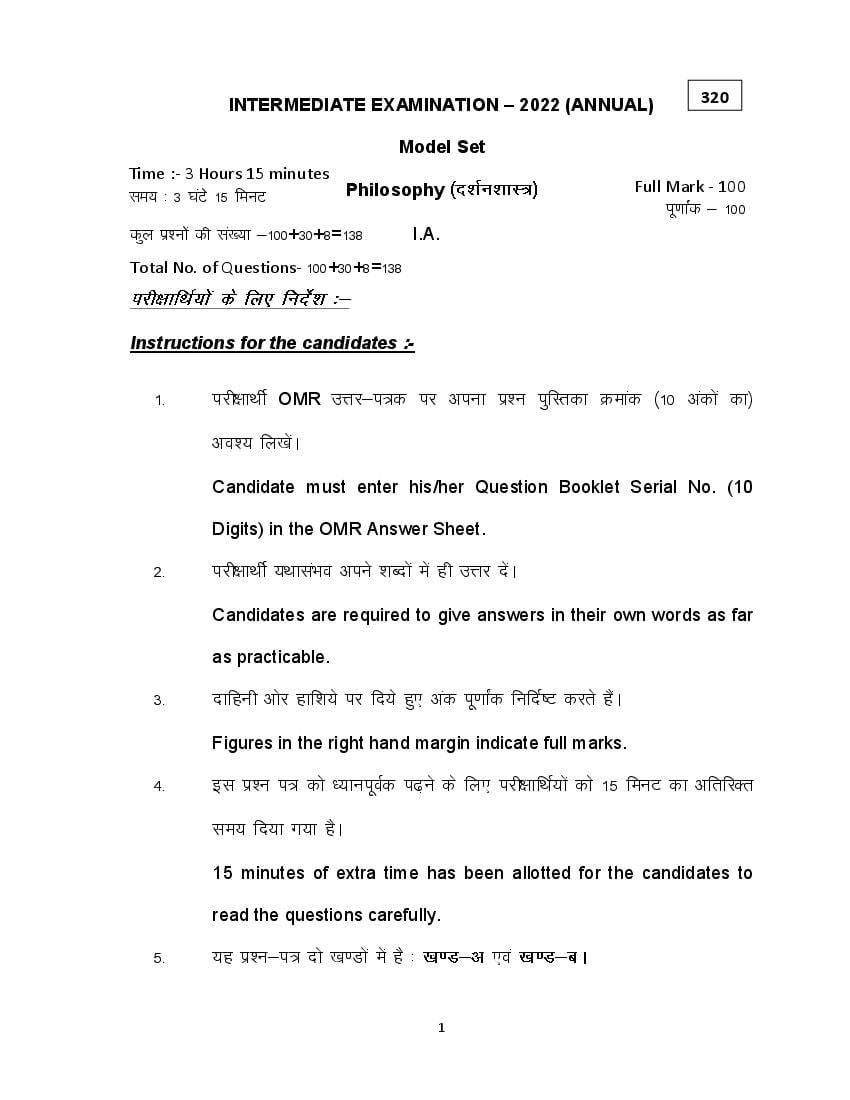
Model Set
Time :- 3 Hours 15 minutes
Philosophy Full Mark - 100
le; % 3 ?kaVs 15 feuV
iw.kkZad & 100
dqy iz’uksa dh la[;k &100+30+8=138 I.A.
Total No. of Questions- 100+30+8=138
Instructions for the candidates :-
1- ijh{kkFkhZ OMR mÙkj&i=d ij viuk iz'u iqfLrdk Øekad ¼10 vadksa dk½
vo'; fy[ksaA
Candidate must enter his/her Question Booklet Serial No. (10
Digits) in the OMR Answer Sheet.
2- ijh{kkFkhZ ;FkklaHko vius 'kCnksa esa gh mÙkj nsaA
Candidates are required to give answers in their own words as far
as practicable.
3- nkfguh vksj gkf’k;s ij fn;s gq, vad iw.kkZad fufnZ"V djrs gSaA
Figures in the right hand margin indicate full marks.
4- bl iz’u i= dks /;kuiwoZd i<+us ds fy, ijh{kkfFkZ;ksa dks 15 feuV dk vfrfjDr
le; fn;k x;k gSA
15 minutes of extra time has been allotted for the candidates to
read the questions carefully.
5- ;g iz’u&i= nks [k.Mksa esa gS % ,oa
1
Page 2
Section-B.
6- [k.M&v esa 100 oLrqfu"B iz’u gSaA ftuesa ls fdUgha 50 iz’uksa dk mÙkj nsuk
vfuok;Z gSA 50 iz’uksa ls vf/kd ds mÙkj fn;s tkrs gSa rc igys 50 mÙkjksa dk gh
ewY;kadu fd;k tk;sxkA izR;sd iz’u ds fy, 1 vad fu/kkZfjr gSA oLrqfu"B iz’uksa
ds lgh fodYi dks miyC/k djk;s x;s OMR-Sheet ¼mÙkj&i=d½ esa fn;s x;s
o`Ùk esa dkys@uhys ckWy isu ls vafdr djsaA fdlh Hkh izdkj ds OgkbVuj@rjy
inkFkZ@CysM@uk[kwu vkfn dk OMR-Sheet ¼mÙkj&i=d½ esa iz;ksx djuk euk
gS] vU;Fkk ijh{kk ifj.kke vekU; gksxkA
In Section-A, there are 100 objective type questions. Out of these
100 questions it is compulsory to answer any 50 questions only. If
more than 50 questions are answered then only the first 50
answers will be evaluated. Each question carries 1 mark. Darken
the circle with black/blue ball pen against the correct option for the
objective question on OMR Answer Sheet provided to you. Do not
use Whitener/Liquid/Blade/Nail etc on OMR Sheet, otherwise the
result will be treated as invalid.
7- [k.M&c esa 30 y?kq mÙkjh; iz’u gSaA izR;sd iz’u ds fy, 2 vad fu/kkZfjr gSa]
ftuesa ls fdUgha 15 iz’uksa dk mÙkj nsuk vfuok;Z gSA blds vfrfjDr bl
esa 08 nh?kZ mÙkjh; iz’u Hkh fn, x, gSaA izR;sd iz’u ds fy, 05 vad
fu/kkZfjr gSa] ftuesa ls fdUgha 4 iz’uksa dk mÙkj nsuk vfuok;Z gSA
2
Page 3
carrying 2 marks. Out of these 30 questions any 15 questions are
to be answered. Apart from this, there are 8 Long Answer Type
questions in Section-B, each question carrying 5 marks. Out of
these 08 questions any 4 questions are to be answered.
8- fdlh izdkj ds bysDVªkWfud midj.k dk iz;ksx iw.kZr;k oftZr gSA
Use of any electronic appliances is strictly prohibited.
Section-A
Objective Type Questions
iz'u la[;k 1 ls 100 rd ds izR;sd iz’u ds fy, pkj fodYi fn, x, gS] ftuesa ls
,d lgh gSA vkidks 100 iz’uksa esa ls fdUgh 50 iz’uksa dk gh mÙkj nsuk gSA vius }kjk pqus
x, lgh fodYi dks OMR-Sheet ¼mÙkj&i=d½ ij fpfUgr djsaA
Question No.- 1 to 100 have four options, out of which only one is correct.
Out of 100 questions any 50 questions are to be answered. You have to
mark, your selected option, on the OMR Sheet.
1- ^e/;e ekxZ* fl)kUr dk laca/k fdl n’kZu ls gS \
(A) osnkUr n’kZu (B) lka[; n’kZu
(C) U;k; n’kZu (D) ckS) n’kZu
With which Philosophy is the principle of ‘Middle Path’ associated?
3
Page 4
(C) Nyaya Philosophy (D) Buddhist Philosophy
2- iq:"k dks vk/;kfRed lÙkk ds :Ik esa dkSu lk n’kZu Lohdkj djrk gS \
(A) tSu n’kZu (A) ckS) n’kZu
(C) lka[; n’kZu (D) U;k; n’kZu
Which philosophy does accept Purusa as a Spiritual reality ?
(A) Jaina Philosophy (B) Buddhism
(C) Sankhya Philosophy (D) Nyaya Philosophy
3- fuEufyf[kr esa ls dkSu vkfLrd n’kZu ugha gS \
(A) lka[; n’kZu (B) ;ksx n’kZu
(C) U;k; n’kZu (D) ckS) n’kZu
Which of the following is not an Orthodox Philosophy ?
(A) Sankhya Philosophy (B) Yoga Philosophy
(C) Nyaya Philosophy (D) Buddhist Philosophy
4- 'kadj ds vuqlkj txr~ fdl izdkj dh lÙkk gS \
(A) O;kogkfjd lÙkk (B) ikjefFkZd lÙkk
(C) izkfrHkkf"kd lÙkk (D) mijksDr lHkh
What kind of reality is World according to Shankara ?
4
Page 5
(C) Dream reality (D) All of the above
5- ^fu"dke deZ* dh vo/kkj.kk dk D;k vFkZ gS \
(A) og deZ tks lq[k nsrk gS
(B) og deZ tks lEifÙk nsrk gS
(C) og deZ tks dsoy drZO; dh Hkkouk ls fd;s tkrs gSa
(D) mijksDr lHkh
What is the meaning of the concept of ‘Niskama Karma’ ?
(A) The Karma which leads to pleasure
(B) The Karma which gives wealth
(C) The Karma which is performed with the feeling of duty only
(D) All of the above
6- fuEufyf[kr esa ls dkSu iq:"kkFkZ ds lanHkZ esa lcls lgh fodYi gS \
(A) dke (B) vFkZ
(C) (A) vkSj (B) nksuksa (D) HkfDr
Which one of the following is the most correct option regarding
Purusartha ?
(A) Kama (B) Artha
5
Page 6
7- ^vusdkUrokn* fl)kUr dks fdlus izfrikfnr fd;k gS \
(A) tSu n’kZu (B) ckS) n’kZu
(C) osnkUr n’kZu (D) mijksDr lHkh
Who has propounded the theory of ‘Anekantavada’ ?
(A) Jainism (B) Buddhism
(C) Vedanta Philosophy (D) All of the above
8- Ykksdlaxzg dk fopkj fdlls lacaf/kr gS \
(A) osnkUr ls (B) v}Sr osnkUr ls
(C) Hkxon~ xhrk ls (D) buesa ls fdlh ls ugha
To whom does the concept of Loksangrah belong ?
(A) Vedanta (B) Advaita Vedanta
(C) Bhagavad Gita (D) None of the above
9- Hkxon~ xhrk fdl egkdkO; dk Hkkx gS \
(A) jkek;.k (B) okYehfd jkek;.k
(C) rqylh jkek;.k (D) egkHkkjr
To which Epic Bhagavad Gita is a part of :
(A) Ramayan (B) Balmiki Ramayana
6
Page 7
10- Hkkjrh; n’kZu esa ca/ku dk vFkZ D;k gS \
(A) vkRek dk tUe] ej.k vkSj iqutZUe ds pØ ls ca/ku
(B) thokRek dk ijekRek ls ,dhdj.k
(C) 'kjhj dk txr~ ls ca/ku
(D) buesa ls dksbZ Hkh ugha
What is the meaning of bondage in Indian Philosophy ?
(A) Bondage of soul with the cycle of birth, death and rebirth
(B) Union of the individual soul with the transcendental self
(C) Bondage of the body with the world
(D) None of the above
11- Hkkjrh; n’kZu esa deZ fl)kUr dk laca/k fdlls gS \
(A) ca/ku ls (B) eqfDr ls
(C) nq%[k fuokj.k ls (D) mijksDr lHkh ls
To whom is the Law of Karma related in Indian Philosophy ?
(A) Bondage (B) Liberation
(C) Elimination of sorrow (D) All of the above
12- iq:"kkFkZ dh vo/kkj.kk dk laca/k gS %
7
Page 8
(B) vykSfdd thou ls
(C) (A) vkSj (B) nksuksa ls
(D) buesa ls dksbZ ugha
The concept of Purusartha is related to :
(A) Worldly life (B) Unworldly life
(C) Both (A) and (B) (D) None of the above
13- ^rhFkZadj* 'kCn dk laca/k fdlls gS \
(A) tSu n’kZu ls (B) ckS) n’kZu ls
(C) lka[; n’kZu ls (D) U;k; n’kZu ls
To whom is the term ‘Tirthankara’ related ?
(A) Jainism (B) Buddhism
(C) Sankhya Philosophy (D) Nyaya Philosophy
14- fdl n’kZu esa ^izd`fr* 'kCn dk iz;ksx gksrk gS \
(A) U;k; n’kZu (B) ckS) n’kZu
(C) tSu n’kZu (D) lka[; n’kZu
In which philosophy is the term ‘Prakriti’ used ?
(A) Nyaya Philosophy (B) Buddhism
8
Page 9
15- fdl fparu iz.kkyh esa ^_.k* dk fopkj ik;k tkrk gS \
(A) ;wuku dk n’kZu (B) ik’pkR; n’kZu
(C) vuqiz;qDr uhfr n’kZu (D) buesa ls dksbZ ugha
In which philosophical system is the concept of ‘Rna’ found ?
(A) Greek Philosophy (B) Western Philosophy
(C) Applied Ethics (D) None of the above
16- dkSu lk Hkkjrh; nk’kZfud lEiznk; }Sroknh gS \
(A) v}Sr osnkUr (B) lka[; n’kZu
(C) ckS) n’kZu (D) buesa ls dksbZ ugha
Which school of Indian Philosophy is a Dualist ?
(A) Advaita Vedanta (B) Sankhya Philosophy
(C) Buddhism (D) None of the above
17- v}Sr osnkUr fdl fopkj/kkjk dks izfrikfnr djrk gS \
(A) }Srokn dks (B) vusdokn dks
(C) ,dokn dks (D) mijksDr lHkh dks
Which thought does Advaita Vedanta expound ?
(A) Dualism (B) Pluralism
(C) Monism (D) All of the above
18- Hkkjrh; n’kZu dk dkSu lEiznk; ewyr% Kkuehekalk ij cy nsrk gS \
9
Page 10
(C) oS’ksf"kd n’kZu (D) mijksDr esa ls dksbZ Hkh ugha
Which school of Indian Philosophy does basically emphasize
epistemology?
(A) Nyaya Philosophy (B) Sankhya Philosophy
(C) Vaisesika Philosophy (D) None of these
19- izek.k D;k gS \
(A) Kku (B) Hkze
(C) oS/k Kku ds lk/ku (C) la’k;
What is Pramana ?
(A) Knowledge
(B) Error
(C) Sources of Valid Knowledge
(D) Doubt
20- pkj vk;Z lR; dk fopkj fdl n’kZu ls lacaf/kr gS \
(A) tSu n’kZu (B) lka[; n’kZu
(C) oS’ksf"kd n’kZu (D) ckS) n’kZu
To which philosophy is the concept of Four Noble Truths related ?
10
Page 11
(C) Vaisesika Philosophy (D) Buddhism
21- tSu n’kZu dks ukfLrd n’kZu D;ksa dgrs gSa \
(A) D;ksafd ;g tho dh lÙkk dks Lohdkj djrk gSA
(B) D;ksafd ;g osn dh izkekf.kdrk dks vLohdkj djrk gSA
(C) D;ksafd ;g iqutZUe esa fo’okl djrk gSA
(D) mijksDr lHkhA
Why is Jainism called a Heterodox Philosophy ?
(A) Because it believes in the reality of Jiva
(B) Because it rejects the authority of Vedas
(C) Because it believes in rebirth
(D) All of the above
22- ^Kkuehekalk* dks vaxzsth esa D;k dgrs gSa \
(A) bfiLVseksyksth (B) esVkfQftDl
(C) ,fFkDl (D) fjfytu
What is Jnana mimansa called in English ?
(A) Epistemology (B) Metaphysics
(C) Ethics (D) Religion
11
Page 12
(A) lr~ dk dsoy ckSf)d Kku
(B) lr~ dk dsoy fo’ys"k.kkRed Kku
(C) lr~ dh iw.kZ n`f"V
(D) lr~ dk dsoy vuqHkotU; Kku
What is the uniqueness of Indian Philosophy ?
(A) Only rational knowledge of Truth
(B) Only analytical knowledge of Truth
(C) Complete Vision of Truth
(D) Only empirical knowledge of Truth.
24- Hkkjrh; n’kZu ds fdl lEiznk; esa rdZ’kkL=h; fl)kUrksa dk fof/kor~ v/;;u
feyrk gS \
(A) lka[; n’kZu esa (B) ;ksx n’kZu esa
(C) U;k; n’kZu esa (D) buesa ls fdlh esa ugha
In which school of Indian Philosophy is the systematic study of
logical principles found ?
(A) Sankhya Philosophy (B) Yoga Philosophy
(C) Nyaya Philosophy (D) None of the above
12
Page 13
x;k gS \
(A) txr (B) vkRek
(C) 'kjhj (D) mijksDr lHkh
Which of the following is regarded as eternal reality in the
Orthodox schools of Indian Philosophy ?
(A) World (B) Soul
(C) Body (D) All of the above
26- v}Sr osnkUr n’kZu ds izoÙkZd dkSu gSa \
(A) jkekuqt (B) dfiy
(C) egkohj (D) 'kadj
Who is the propounder of the Philosophy of Advaita Vedanta ?
(A) Ramanuja (B) Kapil
(C) Mahavir (D) Shankar
27- Hkkjrh; n’kZu ds fdl xzaFk esa vorkj dk Li"V fopkj ik;k tkrk gS \
(A) U;k; lw= (B) ;ksx lw=
(C) Hkxon~xhrk (D) mi;qZDr esa ls dksbZ Hkh ugha
13
Page 14
incarnation found ?
(A) Nyaya Sutra (B) Yoga Sutra
(C) Bhagavad Gita (D) None of the above
28- ;ksx&lw= ds jpf;rk dkSu gSa \
(A) iratfy (B) dfiy
(C) 'kadj (D) d.kkn
Who is the author of Yoga-Sutra ?
(A) Patanjali (B) Kapil
(C) Shankara (D) Kanad
29- Hkkjrh; n’kZu dk dkSu lEiznk; ijek.kq fl)kUr ds fy, egRoiw.kZ gS \
(A) v}Sr osnkUr (B) oS’ksf"kd n’kZu
(C) ;ksx n’kZu (D) mijksDr esa ls dksbZ Hkh ugha
Which school of Indian Philosophy is famous for the atomic
theory?
(A) Advaita Vedanta (B) Vaisesika Philosophy
(C) Yoga Philosophy (D) None of the above
30- fuEufyf[kr esa ls dkSu lk fl)kUr ckS) n’kZu dks Lohdk;Z gS \
14
Page 15
(C) vk/;kfRed nzO; 'kk’or gSA (D) lc dqN ifjorZu’khy gSA
Which of the following principle is acceptable to Buddhism ?
(A) Physical substance is enternal
(B) Soul is eternal
(C) Spiritual substance is eternal
(D) Evertything is Changeable
31- ckS) n’kZu esa fuokZ.k D;k gS \
(A) cU/ku dh fLFkfr (B) nq%[k&fujks/k dh fLFkfr
(C) 'kjhj ds iw.kZr% u"V gksus dh fLFkfr (D) mijksDr lHkh
What is Nirvana according to Buddhism ?
(A) A State of Bondage
(B) A State of the Cessation of Suffering
(C) A State of the complete decay of the body
(D) All of the above
32- lka[; n’kZu dk ikjekfFkZd HkkSfrd rRo D;k gS \
(A) iq:"k (B) vkRek
(C) tho (D) izd`fr
15
Page 16
(A) Purusa (B) Atman
(C) Jiva (D) Prakriti
33- lkekU;r% Hkkjrh; vkfLrd n’kZu psruk dk vf/k"Bku ;k txg fdls ekurk gS \
(A) tho (B) vkRek
(C) iq:"k (D) mijksDr lHkh
What is generally regarded as the substratum or place of
consciousness according to Indian Orthodox Systems ?
(A) Jiva (B) Atman
(C) Purusa (D) All of the above
34- tSu n’kZu ds L;kn~okn ds fl)kUr dk lh/kk laca/k fdlls gS \
(A) nzO; dh vusdrk ls (B) Kku dh lkis{krk ls
(C) tSu /keZ ds iwtk LFkyksa ls (D) mijksDr lHkh
To whom is the Jainism’s principle of Syadvada directly related ?
(A) Plurality of substance
(B) Relativity of knowledge
(C) Places of worship of Jaina Religion
(D) All of the above
35- Hkkjrh; n’kZu ds vuqlkj ije iq:"kkFkZ D;k gS \
16
Page 17
(C) vFkZ (D) /keZ
What is Paramapurusartha according to Indian Philosophy ?
(A) Moksha (B) Kama
(C) Artha (D) Dharma
36- Hkkjrh; n’kZu ds yxHkx lHkh lEiznk; nq%[k dk ewy dkj.k fdls ekurs gSa \
(A) tUe ysus dks (B) Kku dks
(C) vfo|k dks (D) ej.k dks
What is the root cause of sorrow according to almost all the
schools of Indian Philosophy ?
(A) Birth (B) Knowledge
(C) Ignorance (D) Death
37- Hkkjrh; n’kZu dk ^deZ fl)kUr* fdl ekSfyd ifjdYiuk ij vk/kkfjr gS \
(A) fo’okl ij (B) bZ’ojh; d`ik ij
(C) /kkfeZd vkLFkk ij (D) ladYi Lokra«; ij
What is the basic hypothesis upon which the ‘Law of Karma’ of
Indian Philosphy is based ?
(A) Belief (B) God’s grace
(C) Religious faith (D) Freedom of Will
17
Page 18
(A) vkfFkZd <+kps dks (B) jktuhfrd nkf;Ro dks
(C) uSfrd nkf;Ro dks (D) buesa ls fdl dks ugha
What does the term ‘Rna’ indicate in the Indian Philosophical
tradition ?
(A) Economic Structure (B) Political obligation
(C) Moral obligation (D) None of the above
39- fuEufyf[kr esa ls dkSu lk dFku Hkkjrh; n’kZu ds lanHkZ esa lgh ugha gS \
(A) Hkkjrh; n’kZu esa }Srokn dk mnkgj.k gSA
(B) Hkkjrh; n’kZu esa vkfLrd lEiznk; dk mnkgj.k gSA
(C) Hkkjrh; n’kZu esa ukfLrd lEiznk; dk mnkgj.k gSA
(D) Hkkjrh; n’kZu dk Lo:Ik la’k;oknh gSA
Which of the following statements is not correct with regard to
Indian Philosophy ?
(A) There is an example of dualism in Indian Philosophy
(B) There is an example of Orthodox school in Indian Philosophy
(C) There is an example of Heterodox school in Indian Philosophy
(D) Indian Philosophy is sceptic in nature
18
Page 19
(A) ckS) n’kZu (B) U;k; n’kZu
(C) oS’ksf"kd n’kZu (D) mijksDr lHkh
Which philosophy does hold that ‘soul is not a substance but only
stream of consciounsness’?
(A) Buddhism (B) Nyaya Philosophy
(C) Vaisesika Philosophy (D) All of the above
41- o.kkZJe /keZ dk laca/k fdlls gS \
(A) lkekU; /keZ (B) Lo/keZ
(C) vkin /keZ (D) buesa ls dksbZ Hkh ugha
To whom is Varnasharma Dharma related ?
(A) Samanya Dharma (B) Svadharma
(C) Apad Dharma (D) None of these
42- ckS) n’kZu dk ledkyhu n’kZu dkSu gS \
(A) U;k; n’kZu (B) lka[; n’kZu
(C) tSu n’kZu (D) ;ksx n’kZu
Which of the following is the contemporary philosophy of Buddhism?
(A) Nyaya Philosphy (B) Sankhya Philosophy
19
Page 20
43- fdlus dgk gS fd lc dqN nq%[kksa ls Hkjk gS \
(A) jkekuqt (B) cq)
(C) egkohj (D) buesa ls dksbZ Hkh ughaA
Who has said that everything is full of suffering ?
(A) Ramanuj a (B) Buddha
(C) Mahavir (D) None of the above
44- fuEufyf[kr esa ls dkSu rhFkZadj ugha gS \
(A) egkohj (B) ik’oZukFk
(C) _"kHknso (D) d.kkn
Which of the following is not a Tirthankara ?
(A) Mahavir (B) Parashvanath
(C) Rishavadeva (D) Kanad
45- izrhR;leqRikn dk fl)kUr ckS) n’kZu ds fdl vk;ZlR; ls lacaf/kr gS \
(A) f}rh; vk;ZlR; (B) r`rh; vk;ZlR;
(C) izFke vk;ZlR; (D) prqFkZ vk;ZlR;
To which Noble Truth is the Buddhist principle of
Pratityasamutpada related ?
20
Page 21
(C) First Noble Truth (D) Fourth Noble Truth
46- ^lE;d~* 'kCn dk D;k vFkZ gS \
(A) vuqfpr (B) mfpr
(C) rdZ (D) i;kZIr
What is the menaing of the word ‘Samyaka’ ?
(A) Wrong (B) Right
(C) Reason (D) Sufficient
47- tSu n’kZu ds ^tho* dh D;k fo’ks"krk gS \
(A) drkZ (B) Kkrk
(C) HkksDrk (D) mi;qZDr lHkh
What is the characteristics of the ‘Jiva’ of Jainism ?
(A) Doer (B) Knower
(C) Enjoyer (D) All of the above
48- tSu n’kZu ds vuqlkj ftlesa psruk ugha ikbZ tkrh gS] mls D;k dgrs gSa \
(A) nzO; (B) vtho
(C) tho (D) mijksDr lHkh
21
Page 22
Philosophy ?
(A) Substance (B) Ajiva
(C) Jiva (D) All of the above
49- ^iapegkozr* dk fopkj fdl n’kZu esa ik;k tkrk gS \
(A) tSu n’kZu (B) oS’ksf"kd n’kZu
(C) U;k; n’kZu (D) lka[; n’kZu
In which Philosophy is the concept of ‘Panchmahavrat’ found ?
(A) Jain Philosophy (B) Vaisesika Philosophy
(C) Nyaya Philosophy (D) Sankhya Philosophy
50- deZ fdrus izdkj ds gksrs gSa \
(A) izkjC/k (B) lafpr
(C) fØ;ek.k (D) mijksDr lHkh
What are the kinds of Karma ?
(A) Prarabdh (B) Sanchit
(C) Kiryaman (D) All of the above
51- tSu n’kZu ds vuqlkj e`R;q ds mijkUr D;k cp tkrk gS \
(A) 'kjhj (B) tho
22
Page 23
What does survive after death according to Jainism ?
(A) Body (B) Jiva
(C) Ajiva (D) None of the above
52- U;k; n’kZu ds vuqlkj iwoZor~ D;k gS \
(A) izR;{k izek.k dk ,d izdkj gSA
(B) mieku izek.k dk ,d izdkj gSA
(C) vuqeku izek.k dk ,d izdkj gSA
(D) 'kCn izek.k dk ,d izdkj gSA
What is Purvavat according to Nyaya Philosophy ?
(A) It is a kind of perception (Pratyaksha Pramana)
(B) It is a kind of comparison (Upamana Pramana)
(C) It is a kind of inference (Anumana Pranama)
(D) It is a kind of verbal Testimony (Shabda Pramana)
53- fuEufyf[kr esa ls fdl oS/k Kku izkIr djus ds lk/ku ¼izek.k½ esa =qfV dh
lEHkkouk lcls U;wure gksrh gS \
(A) izR;{k (B) vuqeku
(C) 'kCn (D) mieku
23
Page 24
error minimum ?
(A) Perception (B) Inference
(C) Vebal Testimony (D) Comparison
54- ^izek* fdls dgrs gSa \
(A) oS/k Kku dks (B) Kkrk dks
(C) oS/k Kku ds lk/ku dks (D) Kku ds fo"k; dks
What is called ‘Prama’ ?
(A) Valid Knowledge
(B) Knower
(C) Sources of valid knowledge
(D) Object of knowledge
55- U;k; n’kZu esa lkekU;y{k.k izR;{k D;k gS \
(A) lfodYid izR;{k (B) fufoZdYid izR;{k
(C) ykSfdd izR;{k (D) vkykSfdd izR;{k
What is Samanyalakshan Pratyaksha in Nyaya Philosophy ?
(A) Determinate Peception (B) Indeterminate Perception
(C) Ordinary Perception (D) Extra-Ordinary Perception
24
Page 25
(A) pkokZd n’kZu (B) tSu n’kZu
(C) lka[; n’kZu (D) ;ksx n’kZu
Which of the following is related to the concept of Prakriti and its
Guna ?
(A) Charvaka Philosophy (B) Jaina Philosophy
(C) Sankhya Philosophy (D) Yoga Philosophy
57- fufoZdYid izR;{k ds ckn dh voLFkk D;k gS \
(A) lfodYid izR;{k (B) lkekU; y{k.k izR;{k
(C) ykSfdd izR;{k (D) vykSfdd izR;{k
What is the stage which follows after the indeterminate
perception?
(A) Determinate Pecepation (B) Samanya Lakshana Perception
(C) Ordinary Perception (D) Extra-ordinary Perception
58- ykSfdd izR;{k ds mnkgj.k D;k gS \
(A) ckg~; izR;{k (B) vkarfjd izR;{k
(C) (A) rFkk (B) nksuksa (D) buesa ls dksbZ ugha
What is the example of Ordianry perception ?
25
Page 26
(C) Both (A) and (B) (D) None of the above
59- ijkFkkZuqeku esa fdrus vo;o gksrs gSa \
(A) nks (B) rhu
(C) pkj (D) ik¡p
How many constitutents are there in Pararthanuman ?
(A) Two (B) Three
(C) Four (D) Five
60- mieku esa Kku fdl vk/kkj ij izkIr fd;k tkrk gS \
(A) var%vuqHkwfr ds vk/kkj ij (B) fdlh ds 'kCn ds vk/kkj ij
(C) lkn`’;rk ds vk/kkj ij (D) mijksDr dksbZ Hkh ugha
What is the basis of acquiring knowledge in Upamana ?
(A) On the basis of intuition (B) On the basis of testimony
(C) On the basis of similarity (D) None of the above
61- fuEufyf[kr esa ls dkSu lk fodYi lka[; ds izd`fr ds lanHkZ esa lgh gS \
(A) izd`fr ds nks xq.k gksrs gSaA (B) izd`fr ds rhu xq.k gksrs gSaA
(C) izd`fr xq.k jfgr gSA (D) izd`fr ds vusd xq.k gSA
26
Page 27
Prakriti ?
(A) There are two gunas of Prakriti.
(B) There are three gunas of Prakriti
(C) Prakriti is without any guna
(D) There are many gunas of prakriti
62- ^fpÙko`fÙk fujks/k* fdl n’kZu ls lacaf/kr gS \
(A) ;ksx n’kZu ls (B) oS’ksf"kd n’kZu ls
(C) U;k; n’kZu ls (D) ckS) n’kZu ls
To which Philosophy is ‘Chittvritinirodha’ related ?
(A) Yoga Philosophy (B) Vaisesika Philosophy
(C) Nyaya Philosophy (D) Buddhism
63- oS’ksf"kd n’kZu ds vuqlkj fuEufyf[kr esa ls dkSu lgh gS \
(A) nzO; fØ;k dk vkJ; gSA (B) nzO; xq.k dk vkJ; gSA
(C) mijksDr (A) vkSj (B) nksuksa (D) buesa ls dksbZ Hkh ugha
Which of the following is true according to Vaisesika Philosophy ?
(A) Substance is the substractum of action
(B) Substance is the substractrum of quality
27
Page 28
(D) None of these
64- ^fo’ks"k* dks ^inkFkZ* ds :Ik esa fdl n’kZu essa Lohdkj fd;k tkrk gS \
(A) lka[; (B) ;ksx
(B) v}Sr osnkUr (C) oS’ksf"kd
In which Philosophy is ‘Particular’ accepted as ‘Padartha’
(A) Sankhya (B) Yoga
(C) Advaita Vedanta (D) Vaisesika
65- ;ksx n’kZu esa cfgjax lk/ku ds fdrus vo;o gS \
(A) rhu (B) nks
(C) ik¡p (D) pkj
How many constituents are there in ‘Bahirang Sadhan’ of yoga
Philosophy ?
(A) Three (B) Two
(C) Five (D) Four
66- fdl vk/kqfud ik’pkR; nk’kZfud dks cqf)okn dk iz.ksrk ekuk tkrk gS \
(A) fLiukstk (B) ykbcfut
(C) nsdkrZ (D) buesa ls dksbZ ugha
28
Page 29
propounder of Rationalism ?
(A) Spinoza (B) Leibnitz
(C) Descartes (D) None of the above
67- nsdkrZ us lkisf{kd nzO; fdls ekuk gS \
(A) eu dks (B) 'kjhj dks
(C) eu vkSj 'kjhj nksuksa dks (D) mi;qZDr esa ls dksbZ Hkh ugha
To whom has Descartes regarded as relative substance ?
(A) Mind (B) Body
(C) Both Mind and Body (D) None of the above
68- tUetkr izR;; dk fopkj fdlds n’kZu esa ik;k tkrk gS \
(A) nsdkrZ (B) ykWd
(C) cdZys (D) g~;we
In which philosophy is the concept of Innate Idea found ?
(A) Descartes (B) Locke
(C) Berkeley (D) Hume
69- nsdkrZ ds n’kZu esa foosfpr }Srokn dks fdl cqf)oknh nk’kZfud us lq/kkj fd;k
gS\
29
Page 30
(C) g~;we (D) fLiukstk
Which rationalist thinker has corrected the dualism as discussed in
the philosophy of Descartes ?
(A) Locke (B) Berkeley
(C) Hume (D) Spinoza
70- eu vkSj 'kjhj ds lekukUrjokn dk fl)kUr fdl cqf)oknh nk’kZfud us fn;k
gS\
(A) fLiukstk (B) ykWd
(C) cdZys (D) g~;we
Which rationalist thinker has propounded the principle of the
parallelism of mind and body ?
(A) Spinoza (B) Locke
(C) Berkeley (D) Hume
71- Kku ds Lo:Ik ds laca/k esa ik’pkR; nk’kZfudksa dk D;k er gS \
(A) Kku lkoZHkkSe gksrk gSA (B) Kku uohu gksrk gSA
(C) Kku fuf’pr gksrk gSA (D) mijksDr lHkhA
What is the view of western thinkers regarding the nature of
knowledge ?
30
Page 31
(C) Konwledge is certain (D) All of the above
72- ykbcfut fdl nk’kZfud ijEijk ds leFkZd jgs gSa \
(A) leh{kkokn (B) cqf)okn
(C) vuqHkookn (D) mijksDr lHkh
Which philosophical tradition has Leibnitz supported ?
(A) Criticism (B) Rationalism
(C) Empiricism (D) All of the above
73- fdl cqf)oknh nk’kZfud us ewyrRo dks vusd vkSj 'kk’or ekuk gS \
(A) nsdkrZ (B) fLiukstk
(C) ykbcfut (D) mijksDr lHkh
Which rationalist thinker has regarded ultimate reality as many and
eternal ?
(A) Descartes (B) Spinoza
(C) Leibnitz (D) All of the above
74- lr~ dk D;k vFkZ gksrk gS \
(A) lÙkk (B) vfLrRo
(C) lR; (D) mijksDr lHkh
What is the meaning of Real ?
(A) Reality (B) Existence
31
Page 32
75- ik’pkR; n’kZu esa Kku dk lk/ku eq[; :Ik ls fdls ekuk tkrk gS \
(A) izR;{k dks (B) vuqeku dks
(C) mijksDr (A) vkSj (B) nksuksa dks (D) buesa ls fdlh dks ugha
Which is mainly regarded as the means of knowledge in Western
Philosophy ?
(A) Percepetion (B) Inference
(C) Both (A) and (B) (D) None of these
76- ‘Tabula rasa’ dk fopkj fdlds n’kZu esa ik;k tkrk gS \
(A) cdZys (B) ykWd
(C) g~;we (D) dk.V
In which philosophy is the concept of ‘Tabula rasa’ found ?
(A) Berkeley (B) Locke
(C) Hume (D) Kant
77- fdl cqf)oknh nk’kZfud us fpn~ fcUnq ¼Monads½ dk fopkj izfrikfnr fd;k gS\
(A) ykbcfut (B) nsdkrZ
(C) fLiukstk (D) dk.V
Which rationalist thinker has propounded the concept of Monads ?
32
Page 33
(C) Spinoza (D) Kant
78- fdl nk’kZfud lEiznk; dh ekU;rk gS fd Kku dsoy bfUnz;kuqHko ls mRiUu
gksrk gS \
(A) cqf)okn (B) vuqHkookn
(C) leh{kkokn (D) buesa ls dksbZ Hkh ugha
Which Philosophical school does believe that knowledge begins
only by sense experience ?
(A) Rationalism (B) Empiricism
(C) Criticism (D) None of these
79- fdl vuqHkooknh fopkjd us dgk gS fd ftl oLrq dk izR;{k gksrk gS og ,d
izR;; ek= gSA
(A) g~;we (B) ykWd
(C) cdZys (D) buesa ls dksbZ Hkh ugha
Which empiricist thinker has said that the object experienced is
merely an idea ?
(A) Hume (B) Locke
(C) Berkeley (D) None of these
33
Page 34
(A) ykWd (B) cdZys
(C) g~;we (D) mijksDr lHkh
Which empiricist thinker has called sensations as impressions ?
(A) Locke (B) Berkeley
(C) Hume (D) All of the above
81- fdl fopkjd us dgk gS fd Kku dk vkjEHk fnd~ vkSj dky esa bfUnz;kuqHko ls
gksrk gS \
(A) dk.V (B) g~;we
(C) ykWd (D) cdZys
Which thinker has said that knowledge begins by sense
experience in space and time ?
(A) Kant (B) Hume
(C) Locke (D) Berkeley
82- dk.V ds vuqlkj Kku dk Li:Ik D;k gS \
(A) uohurk (B) lkoZHkkSfedrk
(C) vfuok;Zrk (D) mijksDr lHkh
What is the nature of knowledge according to kant ?
34
Page 35
(C) Necessity (D) All of the above
83- fdl nk’kZfud dks vKs;oknh ekuk x;k gS \
(A) g~;we (B) dk.V
(C) ykWd (D) cdZys
Which thinker is regarded as an agnostic ?
(A) Hume (B) Kant
(C) Locke (D) Berkeley
84- vjLrw us pkj dkj.kksa dks fdu nks dkj.kksa esa :ikUrfjr dj fn;k gS \
(A) miknku (B) vkdkfjd dkj.k
(C) mijksDr (A) ,oa (B) (D) buesa ls dksbZ ugha
In which two causes has Aristotle transformed the four causes ?
(A) Material cause (B) Formal cause
(C) Both (A) and (B) (D) None of these
85- bZ’oj&fopkj ;k bZ’oj&izR;; ls bZ’oj&vfLrRo dks izekf.kr djus okyh ;qfDr
dks D;k dgrs gSa \
(A) fo’oewyd ;qfDr (B) iz;kstuewyd ;qfDr
(C) rkfRod ;qfDr (D) uSfrd ;qfDr
35
Page 36
the idea of God ?
(A) Cosmological argument (B) Teleological argument
(C) Ontological argument (D) Moral argument
86- bZ’oj ds vfLrRo ls lacaf/kr fdl ;qfDr dh ;g ekU;rk gS fd fo’o ,d ?kVuk
gS vkSj bZ’oj mldk dkj.k gSA
(A) fo’oewyd ;qfDr (B) iz;kstuewyd ;qfDr
(C) rRoewyd ;qfDr (D) uSfrd ;qfDr
Which argument related to the existence of God does regard the
world as an effect and God as its cause ?
(A) Cosmological argument (B) Teleological argument
(C) Ontological argument (D) Moral argument
87- oLrqokn fdl Kku ls lacaf/kr jgrk gS \
(A) dkYifud Kku (B) ifjdYiukRed Kku
(C) lkekU; Kku (D) uSfrd Kku
To which knowledge is realism related ?
(A) Imaginary Knowledge
(B) Hypothetical Knowledge
36
Page 37
(D) Moral Knowledge
88- oLrqokn vkSj Kkuehekalh; izR;;okn esa D;k laca/k gS \
(A) nksuksa ,d&nwljs ds foijhr fl)kUr gSA
(B) nksuksa ,d&nwljs ls laxfr j[kus okys fl)kUr gSaA
(C) nksuks ,d&nwljs ds iwjd fl)kUr gSA
(D) mijksDr lHkh
What is the relation between the realism and epistemological
idealism ?
(A) Both the theories are apposed to each other.
(B) Both the theories are compatible to each other.
(C) Both the theories are complimentary to each other.
(D) All of the above
89- fdl fl)kUr dh ;g ekU;rk gS fd oLrq,a Kkrk ls Lora= gS \
(A) Kkuehekalh; izR;;okn (B) oLrqokn
(C) izR;;okn (D) mijksDr esa ls dksbZ Hkh ugha
Which theory does hold the view that objects are independent of
the knower ?
(A) Epistemological Idealism (B) Realism
(C) Idealism (D) None of the above
37
Page 38
(A) uhfr’kwU; deZ
(B) uSfrd deZ
(C) ck/;rk dh fLFkfr esa fd;k x;k deZ
(D) lEeksgu dh fLFkfr esa fd;k x;k deZ
To which action is moral judgement related ?
(A) Non moral action
(B) Moral action
(C) Action done in the state of compulsion
(D) Action done in the state of hypnotism
91- uhfr’kkL= D;k gS \
(A) rF;ijd foKku
(B) lkekftd foKku
(C) ekuo&vkpj.k ls lacaf/kr ewY; ijd foKku
(D) 'kq) foKku
What is Ethics ?
(A) Factual Science
(B) Social Science
38
Page 39
(D) Pure Science
92- uhfr’kkL= esa fdl izdkj dk fu.kZ; fn;k tkrk gS \
(A) uSfrd fu.kZ; (B) oS/kkfud fu.kZ;
(C) U;kf;d fu.kZ; (D) mijksDr lHkh
What kind of judgement is passed in Ethics ?
(A) Moral judgement (B) Legal judgement
(C) Judicial judgement (D) All of the above
93- fuEufyf[kr esa ls dkSu uhfr’kkL= ds dk;Z{ks= ds vUrxZr vkrk gS \
(A) ladYi Lokra=~; (B) uSfrdrk dk ekinaM
(C) ekuo dk uSfrd cks/k (D) mijksDr lHkh
Which of the followings comes under the domain of Ethics ?
(A) Freedom of Will
(B) Standard of Morality
(C) Moral sense of human beings
(D) All of the above
94- uSfrd izR;; ^'kqHk* D;k gS \
(A) lk/ku
39
Page 40
(C) lanHkZ fo’ks"k ds vkyksd esa lk/ku vkSj lk/; nksuksa
(D) buesa ls dksbZ Hkh ugha
What is ‘Good’ as an ethical idea ?
(A) Means
(B) End
(C) Both ‘Means’ and ‘End’ depending upon the context
(D) None of these
95- fuEufyf[kr esa ls fdldh ekU;rk ik’pkR; uhfr’kkL= esa ugha gS \
(A) fu;frokn (B) ekuoh; drZO;
(B) bPNk Lokra=~; (D) uSfrd ekin.M
Which of the following is not acknowledged in Western Ethics ?
(A) Determinism (B) Human conduct
(C) Freedom of Will (D) Standard of Morality
96- O;kolkf;d uhfr’kkL= dk v/;;u fdl ifjos’k esa gksrk gS \
(A) jkstxkj ds ifjos’k esa
(B) /ku vtZu ds ifjos’k esa
(C) fdlh Hkh O;olk; esa uSfrd ewY;ksa ds ikyu ds ifjos’k esaA
40
Page 41
In which context is the Professional ethics studied ?
(A) In the context of employment
(B) In the context of wealth earning
(C) In the context of abiding by moral values in any profession
(D) None of the above
97- HkkSfrd i;kZoj.k dh leL;k D;k gS \
(A) ekufld 'kq)rk dk nwf"kr gksuk
(B) vkRek dh 'kq)rk dk nwf"kr gksuk
(C) izkd`frd lalk/kuksa dk vU/kk/kqU/k iz;ksx gksuk
(D) mijksDr dksbZ Hkh ugha
What is the problem of Physical environment ?
(A) Pollution of mental purity
(B) Pollution of the purity of soul
(C) Unrestricted exploitation of the resources of nature
(D) None of the above
98- vuqiz;qDr uhfr’kkL= ds vUrxZr fdldk v/;;u gksrk gS \
(A) vkn’kZewyd uhfr’kkL= dk (B) vf/kuhfr’kkL= dk
41
Page 42
What is studied in Applied Ethics
(A) Normative Ethics (B) Metaethics
(C) Practical Ethics (D) None of the above
99- ihVj flaxj fdl uSfrd fpUru ls lacaf/kr gS \
(A) vuqiz;qDr uhfr’kkL= (B) O;kogkfjd uhfr’kkL=
(C) i;kZoj.kh; uhfr’kkL= (D) mi;qZDr lHkh
To which Ethical thought is Peter Singer related ?
(A) Applied Ethics (B) Practical Ethics
(C) Environmental Ethics (D) All of the above
100- uhfr’kkL= ds vuqlkj euq"; ds deksZ dks mfpr ;k vuqfpr fdl vk/kkj ij
Bgjk;k tkrk gS \
(A) euq"; dh ukxfjdrk ds vk/kkj ij
(B) euq"; dh lH;rk ds vk/kkj ij
(C) euq"; dh laLd`fr ds vk/kkj ij
(D) uSfrdrk ds ekin.M ds vk/kkj ij
What are the basis to judge human actions as right or wrong
according to ethics.
42
Page 43
(B) On the basis of person’s civilization
(C) On the basis of person’s culture
(D) On the basis of the standard of Morality
Section-B
Short Answer Type Questions
iz’u la[;k 1 ls 30 rd y?kq mÙkjh; gSaA buesa ls fdUgha 15 iz’uksa ds mÙkj nsaA izR;sd iz’u
ds fy, 2 vad fu/kkZfjr gSaA vf/kdre 50 'kCnksa esa mÙkj nsaA (15x2=30)
Question no. 1 to 30 are Short answer type. Answer any 15 questions. Each
question carries 2 marks. Answer in maximum 50 words. (15x2=30)
1- Hkkjrh; n’kZu esa var% vuqHkwfr D;k gS \ 2
What is intuition in Indian Philosophy ?
2- D;k bZ’oj esa vkLFkk vkfLrd gksus dk vk/kkj gS \ 2
Is the faith in God the ground for being Orthodox ?
3- tSu n’kZu esa egkohj dk D;k ;ksxnku gS \ 2
What is the contribution of Mahavir in Jainism ?
4- vjLrw dk vkdkfjd dkj.k D;k gS \ 2
What is the formal cause of Aristotle ?
5- izd`fr ds jtks xq.k dk D;k ifj.kke gksrk gS \ 2
What is the implication of the Rajas Guna of Prakriti ?
43
Page 44
Is yoga means or End ?
7- fufoZdYid izR;{k dh voLFkk D;k gS \ 2
What is the stage of Nirvikalpak Perception ?
8- tSu n’kZu esa KkukRed lkis{krk dSls ifjyf{kr gksrk gS \ 2
How does epistemological relativism reflect in Jainism ?
9- yksdlaxzg fdl izdkj ds deZ dk ifj.kke gS \ 2
What kind of Karma does result in Loksangraha ?
10- dkj.krk fl)kUr dk n’kZu esa D;k mi;ksfxrk gS \ 2
What is the utility of causation theory in Philosophy ?
11- ;ksx n’kZu ds vuqlkj ^;e* D;k gS \ 2
What is ‘Yama’ according to Yoga Philosophy ?
12- cdZys vkSj ykWd esa Kkuehekalk ds lanHkZ esa D;k fHkUurk gS \ 2
What is the difference between Berkeley and Locke in the context
of epistemology ?
13- uSfrd fopkj ds :Ik esa ^mfpr* vkSj ^'kqHk* dk o.kZu djsaA 2
Describe ‘Right’ and ‘Good’ in the sense of ethical concept.
14- U;k; rdZ’kkL= esa ^iaoko;o U;k;* ls vki D;k le>rs gSa 2
What do you understand by ‘Five-membered syllogism’ in the
Nyaya Logic ?
15- ;ksx n’kZu ds vuqlkj /;ku D;k gS \ 2
44
Page 45
16- fLiukstk] nsdkZr ds }Srokn dks dSls lq/kkjrs gSa \ 2
How does Spinoza correct the Dualism of Descartes ?
17- oS’ksf"kd n’kZu esa xq.k vkSj deZ dk vf/k"Bku fdls ekuk x;k gS \ 2
What is regarded as the substratum of Quality and Action in
Vaisesika Philosophy?
18- ladYi Lokra=~; ds egRo dks uSfrd fu.kZ; ds vkyksd esa cryk;saA 2
Describe the importance of ‘freedom of will’ in the context of moral
judgement.
19- iq:"kkFkZ ds vkyksd esa dke ds fopkj dk o.kZu djsaA 2
Describe the concept of Kama in the context of Purusartha.
20- lka[; n’kZu esa lE;d~ Kku D;k gS \ 2
What is Right knowledge in Sankhya Philosophy ?
21- ckS) n’kZu esa cks/kx;k dk D;k egRo gS \ 2
What is the importance of Bodh Gaya in Buddhism ?
22- U;k; Kku’kkL= esa ;ksxt izR;{k D;k gS \ 2
What is Yogaj perception in Nyaya epistemology ?
23- Ckkg~; izR;{k ds fdrus izdkj gSa \ 2
What are the kinds of external perception ?
24- Ykkbcfut dk fpn~ fcUnqvksa ds fpn~ fcUnq (Monad of Mondas) D;k gS \ 2
What is Monad of Mondas according to Leibnitz ?
45
Page 46
Why is Descartes called a rationalist ?
26- dk.V us cqf)okn vkSj vuqHkookn dh leh{kk dSls fd;k gS \ 2
How has Kant reconciled the Rationalism and Empiricism?
27- cqf)okfn;ksa ds Kku 'kkL=h; fl)kUr esa D;k deh gS \ 2
What is the shortcoming of the epistemological theory of
Rationalists ?
28- D;k cqf)okn va/kfo’okl dk ekxZ iz’kLr djrk gS \ o.kZu djsaA 2
Does rationalism pave the way for dogmatism ? Describe.
29- ykWd dks vuqHkookn dk iz.ksrk D;ksa ekurs gSa \ 2
Why is Locke regarded as the proponent of Empiricism ?
30- i;kZoj.kh; uhfr’kkL= dh D;k mi;ksfxrk gS \ 2
What is the utility of Environmental Ethics ?
Long Answer Type Questions
iz’u la[;k 31 ls 38 rd nh?kZ mÙkjh; iz’u gSaA bl dksfV ds izR;sd iz’u ds fy, 5 vad
fu/kkZfjr gSaA fdUgha 4 iz’uksa ds mÙkj nsaA vf/kdre 100 'kCnksa esa mÙkj nsaA (5x4=20)
Question no. 31 to 38 are Long answer type questions. Each question
carries 5 marks. Answer any 4 questions. Answer in maximum 100 words.
(5x4=20)
31- 'kadj dk v}Srokn D;k gS \ o.kZu djsaA 5
46
Page 47
32- Lkka[; ds }Srokn dk laf{kIr o.kZu djsaA 5
Describe the Dualism of Sankhya in brief .
33- bZ’oj ds vfLrRo ds lanHkZ esa fo’oewyd ;qfDr dk o.kZu djsaA 5
Describe the cosmological argument for the existence of God.
34- ckS) n’kZu ds dkj.krk fl)kUr dk o.kZu djsaA 5
Describe the causation theory of Buddhism.
35- g~;we ds laLdkj ,oa izR;; ds fopkj dk o.kZu djsaA 5
Describe the Impression and Ideas of Hume.
36- nsdkrZ dh fof/k ls vki D;k le>rs gSa \ 5
What do understand by the Descarte’s Method ?
37- uhfr n’kZu ds {ks= esa fu;frokn D;k gS \ 5
What is determinism in the field of Ethics ?
38- oLrqokn ls vki D;k le>rs gSa \ o.kZu djsaA 5
What do you understand by Realism ? Explain.
47
Document Details
| Board / Org | Bihar Board |
| Exam | Class 12 |
| Type | Sample Paper |
| Pages | 47 |
| Updated | 22 Jul 2026 |