Goa Board Class 12 Question Paper 2024 Political Science
Finished viewing? Save it for later —
Download Goa Board Class 12 Question Paper 2024 Political Science (PDF · 7 pages)About Goa Board Class 12 Question Paper 2024 Political Science
Goa Board Class 12 Question Paper 2024 Political Science is available here for free download. Published by Goa Board for Class 12, this question paper can be viewed online or downloaded as a PDF (7 pages). Candidates preparing for Class 12 can use Goa Board Class 12 Question Paper 2024 Political Science to understand the exam pattern, the type of questions asked, and the overall difficulty level.
Frequently Asked Questions
How can I download Goa Board Class 12 Question Paper 2024 Political Science?
Open this page and click the Download button to save Goa Board Class 12 Question Paper 2024 Political Science as a PDF. It is completely free on AglaSem Docs.
Is Goa Board Class 12 Question Paper 2024 Political Science free to download?
Yes. Goa Board Class 12 Question Paper 2024 Political Science can be viewed online and downloaded as a PDF free of cost on AglaSem Docs.
How many pages does Goa Board Class 12 Question Paper 2024 Political Science have?
Goa Board Class 12 Question Paper 2024 Political Science contains 7 pages, which you can read online or download together as a single PDF.
Where can I find more Class 12 study material?
You can find more Class 12 question papers, sample papers, syllabus, and answer keys on AglaSem Docs.
Goa Board Class 12 Question Paper 2024 Political Science – Text
Read the full text of this question paper below — useful to quickly search, copy and reference the content online without downloading the PDF.
📄 View text version (7 pages)
Page 1
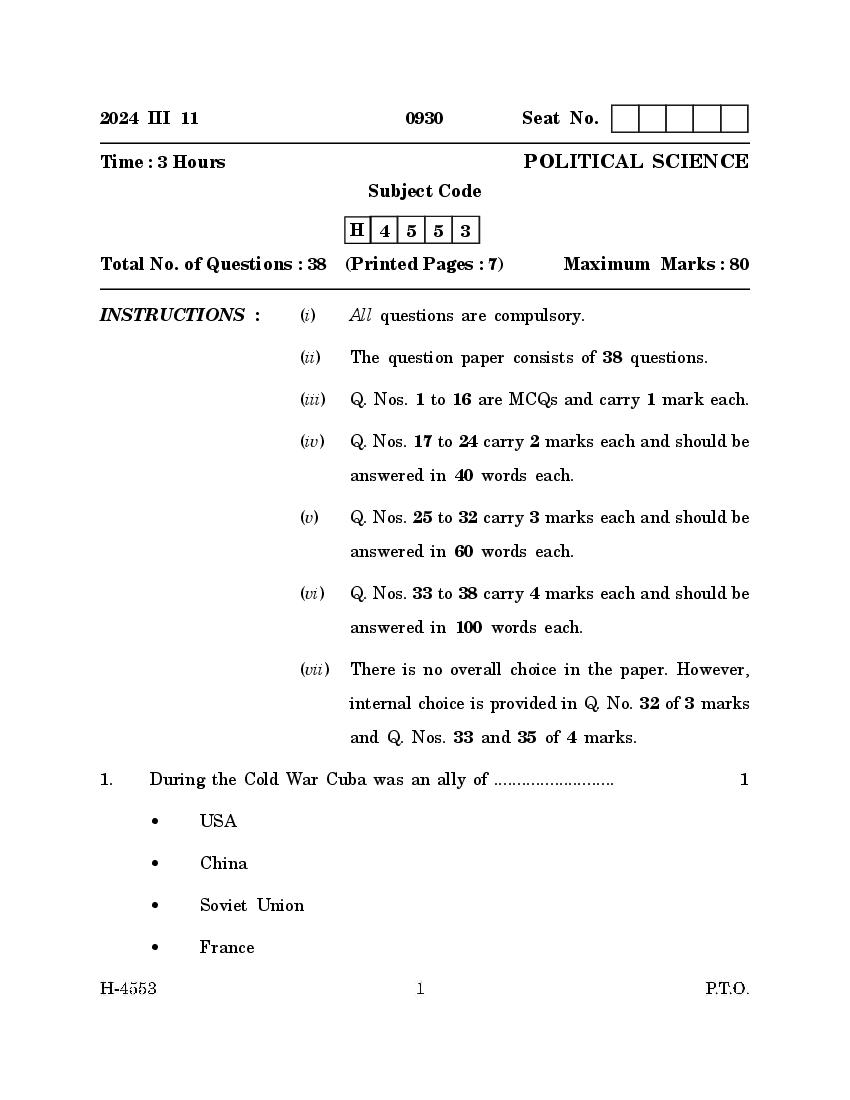
Time : 3 Hours POLITICAL SCIENCE
Subject Code
H 4 5 5 3
Total No. of Questions : 38 (Printed Pages : 7) Maximum Marks : 80
INSTRUCTIONS : (i) All questions are compulsory.
(ii) The question paper consists of 38 questions.
(iii) Q. Nos. 1 to 16 are MCQs and carry 1 mark each.
(iv) Q. Nos. 17 to 24 carry 2 marks each and should be
answered in 40 words each.
(v) Q. Nos. 25 to 32 carry 3 marks each and should be
answered in 60 words each.
(vi) Q. Nos. 33 to 38 carry 4 marks each and should be
answered in 100 words each.
(vii) There is no overall choice in the paper. However,
internal choice is provided in Q. No. 32 of 3 marks
and Q. Nos. 33 and 35 of 4 marks.
1. During the Cold War Cuba was an ally of .......................... 1
• USA
• China
• Soviet Union
• France
Page 2
• Berlin
• Belgrade
• Cairo
• Jakarta
3. In 1985, General Secretary of the Communist Party of the Soviet Union
was .................... 1
• Nikita Khruschev
• Boris Yeltsin
• Leonid Brezhnev
• Mikhail Gorbachev
4. As a part of ‘Global War on Terror’ the USA launched an operation under
the code name ............................. 1
• Operation Infinite Reach
• Operation Enduring Freedom
• Operation Iraqi Freedom
• Operation Desert Storm
5. In August 1990, Iraq invaded ............................... 1
• Qatar
• Saudi Arabia
• Kuwait
• Oman
Page 3
Singapore and ............................... 1
• Burma
• Nepal
• Sri Lanka
• Thailand
7. The currency of the European Union is ......................... 1
• Pound Sterling
• Euro
• Danish Krone
• Lira
8. In 1987, the Government of India sent the Indian Peace Keeping Force (IPKF)
to ............................... 1
• Bhutan
• Maldives
• Bangladesh
• Sri Lanka
9. The United Nations was established immediately after .................... 1
• First World War
• Second World War
• Gulf War
• Cold War
Page 4
• Privatisation
• Urbanisation
• Industrialisation
• Migration
11. The rich and developed countries of the first world are generally referred to
as ........................... 1
• Global West
• Global East
• Global North
• Global South
12. Technology is the important cause of ......................... 1
• Privatisation
• Globalisation
• Liberalism
• Colonialism
13. The first part of India to hold an election based on universal adult franchise
was ........................... 1
• Maharashtra
• Assam
• Manipur
• Karnataka
Page 5
guidance of ..................................... 1
• Vikram Sarabhai
• Homi J. Bhabha
• C.V. Raman
• Satyendra Nath Bose
15. The leader of the student’s movement of 1974 in Bihar was ................. 1
• Morarji Desai
• Ram Manohar Lohia
• Jayprakash Narayan
• Raj Narain
16. Anti-Arrack movement was started in Nellore district of .................... 1
• Karnataka
• Tamil Nadu
• Kerala
• Andhra Pradesh
17. Discuss the criterias that have been proposed for the new permanent and
non-permanent members of the U.N. Security Council. 2
18. Explain the position of UN in a unipolar world. 2
19. Explain any two components of India’s security strategy. 2
Page 6
21. Discuss the challenges faced by the Election Commission of India during the
first general election of 1952. 2
22. Explain the positive consequences of Green Revolution. 2
23. Explain the term ‘Defection’. 2
24. Write a short note on ‘Chipko Movement’. 2
25. Why did Super Powers needed an alliance with the smaller states ? 3
26. Explain US Hegemony as ‘Hard Power’. 3
27. Discuss the causes for the rise of Chinese economy. 3
28. Explain the economic consequences of globalisation. 3
29. Explain the various causes for the dominance of the Congress Party in the
first three general elections of 1952, 1957 and 1962 in India. 3
30. Discuss the key areas of First Five Year Plan in India. 3
31. Explain the electoral verdict of the fourth general election of 1967. 3
32. Discuss the main provisions of the Rajiv-Longoval Accord. 3
Or
Discuss the causes for the Assam Movement against outsiders.
33. Examine the causes of disintegration of USSR. 4
Or
Examine the consequences of Shock Therapy.
34. Analyse the areas of conflict between India and Pakistan. 4
Page 7
Or
Examine the accession of Hyderabad to the Indian Union.
36. Analyse the impact of Chinese invasion of 1962 on India. 4
37. Explain the consequences of emergency of 1975 in India. 4
38. Discuss the political rise of ‘Other Backward Classes’ in India. 4
Document Details
| Board / Org | Goa Board |
| Exam | Class 12 |
| Type | Question Paper |
| Pages | 7 |
| Updated | 30 Apr 2026 |