TN 11th Question Paper 2022 Microbiology
Finished viewing? Save it for later —
Download TN 11th Question Paper 2022 Microbiology (PDF · 11 pages)About TN 11th Question Paper 2022 Microbiology
TN 11th Question Paper 2022 Microbiology is available here for free download. Published by Tamil Nadu Board for Class 11, this question paper can be viewed online or downloaded as a PDF (11 pages). Candidates preparing for Class 11 can use TN 11th Question Paper 2022 Microbiology to understand the exam pattern, the type of questions asked, and the overall difficulty level.
Frequently Asked Questions
How can I download TN 11th Question Paper 2022 Microbiology?
Open this page and click the Download button to save TN 11th Question Paper 2022 Microbiology as a PDF. It is completely free on AglaSem Docs.
Is TN 11th Question Paper 2022 Microbiology free to download?
Yes. TN 11th Question Paper 2022 Microbiology can be viewed online and downloaded as a PDF free of cost on AglaSem Docs.
How many pages does TN 11th Question Paper 2022 Microbiology have?
TN 11th Question Paper 2022 Microbiology contains 11 pages, which you can read online or download together as a single PDF.
Where can I find more Class 11 study material?
You can find more Class 11 question papers, sample papers, syllabus, and answer keys on AglaSem Docs.
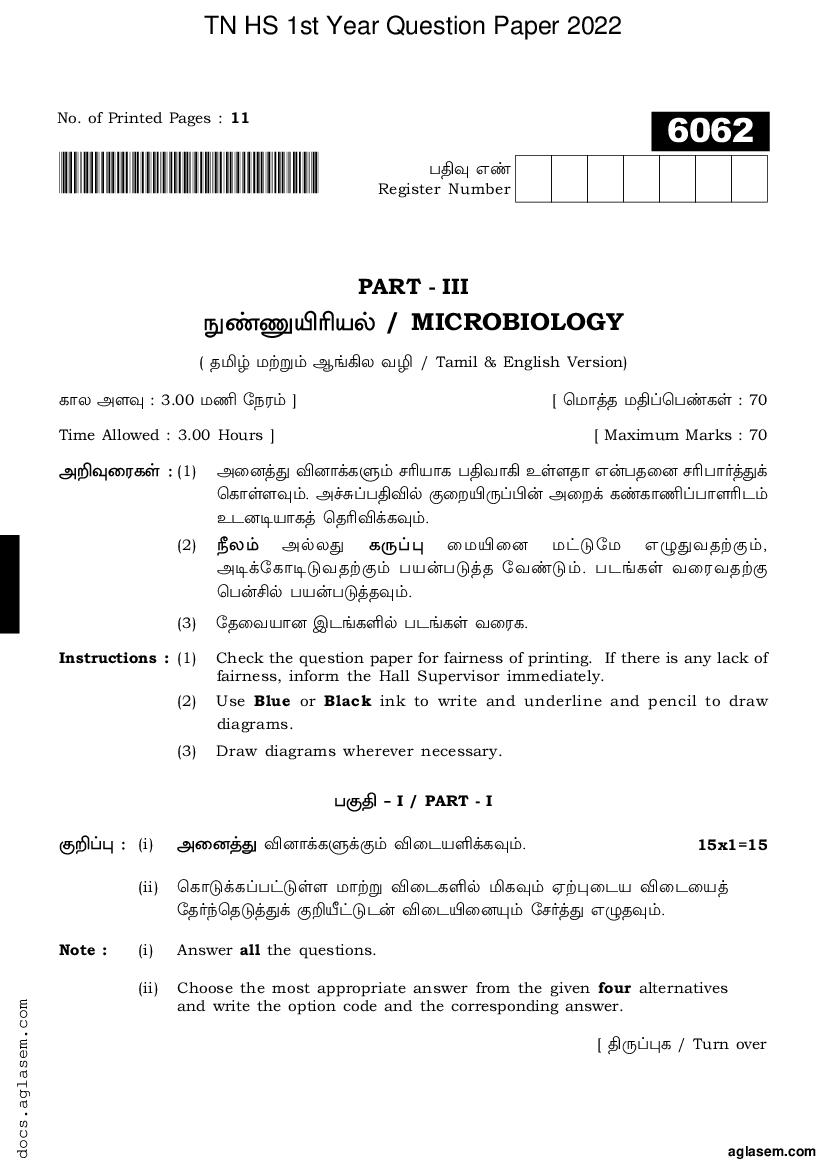
TN 11th Question Paper 2022 Microbiology – Text
Read the full text of this question paper below — useful to quickly search, copy and reference the content online without downloading the PDF.
📄 View text version (11 pages)
Page 1
6062
!6062IstYearMicrobiology! £vÄ Gs
Register Number
PART - III
~sq°›¯À / MICROBIOLOGY
( uªÌ ©ØÖ® B[Q» ÁÈ / Tamil & English Version)
Põ» AÍÄ : 3.00 ©o ÷|µ® ] [ ö©õzu ©v¨ö£sPÒ : 70
Time Allowed : 3.00 Hours ] [ Maximum Marks : 70
AÔÄøµPÒ : (1) AøÚzx ÂÚõUPЮ \›¯õP £vÁõQ EÒÍuõ GߣuøÚ \›£õºzxU
öPõÒÍÄ®. Aa_¨£vÂÀ SøÓ°¸¨¤ß AøÓU PsPõo¨£õÍ›h®
EhÚi¯õPz öu›ÂUPÄ®.
(2) }»® AÀ»x P¸¨¦ ø©°øÚ ©mk÷© GÊxÁuØS®,
AiU÷PõikÁuØS® £¯ß£kzu ÷Ásk®. £h[PÒ ÁøµÁuØS
ö£ß]À £¯ß£kzuÄ®.
(3) ÷uøÁ¯õÚ Ch[PÎÀ £h[PÒ ÁøµP.
Instructions : (1) Check the question paper for fairness of printing. If there is any lack of
fairness, inform the Hall Supervisor immediately.
(2) Use Blue or Black ink to write and underline and pencil to draw
diagrams.
(3) Draw diagrams wherever necessary.
£Sv & I / PART - I
SÔ¨¦ : (i) AøÚzx ÂÚõUPÐUS® Âøh¯ÎUPÄ®. 15x1=15
(ii) öPõkUP¨£mkÒÍ ©õØÖ ÂøhPÎÀ ªPÄ® Hئøh¯ Âøhø¯z
÷uº¢öukzxU SÔ±mkhß Âøh°øÚ²® ÷\ºzx GÊuÄ®.
Note : (i) Answer all the questions.
(ii) Choose the most appropriate answer from the given four alternatives
and write the option code and the corresponding answer.
Page 2
1. "©¸zxÁ ~sq°›¯¼ß u¢øu' GÚ AøÇUP¨£k£Áº ¯õº ?
(A) Cµõ£ºm PõU (B) Aö»Uéõshº ¤öͪ[
(C) Bßhß Áõß ½ÁßíõU (D) ¿°ì £õìa\º
Who is called ‘Father of Medical Microbiology’ ?
(a) Robert Koch (b) Alexander Fleming
(c) Anton Van Leeuwenhock (d) Louis Pasteur
2. Tmk JÎ ~s÷nõUQ°ß ªP AvP¨£i¯õÚ öuÎÄzvÓß __________ BS®.
(A) 0.02 µm (B) 2 µm (C) 20 µm (D) 0.2 µm
The highest resolution possible in compound light microscope is about ___________.
(a) 0.02 µm (b) 2 µm (c) 20 µm (d) 0.2 µm
3. ¤ßÁ¸ÁÚÁØÖÒ Gx Aª» \õ¯® AÀ» ?
(A) C¢v¯õ C[U (B) D÷¯õ]ß
(C) \õL¨µÛß (D) {U÷µõ]ß
Which of the following is not an acidic dye ?
(a) India Ink (b) Eosin
(c) Safranin (d) Nigrosin
4. TØÖ (I) : Põ©õPvºPÒ Gߣx ~sq°›PøÍ öPõÀ¾® ªP ]Ó¢u Põµo
©ØÖ® AÁØøÓ £¯ß£kzv ~sq°º }UP® ö\´²® •øÓ
Sκ ~sq°º }UP® GÚ AøÇUP¨£kQÓx.
TØÖ (II) : A¯Û¯õUS® PvºÃa_PÒ ö£õ¸mPÎß ÷©Ø£µ¨¤À öÁ¨£zøu
EshõUSÁvÀø».
(A) TØÖ (I) ©ØÖ® TØÖ (II) \›
(B) TØÖ (I) \›, TØÖ (II) uÁÖ
(C) TØÖ (I) ©ØÖ® TØÖ (II) uÁÖ
(D) TØÖ (I) uÁÖ, TØÖ (II) \›
Statement (I) : Gamma rays are an excellent sterilizing agent and
sterilization using Gamma rays is referred to as cold
sterilization.
Statement (II) : Ionizing radiations do not produce heat on the surface of
materials.
(a) Statements (I) and (II) are true.
(b) Statement (I) is true and (II) is false.
(c) Statements (I) and (II) are false.
(d) Statement (I) is false and (II) is true.
Page 3
5. ö£õ¸zxP :
(1) Cµzu APõº (i) FmhU P»øÁ
(2) \õÀ÷©õöÚÀ»õ æöPÀ»õ APõº (ii) PõØÖ AØÓ FhP®
(3) ö\¼øÚm F ¤µõz (iii) ÷uºÄU P»øÁ
(4) u÷¯õQøÍ÷Põ÷»m ¤µõz (iv) ö\ÔÅmk® FhP®
(A) (1)-(iii), (2)-(iv), (3)-(i), (4)-(ii)
(B) (1)-(iv), (2)-(iii), (3)-(i), (4)-(ii)
(C) (1)-(ii), (2)-(iv), (3)-(iii), (4)-(i)
(D) (1)-(i), (2)-(iii), (3)-(iv), (4)-(ii)
Match the following :
(1) Blood agar (i) Enriched medium
(2) Salmonella-Shigella agar (ii) Anaerobic medium
(3) Selenite F broth (iii) Selective medium
(4) Thioglycolate broth (iv) Enrichment medium
(a) (1)-(iii), (2)-(iv), (3)-(i), (4)-(ii)
(b) (1)-(iv), (2)-(iii), (3)-(i), (4)-(ii)
(c) (1)-(ii), (2)-(iv), (3)-(iii), (4)-(i)
(d) (1)-(i), (2)-(iii), (3)-(iv), (4)-(ii)
Page 4
6. ¤ßÁ¸® TØÖPÎÀ GøÁ \›¯õÚøÁ ?
(i) ¤ßu[PÀ {ø»°À ~sq°º ö\ÀPÒ ö\À £S¨¤ØS u¯õº¨£kzvU
öPõÒQÓx.
(ii) ©hUøP {ø»°À ~sq°›PÒ ö£¸UP©øh¢x GsoUøP°À
C¸©h[PõQÓx.
(iii) CÓ¨¦ {ø»°À E°¸ÒÍ ö\ÀPÎß ö©õzu GsoUøP {ø»¯õP
C¸US®.
(iv) öuÎÁØÓ ~sq°º ö£¸UPz uhUP¸Â°À ö\À £S¨¦, Fmha\zx
ö\ÔøÁ ©õØÔ¯ø©¨£vÚõÀ Pmk¨£kzu¨£kQÓx.
(A) (i) ©ØÖ® (ii) ©mk® (B) (ii) ©Ø-Ö® (iii) ©mk®
(C) (i), (ii) ©Ø-Ö® (iii) ©m-k® (D) ÷©ØTÔ¯ AøÚzx®
Which of the following statements are true ?
(i) In the lag phase the cell prepares itself for cell division
(ii) In the log phase the organism divides and doubles in number
(iii) The total number of viable cells remain constant in death phase
(iv) In a turbidostat the cell division is controlled by modifying the concentration
of the limiting nutrient.
(a) (i) and (ii) only (b) (ii) and (iii) only
(c) (i), (ii) and (iii) only (d) All of the above
7. ¨›÷¯õ Põ»÷µ £õUj›¯õÂÀ GÆÁøP¯õÚ Pø\°øÇ Aø©¨¦ EÒÍx ?
(A) ÷©õ÷ÚõiøµPì (B) ö£›iøµPì
(C) ÷»õ÷£õiøµPì (D) B®¤iøµPì
Which type of flagella is present in Vibrio Cholerae ?
(a) Monotrichous (b) Peritrichous
(c) Lophotrichous (d) Amphitrichous
8. ÁøP¨£õmi¯À ~sq°›PÎß E¸Áø©¨¦, Eh¼¯À,
__________
E°º÷Áv°¯À ©ØÖ® `Ì{ø» £s¦PøÍ Ai¨£øh¯õPU öPõsk
~sq°›PøÍ ÁøP¨£kzxQÓx.
(A) ‰»UTÖ (B) ö\ƯÀ
(C) |ÃÚ (D) PnURmk •øÓ
The method of classification based on morphology, physiology, biochemical and
ecological characteristics of the micro-organism is _________.
(a) Molecular Taxonomy (b) Classical Taxonomy
(c) Modern Taxonomy (d) Numerical Taxonomy
Page 5
9. BØÖ }µõÚx PhÀ }¸hß P»US® Ph÷»õµ¨ £Sv _________ GÚ
AøÇUP¨£kQÓx.
(A) PhØPÈ (B) H› (C) ÁøÍShõ (D) •PzxÁõµ®
A partly enclosed coastal body of water in which river water is mixed with sea
water is called _________.
(a) Creek (b) Lake (c) Bay (d) Estuary
10. _________ Gߣx AvP©õÚ ~sq°›PÒ ©ØÖ® Auß ö\¯ÀvÓß
ysh¨£k® ÷Áº £Sv¯õS®.
(A) ¤À÷»õ¤÷»ß ÂøÍÄ (B) ìö£º÷©õ줯º ÂøÍÄ
(C) øµ÷\õ줯º ÂøÍÄ (D) ¤À÷»õ줯º ÂøÍÄ
Increased microbial community as well as microbial activities are influenced by
the root zone. This effect is known as __________.
(a) Phyloplane effect (b) Spermosphere effect
(c) Rhizosphere effect (d) Phylosphere effect
11. Â.H.G®. (VAM) AvPÍÂÀ EØ£zv ö\´¯ __________ ÷uøÁ¨£kQÓx.
(A) E¸øÍUQÇ[Qß ÷ÁºPÒ (B) ÷\õÍ£°›ß ÷ÁºPÒ
(C) £¸zva ö\i°ß ÷ÁºPÒ (D) ö|Ø£°›ß ÷ÁºPÒ
The mass cultivation of VAM is preferably done in :
(a) Potato roots (b) Sorghum roots
(c) Cotton roots (d) Rice roots
12. Cµzu KmhzvÀ £õUj›¯õ C¸¨£x __________ GÚ AøÇUP¨£kQÓx.
(A) £õUj›«¯õ (B) ö\¨j]«¯õ (C) ø£±ª¯õ (D) øÁ›«¯õ
Circulation of bacteria in the blood is known as _________.
(a) Bacteremia (b) Septicemia (c) Pyemia (d) Viremia
13. ¼®÷£õø\mkPÍõÀ Aøh¯õÍ® Põq® C®³÷ÚõöáÛß SÔ¨¤mh £Sv
__________ BS®.
(A) íõ¨hßPÒ (B) xøn³UQPÒ
(C) BßiöáßPÒ (D) G¤÷hõ¨PÒ
Lymphocytes recognize discrete sites of an immunogen known as __________.
(a) Haptens (b) Adjuvants
(c) Antigens (d) Epitopes
Page 6
14. GºÂß \õºPõL¨ Âv¨£i ö©õzu GsoUøP __________ BP
öÁΨ£kzu¨£kQÓx.
(A) A+G = T+C (B) A = C (C) A = G (D) C = G
Erwin Chargaff Rule can be quantitatively expressed as :
(a) A+G = T+C (b) A = C (c) A = G (d) C=G
15. ]ÖShÀ ©ØÖ® ö£¸[Sh¼¾ÒÍ ÷PõøǨ£h»® ÃUP©øhuÀ __________
BS®.
(A) ]ÖShÀ AÇØ] ©ØÖ® ö£¸[ShÀ AÇØ] (Enterocolitis)
(B) ]ÖShÀ AÇØ] (enteritis)
(C) Á°ØÖ EøÓ AÇØ] (Peritonitis)
(D) ö£¸[ShÀ AÇØ] (colitis)
Inflammation involving the mucosa of both large and small intestine is :
(a) Enterocolitis
(b) Enteritis
(c) Peritonitis
(d) Colitis
£Sv & II / PART - II
SÔ¨¦ : GøÁ÷¯Ý® BÖ ÂÚõUPÐUS Âøh¯ÎUPÄ®. ÂÚõ Gs. 24 &US
Pmhõ¯©õP Âøh¯ÎUPÄ®. 6x2=12
Note : Answer any six questions. Question No. 24 is compulsory.
16. Áøµ¯Ö : (i) GsnÍÄz xøÍ (ii) öuÎÄ vÓß
Define : (i) Numerical aperture (ii) Resolution
17. ¦÷µõiìhõ E»Pzvß £s¦PÒ GøÁ÷¯Ý® |õßQøÚ¨ £mi¯¼kP.
List any 4 properties of kingdom Protista.
18. £¯ßö£Ö® ÁõÌUøP •øÓ GßÓõÀ GßÚ ? GkzxUPõmk u¸P.
What is commensalism ? Give an example.
19. öÁ¨£ {ø»¨£kzxu¼ß •UQ¯zxÁ® ¯õx ?
Why is heat fixation important ?
20. ö£Ó¨£mh ÷|õ´zuk¨£õØÓÀ GßÓõÀ GßÚ ?
What is acquired immunity ?
Page 7
21. i.Gß.H. Cµmizu¼À •ß÷ÚõUS CøÇ ©ØÖ® ¤ßu[Q¯ CøÇ £ØÔ }[-PÒ
¦›¢x öPõshx GßÚ ?
What do you understand by leading strand and lagging strand in DNA
replication ?
22. PõØÔÀ EÒÍ ~sq°›PøÍ PnUQh¨ £¯ß£kzu¨£k® •øÓPÒ
GøÁ-÷¯-Ý® |õßQøÚ GÊxP.
Write any four methods used to enumerate micro-organisms in air.
23. öhÀhõ AP|a_ GßÓõÀ GßÚ ?
What is delta endotoxin ?
24. £õUj›¯õUPÎß Ps ÷|õ´öuõØÖPÎÀ GøÁ÷¯Ý® Cµsiß ÷|õ´UPõµo,
AÔSÔPÒ ©ØÖ® £µÄ® ÁÈ•øÓPøÍ GÊxP.
Write any two pathogen, signs and symptoms and transmission of bacterial
infections of the eye.
£Sv & III / PART - III
SÔ¨¦ : GøÁ÷¯Ý® BÖ ÂÚõUPÐUS Âøh¯ÎUPÄ®. ÂÚõ Gs 33 &US
Pmhõ¯©õP Âøh¯ÎUPÄ®. 6x3=18
Note : Answer any six questions. Question No. 33 is compulsory.
25. \ÆÄ ÁiPmi G¨ö£õ¸mPÍõÀ BÚx ? Auß £¯ßPøÍ GÊxP.
What are membrane filters made up of ? What are its uses ?
26. Phzx® FhP® £ØÔ ]Ö SÔ¨¦ ÁøµP.
Write a note on transport medium.
Page 8
27. Ai¨£øh öÁ¨£{ø» GßÓõÀ GßÚ ? SøÓ¢u öÁ¨£{ø» ¸®¤PÒ
Áøµ¯ÖUPÄ®.
What are cardinal temperatures ? Define Psychrophiles.
28. Qµõ® £õ]miÆ ©ØÖ® Qµõ® ö|PmiÆ £õUj›¯õUPøÍ ÷ÁÖ£kzxP.
Differentiate between gram positive and gram negative bacteria.
29. E°ºÁÈ ÷uõßÓÀ (Biogenesis) ©ØÖ® E°µØÓ ÷uõßÓÀ (Abiogenesis) GßÝ®
ÁõºzøuPÎß Áõ°»õP }º ¦›¢x öPõÒÁx ¯õx ? uõ÷Ú ÷uõßÔ¯ uø»•øÓ
÷Põm£õmiøÚ ©ÖzuÁº ¯õº ? uõ÷Ú ÷uõßÔ¯ uø»•øÓ ÷Põm£õmiøÚ
©Ö¨£uØS £¯ß£kzv¯ ÷\õuøÚ°ß ö£¯º GßÚ ?
What do you understand by the terms Biogenesis and Abiogenesis ? Who disproved
spontaneous generation ? Write the name of the experiment carried out to disprove
spontaneous generation.
30. JÎUPvºPÒ ö£õ¸Îß «x ÷©õx® ö£õÊx GßÚÁõQÓx ?
What happens to light rays when they interact with an object ?
31. \õ¯® ©ØÖ® øh Áøµ¯Ö. \õ¯® AÀ»x øh&°À EÒÍ ‰ßÖ TÖPÎß
ö£¯ºPøÍ GÊxP.
Define stain and dye. Name the three components of a stain or dye.
32. P»¨¦ Eµ® Áøµ¯Ö. AøÁ u¯õ›UP Gx £¯ß£kQÓx ? Auß J¸ |ßø©ø¯
GÊxP.
Define compost. What is used to make compost and mention any one benefit of
compost.
33. øu©ì, {n}º •ia_PÒ ©ØÖ® G¾®¦ ©äøá £oPÎÀ H÷uÝ® JßÔøÚ
GÊxP.
Write one function each of Thymus, Lymph nodes and Bone marrow.
Page 9
£Sv & IV / PART - IV
SÔ¨¦ : AøÚzx ÂÚõUPÐUS® Âøh¯ÎUPÄ®. 5x5=25
Note : Answer all the questions.
34. (A) Qµõ® ö|PmiÆ £õUj›¯õÂß öÁÎ\ÆÄ £ØÔ ÂÁõvUPÄ®. öÁÎa
\ÆÂß £oPøÍ GÊxP.
AÀ»x
(B) (i) öÁ¨£ ~sq°º }UP® £ØÔ GÊxP.
(ii) ~sq°º }UPzvØS £¯ß£kzu¨£k® öÁ¨£ PõØÖ Ak¨¦ ©ØÖ®
ªßöÁ¨£ \©{ø» Ak¨¦ ÷ÁÖ£kzxP.
(a) Discuss outer membrane of gram negative bacteria. Write the function of
the outer membrane.
OR
(b) (i) Write about the sterilization by Heat.
(ii) Differentiate between sterilization using Autoclave and Hot air oven.
35. (A) hõºU ¥Àk Pßöhß\›ß uÛzußø©ø¯²®, £oPøͲ® GÊxP. hõºU
¥Àk ~s÷nõUQ°À ©õv› GÆÁõÖ Põn¨£kQÓx Gߣøu ÂÁ›UPÄ®.
AÀ»x
(B) ÷Põk umk •øÓPÎß ‰»® ~sq°›PøÍ GÆÁõÖ uÛø©¨£kzxÁõ´ ?
(a) Write the distinct feature and role of dark field condenser. Explain the
appearance of specimen when viewed under dark field microscope.
OR
(b) How will you isolate micro-organisms by streak plate method ?
Page 10
36. (A) Gvº©øÓ ©ØÖ® ÷|º©øÓ \õ¯÷©ØS® •øÓø¯ ÂÁõvUPÄ®.
AÀ»x
(B) (i) ~sq°›PÎß Áͺa]US ÷uøÁ¨£k® ~s Fmh® ©ØÖ® ö£¸®
Fmha\zxPÒ & Áøµ¯Ö.
(ii) ö£¸® Fmha\zxPÐUS Euõµn® u¢x £oPøÍ GÊxP.
(iii) ~sq°›PÐUS ÷uøÁ¨£k® Áͺa] PõµoPÒ ¯õøÁ ?
(a) Discuss positive and negative staining.
OR
(b) (i) Define macronutrients and micronutrients by micro-organisms for their
growth.
(ii) Give examples of macronutrients and their roles.
(iii) What are the growth factors required by micro-organisms ?
37. (A) (i) ©zv¯ |µ®¦ ©sh» (CNS) ÷|õ´öuõØÖPÎß Cµsk ÁøPPøÍ
GÊxP.
(ii) ]Ö}µP £õøu ÷|õ´zöuõØÔß •ßPõµoPøͨ £mi¯¼kP.
(iii) ]Ö}µP ø£ AÇØ] ©ØÖ® ]Ö}µP ~sSÇõ´ AÇØ]ø¯ ÂÁ›zx,
Auß ÷|õ´ PõµoPøͲ® AÔSÔPøͲ® GÊxP.
AÀ»x
(B) C¸vø\ CµmizuÀ •øÓø¯ ÂÁ›. i.Gß.H. Cµmizu¼À £[÷PØS®
ö|õvPÒ GøÁ÷¯Ý® ‰ßÔøÚ Á›ø\¨£kzv, Auß £oPøÍ GÊxP.
(a) (i) Name two types of CNS infections.
(ii) List the predisposing factors of UTI.
(iii) Explain cystitis and pyelonephritis and write their causative agents
with symptoms.
OR
(b) Explain Bidirectional Replication and list any three enzymes involved in
DNA replication with their functions.
Page 11
38. (A) Bßi£õiPÒ & Áøµ¯Ö. C®³÷ÚõS÷Íõ¦¼ß Aø©¨ø£¨ £h® Áøµ¢x
£õP[PøÍU SÔUPÄ®.
AÀ»x
(B) P¢uP _ÇØ]ø¯ ÂÁ›UPÄ®.
(a) Define Antibodies. Draw and label the structure of Immunoglobulin.
OR
(b) Explain sulphur cycle.
-o0o-
Document Details
| Board / Org | Tamil Nadu Board |
| Exam | Class 11 |
| Type | Question Paper |
| Pages | 11 |
| Updated | 30 Apr 2026 |