KCET 2017 Question Paper Maths
Finished viewing? Save it for later —
Download KCET 2017 Question Paper Maths (PDF · 16 pages)About KCET 2017 Question Paper Maths
KCET 2017 Question Paper Maths is available here for free download. Published by KEA for Karnataka Common Entrance Test, this question paper can be viewed online or downloaded as a PDF (16 pages). Candidates preparing for Karnataka Common Entrance Test can use KCET 2017 Question Paper Maths to understand the exam pattern, the type of questions asked, and the overall difficulty level.
Frequently Asked Questions
How can I download KCET 2017 Question Paper Maths?
Open this page and click the Download button to save KCET 2017 Question Paper Maths as a PDF. It is completely free on AglaSem Docs.
Is KCET 2017 Question Paper Maths free to download?
Yes. KCET 2017 Question Paper Maths can be viewed online and downloaded as a PDF free of cost on AglaSem Docs.
How many pages does KCET 2017 Question Paper Maths have?
KCET 2017 Question Paper Maths contains 16 pages, which you can read online or download together as a single PDF.
Where can I find more Karnataka Common Entrance Test study material?
You can find more Karnataka Common Entrance Test question papers, sample papers, syllabus, and answer keys on AglaSem Docs.
KCET 2017 Question Paper Maths – Text
Read the full text of this question paper below — useful to quickly search, copy and reference the content online without downloading the PDF.
📄 View text version (16 pages)
Page 1
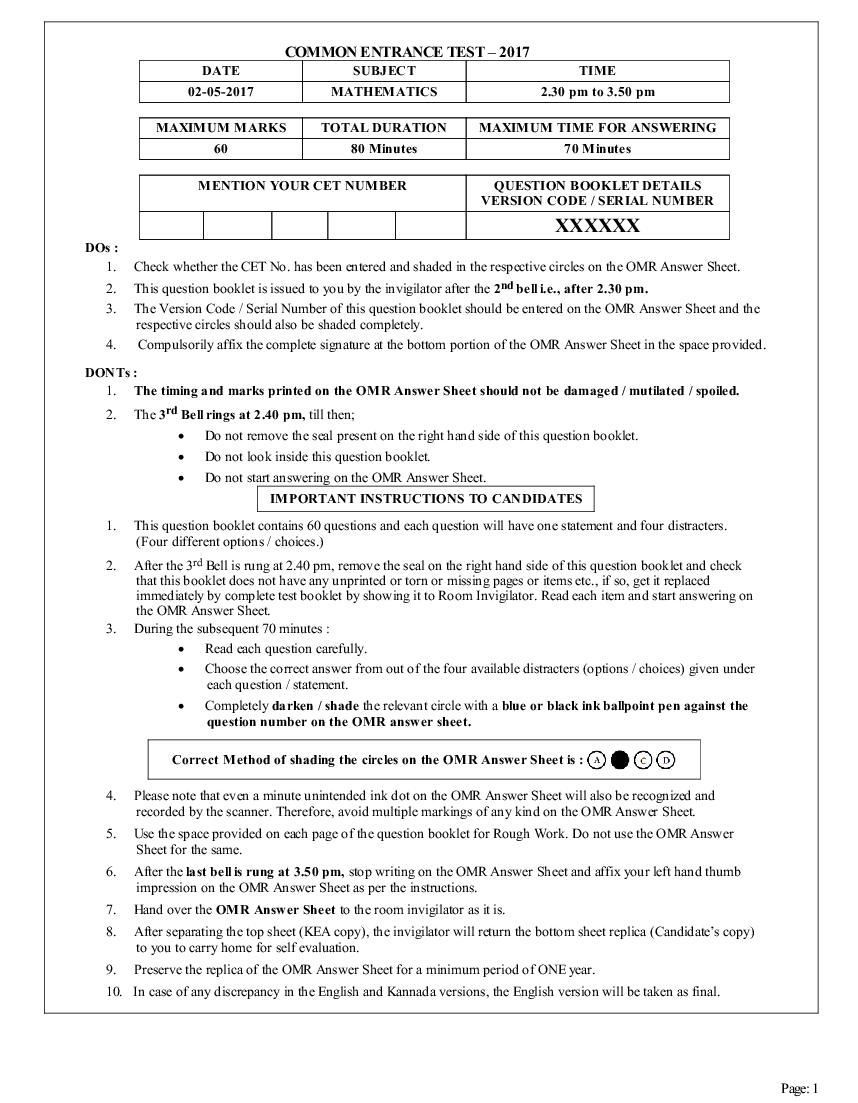
DATE SUBJECT TIME
02-05-2017 MATHEMATICS 2.30 pm to 3.50 pm
MAXIMUM MARKS TOTAL DURATION MAXIMUM TIME FOR ANSWERING
60 80 Minutes 70 Minutes
MENTION YOUR CET NUMBER QUESTION BOOKLET DETAILS
VERSION CODE / SERIAL NUMBER
XXXXXX
DOs :
1. Check whether the CET No. has been entered and shaded in the respective circles on the OMR Answer Sheet.
2. This question booklet is issued to you by the invigilator after the 2 nd bell i.e., after 2.30 pm.
3. The Version Code / Serial Number of this question booklet should be entered on the OMR Answer Sheet and the
respective circles should also be shaded completely.
4. Compulsorily affix the complete signature at the bottom portion of the OMR Answer Sheet in the space provided.
DONTs :
1. The timing and marks printed on the OMR Answer Sheet should not be damaged / mutilated / spoiled.
2. The 3 rd Bell rings at 2.40 pm, till then;
· Do not remove the seal present on the right hand side of this question booklet.
· Do not look inside this question booklet.
· Do not start answering on the OMR Answer Sheet.
IMPORTANT INSTRUCTIONS TO CANDIDATES
1. This question booklet contains 60 questions and each question will have one statement and four distracters.
(Four different options / choices.)
2. After the 3rd Bell is rung at 2.40 pm, remove the seal on the right hand side of this question booklet and check
that this booklet does not have any unprinted or torn or missing pages or items etc., if so, get it replaced
immediately by complete test booklet by showing it to Room Invigilator. Read each item and start answering on
the OMR Answer Sheet.
3. During the subsequent 70 minutes :
· Read each question carefully.
· Choose the correct answer from out of the four available distracters (options / choices) given under
each question / statement.
· Completely darken / shade the relevant circle with a blue or black ink ballpoint pen against the
question number on the OMR answer sheet.
Correct Method of shading the circles on the OMR Answer Sheet is :
4. Please note that even a minute unintended ink dot on the OMR Answer Sheet will also be recognized and
recorded by the scanner. Therefore, avoid multiple markings of any kind on the OMR Answer Sheet.
5. Use the space provided on each page of the question booklet for Rough Work. Do not use the OMR Answer
Sheet for the same.
6. After the last bell is rung at 3.50 pm, stop writing on the OMR Answer Sheet and affix your left hand thumb
impression on the OMR Answer Sheet as per the instructions.
7. Hand over the OMR Answer Sheet to the room invigilator as it is.
8. After separating the top sheet (KEA copy), the invigilator will return the bottom sheet replica (Candidate’s copy)
to you to carry home for self evaluation.
9. Preserve the replica of the OMR Answer Sheet for a minimum period of ONE year.
10. In case of any discrepancy in the English and Kannada versions, the English version will be taken as final.
Page: 1
Page 2
(A) ) = n(A) (B) ) = n(B) (A) ) = n(A) (B) ) = n(B)
(C) ) = n(B) (D) )=φ (C) ) = n(B) (D) )=φ
Question Id : 1 Question Id : 1
2. The value of 2.
is (A) (B)
(A) (B)
(C) (D)
(C) (D)
Question Id : 2
Question Id : 2
3. 3 + 5 +7 + …. to n term is 3. 3 + 5 +7 + …. n
(A) n(n + 2) (B) (A) n(n + 2) (B)
(C) (D) (C) (D)
Question Id : 3 Question Id : 3
4. 4.
= 1, then the least positive integral = 1 m
value of m is
(A) 2 (B) 3 (A) 2 (B) 3
(C) 4 (D) 1 (C) 4 (D) 1
Question Id : 4 Question Id : 4
5. If ≤ 1, then 5. ≤ 1
(A) (B) (A) (B)
(C) (D) (C) (D)
Question Id : 5 Question Id : 5
6. If = then n is equal to 6. = n
(A) 26 (B) 12 (A) 26 (B) 12
(C) 6 (D) 20 (C) 6 (D) 20
Question Id : 6 Question Id : 6
7. The total number of terms in the expansion of 7.
after simplification is
(A) 24 (B) 47 (A) 24 (B) 47
(C) 48 (D) 96 (C) 48 (D) 96
Question Id : 7 Question Id : 7
Page: 2
Page 3
and perpendicular to the line
is
(A) (B) (A) (B)
(C) (D) (C) (D)
Question Id : 8
Question Id : 8
9. 9.
The eccentricity of the ellipse + +
is (A) (B)
(A) (B)
(C) (D)
(C) (D)
Question Id : 9
Question Id : 9
10. The perpendicular distance of the point 10. XY
from XY-plane is (A) 8 (B) 7
(A) 8 (B) 7 (C) 6 (D) 5
(C) 6 (D) 5 Question Id : 10
Question Id : 10
11. 11.
The value of is
(A) 4/9 (B) 9/4 (A) 4/9 (B) 9/4
(C) 9/3 (D) 3/4 (C) 9/3 (D) 3/4
Question Id : 11 Question Id : 11
12. The contrapositive statement of the statement 12. “
“If is prime number, then is odd” is ”
(A) I f is not a prime number, then is not (A)
odd
(B) If is a prime number, then is not odd. (B)
(C) If is not a prime number, then is odd.
(C)
(D) I f is not odd, then is not a prime
number. (D)
Question Id : 12
Question Id : 12
Page: 3
Page 4
deviation is 24, then Arithmetic mean is 24
(A) 40 (B) 7/20 (A) 40 (B) 7/20
(C) 20/7 (D) 1/40 (C) 20/7 (D) 1/40
Question Id : 13 Question Id : 13
14. The range of the function )= is 14. )=
(A) (0, 3) (B) [0, 3] (A) (0, 3) (B) [0, 3]
(C) (0, 3] (D) [0, 3) (C) (0, 3] (D) [0, 3)
Question Id : 14 Question Id : 14
15. Let be defined by = , then 15. =
(A) f is one-one and onto
(B) f may be one-one and onto (A) f -
(C) f is one-one but not onto (B) f -
(D) f is neither one-one nor onto (C) f -
Question Id : 15
(D) f -
Question Id : 15
16. The range of is 16.
(A) (B) (A) (B)
(C) (D) (C) (D)
Question Id : 16 Question Id : 16
17. If , then 17.
is equal to
(A) π (B) (A) π (B)
(C) (D) (C) (D)
Question Id : 17 Question Id : 17
18. If , , then is 18. ,
(A) (B) (A) (B)
(C) (D) (C) (D)
Question Id : 18 Question Id : 18
Page: 4
Page 5
If
B = then A − B is B= , A − B
equal to
(A) I (B) 0 (A) I (B) 0
(C) 2I (D) (C) 2I (D)
Question Id : 19 Question Id : 19
20. If a matrix A is both symmetric and skew 20. A
symmetric, then A
(A) A is diagonal matrix (A) A (B) A
(B) A is a zero matrix (C) A (D) A
(C) A is scalar matrix (D) A is square matrix Question Id : 20
Question Id : 20
21. 21.
If , then the value y
of and y are
(A) (A) (B)
(B) (C)
(C) (D)
Question Id : 21
(D)
Question Id : 21
22. Binary operation * on R − {−1} defined by 22.
R − {−1 } , =
= is
(A) * is associative and commutative (A)
(B) * is associative but not commutative
(B)
(C) * is neither associative nor commutative
(C)
(D) * is commutative but not associative
Question Id : 22 (D)
Question Id : 22
Page: 5
Page 6
If then is equal to
(A) 2 (B) 4 (A) 2 (B) 4
(C) 8 (D) (C) 8 (D)
Question Id : 23 Question Id : 23
24. If A is a square matrix of order 3 × 3, then |KA| 24. A 3 × 3 |KA|
is equal to
(A) K|A| (B) (A) K|A| (B)
(C) (D) 3K|A| (C) (D) 3K|A|
Question Id : 24
Question Id : 24
25. The area of triangle with vertices (K, 0), 25. (K, 0), (4, 0), (0, 2)
, (0, 2) is 4 square units, then value of K 4 K
(A) 0 8 (B) 0 − 8
is
(A) 0 or 8 (B) 0 or − 8 (C) 0 (D) 8
(C) 0 (D) 8 Question Id : 25
Question Id : 25
26. 26.
then
(A) =−Δ (B) =Δ (A) =−Δ (B) =Δ
(C) (D) =2Δ (C) (D) =2Δ
Question Id : 26 Question Id : 26
27. 27.
If = is continuous at =
, then the value of K is K
(A) 3 (B) 4 (A) 3 (B) 4
(C) 3/4 (D) 4/3 (C) 3/4 (D) 4/3
Question Id : 27 Question Id : 27
Page: 6
Page 7
function in [2, 4] is C
(A) 3 (B) 2 (A) 3 (B) 2
(C) 4 (D) 7/2 (C) 4 (D) 7/2
Question Id : 28 Question Id : 28
29. The point on the curve where the 29.
tangent makes an angle of π /4 with X-axis is X π /4
(A) (B) .
(A) (B)
(C) (4, 2) (D) (1, 1)
Question Id : 29 (C) (4, 2) (D) (1, 1)
Question Id : 29
30. The function is strictly 30.
increasing in the interval
(A) (B) (A) (B)
(C) (D) (C) (D)
Question Id : 30 Question Id : 30
31. The rate of change of volume of a sphere with 31. 4 cm
respect to its surface area when the radius is
is (A) (B)
(A) (B) (C) (D)
(C) (D) Question Id : 31
Question Id : 31
32. 32.
, then is equal
to (A) 1/2 (B) π /4
(A) 1/2 (B) π /4 (C) 0 (D) 1
(C) 0 (D) 1 Question Id : 32
Question Id : 32
Page: 7
Page 8
If y = , then is equal y=
to (A)
(A)
(B)
(B)
(C)
(C)
(D)
(D)
Question Id : 33
Question Id : 33
34. then is 34.
equal to (A) 1 (B) 0
(A) 1 (B) 0 (C) (D) 2
(C) − 1 (D) 2 Question Id : 34
Question Id : 34
35. The derivative of w.r.t 35.
is (A) 2 (B)
(A) 2 (B)
(C) (D)
(C) (D)
Question Id : 35
Question Id : 35
Page: 8
Page 9
If ) then is equal to )
(A) (B) (A) (B)
(C) (D) (C) (D)
Question Id : 36 Question Id : 36
37. 37.
is equal to
(A) (B) (A) (B)
(C) (D) (C) (D)
Question Id : 37 Question Id : 37
38. 38.
is equal to
(A) (A)
(B) (B)
(C) (C)
(D) (D)
Question Id : 38 Question Id : 38
Page: 9
Page 10
is equal to
(A) (A)
+C +C
(B) (B)
+C +C
(C) (C)
+C +C
(D) (D)
+C +C
Question Id : 39 Question Id : 39
40. 40.
is equal to
(A) (B) (A) (B)
(C) (D) (C) (D)
Question Id : 40 Question Id : 40
41. 41.
is equal to
(A) 29 (B) 28 (A) 29 (B) 28
(C) 27 (D) 30 (C) 27 (D) 30
Question Id : 41 Question Id : 41
42. 42.
is equal to
(A) 0 (B) 1 (A) 0 (B) 1
(C) (D) (C) (D)
Question Id : 42 Question Id : 42
Page: 10
Page 11
is equal to
(A) (B) (A) (B)
(C) (D) (C) (D)
Question Id : 43 Question Id : 43
44. The area of the region bounded by the curve 44. y = 16
and the line y = 16 is
(A) sq. units (B) sq. units (A) (B)
(C) sq. units (D) sq. units (C) (D)
Question Id : 44 Question Id : 44
45. Area of the region bounded by the curve 45.
and is
(A) 2 sq. units (B) 4 sq. units (A) 2 (B) 4
(C) 3 sq. units (D) 1 sq. unit (C) 3 (D) 1
Question Id : 45 Question Id : 45
46. The degree of the differential equation 46.
=
= is
(A) 1 (B) 2 (A) 1 (B) 2
(C) 3 (D) 4 (C) 3 (D) 4
Question Id : 46 Question Id : 46
47. General solution of differential equation 47.
is
(A) (B) (A) (B)
(C) (C)
(D) (D)
Question Id : 47 Question Id : 47
Page: 11
Page 12
equation is
(A) (B) (A) (B)
(C) (D) (C) (D)
Question Id : 48 Question Id : 48
49. and are 49.
orthogonal, then value of λ is λ
(A) 0 (B) 1 (A) 0 (B) 1
(C) (D) (C) (D)
Question Id : 49 Question Id : 49
50. , , are unit vectors such that 50. , ,
, then the value of
is equal to (A) 1 (B) 3
(A) 1 (B) 3 (C) (D)
(C) (D)
Question Id : 50
Question Id : 50
51. If & are unit vectors, then angle between 51.
for to be unit vector is
(A) 30 ° (B) 45 °
(C) 60 ° (D) 90 ° (A) 30 ° (B) 45 °
Question Id : 51
(C) 60 ° (D) 90 °
Question Id : 51
52. Reflexion of the point ( α , β , γ ) in XY plane is 52. X Y ( α , β , γ )
(A) ( α , β , 0) (B) (0, 0, γ ) (A) ( α , β , 0) (B) (0, 0, γ )
(C) (− α , − β , γ ) (D) ( α , β , − γ ) (C) (− α , − β , γ ) (D) ( α , β , − γ )
Question Id : 52 Question Id : 52
Page: 12
Page 13
angle ( α ) with X-axis. The value of α is ( α ) α
equal to (A) (B)
(A) (B)
(C) (D)
(C) (D)
Question Id : 53
Question Id : 53
54. The distance of the point (−2, 4, −5) from the 54.
= = (−2,
line = = is
4, −5)
(A) (B) (A) (B)
(C) (D) (C) (D)
Question Id : 54 Question Id : 54
55. A box has 100 pens of which 10 are defective. 55. 100 10
The probability that out of a sample of 5 pens . 5
drawn one by one with replacement and atmost
one is defective is
(A) (B) (A) (B)
(C) (C)
(D) (D)
Question Id : 55 Question Id : 55
56. Two events A and B will be independent if 56. A B
(A) A and B are mutually exclusive (A) A B
(B) P(A' B') = (1 − P(A)) (1 − P(B)) (B) P(A' B') = (1 − P(A)) (1 − P(B))
(C) P(A) = P(B) (D) P(A) + P(B) = 1 (C) P(A) = P(B) (D) P(A) + P(B) = 1
Question Id : 56 Question Id : 56
Page: 13
Page 14
The value of k is k
(A) 0.14 (B) 0.3 (A) 0.14 (B) 0.3
(C) 0.7 (D) 1 (C) 0.7 (D) 1
Question Id : 57 Question Id : 57
58. The shaded region in the figure is the solution 58.
set of the inequations .
(A) (A)
(B) (B)
(C) (C)
(D) (D)
Question Id : 58 Question Id : 58
59. If an LPP admits optimal solution at two 59. LPP
consecutive vertices of a feasible region, then
(A) the required optimal solution is at the (A)
midpoint of the line joining two points. .
(B) the optimal solution occurs at every point (B)
on the line joining these two points
(C) the LPP under consideration is not
.
solvable (C) LPP .
(D) the LPP under consideration must be (D) LPP .
reconstructed Question Id : 59
Question Id : 59
60. 60.
is equal to
(A) 4 (B) 4.5 (A) 4 (B) 4.5
(C) 3.5 (D) 3 (C) 3.5 (D) 3
Question Id : 60 Question Id : 60
Page: 14
Page 15
Page: 15
Page 16
02-05-2017 . 2.30 3.50
60 80 70
/
0
:
1. ...
.
2. 2 , . 2.30 .
3. / ...
.
4. ... .
:
1. ... / / .
2. . 2.40 . ,
· .
· .
· ... .
1. 60 , 4 .
2. . 2.40
,
. ... .
3. 70 :
· .
· .
· ...
.
... :
4. ... . ...
.
5. . ... .
6. . 3.50 . .
7. ... .
8. (KEA copy) (
) .
9. .
10.
.
Page: 16
Document Details
| Board / Org | KEA |
| Exam | Karnataka Common Entrance Test |
| Type | Question Paper |
| Pages | 16 |
| Language | english |
| Updated | 30 Apr 2026 |