CBSE Class 11 Business Studies Syllabus 2020-21
Finished viewing? Save it for later —
Download CBSE Class 11 Business Studies Syllabus 2020-21 (PDF · 5 pages)About CBSE Class 11 Business Studies Syllabus 2020-21
CBSE Class 11 Business Studies Syllabus 2020-21 is available here for free download. Published by CBSE for Class 11, this syllabus can be viewed online or downloaded as a PDF (5 pages). Candidates preparing for Class 11 can use CBSE Class 11 Business Studies Syllabus 2020-21 to understand the exam pattern, the type of questions asked, and the overall difficulty level.
Frequently Asked Questions
How can I download CBSE Class 11 Business Studies Syllabus 2020-21?
Open this page and click the Download button to save CBSE Class 11 Business Studies Syllabus 2020-21 as a PDF. It is completely free on AglaSem Docs.
Is CBSE Class 11 Business Studies Syllabus 2020-21 free to download?
Yes. CBSE Class 11 Business Studies Syllabus 2020-21 can be viewed online and downloaded as a PDF free of cost on AglaSem Docs.
How many pages does CBSE Class 11 Business Studies Syllabus 2020-21 have?
CBSE Class 11 Business Studies Syllabus 2020-21 contains 5 pages, which you can read online or download together as a single PDF.
Where can I find more Class 11 study material?
You can find more Class 11 question papers, sample papers, syllabus, and answer keys on AglaSem Docs.
CBSE Class 11 Business Studies Syllabus 2020-21 – Text
Read the full text of this syllabus below — useful to quickly search, copy and reference the content online without downloading the PDF.
📄 View text version (5 pages)
Page 1
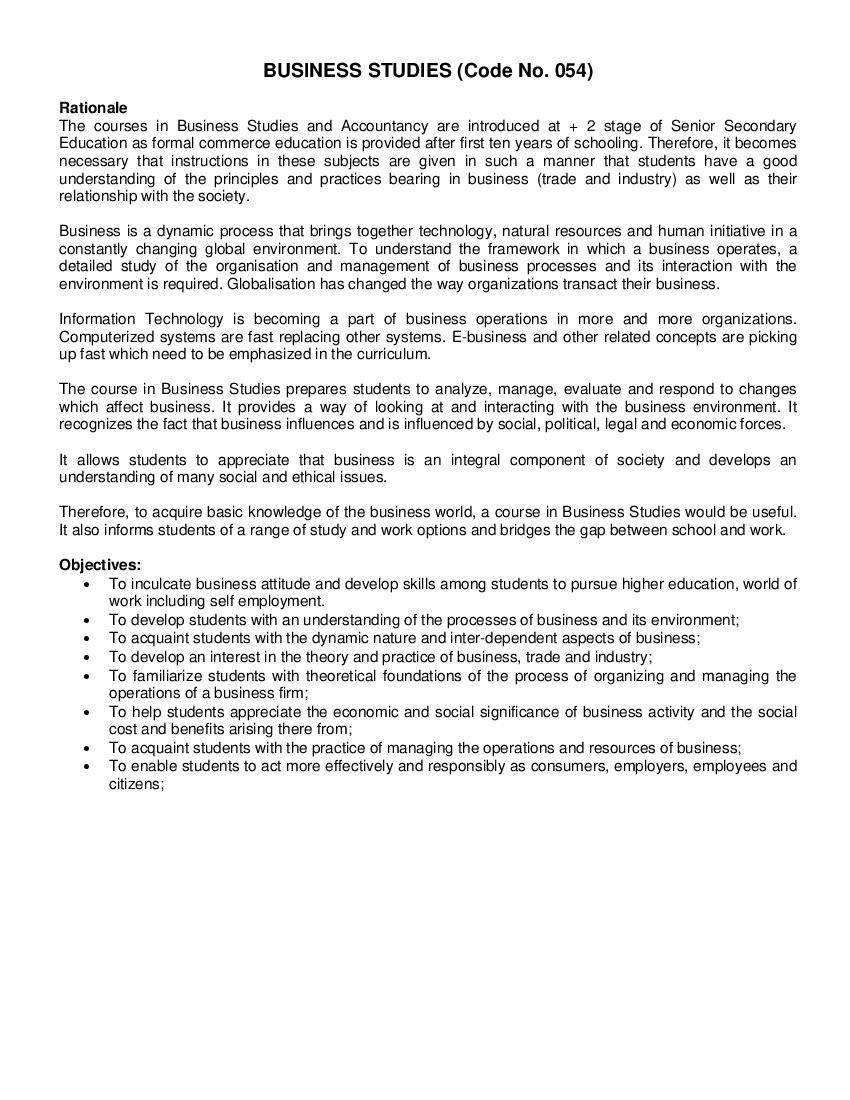
Rationale
The courses in Business Studies and Accountancy are introduced at + 2 stage of Senior Secondary
Education as formal commerce education is provided after first ten years of schooling. Therefore, it becomes
necessary that instructions in these subjects are given in such a manner that students have a good
understanding of the principles and practices bearing in business (trade and industry) as well as their
relationship with the society.
Business is a dynamic process that brings together technology, natural resources and human initiative in a
constantly changing global environment. To understand the framework in which a business operates, a
detailed study of the organisation and management of business processes and its interaction with the
environment is required. Globalisation has changed the way organizations transact their business.
Information Technology is becoming a part of business operations in more and more organizations.
Computerized systems are fast replacing other systems. E-business and other related concepts are picking
up fast which need to be emphasized in the curriculum.
The course in Business Studies prepares students to analyze, manage, evaluate and respond to changes
which affect business. It provides a way of looking at and interacting with the business environment. It
recognizes the fact that business influences and is influenced by social, political, legal and economic forces.
It allows students to appreciate that business is an integral component of society and develops an
understanding of many social and ethical issues.
Therefore, to acquire basic knowledge of the business world, a course in Business Studies would be useful.
It also informs students of a range of study and work options and bridges the gap between school and work.
Objectives:
• To inculcate business attitude and develop skills among students to pursue higher education, world of
work including self employment.
• To develop students with an understanding of the processes of business and its environment;
• To acquaint students with the dynamic nature and inter-dependent aspects of business;
• To develop an interest in the theory and practice of business, trade and industry;
• To familiarize students with theoretical foundations of the process of organizing and managing the
operations of a business firm;
• To help students appreciate the economic and social significance of business activity and the social
cost and benefits arising there from;
• To acquaint students with the practice of managing the operations and resources of business;
• To enable students to act more effectively and responsibly as consumers, employers, employees and
citizens;
Page 2
CLASS–XI (2020-21)
Theory: 80 Marks 3 Hours
Project: 20 Marks
Units Periods Marks
Part A Foundations of Business
1 Evolution and Fundamentals of Business 18 16
2 Forms of Business Organisations 20
3 Public, Private and Global Enterprises 10 14
4 Business Services 14
5 Emerging Modes of Business 05 10
6 Social Responsibility of Business and Business Ethics 08
Total 75 40
Part B Finance and Trade
7 Sources of Business Finance 28 20
8 Small Business and Entrepreneurship Development 16
9 Internal Trade 22 20
10 International Business 04
Total 70 40
Project Work 20 20
Part A: Foundation of Business
Concept includes meaning and features
Unit 1: Evolution and Fundamentals of Business
Content After going through this unit, the student/
learner would be able to:
History of Trade and Commerce in India: • To acquaint the History of Trade and
Indigenous Banking System, Rise of Commerce in India
Intermediaries, Transport, Trading Communities:
Merchant Corporations, Major Trade Centers,
Major Imports and Exports, Position of Indian Sub-
Continent in the World Economy.
• Understand the meaning of business with
Business – meaning and characteristics special reference to economic and non-
economic activities.
• Discuss the characteristics of business.
Business, profession and employment-Concept • Understand the concept of business,
profession and employment.
• Differentiate between business, profession
and employment.
Objectives of business • Appreciate the economic and social
objectives of business.
• Examine the role of profit in business.
Classification of business activities - Industry and • Understand the broad categories of
Commerce business activities- industry and
commerce.
Industry-types: primary, secondary, tertiary • Describe the various types of industries.
Meaning and subgroups
Page 3
wholesale and retail) and auxiliaries to trade; and auxiliaries to trade.
(banking, insurance, transportation, warehousing, • Discuss the meaning of different types of
communication, and advertising) – meaning trade and auxiliaries to trade.
• Examine the role of commerce- trade and
auxiliaries to trade.
• Understand the concept of risk as a
Business risk-Concept special characteristic of business.
• Examine the nature and causes of
business risks.
Unit 2: Forms of Business organizations
Sole Proprietorship-Concept, merits and • List the different forms of business
limitations. organizations and understand their
meaning.
• Identify and explain the concept, merits
and limitations of Sole Proprietorship.
Partnership-Concept, types, merits and limitation • Identify and explain the concept, merits
of partnership, registration of a partnership firm, and limitations of a Partnership firm.
partnership deed. Types of partners • Understand the types of partnership on the
basis of duration and on the basis of
liability.
• State the need for registration of a
partnership firm.
• Discuss types of partners –active,
sleeping, secret, nominal and partner by
estoppel.
Hindu Undivided Family Business: Concept • Understand the concept of Hindu
Undivided Family Business.
• Identify and explain the concept, merits
Cooperative Societies-Concept, types, merits, and and limitations of Cooperative Societies.
limitations. • Understand the concept of consumers,
producers, marketing, farmers, credit and
housing co-operatives.
Company - Concept, merits and limitations; Types: • Identify and explain the concept, merits
Private, Public and One Person Company – and limitations.
Concept • Understand the concept of private and
public company and one person company.
• Understand the meaning of one person
company.
• Distinguish between a private company
and a public company.
Formation of company - stages, important • Highlight the stages in the formation of a
documents to be used in the formation of a company.
company • Discuss the important documents used in
the various stages in the formation of a
company.
Page 4
Public sector and private sector enterprises – • Develop an understanding of Public sector
Concept and private sector enterprises
Forms of public sector enterprises: Departmental • Identify and explain the features, merits
Undertakings, Statutory Corporations and and limitations of different forms of public
Government Company. sector enterprises
Unit 4: Business Services
Business services – meaning and types. Banking: • Understand the meaning and types of
Types of bank accounts - savings, current, business services.
recurring, fixed deposit and multiple option deposit • Develop an understanding of different
account types of bank accounts.
Banking services with particular reference to Bank • Develop an understanding of the different
Draft, Bank Overdraft, Cash credit. E-Banking services provided by banks
meaning, Types of digital payments
Insurance – Principles. Types – life, health, fire • Understand Utmost Good Faith, Insurable
and marine insurance – concept Interest, Indemnity, Contribution, Doctrine
of Subrogation and Causa Proxima as
principles of insurance
• Discuss different types of insurance-life,
health, fire, marine insurance
Unit 5: Emerging Modes of Business
E - business: concept, scope and benefits • Give the meaning of e-business.
• Discuss the scope of e-business.
• Appreciate the benefits of e-business
• Distinguish e-business from traditional
business.
Unit 6: Social Responsibility of Business and Business Ethics
Concept of social responsibility • State the concept of social responsibility.
Case for social responsibility • Examine the case for social responsibility.
Responsibility towards owners, investors, • Identify social responsibilities towards
consumers, employees, government and different interest groups.
community.
Role of business in environment protection • Appreciate the role of business in
environment protection.
Part B: Finance and Trade
Unit 7: Sources of Business Finance
Business finance: Concept and Importance • State the meaning, nature and importance
of business finance.
Owners’ funds- equity shares, preferences share, • Classify the various sources of funds into
retained earnings, Global Depository receipt owners’ funds.
(GDR), American Depository Receipt (ADR) and • State the meaning of owners’ funds.
International Depository Receipt (IDR) – concept • Understand the meaning of Global
Depository receipts, American Depository
Receipts and International Depository
Receipts.
Page 5
financial institution and commercial banks, public • Discuss the concept of debentures, bonds,
deposits,trade credit and loans from financial institutions and
commercial banks, Trade credit
• Distinguish between owners’ funds and
borrowed funds.
Unit 8: Small Business and Entrepreneurship Development
Entrepreneurship Development (ED): Concept and • Understand the concept and need of
Need. Process of Entrepreneurship Development: Entrepreneurship Development (ED),
Start-up India Scheme, ways to fund start-up. Intellectual Property Rights
Intellectual Property Rights and Entrepreneurship • Understand the process of
Entrepreneurship Development
Small scale enterprise – Definition • Understand the definition of small
enterprises
Role of small business in India with special • Discuss the role of small scale business in
reference to rural areas India with special reference to rural areas
Government schemes and agencies for small • Appreciate various schemes of NSIC and
scale industries: National Small Industries DIC with special reference to rural,
Corporation (NSIC) and District Industrial Centre backward area.
(DIC) with special reference to rural, backward
areas
Unit 9: Internal Trade
Internal trade - meaning and types of services • State the meaning and types of internal
rendered by a wholesaler and a retailer trade.
• Appreciate the services of wholesalers and
retailers.
Large scale retailers-Departmental stores, chain • Highlight the distinctive features of
stores – concept departmental stores, chain stores
Unit 10: International Trade
International trade: concept and benefits • Understand the concept of international
trade.
• Describe the benefit of international trade
to the nation and business firms.
Unit 11: Project Work
As per CBSE guidelines.
Document Details
| Board / Org | CBSE |
| Exam | Class 11 |
| Type | Syllabus |
| Pages | 5 |
| Updated | 22 Jul 2026 |