GATE 2026 Syllabus for TF
Finished viewing? Save it for later —
Download GATE 2026 Syllabus for TF (PDF · 3 pages)About GATE 2026 Syllabus for TF
GATE 2026 Syllabus for TF is available here for free download. Published by IIT for GATE, this syllabus can be viewed online or downloaded as a PDF (3 pages). Candidates preparing for GATE can use GATE 2026 Syllabus for TF to understand the exam pattern, the type of questions asked, and the overall difficulty level.
Frequently Asked Questions
How can I download GATE 2026 Syllabus for TF?
Open this page and click the Download button to save GATE 2026 Syllabus for TF as a PDF. It is completely free on AglaSem Docs.
Is GATE 2026 Syllabus for TF free to download?
Yes. GATE 2026 Syllabus for TF can be viewed online and downloaded as a PDF free of cost on AglaSem Docs.
How many pages does GATE 2026 Syllabus for TF have?
GATE 2026 Syllabus for TF contains 3 pages, which you can read online or download together as a single PDF.
Where can I find more GATE study material?
You can find more GATE question papers, sample papers, syllabus, and answer keys on AglaSem Docs.
GATE 2026 Syllabus for TF – Text
Read the full text of this syllabus below — useful to quickly search, copy and reference the content online without downloading the PDF.
📄 View text version (3 pages)
Page 1
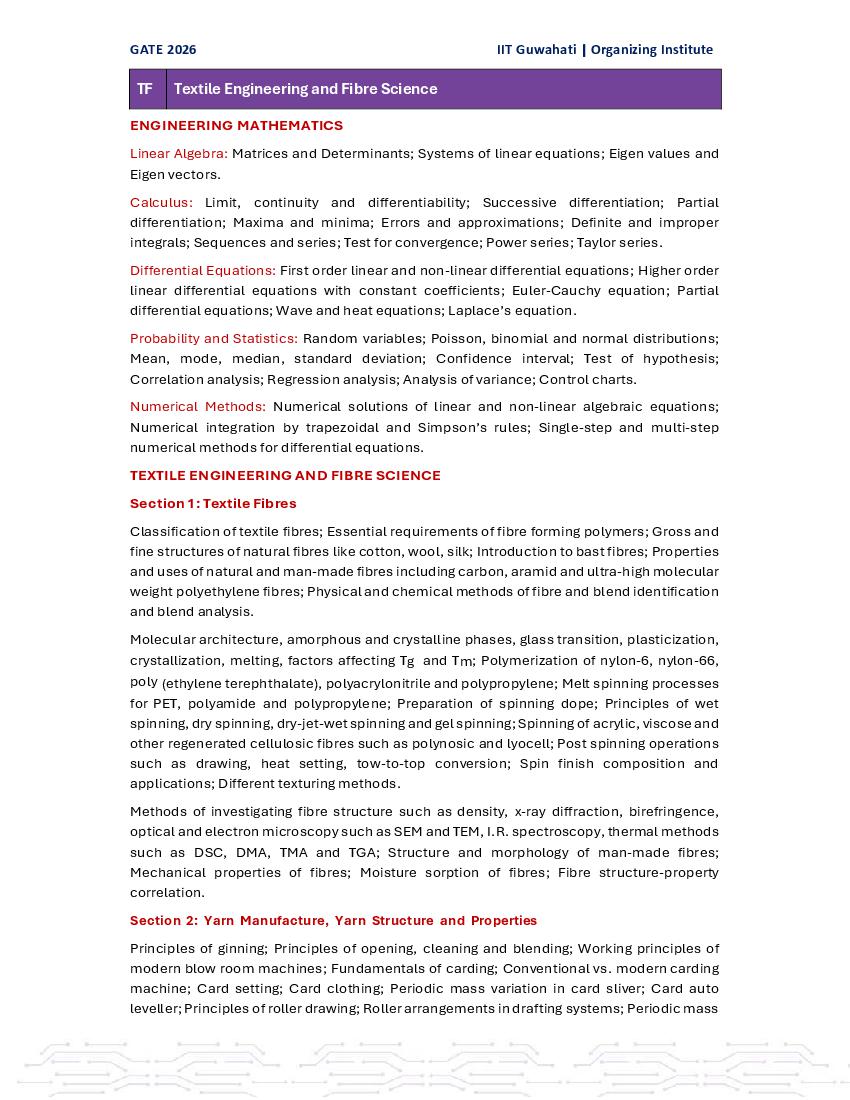
TF Textile Engineering and Fibre Science
ENGINEERING MATHEMATICS
Linear Algebra: Matrices and Determinants; Systems of linear equations; Eigen values and
Eigen vectors.
Calculus: Limit, continuity and differentiability; Successive differentiation; Partial
differentiation; Maxima and minima; Errors and approximations; Definite and improper
integrals; Sequences and series; Test for convergence; Power series; Taylor series.
Differential Equations: First order linear and non-linear differential equations; Higher order
linear differential equations with constant coefficients; Euler-Cauchy equation; Partial
differential equations; Wave and heat equations; Laplace’s equation.
Probability and Statistics: Random variables; Poisson, binomial and normal distributions;
Mean, mode, median, standard deviation; Confidence interval; Test of hypothesis;
Correlation analysis; Regression analysis; Analysis of variance; Control charts.
Numerical Methods: Numerical solutions of linear and non-linear algebraic equations;
Numerical integration by trapezoidal and Simpson’s rules; Single-step and multi-step
numerical methods for differential equations.
TEXTILE ENGINEERING AND FIBRE SCIENCE
Section 1: Textile Fibres
Classification of textile fibres; Essential requirements of fibre forming polymers; Gross and
fine structures of natural fibres like cotton, wool, silk; Introduction to bast fibres; Properties
and uses of natural and man-made fibres including carbon, aramid and ultra-high molecular
weight polyethylene fibres; Physical and chemical methods of fibre and blend identification
and blend analysis.
Molecular architecture, amorphous and crystalline phases, glass transition, plasticization,
crystallization, melting, factors affecting Tg and Tm; Polymerization of nylon-6, nylon-66,
poly (ethylene terephthalate), polyacrylonitrile and polypropylene; Melt spinning processes
for PET, polyamide and polypropylene; Preparation of spinning dope; Principles of wet
spinning, dry spinning, dry-jet-wet spinning and gel spinning; Spinning of acrylic, viscose and
other regenerated cellulosic fibres such as polynosic and lyocell; Post spinning operations
such as drawing, heat setting, tow-to-top conversion; Spin finish composition and
applications; Different texturing methods.
Methods of investigating fibre structure such as density, x-ray diffraction, birefringence,
optical and electron microscopy such as SEM and TEM, I.R. spectroscopy, thermal methods
such as DSC, DMA, TMA and TGA; Structure and morphology of man-made fibres;
Mechanical properties of fibres; Moisture sorption of fibres; Fibre structure-property
correlation.
Section 2: Yarn Manufacture, Yarn Structure and Properties
Principles of ginning; Principles of opening, cleaning and blending; Working principles of
modern blow room machines; Fundamentals of carding; Conventional vs. modern carding
machine; Card setting; Card clothing; Periodic mass variation in card sliver; Card auto
leveller; Principles of roller drawing; Roller arrangements in drafting systems; Periodic mass
Page 2
variation in drawn sliver; Draw frame auto leveller; Principles of cotton combing; Combing
cycle and mechanisms; Recent developments in combing machine; Principles of drafting,
twisting, and bobbin building in roving formation; Modern developments in roving machine;
Principles of drafting, twisting and cop building in ring spinning; Causes of end breakages;
Modern developments in ring spinning machine; Working principles of ring doubler and two-
for-one twister; Relationship between single yarn twist and folded yarn twist; Principles of
compact, rotor, air-jet, air-vortex, friction, core, wrap and twist-less spinning processes.
Influence of fibre geometry, fibre configuration and fibre orientation in yarn; Fibre packing
density of yarn; Yarn diameter; Yarn twist and its relation to yarn strength; Helical
arrangement of fibres in yarns; Yarn contraction; Fibre migration in yarns; Stress-strain
relation in yarn; Mass irregularity of yarn; Structure-property relationship in ring, compact,
rotor, air-jet and friction spun yarns.
Section 3: Fabric Manufacture, Structure and Properties
Principles of winding processes; Classification of winding methods; Patterning mechanism;
Yarn clearers and tensioners; Different systems of yarn splicing; Warping objectives and
classification; Different types of warping creels; Features of beam and sectional warping
machines; Different sizing systems; Sizing of spun and filament yarns;Drawing-in process;
Principles of pirn winding.
Primary and secondary motions of loom; Shedding motion; Positive and negative shedding
mechanisms; Type of sheds; Tappet, dobby and jacquard shedding; Weft insertion;
Mechanics of weft insertion with shuttle; Shuttle picking and checking; Beat-up; Kinematics
of sley; Loom timing diagram; Cam designing; Effect of sley setting and cam profile on fabric
formation; Take- up and Let-off motions; Warp and weft stop motions; Warp protection; Weft
replenishment; Principles of weft insertion systems of shuttle-less weaving machines such
as projectile, rapier, water-jet and air-jet; Principles of functioning of multiphase and
circular looms; Types of selvedges.
Basic woven fabric constructions and their derivatives; Crepe, cord, terry, gauze, leno
and double cloth constructions; Drawing and lifting plans.
Fundamentals of weft knitting; Classification of weft knitting technologies; Weft knitted
constructions such as plain, rib, interlock and purl; Different knit stitches such as loop, tuck
and float. Principle of warp knitting; Classification of warp knitting technologies; Swinging
and shogging motion of guide bar; Basic warp knit construction such as pillar, tricot,
atlas, inlay and nets.Fibre preparation processes for nonwovens; Web formation and
bonding processes;Spun-bonding and melt-blowing technologies; Applications of
nonwoven fabrics.
Principles of braiding; Type of braids; Maypole braiding technology. Peirce’s equations for
plain woven fabric geometry; Elastic a model of plain-woven fabric; Thickness, cover and
maximum set of woven fabrics; Geometry of plain weft knitted loop; Munden’s constants
and tightness factor for plain weft knitted fabrics; Geometry of tubular braids.
Section 4: Textile Testing
Sampling techniques for fibres, yarns and fabrics; Sample size and sampling errors.
Moisture in textiles; Fibre length, fineness, crimp, maturity and trash content; Tensile testing
of fibres; High volume fibre testing.
Page 3
Linear density of sliver, roving and yarn; Twist and hairiness of yarn; Tensile testing of yarns;
Evenness testing; Fault measurement and analysis of yarns.
Fabric thickness, compressibility, stiffness, shear, drape, crease recovery, tear strength,
bursting strength, pilling and abrasion resistance; Tensile testing of fabrics; Objective
evaluation of low stress mechanical characteristics; Air permeability; Wetting and wicking;
Water-vapour transmission through fabrics; Thermal resistance of fabrics.
Section 5: Chemical Processing
Impurities in natural fibre; Singeing; Chemistry and practice of preparatory processes for
cotton; Preparatory processing of wool and silk; Mercerization of cotton; Preparatory
processes for manmade fibres and their blends; Optical brightening agent.
Classification of dyes; Dyeing of cotton, wool, silk, polyester, nylon and acrylic with
appropriate classes of dyes; Dyeing of polyester/cotton and polyester/wool blends; Dyeing
machines; Dyeing processes and machines for cotton knitted fabrics; Dye-fibre interaction;
Introduction to thermodynamics and kinetics of dyeing; Brief idea about the relation
between colour and chemical constitution; Beer-Lambert’s law; Kubelka-Munk theory and
its application in colour measurement; Methods for determination of wash, light and rubbing
fastness.
Methods of printing such as roller printing and screen printing; Preparation of printing paste;
Various types of thickeners; Printing auxiliaries; Direct styles of printing of (i) cotton with
reactive dyes, (ii) wool, silk, nylon with acid and metal complex dyes, (iii) polyester with
disperse dyes; Resist and discharge printing of cotton, silk and polyester; Pigment printing;
Transfer printing of polyester; Inkjet printing; Printing faults.
Mechanical finishing of cotton; Stiff, soft, wrinkle resistant, water repellent, flame retardant
and enzyme (bio-polishing) finishing of cotton; Milling, decatizing and shrink resistant
finishing of wool; Antistatic and soil release finishing; Heat setting of synthetic fabrics;
Minimum application techniques. Pollution control and treatment of effluents.
Document Details
| Board / Org | IIT |
| Exam | GATE |
| Type | Syllabus |
| Pages | 3 |
| Updated | 24 Sep 2026 |