GATE 2026 Syllabus for XH
Finished viewing? Save it for later —
Download GATE 2026 Syllabus for XH (PDF · 14 pages)About GATE 2026 Syllabus for XH
GATE 2026 Syllabus for XH is available here for free download. Published by IIT for GATE, this syllabus can be viewed online or downloaded as a PDF (14 pages). Candidates preparing for GATE can use GATE 2026 Syllabus for XH to understand the exam pattern, the type of questions asked, and the overall difficulty level.
Frequently Asked Questions
How can I download GATE 2026 Syllabus for XH?
Open this page and click the Download button to save GATE 2026 Syllabus for XH as a PDF. It is completely free on AglaSem Docs.
Is GATE 2026 Syllabus for XH free to download?
Yes. GATE 2026 Syllabus for XH can be viewed online and downloaded as a PDF free of cost on AglaSem Docs.
How many pages does GATE 2026 Syllabus for XH have?
GATE 2026 Syllabus for XH contains 14 pages, which you can read online or download together as a single PDF.
Where can I find more GATE study material?
You can find more GATE question papers, sample papers, syllabus, and answer keys on AglaSem Docs.
GATE 2026 Syllabus for XH – Text
Read the full text of this syllabus below — useful to quickly search, copy and reference the content online without downloading the PDF.
📄 View text version (14 pages)
Page 1
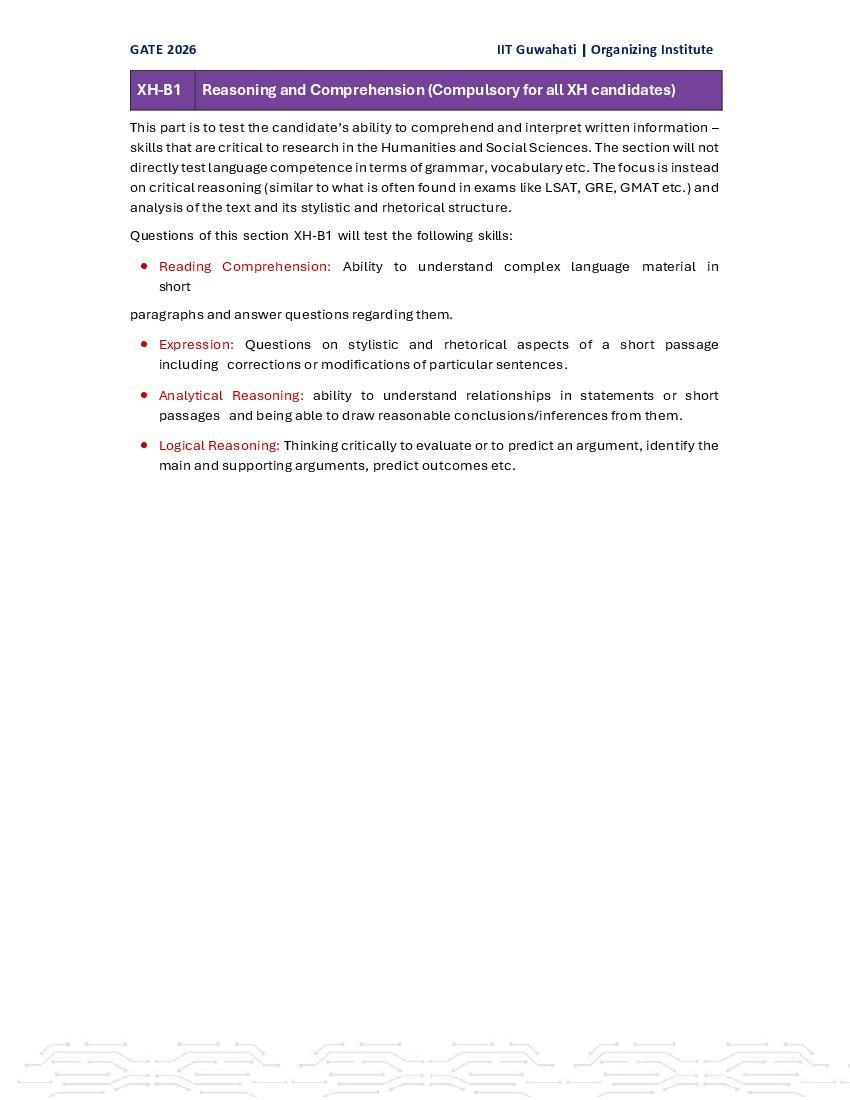
XH-B1 Reasoning and Comprehension (Compulsory for all XH candidates)
This part is to test the candidate’s ability to comprehend and interpret written information –
skills that are critical to research in the Humanities and Social Sciences. The section will not
directly test language competence in terms of grammar, vocabulary etc. The focus is instead
on critical reasoning (similar to what is often found in exams like LSAT, GRE, GMAT etc.) and
analysis of the text and its stylistic and rhetorical structure.
Questions of this section XH-B1 will test the following skills:
Reading Comprehension: Ability to understand complex language material in
short
paragraphs and answer questions regarding them.
Expression: Questions on stylistic and rhetorical aspects of a short passage
including corrections or modifications of particular sentences.
Analytical Reasoning: ability to understand relationships in statements or short
passages and being able to draw reasonable conclusions/inferences from them.
Logical Reasoning: Thinking critically to evaluate or to predict an argument, identify the
main and supporting arguments, predict outcomes etc.
Page 2
XH-C1 Economics
C1.1 Microeconomics: Theory of Consumer Behaviour: Cardinal Approach and Ordinal
Approach; Consumer Preferences; Nature of the utility function; Marshallian and Hicksian
demand functions; Duality Theorem. Slutsky equation and Comparative Statics.
Homogeneous and Homothetic Utility Functions; Euler’s Theorem. The Theory of Revealed
Preference: Weak Axiom of Revealed Preference and Strong Axiom of Revealed Preference,
Theory of Production and Costs: Short-run and Long-run Analysis, Existence, Uniqueness
and Stability of Market Equilibrium: Walrasian and Marshallian Stability Analysis. The
Cobweb Model, Decision making under uncertainty and risk. Asymmetric Information:
Adverse Selection and Moral Hazard. Theory of Agency costs. The Theory of Search, Non-
Cooperative games: Constant sum game, Mixed Strategy & Pure Strategy, Bayesian Nash
Equilibrium, SPNE, Perfect Bayesian Equilibria., Theory of Firm: Market Structures —
Competitive and Non- competitive equilibria and their efficiency properties. Structure-
Conduct-Performance Paradigm, Factor Pricing: Marginal productivity Theory of Distribution
in Perfectly Competitive markets; Theory of Employment in Imperfectly Competitive Markets
— Monopolistic Exploitation, General Equilibrium Analysis. Welfare Economics:
Fundamental Theorems, Social Welfare Function. Efficiency Criteria: Pareto-Optimality.
C1.2 Macroeconomics: National Income Accounting: Closed Economy Concepts and
Measurement and Open Economy Issues, Determination of output and employment:
Classical & Keynesian Framework, Theories of Consumption: Absolute Income Hypothesis,
Relative Income Hypothesis, Life Cycle Hypothesis, Permanent Income Hypothesis and
Robert Hall’s Random Walk Model; Investment Function Specifications - Dale Jorgenson’s
Neoclassical Theory of Capital Accumulation and Tobin’s, Keynesian Stabilization Policies,
(Autonomous) Multipliers and Investment Accelerator, Demand and Supply of Money,
Components of Money Supply, Liquidity Preference and Liquidity Trap, Money Multiplier,
Interest Rate determination, Central Banking, Objectives, Instruments (Direct and Indirect)
of Monetary Policy, Prudential Regulation, Quantitative Easing (Unconventional Monetary
Policy), Commercial Banking, Non- Banking Financial Institutions, Capital Market and its
Regulation, Theories of Inflation and Expectations Augmented Phillips Curve, Real Business
Cycles, Adaptive Expectations Hypothesis, Rational Expectation Hypothesis and its critique.
Closed Economy IS – LM Model and Mundell Fleming Model: Monetary and Fiscal Policy
Efficacy. The Impossible Trinity.
C1.3 Statistics, Econometrics and Mathematical Economics: Probability Theory:
Concepts of probability, Probability Distributions [Discrete and Continuous], Central
Limit Theorem, Index Numbers and Construction of Price Indices, Sampling Methods &
Sampling Distribution, Statistical Inferences, Hypothesis Testing, Linear Regression
Models and the Gauss Markov Theorem, Heteroscedasticity, Multicollinearity and
Autocorrelation, Spurious regressions and Unit roots, Simultaneous Equation Models –
recursive and non-recursive. Identification Problem, Differential Calculus and its
Applications, Linear Algebra – Matrices, Applications of Cramer’s Rule, Static Optimization
Problems and Applications, Input-Output Model, Linear Programming, Difference
equations and Differential equations with applications.
C1.4 International Economics: Theories of International Trade, International Trade under
Imperfect Competition, Gains from Trade, Terms of Trade, Trade Multiplier, Tariff and Non-
Tariff barriers to trade; Dumping and Anti-Dumping Policies, GATT, WTO and Regional Trade
Page 3
Blocks; Trade Policy Issues, Balance of Payments: Composition, Equilibrium and
Disequilibrium and Adjustment Mechanisms, Foreign Exchange Market and Arbitrage,
Exchange rate determination, IMF & World Bank.
C1.5 Public Economics: Market Failure and Remedial Measures: Asymmetric
Information, Public Goods, Externality, Regulation of Market – Collusion and Consumers’
Welfare, Public Revenue: Tax & Non-Tax Revenue, Direct & Indirect Taxes, Progressive
and non-Progressive Taxation, Incidence and Effects of Taxation, Public expenditure,
Public Debt and its management, Public Budget and Budget Multiplier, Tax Incidence,
Fiscal Policy and its implications, Environment as a Public Good, Market Failure and Coase
Theorem, Cost-Benefit Analysis.
C1.6 Development Economics: Theories of Economic Development: Adam Smith, David
Ricardo, Karl Marx, J. Schumpeter, W. Rostow, Balanced & Unbalanced Growth, Big Push
Approach, Indicators of Economic Development: HDI, SDGs, MDGs, Poverty and
Inequalities – Concepts and Measurement Issues, Social Sector Development: Health,
Education, Gender, Fertility, Morbidity, Mortality, Migration, Child Labor, Age Structure,
Demographic Dividend, Models of Economic Growth: Harrod-Domar, Solow, Ramsey,
Technical progress – Disembodied & Embodied, Endogenous Growth Models.
C1.7 Indian Economy: Economic Growth in India: Pattern and Structure, Agriculture,
Industry & Services Sector: Pattern & Structure of Growth, Major Challenges, Policy
Responses, Rural & Urban Development – Issues, Challenges & Policy Responses, Flow of
Foreign Capital, Trade Policies, Infrastructure Development: Physical and Social; Public-
Private Partnerships, Reforms in Land, Labour and Capital Markets, Poverty, Inequality &
Unemployment, Functioning of Monetary Policy in India, Fiscal Policy in the Indian context:
Structure of Receipts and Expenditure, Tax reforms-Goods and Services Tax, Issues of
Growth and Equity, Fiscal Federalism, Centre-State Financial Relations and Finance
Commissions of India; Sustainability of Deficits and Debt, The Fiscal Responsibility and
Budget Management Act 2003, Demonetization and aftermath. India’s balance of payments,
Composition of India’s Trade, Competitiveness of India’s exports, India’s exchange rate
policy.
Page 4
XH-C2 English
C2.1 Multi-genre literatures in English—poetry, the novel and other forms of fiction including
the short story, drama, creative non-fiction, and non-fiction prose—with emphasis on the
long 19th and 20th centuries.
C2.2 Especially in a comparative context, anglophone and in English translation, literatures
from India and, extending to some degree, the larger Indian subcontinent.
C2.3 Literary criticism and theory; critical and cultural intellectual-traditions and
approaches widely referred to and used in the discipline of English.
C2.4 History of English literature and English literary studies.
C2.5 Research approaches and methodologies, including interpretive techniques
responsive to literary forms, devices, concepts, and genres.
Note:
(i) The five units above list aspects that the question paper will include rather than single
separate modules or sections. These five units listed are not necessarily exclusive to
each other either. The question paper will also not be divided into sections corresponding
to the above aspects; and
(ii) While the paper will test candidates for a reasonable breadth of disciplinary knowledge,
it would prioritize conceptual depth and methodological sensitivity demonstrative of
disciplinary training over information, wherever possible.
Page 5
XH-C3 Linguistics
C3.1 Language and Linguistics
Language spoken, written and signed; description and prescription; language and cultural
heritage; language and social identity; language as an object of inquiry – its structure, units
and components; design features; writing systems; biological foundations and language
faculty; linguistic competence and performance; levels of grammar; contrast and
complementation; rules - context dependent and context free; levels of adequacy for
analysis; interdisciplinary approaches; schools of linguistic thought (European, American)
and the Indian Grammatical Tradition.
C3.2 Levels of Grammar and Grammatical Analysis
A. Phonetics and Phonology: Vocal tract anatomy; phonation; articulatory
parameters; classification of sounds; gestural theory of speech production; cardinal vowels;
secondary and co-articulation; suprasegmentals - length, stress, tone, intonation and
juncture; IPA; basic physics of sound and of phonation and articulation; acoustic cues
for speech sounds; organisation of phones into phonemes; phoneme inventories and cross-
linguistic properties; syllable structure and phonological properties; principles of phonological
analysis - phonetic similarity, contrastive and complementary distribution, free variation,
allophones; linear and non-linear approaches; levels of representation; phonological
rules; distinctive features (major class, manner, place, etc.); feature geometry; rule
ordering, markedness and unspecified featural values; core principles of lexical
phonology, optimality theory, autosegmental phonology and prosodic morphology.
B. Morphology: Concepts of morpheme, morph, allomorph, zero allomorph, conditions on
allomorphs; lexeme and word; types of morphemes – structural and functional; affixes vs
clitics; grammatical categories; morphological theories – generative, lexicalist, process and
distributed morphology; identification of morphemes and parts of speech; alternation;
morphophonology; inflection vs. derivation; conjugation and declension; word creation and
word formation rules and processes; creativity and productivity, blocking, bracketing
paradoxes, constraints on affix ordering; mental lexicon; lexical categories; valency
changing operations.
C Syntax: Basic syntactic units and their types: word, phrase, clause, sentence and their
description and generation; grammatical and case relations; key ideas fromsyntactic
theories, Generative Grammars including Minimalist Program, HPSG, Relational Grammar
and Lexical Functional Grammar; phrase structure rules (including X-bar theory); universal
grammar and cross-linguistic properties; idea of grammaticality judgements; solving the
language acquisition problem; diagnostics of structure; syntactic phenomena such as
movement, binding, ellipses, case-checking, islands, argument structure etc.; unergatives
and unaccusatives.
A. Semantics and Pragmatics: Types of meaning, lexical and compositional; syntax-
semantics interface (semantic roles, binding, scope, LF etc.); sense and reference,
connotation and denotation, lexical semantic relations (homonymy, hypo/hypernymy,
antonymy, synonymy, ambiguity); prototype theory and componential analysis; sentence
meaning and truth conditions, contradictions, entailment; basic set theory; propositions,
truth values, sentential connectives; arguments, predicates, quantifiers, variables;
in/definiteness, mood and modality; language use in context; sentence meaning and
Page 6
utterance meaning; speech acts; deixis; presupposition and implicature: Gricean maxims;
information structure; politeness, power and solidarity; discourse analysis.
C3.3 Historical Linguistics
Neogrammarian laws of phonetic change such as Grimm’s, Verner’s, Grassmann’s Laws;
genesis and spread of sound change; split and merger; conditioned vs. unconditioned
change; lexical diffusion of sound change; analogical changes and paradigm levelling;
relative chronology of different changes; study of sound change in progress;
morphosyntactic (syncretism, grammaticalisation and lexicalisation) and semantic change
(extension, narrowing, figurative speech); linguistic reconstruction - external vs. internal: the
comparative method; lexicostatistics; language contact and dialect geography – borrowing
and impact of borrowing; pidgins and creoles; bi- and multilingualism as the source for
borrowing; dialect geography - dialect atlas; isogloss, focal, transition and relic areas.
C3.4 Sociolinguistics
Micro-and macro approaches to language in society; linguistic repertoire language,
dialect, sociolect, idiolect; diglossia; taboo, slang and euphemism; elaborated and
restricted codes; speech community and communicative competence; ethnography of
speaking; lingua franca; diasporic language; linguistic variables and their co-variation
along linguistic/social dimensions; language policies and development (especially
inIndia); language contact and outcomes (language loss, pidginization and creolization);
code-mixing and code-switching; language movements – state and societal
interventions; script development and modifications; linguistic minorities; language
ecology and endangerment linguistic vitality, language endangerment (EGIDS scale),
parameters of endangerment, documentation and revitalisation.
C3.5 Areal Typology, Universals, Cross-linguistic Features
Morphological types of languages agglutinative, analytical (isolating), synthetic fusional
(inflecting), polysynthetic (incorporating) languages; formal and substantive universals,
absolute and statistical universals; implicational and non-implicational universals
(Greenberg); linguistic relatedness—genetic, typological and areal classification of
languages; universals and parametric variation; word order typology; salient features of
South Asian languages - Indo-Aryan, Dravidian, Austro-Asiatic, and Tibeto-Burman language
families; Linguistic Survey of India; contact induced typological change.
C3.6 Methods of Analysis
Experimental and non-experimental methods; sampling and tools; identification of variables
and their variants; data processing and interpretation; quantitative analysis of data;
ethnomethodology; participant observation; field methods and elicitation; document
creation; ethics.
C3.7 Applied Linguistics
Psycholinguistics — the study of how humans learn, represent, comprehend, and produce
language. Topics include word recognition and storage, sentence production and
comprehension, reading, speech perception, language acquisition, neural representation of
language, bilingualism, and language disorders.
Page 7
XH-C4 Philosophy
C4.1 Classical Indian Philosophy
C4.1.1 Orthodox Systems: Sānkhya- Puruṣa, Prak‐ti, Gu‐as, Satkāryavāda, Mokṣa
(Kaivalya), Pramā‐as and Theory of Error, Yoga – Pramā‐as, Theory of Error, Iśvara, Citta,
Kleśa, Aṣ‐ānga- yoga, Kaivalya (Mokṣa), Nyāya – Pramā‐as, Hetvābhāsa, Iśvara,
Asatkāryavāda, Theory of Error, Navya-Nyāya, Vaiśeṣika – Parata‐prāmā‐ya, Padārthas
(categories), Theory of Atomism (paramā‐uvāda), Mīmāmsā– Dharma, Apūrva, Mokṣa,
Pramā‐as (both in Kumārila and Prabhākara), Anyathākhyāti, and, Vedānta– Advaita
(Adhyāsa, Brahman, Iśvara, Ātman, Jīva, Mokṣa, Viśiṣ‐ādvaita (Tattva-traya, Mokṣa, and
Refutation of Māyāvāda), Dvaita, Dvaitādvaita, Śuddhādvaita, Pramā‐a in Advaita and
Viśiṣ‐ādvaita.
C4.1.2 Heterodox Systems: Cārvāka – Pramā‐a, Indian marerislism and Hedonism,
Jainism- Pramā‐as, Syādvāda, Anekāntavāda, Padārtha (categories), Jīva and Ajīva, Mokṣa,
Mahāvrata, A‐uvrata, and, Buddhism – Ti-pi‐aka, Sarvāstivāda, Sautrāntika, Mādhyamika,
Yogācāra- Vijñānavāda, Pañca-skandha, Anityavāda, Anātmavāda, Doctrine of
Momentariness, Doctrine of Dependent Origination, Pramānas, Doctrine of Two Truths,
Doctrine of Tri-kāya, Ṣa‐- pāramitās, Brahmavihāras, Pāñcaśīla, and Bodhisattva Ideal, and
Upāyakauśalya.
C4.1.3 Upaniṣads, Bhagavadgītā, and Dharmaśāstras: Philosophy of the Upaniṣads –
Pure Monism, Brahmam and Ātman, Pañca-kośa, Parā-vidyā and Aparā-vidyā, Meaning of
Dharma, ‐ta, Purusārtha, Śreyas and Preyas, Var‐āśrama-dharma, Dharma- Svadharma and
Sādhāra‐a Dharma, ‐na, Yajña, Karma-yoga, Sthitaprajña, Lokasa‐graha, and Law of
Karma.
C4.1.4 KāṣmiraŚaivism, Śaivasiddhānta, VīraŚaivism, Śāktism and Vaiṣ‐avism:
KāṣmīraŚaivism – Pratyābhijña school, Śiva and Śakti, and Conception of Kriyā,
Śaivasiddhānta – God (pati) and Divine Power (śakti), Proofs for God’s Existence, Bondage and
Liberation, VīraŚaivism – Philosophical basis of VīraŚaivism, Śāktism - Philosophical
basis of Śāktism, and Vaiṣ‐avism – Philosophical basis of Vaiṣ‐avism.
C4.2 Contemporary Indian Philosophy
C4.2.1 Vivekananda: Notion of God, Freedom and Karma, Nature of Soul/self, Practical
Vedanta, and Universal Religion. Aurobindo: World Process – Involution and Evolution, Four
Theories of Existence, The Supermind, Integral Yoga, and Gnostic Being. Iqbal: Nature
of Intuition, Nature of Self, and Notion of God. Tagore: Humanism and Nature of Man, Notion of
Religion, and Nationalism. K. C. Bhattacharyya: Concept of Absolute and Its Alternative
Forms, and Notion Subjectivity and Freedom. Radhakrishnan: Nature of Ultimate
Reality, Religious Experience, Intellect and Intuition, Hindu View of Life. J. Krishnamurti:
Notion of Freedom, Choiceless Awareness, Truth is a Pathless Land, and Notion of
Education. Gandhi: Notion of Truth, Non-violence, Satyagraha, Swaraj, and Trusteeship.
Ambedkar: Annihilation of Caste, Neo-Buddhism, Democracy, and Natural Rights and
Law. M. N. Roy: Radical Humanism and Materialism.
C4.3 Classical and Modern Western Philosophy
C4.3.1 Metaphysics: Pre-Socratic Philosophy of Thales, Anaxagoras, Anaximenies, Ionians,
Pythagoras, Parmenides, Heraclitus and Democritus. Metaphysics of Plato and Aristotle:
Page 8
The question of Being (to on/ousia): Being as Idea in Plato's Phaedo, Republic and the
Sophist, Being as synthesis of hyle [matter] and morphe [form] in Aristotle's Metaphysics
and Physics. Problem of evil and existence of God in St. Augustine, St. Anselm, and St.
Thomas Aquinas Metaphysics in Modern Philosophy: Substance, Mind-Body Dualism,
Attribute, Parallelism, Pre-established harmony, the existence of God, Problem of
Solipsism, Self and Personal Identity, Rejection of Metaphysics, Phenomena and Noumena,
Transcendental Deduction of Categories, Being and Becoming, Absolute Idealism
C4.3.2 Epistemology: Plato and Aristotle’s Theory of Knowledge, Doxa, Episteme, and
Sophia, Method of Dialectics, Theoretical and Practical Reason, Theory of Causation,
Descarte’s Method of Doubt, cogito ergo sum, Innate Ideas and its refutation, Principle of
Non- contradiction, Sufficient Reason, and Identity of Indiscernible, Locke’s Three Grades
of Knowledge, Berkeley’s Critique of Abstract Ideas, Hume’s Impressions and Ideas,
Induction and Causality, Kant’s Copernican Revolution, Forms of Sensibility, Possibility of
Synthetic a priori Judgments. Hegel’s Dialectics, Spirit, and Absolute Idealism.
C4.3.3 Ethics: Concepts of Good, Right, Justice, Duty, Obligation, Cardinal Virtues,
Eudaemonism; Intuition as explained in Teleological and Deontological Theories;
Egoism, Altruism, Universalism, Subjectivism, Cultural Relativism, Super-naturalism,
Ethical realism and Intuitionism, Kant’s moral theory, Postulates of Morality, Good-will,
Categorical Imperative, Duty, Means and ends, Maxims; Utilitarianism: Principle of
Utility, Problem of Sanction and Justification of Morality, Moral theories of Bentham, J. S.
Mill, Sidgwick; Theories of Punishment; Ethical Cognitivism and Non-cognitivism,
Emotivism, Prescriptivism, Descriptivism.
C4.3.4 Social and Political Philosophy: Plato’s theory of Justice and State, Aristotle’s
definition of State and Political Naturalism; Classical Liberalism and Social Contract Theory
(Hobbes, Rousseau, Locke); Marx’s Dialectical Materialism, Alienation, and critique of
Capitalism.
C4.3.5 Logic: Truth and Validity, Nature of Propositions, Categorical Syllogism, Laws of
Thought Classification of Propositions Square of Opposition, Truth-Functions and
Propositional Logic, Quantification and Rules of Quantification; Symbolic Logic: Use of
symbols; Truth Table for testing the validity of arguments; Differences between Deductive
and Inductive Logic, Causality and Mill’s Method.
C4.4 Contemporary Western Philosophy
C4.4.1 Frege’s Sense and Reference; Logical Positivism’s Verification theory of
meaning, Elimination of Metaphysics; Moore’s Distinction between Sense and
Reference, Defense of common-sense, Proof of an External World; Russell’s Logical
Atomism, Definite Descriptions,
Refutation of Idealism; Wittgenstein on Language and Reality, the Picture Theory, critique of
private language, Meaning and Use, Forms of life; Gilbert Ryle on Systematically Misleading
Expressions, critique of Cartesian dualism; W.V.O. Quine’s Two Dogmas of Empiricism; P.F.
Strawson’s concept of Person; Husserl’s Phenomenological Method, Philosophy as a
rigorous science, Intentionality, Phenomenological Reduction, Inter-subjectivity;
Heidegger’s concept of Being (Dasein), Being in the world; Sartre’s Concept of Freedom,
Bad-faith, Humanism; Merleau-Ponty on Perception, Embodied Consciousness; William
James’s Pragmatic Theories of Meaning and Truth, Varieties of Religious experience; John
Dewey on Pragmatist Epistemology with focus on Inquiry, fallibilism and Experience,
Page 9
Education; Nietzsche on the Critique of Enlightenment, Will to Power, Genealogy of Moral;
Richard Rorty’s Critique of Representationalism, Against Epistemological method, Edifying
Philosophy, Levinas: Ethics as a first philosophy, Philosophy of ‘other’; Rawls’ Veil of
Ignorance, Principle of Justice; Nozick’s critique of Rawls, Libertarianism: Charles Taylor’s
Communitarianism, critique of the Liberal Self, Politics of recognition; Martha Nussbaum’s
Liberal Feminism and Capability Approach; Simone de Beauvoir on Situated Freedom and
Ethics of Ambiguity; Code and Harding on Situated Knowledge and Strong and Weak
Objectivity; Gilligan and Noddings on Ethics of Care, Debate between Care and Justice.
Page 10
XH-C5 Psychology
C5.1 Research Methods and Statistics
C5.1.1 Approaches to Research: Philosophical worldviews & criteria involved in approach.
Research design: quantitative & qualitative, mixed methods.
C5.1.2 Designing Research: Research problems, purpose statement, Variables and
Operational Definitions, Hypothesis, Sampling.
C5.1.3 Nature of Quantitative & Qualitative Research: Structured, semi-structured
interviewing, self-completion questionnaires (Survey), observation, Experimental, Quasi-
experimental, Field studies, Focus groups discussions, Narratives, Case studies,
Ethnography.
C5.1.4 Ethics in conducting and reporting research.
C5.1.5 Statistics in Psychology: Measures of Central Tendency and Dispersion. Normal
Probability Curve. Parametric and Non-parametric tests Effect size and Power analysis.
C5.1.6 Correlational Analysis: Correlation [Product Moment, Rank Order], Partial
correlation, multiple correlation. Special Correlation Methods: Biserial, Point biserial,
tetrachoric, phi coefficient. Regression: Simple linear regression, Multiple regression.
Factor analysis: Assumptions, Methods, Rotation and Interpretation.
C5.1.7 Experimental Designs: ANOVA [One-way, Factorial], Randomized Block Designs,
Repeated Measures Design, Latin Square, Cohort studies, Time series, MANOVA, ANCOVA.
Single-subject designs.
C5.2 Psychometrics: Foundations of Psychological measurement; Basic components:
scales and items’ Construction and analysis of items: Intelligence test items, performance
tests, Ability & Aptitude test, Personality questionnaires. Method of test construction,
Standardization of measures: Reliability, Validity, Norms, Application of assessment and
measurements in Tests— Applications of psychological testing in various settings-
educations, counselling and guidance, clinical, organizational and developmental.
C5.3 Biological and Evolutionary Basis of Behaviour: Heredity and behaviour Evolution
and natural selection, Nervous system, structures of the brain and their functions, Neurons:
Structure, functions, types, neural impulse, synaptic transmission. Neurotransmitters.
Hemispheric lateralization, The endocrine system types and functions, Biological basis of
Motivation: Hunger, Thirst, Sleep and Sex. Biological basis of emotion: The Limbic system,
Hormonal regulation of behaviour. Methods of Physiological Psychology: Invasive methods
– Anatomical methods, degeneration techniques, lesion techniques, chemical methods,
microelectrode studies, Non-invasive methods – EEG, Scanning methods, Muscular and
Glandular system: Genetics and behaviour: Chromosomal anomalies; Nature-Nurture
controversy [Twin studies and adoption studies].
C5.4 Perception, Learning, Memory and Forgetting: What is sensation, sensory thresholds
and sensory adaptations, Vision, hearing, touch and pain, smell and taste, kinesthesis and
vestibular sense, Perception: role of attention; organizing principles of perception, gestalt
perception, depth perception and illusions, Theories of learning: classical conditioning,
operant conditioning, social learning theory, cognitive learning, Memory: encoding, storage,
retrieval, Information processing theories of memory, Retrieval in Long term memory,
Page 11
reconstructive nature of long-term memory, Forgetting: encoding failure, interference
theory, memory trace decay theory, the physical aspects of memory.
C5.5 Cognition: Thinking, Intelligence and Language: Basic elements of thought:
Concepts, Propositions, Imagery. Current paradigms of cognitive psychology – Information
processing approach, ecological approach, Problem solving: Methods of problem solving,
Strategies and obstacles, Role of Metacognitive processing, decision-making: choosing
among alternatives, Intelligence: Theories of intelligence (Spearman; Thurstone; Jensen;
Cattell; Gardner; Stenberg) and Emotional Intelligence; Measuring intelligence, Individual
differences in Intelligence; Role of heredity and environment, Difference between
Intelligence, Aptitude and Creativity.
C5.6 Personality: Theories of personality: Psychoanalytic, behaviourist, social
cognitive view, humanism and trait and type theories, Biology of personality and
Assessment of personality.
C5.7 Motivation, Emotion and Stress and Coping: Approaches to understanding
motivation: instinct, drive-reduction, arousal, incentive, humanistic, Achievement
motivation, Intrinsic motivation, aggression, curiosity and exploration, Emotions: nature of
emotions; biological basis of emotions, Theories of emotions: James-Lange, Canon-Bard,
Schachter and Singer, Lazarus, Definition of stress; what are stressors; cognitive factors in
stress, Factors in stress reaction: General adaptation syndrome; effect of stress, Coping
with stress: problem-focused coping; emotion-focused coping, REBT and meditation
C5.8 Social Psychology: Social perception: Attribution; impression formation; social
categorization, implicit personality theory, Social influence: conformity, compliance and
obedience, Attitudes, beliefs and values: Evaluating the social world, attitude formation,
attitude change and persuasion, cognitive dissonance, Prejudice, discrimination,
Aggression, power and prosocial behaviour, Belief systems and value patterns. Group
dynamics, leadership style and effectiveness, Theories of intergroup relations and conflicts.
C5.9 Development Across the Life Span: Nature versus nurture in human
development, Prenatal development: Chromosomes, Genes and DNA. Physical, cognitive and
psychosocial development in infancy, childhood, adolescence and adulthood, Theories
of aging, Moral development.
C5.10 Applications of Psychology: Psychological disorders: Conceptions of mental
disorders; Assessment and diagnosis, DSM and Other tools, PTSD and Trauma;
Psychotherapies: Psychodynamic, Phenomenological/Experiential therapy;
Behaviour therapy; cognitive therapy; biological therapy, Applications of theories of
motivation and learning in School: Factors in educational achievement; counselling &
guidance in schools, Application of theories of motivation, learning, emotions, perceptions,
group dynamics & leadership to organizational set up, Issues of Personal space, crowding,
and territoriality.
Page 12
XH-C6 Sociology
C6.1 Sociological Theory
C6.1.1 Classical Sociological Traditions: Emile Durkheim (Social Solidarity, Social
Facts, Religion, Functionalism, Suicide, Anomie, Division of Labour, Law; Max Weber
(Types of authority, Social action, Protestant ethic and the spirit of capitalism, Bureaucracy,
Ideal type, Methodology); Karl Marx: Class and class conflict, dialectical and historical
materialism, capitalism, surplus value, alienation).
C6.1.2 Structural-Functionalism and Structuralism: Bronislaw Malinowski; A.R. Radcliffe-
Brown, Talcott Parsons (AGIL, Systems approach), Robert K. Merton (Middle range theory,
reference groups, latent and manifest function), Claude Levi Strauss (Myths, Structuralism).
C6.1.3 Hermeneutic and Interpretative Traditions: G.H. Mead, Alfred Schutz
(Phenomenology); Harold Garfinkel (Ethnomethodology); Erving Goffman (Symbolic
interaction, dramaturgy); Clifford Geertz (Culture, thick description).
C6.1.4 Post-Modernism, Post-Structuralism and Post-Colonialism: Pierre Bourdieu,
Michel Foucault, Jurgen Habermas, Anthony Giddens, Frankfurt School.
C6.1.5 Conflict Theory: Ralf Dahrendorf; C Wright Mills.
C6.1.6 Indian Thinkers: M.K. Gandhi, B.R. Ambedkar, Radha Kamal Mukherjee, G. S.
Ghurye, M.N. Srinivas, Irawati Karve.
C6.2 Research Methodology and Methods
C6.2.1 Conceptualizing Social Reality: Philosophy of Science; Scientific Method and
Epistemology in Social Science; Hermeneutic Traditions; Objectivity and Reflexivity in
Social Science; Ethics and Politics of research.
C6.2.2 Research Design: Reading Social Science Research, Data and Documents;
Induction and Deduction; Fact, Concept and Theory; Hypotheses, Research Questions,
Objectives.
C6.2.3 Quantitative and Qualitative Methods: Ethnography; Survey Method; Historical
Method;Comparative Method.
C6.2.4 Research Techniques: Sampling; Questionnaire and Schedule; Statistical Analysis;
Observation, Interview and Case study; Interpretation, Data Analysis and Report Writing.
C6.3 Sociological Concepts
C6.3.1 Sociological Concepts: Social Structure; Culture; Network; Status and Role;
Identity; Community; Socialization; Diaspora; Values, Norms and Rules; Personhood,
Habitus and Agency; Bureaucracy, Power and Authority; Self and society.
C6.3.2 Social Institutions: Marriage, Family and Kinship; Economy; Polity; Religion;
Education; Law and Customs.
C6.3.3 Social Stratification: Social Difference, Hierarchy, Inequality and Marginalization:
Caste and Class; Status and Power; Gender, Sexuality and Disability; Race, Tribe and
Ethnicity.
C6.3.4 Social Change: Evolution and Diffusion; Modernization and Development; Social
Transformations and Globalization; Social Mobility –Sanskritization, Educational and
Page 13
Occupational change.
C6.4 Agrarian Sociology and Rural Transformation: Rural and Peasant Society; Caste-
Tribe Distinction and Continuum; Agrarian Social Structure and Emergent Class
Relations; Land Ownership and Agrarian Relations; Decline of Agrarian Economy, De-
Peasantization and Agrarian Change; Agrarian Unrest and Peasant Movements; Feudalism,
Mode of production debate; Land reforms; Panchayati Raj; Rural development
programmes and community development; Green revolution and agricultural change;
Peasants and farmers movements.
C6.5 Family, Marriage and Kinship; Theoretical Approaches: Structural-
Functionalist, Alliance and Cultural; Gender Relations and Power Dynamics;
Inheritance, Succession and Authority; Gender, Sexuality and Reproduction; Children,
Youth and Elderly; Emotions and Family; Emergent Forms of Family; Changing Marriage
Practices; Changing Care and Support Systems; Family Laws; Domestic Violence and
Crime against Women; Honour Killing.
C6.6 Indian Society/Sociology of India: Colonial, Nationalist, Indological perspectives
(G.S. Ghurye); Structural-Functional approach (M.N. Srinivas); Dialectical approach
(A.R. Desai); Subaltern studies (R. Guha); Non Brahmin perspectives (Phule, Dr.
Babasaheb Ambedkar); Feminist perspectives (LeelaDube, SharmilaRege); Social
Institutions – Family, Kinship, Household, Village and Urban Settings; Social Stratification –
Caste, Class, Tribe and Gender; Tradition and Modernity (M.N. Srinivas, Yogendra Singh,
Dipankar Gupta); Peasants and agrarian sociology (Andre Beteille, A.R. Desai, D.N.
Dhanagare); Village studies; Communalism and Secularism.
C6.7 Social Movements
C6.7.1 Introduction to Social Movements: Nature, Definitions, Characteristics; Social
Movement and Social Change; Types of social movements (Reform, Rebellion, Revival,
Revolution, Insurrection, Counter Movement).
C6.7.2 Theories of Social Movements: Structural–functional; Marxist; Resource Mobilization
Theory; New Social Movements.
C6.7.3 Social Movement in India with Specific Reference to Social Basis, Leadership,
Ideology and Actions: Peasant movement; Labour movement; Dalit movement; Women’s
movement, Environmental movement.
C6.7.4 Social Movements, Civil Society and Globalization: Social movement and its
relationship with state and civil society; Social movements and impact of globalization:
Debates; Issues of citizenship.
C6.8 Sociology of Development
C6.8.1 Perspectives on the Study of Development: Definitions and Indices; Liberal, Marxist,
and Neo-Marxist Perspectives (Dependency theory, World Systems); Epistemological
Critiques of Development.
C6.8.2 State and Market: Institutions and ideologies: Planned Development and Society;
Globalisation and Liberalization.
C6.8.3 The Micro-Politics of Development: Transforming Communities: Maps and Models;
Knowledge and Power in Development; Re-inventing Development: Subaltern Movements;
Post-colonial development; Decentralization and devolution; Participatory approaches.
Page 14
C6.8.4 Sustainable Development: Post-sustainable development; Development, violence
and inequality; Post-structural perspectives (Escobar); Alternative development paradigms;
Feminist critique; Human development.
Document Details
| Board / Org | IIT |
| Exam | GATE |
| Type | Syllabus |
| Pages | 14 |
| Updated | 24 Sep 2026 |