DUET 2021 Question Paper MCA
Finished viewing? Save it for later —
Download DUET 2021 Question Paper MCA (PDF · 14 pages)About DUET 2021 Question Paper MCA
DUET 2021 Question Paper MCA is available here for free download. Published by NTA for DUET, this question paper can be viewed online or downloaded as a PDF (14 pages). Candidates preparing for DUET can use DUET 2021 Question Paper MCA to understand the exam pattern, the type of questions asked, and the overall difficulty level.
Frequently Asked Questions
How can I download DUET 2021 Question Paper MCA?
Open this page and click the Download button to save DUET 2021 Question Paper MCA as a PDF. It is completely free on AglaSem Docs.
Is DUET 2021 Question Paper MCA free to download?
Yes. DUET 2021 Question Paper MCA can be viewed online and downloaded as a PDF free of cost on AglaSem Docs.
How many pages does DUET 2021 Question Paper MCA have?
DUET 2021 Question Paper MCA contains 14 pages, which you can read online or download together as a single PDF.
Where can I find more DUET study material?
You can find more DUET question papers, sample papers, syllabus, and answer keys on AglaSem Docs.
DUET 2021 Question Paper MCA – Text
Read the full text of this question paper below — useful to quickly search, copy and reference the content online without downloading the PDF.
📄 View text version (13 pages)
Page 1
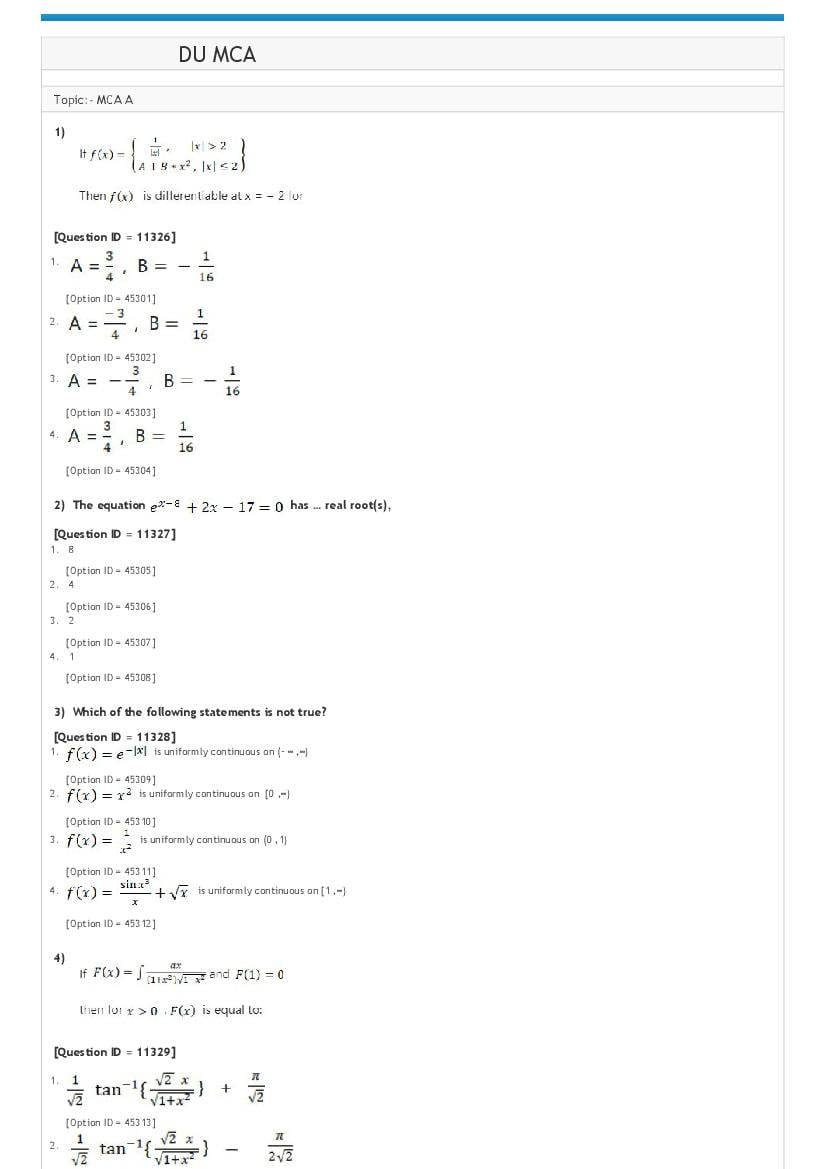
Topic:‐ MCA A
1)
[Question ID = 11326]
1.
[Option ID = 45301]
2.
[Option ID = 45302]
3.
[Option ID = 45303]
4.
[Option ID = 45304]
2) The equation has … real root(s),
[Question ID = 11327]
1. 8
[Option ID = 45305]
2. 4
[Option ID = 45306]
3. 2
[Option ID = 45307]
4. 1
[Option ID = 45308]
3) Which of the following statements is not true?
[Question ID = 11328]
1. is uniformly continuous on (– ∞ ,∞)
[Option ID = 45309]
2. is uniformly continuous on [0 ,∞)
[Option ID = 45310]
3. is uniformly continuous on (0 ,1)
[Option ID = 45311]
4. is uniformly continuous on [1 ,∞)
[Option ID = 45312]
4)
[Question ID = 11329]
1.
[Option ID = 45313]
2.
Page 2
3.
[Option ID = 45315]
4.
[Option ID = 45316]
5)
[Question ID = 11330]
1. 19/3 [Option ID = 45317]
2. 10/7 [Option ID = 45318]
3. 3/5 [Option ID = 45319]
4. 4/3 [Option ID = 45320]
6)
[Question ID = 11331]
1. is divergent sequence
[Option ID = 45321]
2.
[Option ID = 45322]
3. is bounded above by 2
[Option ID = 45323]
4. is decreasing sequence.
[Option ID = 45324]
7)
[Question ID = 11332]
1.
[Option ID = 45325]
2.
[Option ID = 45326]
3.
[Option ID = 45327]
4. 1
[Option ID = 45328]
8) The series converges to:
[Question ID = 11333]
1.
[Option ID = 45329]
Page 3
[Option ID = 45330]
3.
[Option ID = 45331]
4.
[Option ID = 45332]
9)
[Question ID = 11334]
1. Continuous and all directional derivatives of f exist.
[Option ID = 45333]
2. Continuous and not all directional derivatives of f exist.
[Option ID = 45334]
3. Not Continuous and not all directional derivatives of f exist.
[Option ID = 45335]
4. Not Continuous and but all directional derivatives of f exist.
[Option ID = 45336]
10)
[Question ID = 11335]
1. Pair of lines [Option ID = 45337]
2. Circle [Option ID = 45338]
3. Parabola [Option ID = 45339]
4. Hyperbola [Option ID = 45340]
11)
[Question ID = 11336]
1. 1
[Option ID = 45341]
2.
[Option ID = 45342]
3.
[Option ID = 45343]
4.
[Option ID = 45344]
12)
[Question ID = 11337]
1.
[Option ID = 45345]
2.
[Option ID = 45346]
3.
Page 4
4.
[Option ID = 45348]
13)
[Question ID = 11338]
1. Circle
[Option ID = 45349]
2. Parabola
[Option ID = 45350]
3. Sphere
[Option ID = 45351]
4. Cone
[Option ID = 45352]
14)
[Question ID = 11339]
1.
[Option ID = 45353]
2.
[Option ID = 45354]
3.
[Option ID = 45355]
4.
[Option ID = 45356]
15) Which of the following is false:
[Question ID = 11340]
1. Every convergent positive series is convergent.
[Option ID = 45357]
2. Every absolutely convergent series is convergent
[Option ID = 45358]
3.
[Option ID = 45359]
4. The series is a divergent series.
[Option ID = 45360]
16)
[Question ID = 11341]
1.
[Option ID = 45361]
2.
[Option ID = 45362]
3.
[Option ID = 45363]
4.
Page 5
17)
[Question ID = 11342]
1.
[Option ID = 45365]
2.
[Option ID = 45366]
3.
[Option ID = 45367]
4.
[Option ID = 45368]
18) Let K = {a + b ω + c ω2 : ω ≠1, ω3 = 1, a, b, c ∈ Z5}, where Z5 is the set of integers multiplicative modulo 5.
Then which one of the following is NOT correct about K?
[Question ID = 11343]
1. K has no zero divisor
[Option ID = 45369]
2. K has only one idempotent
[Option ID = 45370]
3. Every element of K is not a unit
[Option ID = 45371]
4. K is a field and the number of non‐isomorphic subfields of K is 2
[Option ID = 45372]
19) Let G = U (98) = {k ∈ N: k ≤ 98, and GCD (k, 98) = 1} be a group, where N is the set of all natural numbers. The number of
generators of the largest cyclic subgroup of G is
[Question ID = 11344]
1. 12
[Option ID = 45373]
2. 32
[Option ID = 45374]
3. 42
[Option ID = 45375]
4. 49
[Option ID = 45376]
20)
[Question ID = 11345]
1. G is non‐abelian group of order 8
[Option ID = 45377]
2. Centre of G is of order 2
[Option ID = 45378]
3. G has a normal subgroup
[Option ID = 45379]
4. Centre of G is of order 4
[Option ID = 45380]
21)
Page 6
1.
[Option ID = 45381]
2.
[Option ID = 45382]
3.
[Option ID = 45383]
4.
[Option ID = 45384]
22) Let z be a complex number satisfying 3|z − 12| = 5|z – 8 i | and |z − 4| = |z − 8|, where i2 = −1. If Re (z) and Im (z) are
the real and the imaginary parts of z respectively, then value of Re (z) + Im (z) equals[Question ID = 11347]
1. −11 [Option ID = 45385]
2. 23 [Option ID = 45386]
3. 21 [Option ID = 45387]
4. −13 [Option ID = 45388]
23)
[Question ID = 11348]
1. 2 [Option ID = 45389]
2. 30 [Option ID = 45390]
3. 31 [Option ID = 45391]
4. 62 [Option ID = 45392]
24)
[Question ID = 11349]
1. 234
[Option ID = 45393]
2. 316
[Option ID = 45394]
3. 433
[Option ID = 45395]
4. 334
[Option ID = 45396]
25) The number of cyclic subgroups of order 15 in a group equals
[Question ID = 11350]
1. 12
[Option ID = 45397]
2. 6
[Option ID = 45398]
3. 5
[Option ID = 45399]
4. 4
[Option ID = 45400]
26) Which one of the following sets is NOT a subring of the ring M2(R), of all 2 × 2 real matrices?
[Question ID = 11351]
1.
Page 7
2.
[Option ID = 45402]
3.
[Option ID = 45403]
4.
[Option ID = 45404]
27)
[Question ID = 11352]
1.
[Option ID = 45405]
2.
[Option ID = 45406]
3.
[Option ID = 45407]
4.
[Option ID = 45408]
28)
[Question ID = 11353]
1. 5600
[Option ID = 45409]
2. 1600
[Option ID = 45410]
3. 0
[Option ID = 45411]
4. 4000
[Option ID = 45412]
29) Let Re(z) and Im(z) be the real and imaginary parts of any complex number z , and arg(z) denotes the principal argument of
z. Let z1 and z2 be two distinct complex numbers such that Re(z1) = |z − 2| and Re(z2) = |z2 − 2|. If arg(z1 − z2) = π /6
then
[Question ID = 11354]
1. Im(z1 + z2) =
[Option ID = 45413]
2. Im(z1 + z2) =
[Option ID = 45414]
3. Re(z1 − z2) = 8
[Option ID = 45415]
4. Re(z1 − z2) = 9
[Option ID = 45416]
Page 8
[Question ID = 11355]
1. The set of all units in is {(1, 1),(1, 5),(3, 1),(3, 5)}
[Option ID = 45417]
2. The set of all nilpotent elements in is {(0.0),(0, 2)}
[Option ID = 45418]
3. The total number of the zero‐divisors in is 28.
[Option ID = 45419]
4. The set of zero‐divisors is {(a, b) : a = 0, 2 and b = 0, 2, 3, 4 }
[Option ID = 45420]
31) Given that 3x = 656. The valve of 5x – 5 is ...[Question ID = 11356]
1. 81 [Option ID = 45421]
2. 125 [Option ID = 45422]
3. 225 [Option ID = 45423]
4. 1/125 [Option ID = 45424]
32) What is the next term in the series 6, 20, 42, 72, 110, … is[Question ID = 11357]
1. 156 [Option ID = 45425]
2. 210 [Option ID = 45426]
3. 110 [Option ID = 45427]
4. 196 [Option ID = 45428]
33) Next term in the series zaa, yeb, xic, wod, vue, ... is
[Question ID = 11358]
1. uaf
[Option ID = 45429]
2. uef
[Option ID = 45430]
3. teg
[Option ID = 45431]
4. tag
[Option ID = 45432]
34) Age of a child is half of the age of father. Twenty years ago the age of father was 10 times the age of son. What is the age
of father?[Question ID = 11359]
1. 60 years [Option ID = 45433]
2. 55 years [Option ID = 45434]
3. 50 years [Option ID = 45435]
4. 45 years [Option ID = 45436]
35) In a race of 1 Kilometer, athlete A beats athlete B by 50 meters, in another race of 500 meters, athlete B beats athlete C
by 50 meters. By how many meters (Approximately) can athlete A beat athlete C in a race of 400 meters?
[Question ID = 11360]
1. 50 meters
[Option ID = 45437]
2. 58 meters
[Option ID = 45438]
3. 62 meters
[Option ID = 45439]
4. 70 meters
[Option ID = 45440]
36) Persons A, B, and C can finish a work in 15, 10, and 12 days respectively. Person B and person C start the work
together but are asked to leave after 4 days. In how many days will the remaining work be done by person A?
[Question ID = 11361]
1. 2 days
[Option ID = 45441]
2. 3 days
[Option ID = 45442]
3. 4 days
[Option ID = 45443]
4. 5 days
[Option ID = 45444]
Page 9
1) The causes and physical characteristics of pandemics and disasters are very different. More than any previous
disaster such as Ebola, HIV, SARS, TB and malaria , the Coronavirus Disease (COVID‐19) has exposed underlying risks and
vulnerabilities and challenged the traditional notion of risk .The impact on population groups with pre‐existing vulnerabilities has
been particularly severe especially where the health crisis has turned into a humanitarian and economic crisis. There are
examples of countries.
In the Asia‐Pacific region that experienced disasters in the year or months before the onset of the COVID‐19
pandemic and where the impacts of both the virus itself and the government response to contain its spread have
either reinforced the socio‐economic impacts of the previous disaster or have impeded planned recovery efforts. In
April 2020, the small island states of Fiji, Solomon Islands, Tonga and Vanuatu were impacted by Tropical Cyclone
Harold. While they were relatively isolated from the health risks of COVID‐19 due to early closure of borders,
they were already feeling the effects of economic losses due to reduced market demand from tourism, fisheries and
global commodities
Which of the following is a vulnerable group?
[Question ID = 11362]
1. Persons with pre‐existing disabilities
[Option ID = 45445]
2. People living with pet animals
[Option ID = 45446]
3. People living in multi‐storeyed buildings
[Option ID = 45447]
4. People living in residential complexes
[Option ID = 45448]
2) The causes and physical characteristics of pandemics and disasters are very different. More than any previous
disaster such as Ebola, HIV, SARS, TB and malaria, the Coronavirus Disease (COVID‐19) has exposed underlying risks and
vulnerabilities and challenged the traditional notion of risk .The impact on population groups with pre‐existing vulnerabilities has
been particularly severe especially where the health crisis has turned into a humanitarian and economic crisis. There are
examples of countries.
In the Asia‐Pacific region that experienced disasters in the year or months before the onset of the COVID‐19
pandemic and where the impacts of both the virus itself and the government response to contain its spread have
either reinforced the socio‐economic impacts of the previous disaster or have impeded planned recovery efforts. In
April 2020, the small island states of Fiji, Solomon Islands, Tonga and Vanuatu were impacted by Tropical Cyclone
Harold. While they were relatively isolated from the health risks of COVID‐19 due to early closure of borders,
they were already feeling the effects of economic losses due to reduced market demand from tourism, fisheries and
global commodities
What disaster struck island states of Fiji?
[Question ID = 11363]
1. Earthquake
[Option ID = 45449]
2. Floods
[Option ID = 45450]
3. Cyclone
[Option ID = 45451]
4. Economic losses
[Option ID = 45452]
3) The causes and physical characteristics of pandemics and disasters are very different. More than any previous
disaster such as Ebola, HIV, SARS, TB and malaria, the Coronavirus Disease (COVID‐19) has exposed underlying risks and
vulnerabilities and challenged the traditional notion of risk .The impact on population groups with pre‐existing vulnerabilities has
been particularly severe especially where the health crisis has turned into a humanitarian and economic crisis. There are
examples of countries.
In the Asia‐Pacific region that experienced disasters in the year or months before the onset of the COVID‐19
pandemic and where the impacts of both the virus itself and the government response to contain its spread have
either reinforced the socio‐economic impacts of the previous disaster or have impeded planned recovery efforts. In
April 2020, the small island states of Fiji, Solomon Islands, Tonga and Vanuatu were impacted by Tropical Cyclone
Harold. While they were relatively isolated from the health risks of COVID‐19 due to early closure of borders,
they were already feeling the effects of economic losses due to reduced market demand from tourism, fisheries and
global commodities
Which of the following is false?
[Question ID = 11364]
1. COVID 19 has challenged the traditional notion of risk.
[Option ID = 45453]
2. In Fiji economic losses occurred due to reduced market from tourism.
Page 10
3. Many countries experienced disasters in the years or months before the onset of the COVID‐19
[Option ID = 45455]
4. The characteristics of TB and COVID 19 are same.
[Option ID = 45456]
4) The causes and physical characteristics of pandemics and disasters are very different. More than any previous
disaster such as Ebola, HIV, SARS, TB and malaria, the Coronavirus Disease (COVID‐19) has exposed underlying risks and
vulnerabilities and challenged the traditional notion of risk .The impact on population groups with pre‐existing vulnerabilities has
been particularly severe especially where the health crisis has turned into a humanitarian and economic crisis. There are
examples of countries.
In the Asia‐Pacific region that experienced disasters in the year or months before the onset of the COVID‐19
pandemic and where the impacts of both the virus itself and the government response to contain its spread have
either reinforced the socio‐economic impacts of the previous disaster or have impeded planned recovery efforts. In
April 2020, the small island states of Fiji, Solomon Islands, Tonga and Vanuatu were impacted by Tropical Cyclone
Harold. While they were relatively isolated from the health risks of COVID‐19 due to early closure of borders,
they were already feeling the effects of economic losses due to reduced market demand from tourism, fisheries and
global commodities
In the full form of COVID
[Question ID = 11365]
1. ‘CO' stands for 'corona,' 'VI' for 'virus,' and 'D' for disease.
[Option ID = 45457]
2. ‘CO' stands for 'corona,' 'V' for 'virus,' ‘I’ for induced and 'D' for disease.
[Option ID = 45458]
3. ‘CO' stands for 'corona,' 'V' for 'virus,' ‘I ’ for incite and 'D' for disease
[Option ID = 45459]
4. ‘CO' stands for 'corona,' 'V' for 'virus,' ‘I ’ for indicative and 'D' for disease
[Option ID = 45460]
5) The causes and physical characteristics of pandemics and disasters are very different. More than any previous
disaster such as Ebola, HIV, SARS, TB and malaria, the Coronavirus Disease (COVID‐19) has exposed underlying risks and
vulnerabilities and challenged the traditional notion of risk .The impact on population groups with pre‐existing vulnerabilities has
been particularly severe especially where the health crisis has turned into a humanitarian and economic crisis. There are
examples of countries.
In the Asia‐Pacific region that experienced disasters in the year or months before the onset of the COVID‐19
pandemic and where the impacts of both the virus itself and the government response to contain its spread have
either reinforced the socio‐economic impacts of the previous disaster or have impeded planned recovery efforts. In
April 2020, the small island states of Fiji, Solomon Islands, Tonga and Vanuatu were impacted by Tropical Cyclone
Harold. While they were relatively isolated from the health risks of COVID‐19 due to early closure of borders,
they were already feeling the effects of economic losses due to reduced market demand from tourism, fisheries and
global commodities
Countries In the Asia‐Pacific region experienced disasters before the onset of the COVID‐19.
[Question ID = 11366]
1. A week
[Option ID = 45461]
2. Months
[Option ID = 45462]
3. Years
[Option ID = 45463]
4. Decades
[Option ID = 45464]
Topic:‐ MCA C
1) Air pollution is the single greatest environmental risk to living beings and one of the main causes of death and disease
globally. Air pollution affects all but it disproportionately affects women, children and the elderly, especially in low‐income
populations as they are often exposed to high levels of ambient air pollution and indoor air pollution from cooking and heating
with wood fuel and kerosene and also has a negative impact on ecosystems.
Some air pollutants, such as black carbon, methane, hydro‐ fluorocarbons and ground‐level ozone, are also short‐lived climate
pollutants and are responsible for a significant portion of air pollution‐related deaths, as well as impacts on crops and hence food
security, so their reduction has co‐benefits for the climate. The average atmospheric lifetime of a single black carbon soot
particle is only two or three weeks. Methane has an atmospheric lifetime of 12 years. Ground‐level ozone lasts only a few hours
to a few days in the atmosphere. The average HFC lifespan, weighted by their respective emissions, is 15 years.
All countries need to substantially reduce the number of deaths and illnesses from hazardous chemicals and air, water and soil
pollution and contamination by 2030, as well as to reduce the adverse per capita environmental impact of cities, including by
Page 11
Today, the international community acknowledges that improving air quality can enhance climate change mitigation and that
climate change mitigation efforts can improve air quality. Seventh of September every year is designated as the International
Day of Clean Air for blue skies.
Air pollution disproportionately affects…especially in low‐income populations
[Question ID = 11368]
1. Women only
[Option ID = 45469]
2. Children only
[Option ID = 45470]
3. Elderly only
[Option ID = 45471]
4. women, children and the elderly
[Option ID = 45472]
2) Air pollution is the single greatest environmental risk to living beings and one of the main causes of death and disease
globally. Air pollution affects all but it disproportionately affects women, children and the elderly, especially in low‐income
populations as they are often exposed to high levels of ambient air pollution and indoor air pollution from cooking and heating
with wood fuel and kerosene and also has a negative impact on ecosystems.
Some air pollutants, such as black carbon, methane, hydro‐ fluorocarbons and ground‐level ozone, are also short‐lived climate
pollutants and are responsible for a significant portion of air pollution‐related deaths, as well as impacts on crops and hence food
security, so their reduction has co‐benefits for the climate. The average atmospheric lifetime of a single black carbon soot
particle is only two or three weeks. Methane has an atmospheric lifetime of 12 years. Ground‐level ozone lasts only a few hours
to a few days in the atmosphere. The average HFC lifespan, weighted by their respective emissions, is 15 years.
All countries need to substantially reduce the number of deaths and illnesses from hazardous chemicals and air, water and soil
pollution and contamination by 2030, as well as to reduce the adverse per capita environmental impact of cities, including by
paying special attention to air quality and municipal and other waste management by 2030.
Today, the international community acknowledges that improving air quality can enhance climate change mitigation and that
climate change mitigation efforts can improve air quality. Seventh of September every year is designated as the International
Day of Clean Air for blue skies.
Which of the following is false
[Question ID = 11369]
1. Air pollution can cause food security.
[Option ID = 45473]
2. Reducing short lived pollutants can improve the climate.
[Option ID = 45474]
3. Adverse per capita environmental impact of cities is under control
[Option ID = 45475]
4. Climate change mitigation efforts can improve air quality.
[Option ID = 45476]
3) Air pollution is the single greatest environmental risk to living beings and one of the main causes of death and disease
globally. Air pollution affects all but it disproportionately affects women, children and the elderly, especially in low‐income
populations as they are often exposed to high levels of ambient air pollution and indoor air pollution from cooking and heating
with wood fuel and kerosene and also has a negative impact on ecosystems.
Some air pollutants, such as black carbon, methane, hydro‐ fluorocarbons and ground‐level ozone, are also short‐lived climate
pollutants and are responsible for a significant portion of air pollution‐related deaths, as well as impacts on crops and hence food
security, so their reduction has co‐benefits for the climate. The average atmospheric lifetime of a single black carbon soot
particle is only two or three weeks. Methane has an atmospheric lifetime of 12 years. Ground‐level ozone lasts only a few hours
to a few days in the atmosphere. The average HFC lifespan, weighted by their respective emissions, is 15 years.
All countries need to substantially reduce the number of deaths and illnesses from hazardous chemicals and air, water and soil
pollution and contamination by 2030, as well as to reduce the adverse per capita environmental impact of cities, including by
paying special attention to air quality and municipal and other waste management by 2030.
Today, the international community acknowledges that improving air quality can enhance climate change mitigation and that
climate change mitigation efforts can improve air quality. Seventh of September every year is designated as the International
Day of Clean Air for blue skies.
What is the full form of SLCP?
[Question ID = 11370]
1. Short‐Lived Climate Pollutants
[Option ID = 45477]
2. Short‐Lived Climate Pollution
[Option ID = 45478]
3. Short‐Lived Carbon Pollutants
Page 12
4. Short‐Life Climate Pollutants
[Option ID = 45480]
4) Air pollution is the single greatest environmental risk to living beings and one of the main causes of death and disease
globally. Air pollution affects all but it disproportionately affects women, children and the elderly, especially in low‐income
populations as they are often exposed to high levels of ambient air pollution and indoor air pollution from cooking and heating
with wood fuel and kerosene and also has a negative impact on ecosystems.
Some air pollutants, such as black carbon, methane, hydro‐ fluorocarbons and ground‐level ozone, are also short‐lived climate
pollutants and are responsible for a significant portion of air pollution‐related deaths, as well as impacts on crops and hence food
security, so their reduction has co‐benefits for the climate. The average atmospheric lifetime of a single black carbon soot
particle is only two or three weeks. Methane has an atmospheric lifetime of 12 years. Ground‐level ozone lasts only a few hours
to a few days in the atmosphere. The average HFC lifespan, weighted by their respective emissions, is 15 years.
All countries need to substantially reduce the number of deaths and illnesses from hazardous chemicals and air, water and soil
pollution and contamination by 2030, as well as to reduce the adverse per capita environmental impact of cities, including by
paying special attention to air quality and municipal and other waste management by 2030.
Today, the international community acknowledges that improving air quality can enhance climate change mitigation and that
climate change mitigation efforts can improve air quality. Seventh of September every year is designated as the International
Day of Clean Air for blue skies.
International Day of Clean Air for blue skies’ falls on … every year.
[Question ID = 11371]
1. 17th September
[Option ID = 45481]
2. 7th September
[Option ID = 45482]
3. 27th September
[Option ID = 45483]
4. 30th September
[Option ID = 45484]
5) Air pollution is the single greatest environmental risk to living beings and one of the main causes of death and disease
globally. Air pollution affects all but it disproportionately affects women, children and the elderly, especially in low‐income
populations as they are often exposed to high levels of ambient air pollution and indoor air pollution from cooking and heating
with wood fuel and kerosene and also has a negative impact on ecosystems.
Some air pollutants, such as black carbon, methane, hydro‐ fluorocarbons and ground‐level ozone, are also short‐lived climate
pollutants and are responsible for a significant portion of air pollution‐related deaths, as well as impacts on crops and hence food
security, so their reduction has co‐benefits for the climate. The average atmospheric lifetime of a single black carbon soot
particle is only two or three weeks. Methane has an atmospheric lifetime of 12 years. Ground‐level ozone lasts only a few hours
to a few days in the atmosphere. The average HFC lifespan, weighted by their respective emissions, is 15 years.
All countries need to substantially reduce the number of deaths and illnesses from hazardous chemicals and air, water and soil
pollution and contamination by 2030, as well as to reduce the adverse per capita environmental impact of cities, including by
paying special attention to air quality and municipal and other waste management by 2030.
Today, the international community acknowledges that improving air quality can enhance climate change mitigation and that
climate change mitigation efforts can improve air quality. Seventh of September every year is designated as the International
Day of Clean Air for blue skies.
Match List I with List II
List I List II
A. Black Carbon I. 12 YEARS
B. Methane II. 15 YEARS
C. Hydro‐ FluorocarbonsIII. 2‐3 WEEKS
D. Ground‐Level Ozone IV. FEW HOURS TO FEW DAYS
Choose the correct answer from the options given below
[Question ID = 11372]
1. A ‐ III, B ‐ I, C ‐ II, D ‐ IV
[Option ID = 45485]
2. A ‐ II, B ‐ III, C ‐ IV, D ‐ I
[Option ID = 45486]
3. A ‐ IV, B ‐ II, C ‐ III, D ‐ I
[Option ID = 45487]
4. A ‐ I, B ‐ IV, C ‐ II, D ‐ III
Page 13
Topic:‐ MCA D
1) What is the floating point representation of 12.25?[Question ID = 11373]
1. 1100.01 [Option ID = 45489]
2. 1100.11001 [Option ID = 45490]
3. 1100.10 [Option ID = 45491]
4. 1100.10011 [Option ID = 45492]
2) Consider the following function:
void swap (int x, int y)
{
int temp = x;
x = y;
y = temp;
}
The above function is invoked as follows:
int a = 3;
int b = 4;
swap(a, b);
What will be the values assigned to a and b on execution of the function call:
swap(a, b)?
[Question ID = 11374]
1. a = 3, b = 3
[Option ID = 45493]
2. a = 3, b = 4
[Option ID = 45494]
3. a = 4, b = 3
[Option ID = 45495]
4. a = 4, b = 4
[Option ID = 45496]
3) The value of n in the following code segment is
int a[] ={1, 2, 3, 4};
int i = 0 , n;
i++ ;
n = a[++i];
[Question ID = 11375]
1. 1
[Option ID = 45497]
2. 2
[Option ID = 45498]
3. 3
[Option ID = 45499]
4. 4
[Option ID = 45500]
4) The following bit pattern denotes a negative integer in two’s complement form.
1111111111111010
What value does it represent?
[Question ID = 11376]
1. ‐6
[Option ID = 45501]
2. ‐4
[Option ID = 45502]
3. ‐2
[Option ID = 45503]
4. ‐1
[Option ID = 45504]
Document Details
| Board / Org | NTA |
| Exam | DUET |
| Type | Question Paper |
| Pages | 14 |
| Language | english |
| Updated | 30 Apr 2026 |