UPSC IFS 2017 Question Paper for Agriculture Engineering Paper-I
Finished viewing? Save it for later —
Download UPSC IFS 2017 Question Paper for Agriculture Engineering Paper-I (PDF · 5 pages)About UPSC IFS 2017 Question Paper for Agriculture Engineering Paper-I
UPSC IFS 2017 Question Paper for Agriculture Engineering Paper-I is available here for free download. Published by UPSC for Indian Forest Service Examination, this question paper can be viewed online or downloaded as a PDF (5 pages). Candidates preparing for Indian Forest Service Examination can use UPSC IFS 2017 Question Paper for Agriculture Engineering Paper-I to understand the exam pattern, the type of questions asked, and the overall difficulty level.
Frequently Asked Questions
How can I download UPSC IFS 2017 Question Paper for Agriculture Engineering Paper-I?
Open this page and click the Download button to save UPSC IFS 2017 Question Paper for Agriculture Engineering Paper-I as a PDF. It is completely free on AglaSem Docs.
Is UPSC IFS 2017 Question Paper for Agriculture Engineering Paper-I free to download?
Yes. UPSC IFS 2017 Question Paper for Agriculture Engineering Paper-I can be viewed online and downloaded as a PDF free of cost on AglaSem Docs.
How many pages does UPSC IFS 2017 Question Paper for Agriculture Engineering Paper-I have?
UPSC IFS 2017 Question Paper for Agriculture Engineering Paper-I contains 5 pages, which you can read online or download together as a single PDF.
Where can I find more Indian Forest Service Examination study material?
You can find more Indian Forest Service Examination question papers, sample papers, syllabus, and answer keys on AglaSem Docs.
UPSC IFS 2017 Question Paper for Agriculture Engineering Paper-I – Text
Read the full text of this question paper below — useful to quickly search, copy and reference the content online without downloading the PDF.
📄 View text version (5 pages)
Page 1
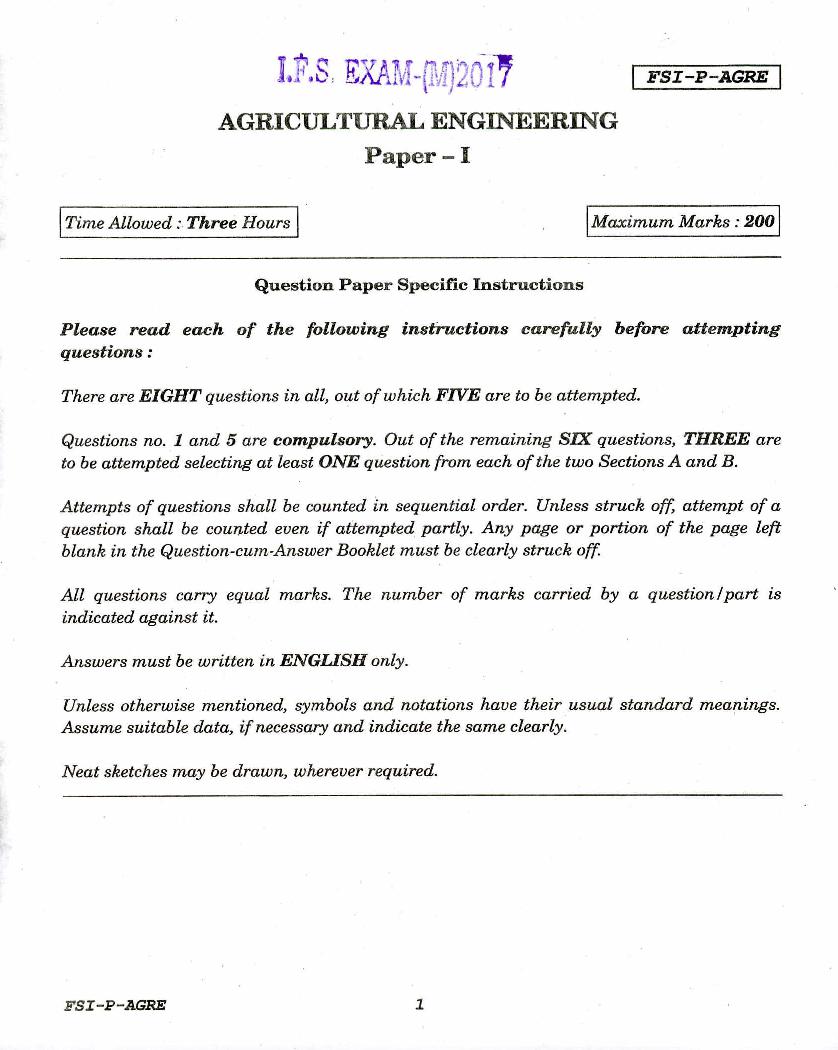
........ ...................... ^ rS I-P -A G R E
AGRICULTURAL ENGINEERING
Paper - 1
Time Allowed : Three Hours Maximum M arks: 200
Question Paper Specific Instructions
Please read each o f the following instructions carefully before attempting
questions:
There are EIGHT questions in all, out o f which FIVE are to be attempted.
Questions no. 1 and 5 are compulsory. Out o f the remaining SIX questions, THREE are
to be attempted selecting at least ONE question from each o f the two Sections A and B.
Attempts o f questions shall be counted in sequential order. Unless struck off, attempt o f a
question shall be counted even if attempted partly. Any page or portion o f the page left
blank in the Question-cum-Answer Booklet must be clearly struck off.
All questions carry equal marks. The number o f marks carried by a question /part is
indicated against it.
Answers must be written in ENGLISH only.
Unless otherwise mentioned, symbols and notations have their usual standard meanings.
Assume suitable data, if necessary and indicate the same clearly.
Neat sketches may be drawn, wherever required.
Page 2
Q l. Answer the following ; 8x5=40
(a) Discuss the issues and challenges related to watershed management.
What is the role of peoples’ participation in watershed development ? 8
(b) Discuss land shaping concepts, purpose and applicability in a
watershed. 8
(c) Explain in brief, different methods of calculating earth and soil volumes. 8
(d) Explain the procedure to conduct a topographical survey of a watershed
by direct contour method. 8
(e) Describe briefly, the SCS-CN method of runoff estimation.
A watershed has 100 ha area. The watershed has 20 ha pasture in silty
clay soil of 2% slope (CN = 65), 30 ha of pasture on silty loam soil of
0-5% slope (CN = 70) and remaining 50 ha of wheat crop on loam soil of
1% slope (CN = 85). Estimate the weighted curve number for the
watershed. 8
Q2. (a) What are rainfall Depth-Area-Duration (DAD) curves ? Write down the
step-by-step procedure for drawing Depth-Area-Duration curves. 10
(b) Explain in brief, different types of erosion and their causes. 10
(c) Define Water Harvesting. Write the components and sequential steps for
runoff water harvesting systems in the dry regions of India with suitable
sketches. Also write the limitations of water harvesting systems. 10
(d) Design a waste weir using the following data : 10
Cimaulative catchment area : 35 ha
Flood depth over the crest of weir : 0-6 m
Intensity of rainfall; 50 mm/hr
Runoff coefficient: 0-5
Q3. (a) Write the step-by-step procedure for planning and design of a graded
bunding. 10
(b) Design a grassed waterway of parabolic shape to carry a flow of 2-6 m^/s,
down a slope of 3%. The waterway has a good stand of grass and velocity
of 1-75 m/s can be allowed. Assume the value of Manning’s roughness
coefficient ‘n’ as 0 04. 10
(c) Discuss the fimctions, limitations and design features of chute spillways. 10
(d) What are the different types of farm ponds and their essential design
requirements ? 10
FSI-P-AGRE 2
Page 3
in watershed development and management. 10
(b) Write short notes on the following : 10
(i) Universal Soil Loss Equation
(ii) Catchment Area Treatment
(iii) Agronomic Erosion Control Measures
(iv) Functions and Planning of Terraces
(v) Elements of Flood Routing
(c) It is planned to construct bench terraces on a 20% hill slope. If the
vertical interval is 2 m, determine ; 10
(i) Length per hectare
(ii) Earthwork
(iii) Area lost, both for vertical cut and batter slope of 1 : 1. (The cut
should be equal to fill)
(d) Discuss different methods of Gully Control. Explain the steps followed in
the design of gully control structures. 10
Page 4
Q5. Answer the following : 8y.5-40
(a) Differentiate between the following : 8
(i) Water requirement and Irrigation requirement
(ii) Crop water use efficiency and Field water use efficiency
(iii) Evaporation and Consumptive use
(iv) Confined and Unconfined aquifers
(b) Discuss the procedure to develop soil moisture characteristic curve and
its critical points. 8
(c) Discuss Darcy’s law of soil water flow with a definition sketch. In what
flow conditions is it applicable ? 8
(d) What is Cavitation ? How does it affect the performance of a pumping
system ? How is it prevented in a centrifugal pump ? 8
(e) A field soil sample prior to being disturbed has a volume of 82 cm^. The
sample weighed 125 grams. After drying at 105°C for 24 hours, the dry
soil sample weighs 100 grams. What is the soil moisture content on
weight basis and volume basis ? What depth of water must be applied to
increase the volumetric water content of the top 1 m of soil to 0-40 ?
Assume the density of water as I'OO gm/cm^. 8
Q6. (a) Draw a neat sketch showing the basic components of a drip irrigation
system. Also describe the functions of each of them in brief. 10
(b) Discuss the important aquifer characteristics influencing yields of wells. 10
(c) Discuss sprinkler irrigation uniformity and its measures and describe
the procedure to estimate it in the field. 10
(d) G iven:
Climate Hot humid
Soil Fine sandy loaim
Wind speed 7 km/h
Crop Wheat
Effective root zone depth 1-5 m
Water available in top soil {1-0 m) 167 mm/m
Water available in top soil (0-5 m) 183 mm/m
Irrigation application efficiency 80%
EC, 2-0 dS/m
ECg {for 10% yield reduction) 3-4 dS/m
Area 10 ha
Peak rate of water removal 7-6 mm/day
Management allowed deficit (MAD) 50%
Operating hours per day 12 hours
Find the Net and Gross depth of irrigation, Leaching requirement.
Irrigation interval and Sprinkler system capacity. 10
Page 5
these two indices. What are salt affected soils ? Explain different
reclamation measures to manage saltaffected soils. 10
(b) A 25 cm diameter well is pumped at a uniform rate of 50 Z/s. The
drawdown observed at 1 m and 100 m distances from the centre of the
well are 8 m and 40 m respectively. Determine the hydraulic
conductivity of the water bearing strata. Assume the thickness of the
saturated part of the aquifer as 25 m. 10
(c) Discuss the Pumping Test of wells. Explain the step-by-step procedure
adopted for conducting pumping tests of wells. 10
(d) What are submersible pumps ? Explain the complete procedure to install
a submersible pump in a bore well including initial preparations,
installation and testing. 10
Q8. (a) Discuss various types of poly houses (low to high cost) used for
cultivation of high value crops. Explain the working principle of fan and
pad evaporative cooling systems. 10
(b) Discuss dairy bams, their types and their components. Draw a model
layout of a dairy farm fora 20 cow/buffalo unit. 10
(c) Discuss the purpose, benefits and types of subsurface drainage systems.
Explain the design of pipe drainage systems used for large irrigation
projects. 10
(d) What is a Farmstead ? What factors govern the location of the farmstead
on the farm ? lo
Document Details
| Board / Org | UPSC |
| Exam | Indian Forest Service Examination |
| Type | Question Paper |
| Pages | 5 |
| Updated | 30 Apr 2026 |