UPSC IFS 2017 Question Paper for Agriculture Paper-I
Finished viewing? Save it for later —
Download UPSC IFS 2017 Question Paper for Agriculture Paper-I (PDF · 5 pages)About UPSC IFS 2017 Question Paper for Agriculture Paper-I
UPSC IFS 2017 Question Paper for Agriculture Paper-I is available here for free download. Published by UPSC for Indian Forest Service Examination, this question paper can be viewed online or downloaded as a PDF (5 pages). Candidates preparing for Indian Forest Service Examination can use UPSC IFS 2017 Question Paper for Agriculture Paper-I to understand the exam pattern, the type of questions asked, and the overall difficulty level.
Frequently Asked Questions
How can I download UPSC IFS 2017 Question Paper for Agriculture Paper-I?
Open this page and click the Download button to save UPSC IFS 2017 Question Paper for Agriculture Paper-I as a PDF. It is completely free on AglaSem Docs.
Is UPSC IFS 2017 Question Paper for Agriculture Paper-I free to download?
Yes. UPSC IFS 2017 Question Paper for Agriculture Paper-I can be viewed online and downloaded as a PDF free of cost on AglaSem Docs.
How many pages does UPSC IFS 2017 Question Paper for Agriculture Paper-I have?
UPSC IFS 2017 Question Paper for Agriculture Paper-I contains 5 pages, which you can read online or download together as a single PDF.
Where can I find more Indian Forest Service Examination study material?
You can find more Indian Forest Service Examination question papers, sample papers, syllabus, and answer keys on AglaSem Docs.
UPSC IFS 2017 Question Paper for Agriculture Paper-I – Text
Read the full text of this question paper below — useful to quickly search, copy and reference the content online without downloading the PDF.
📄 View text version (5 pages)
Page 1
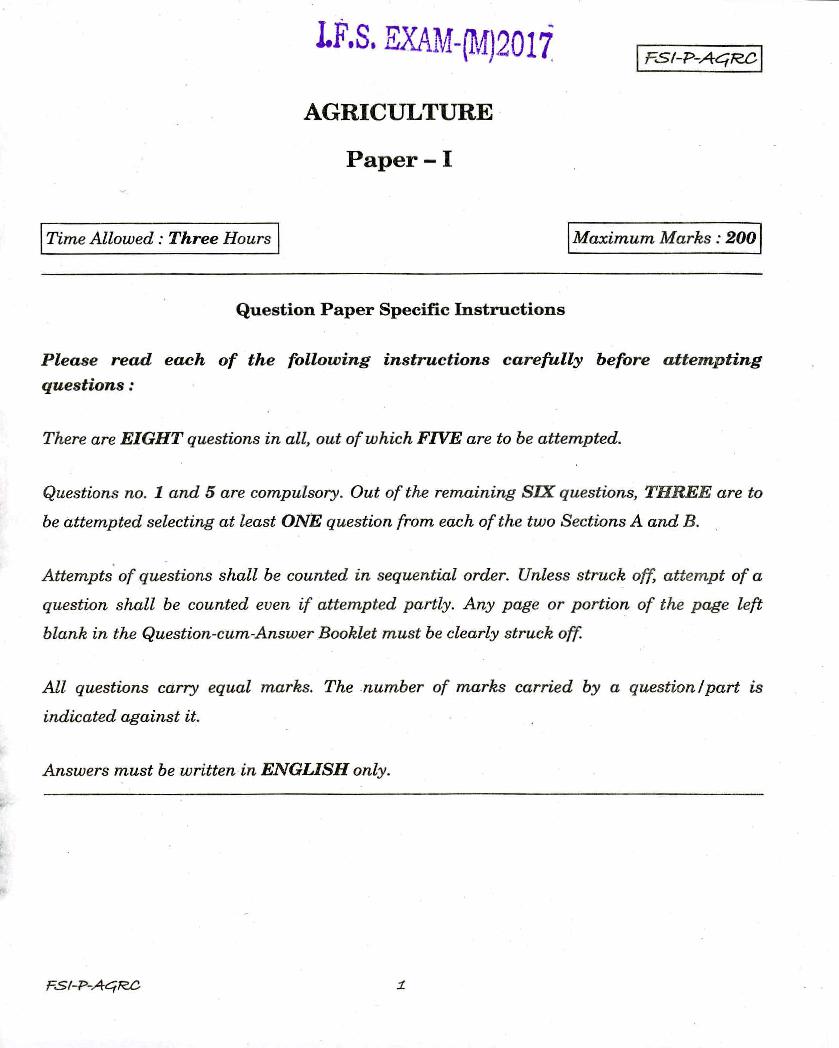
AGRICULTURE
Paper - 1
Time Allowed: Three Hours Maximum M arks: 200
Question Paper Specific Instructions
Please read each o f the following instructions carefully before attempting
questions:
There are EIGHT questions in all, out o f which FIVE are to be attempted.
Questions no. 1 and 5 are compulsory. Out o f the remaining SIX questions, THREE are to
be attempted selecting at least ONE question from each o f the two Sections A and B.
Attempts o f questions shall be counted in sequential order. Unless struck off, attempt o f a
question shall be counted even if attempted partly. Any page or portion o f the page left
blank in the Question-cum-Answer Booklet must be clearly struck off.
All questions carry equal marks. The number of marks carried by a question Ipart is
indicated against it.
Answers must be written in ENGLISH only.
F .s / - P - A £ :f f z c
Page 2
Q l. Answer the following in about 150 words each : Sx5=40
(a) What are the climatic parameters affecting crop productivity according
to which farmers follow the cropping pattern in the western zone of the
country ? 8
(b) Justify the plant ecology and edaphic factors influencing sustainable
agriculture. 8
(c) What are the problems of herbicide-resistance in wheat crop ? 8
(d) Diversification and intensification are important in present day
agriculture. Explain. 8
(e) What is the importance of agroforestry and social forestry in the
changing environment ? 8
Q2. Describe the package and practices, viz., planting pattern, sowing
time and spacing, weeds and nutrients management and productivity
of the following crops: ^10x4=4
(a) Chickpea 10
(b) Wheat ■' 10
(c) Lucerne . 10
(d) Sunflower 10
Q3. Answer the following in about 200 words each : 10x4=40
(a) What are the essential elements of plant nutrients ? State the
significance of C ; N ratio in crop productivity. 10
(b) Describe crop management practices in the early stage of saline and
alkaline soils. 10
(c) Describe phosphorus fixation in relation to soil pH. 10
(d) Soil solarization is an important tool for weed control. Justify. 10
F ^ ! ~ P ~ A ^ K jC-
Page 3
(a) Describe Dryland technology and Rainfed agriculture for stabilizing
production. 10
(b) Define Land Degradation and discuss the major factors affecting it. 10
(c) Explain the need of Integrated Nutrient Management (INM) in present
day agriculture. ^0
(d) Enumerate the agronomic measures for soil and water conservation £ind
practices adopted by the farmers. 10
Page 4
Q5. Answer the following in about 150 words each ; 8^=40
(a) Discuss the role of Drip/Sprinkler irrigation system in increasing water
use efficiency and productivity. 8
(b) Describe Cropping systems, Intercropping and Relay cropping in
agriculture, with examples. <5
(c) Explain the current water pollution issues in agriculture with suitable
remedies. 8
(d) Vermicompost is important in sustainable agriculture. Justify. 8
(e) Discuss Water Harvesting and the role of the Government and NGOs for
its promotion. 8
Q6. Answer the following in about 200 words each ; 10x4=40
(a) Explain the short term and long term effects of agriculture
mechanization. 10
(b) Define Farm Management and explain the role of the farm manager in
planning intensive agriculture. 10
(c) Explain about rural employment for women through agriciilture. 10
(d) Price fluctuations of agricultural products have an impact on small and
marginal farmers. Justify. 10
Q7. Answer the following in about 200 words each : 10x4=40
(a) What are the problems faced by landless agricultural labourers ? What
are the steps taken by the Government in order to intervene in the
matter ? 10
(b) Discuss the role of Krishi Vigyan Kendras (KVK) in transfer of
technologies to end users. 10
(c) Explain management of wasteland for promoting agricultural
production. 10
(d) What is Contractual Farming ? What are its merits and demerits in
present day agriculture ? 10
Page 5
(a) Role of Farmers’ Field School (FFS) in agriculture 10
(b) Role of Cooperative Societies in agriculture 10
(c) Importance of Extension Workers in transfer of technology to farmers 10
(d) Integrated Farming System and its profitablility to the farmers 10
F S h P - A C iJ z c
Document Details
| Board / Org | UPSC |
| Exam | Indian Forest Service Examination |
| Type | Question Paper |
| Pages | 5 |
| Updated | 30 Apr 2026 |