TN 11th Question Paper 2022 Physics
Finished viewing? Save it for later —
Download TN 11th Question Paper 2022 Physics (PDF · 11 pages)About TN 11th Question Paper 2022 Physics
TN 11th Question Paper 2022 Physics is available here for free download. Published by Tamil Nadu Board for Class 11, this question paper can be viewed online or downloaded as a PDF (11 pages). Candidates preparing for Class 11 can use TN 11th Question Paper 2022 Physics to understand the exam pattern, the type of questions asked, and the overall difficulty level.
Frequently Asked Questions
How can I download TN 11th Question Paper 2022 Physics?
Open this page and click the Download button to save TN 11th Question Paper 2022 Physics as a PDF. It is completely free on AglaSem Docs.
Is TN 11th Question Paper 2022 Physics free to download?
Yes. TN 11th Question Paper 2022 Physics can be viewed online and downloaded as a PDF free of cost on AglaSem Docs.
How many pages does TN 11th Question Paper 2022 Physics have?
TN 11th Question Paper 2022 Physics contains 11 pages, which you can read online or download together as a single PDF.
Where can I find more Class 11 study material?
You can find more Class 11 question papers, sample papers, syllabus, and answer keys on AglaSem Docs.
TN 11th Question Paper 2022 Physics – Text
Read the full text of this question paper below — useful to quickly search, copy and reference the content online without downloading the PDF.
📄 View text version (11 pages)
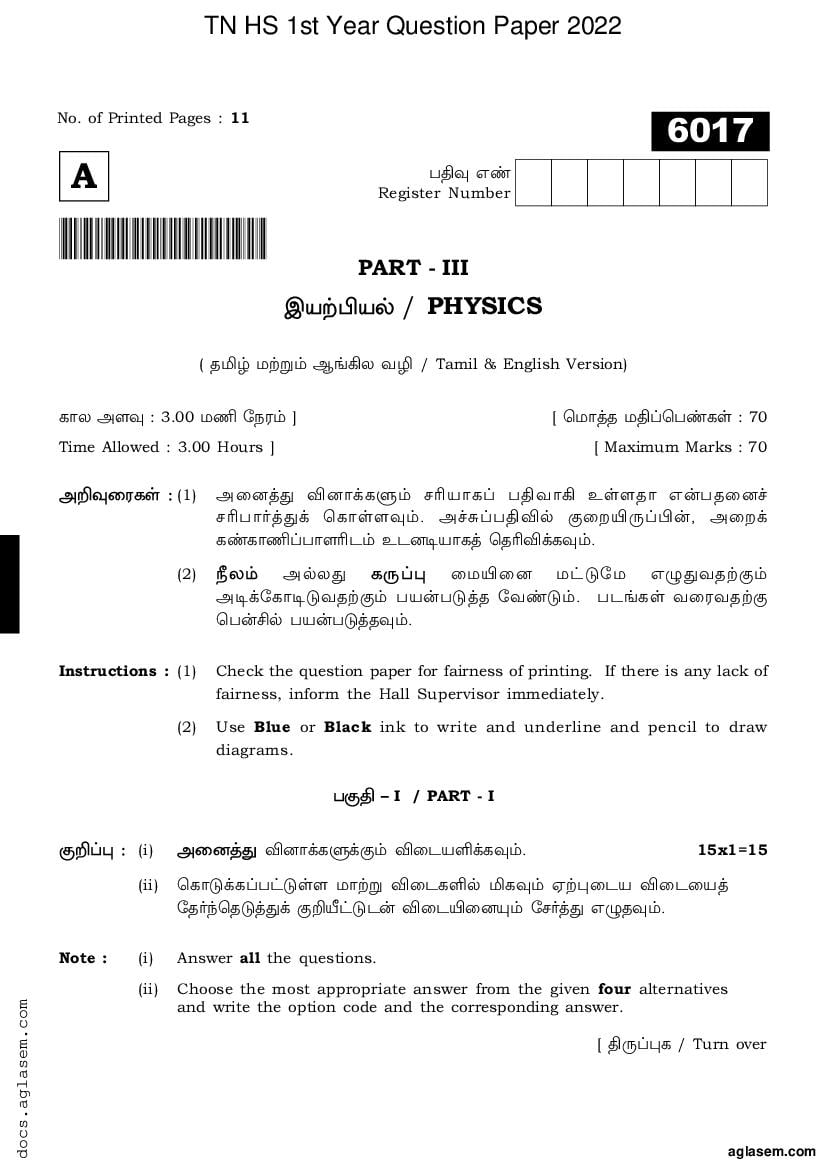
Page 1
6017
A £vÄ Gs
Register Number
!6017IstYearPhysics!
PART - III
C¯Ø¤¯À / PHYSICS
( uªÌ ©ØÖ® B[Q» ÁÈ / Tamil & English Version)
Põ» AÍÄ : 3.00 ©o ÷|µ® ] [ ö©õzu ©v¨ö£sPÒ : 70
Time Allowed : 3.00 Hours ] [ Maximum Marks : 70
AÔÄøµPÒ : (1) AøÚzx ÂÚõUPЮ \›¯õP¨ £vÁõQ EÒÍuõ GߣuøÚa
\›£õºzxU öPõÒÍÄ®. Aa_¨£vÂÀ SøÓ°¸¨¤ß, AøÓU
PsPõo¨£õÍ›h® EhÚi¯õPz öu›ÂUPÄ®.
(2) }»® AÀ»x P¸¨¦ ø©°øÚ ©mk÷© GÊxÁuØS®
AiU÷PõikÁuØS® £¯ß£kzu ÷Ásk®. £h[PÒ ÁøµÁuØS
ö£ß]À £¯ß£kzuÄ®.
Instructions : (1) Check the question paper for fairness of printing. If there is any lack of
fairness, inform the Hall Supervisor immediately.
(2) Use Blue or Black ink to write and underline and pencil to draw
diagrams.
£Sv – I / PART - I
SÔ¨¦ : (i) AøÚzx ÂÚõUPÐUS® Âøh¯ÎUPÄ®. 15x1=15
(ii) öPõkUP¨£mkÒÍ ©õØÖ ÂøhPÎÀ ªPÄ® Hئøh¯ Âøhø¯z
÷uº¢öukzxU SÔ±mkhß Âøh°øÚ²® ÷\ºzx GÊuÄ®.
Note : (i) Answer all the questions.
(ii) Choose the most appropriate answer from the given four alternatives
and write the option code and the corresponding answer.
[ v¸¨¦P / Turn over
Page 2
1. xy uÍ® JßÔÀ xPöÍõßÖ PiPõµ•Ò _Ǿ® vø\°À ^µõÚ Ámh C¯UPzøu
÷©ØöPõÒQÓx GÛÀ, AzxPÎß ÷Põnz vø\÷ÁPzvß vø\ :
(A) −z vø\°À (B) +y vø\°À
(C) −x vø\°À (D) +z vø\°À
If a particle executes uniform circular motion in the xy plane in clockwise direction,
then the angular velocity is in :
(a) −z direction (b) +y direction
(c) −x direction (d) +z direction
Cp
2. 8 g O® ©ØÖ® 16 g BUêáß EÒÍ Áõ²UP»øÁ°ß γ = ©v¨¦
Cv
GßÚ ?
(A) 27/17 (B) 23/15
(C) 17/27 (D) 15/23
Cp
The ratio γ = for a gas mixture consisting of 8 g of helium and 16 g of oxygen
Cv
is :
(a) 27/17 (b) 23/15
(c) 17/27 (d) 15/23
3. ÁøÍÄa\õø» JßÔÀ Põº JßÖ vjöµßÖ Chx¦Ó©õPz v¸®¦®÷£õx
AUPõ›¾ÒÍ £¯oPÒ Á»x¦Ó©õPz uÒͨ£kÁuØS ¤ßÁ¸ÁÚÁØÖÒ Gx
Põµn©õP Aø©²® ?
(A) K´ÂÀ {ø»©® (B) vø\°À {ø»©®
(C) {ø»©©ØÓ ußø© (D) C¯UPzvÀ {ø»©®
When a car takes a sudden left turn in the curved road, passengers are pushed
towards the right due to :
(a) inertia of rest (b) inertia of direction
(c) absence of inertia (d) inertia of motion
A
Page 3
4. π&ß ©v¨¦ 3.14 GÛÀ π2&ß ©v¨¦ :
(A) 9.86 (B) 9.8596 (C) 9.9 (D) 9.860
If π=3.14, then the value of π2 is :
(a) 9.86 (b) 9.8596 (c) 9.9 (d) 9.860
5. RÌUPshÁØÖÒ Gx ì÷P»º AÀ» ?
(A) AÊzu® (B) £õS{ø»
(C) uøPÄ (D) £µ¨¦ CÊÂø\
Which of the following is not a scalar ?
(a) Pressure (b) Viscosity
(c) Stress (d) Surface tension
6. Cµmøh E¸ÁõUSÁx :
(A) _ÇØ] ©ØÖ® Ch¨ö£¯ºa] (B) _ÇØ] C¯UP®
(C) C¯UPªßø© (D) Ch¨ö£¯ºa] C¯UP®
A couple produces :
(a) Rotation and translation (b) Pure rotation
(c) No motion (d) Pure translation
7. QøhzuÍzøu¨ ö£õ¸zx 308 ©ØÖ® 608 ÷PõnzvÀ Cµsk ö£õ¸mPÒ
GÔ¯¨£kQßÓÚ. AÁØÔß QøhzuÍ ö|kUP® •øÓ÷¯ R308 ©ØÖ® R608 GÚU
P¸vÚõÀ, ¤ßÁ¸ÁÚÁØÖÒ ö£õ¸zu©õÚ Cønø¯z ÷uºÄ ö\´P.
(A) R308= R60ᑻ (B) R308=R608
2
(C) R308=2R608 (D) R308=4R608
Two objects are projected at angles 308 and 608 respectively with respect to the
horizontal direction. The range of two objects are denoted as R 308 and R608.
Choose the correct relation from the following :
R
(a) R308= 60ᑻ (b) R308=R608
2
(c) R308=2R608 (d) R308=4R608
A [ v¸¨¦P / Turn over
Page 4
8. Dº¨¤ß •kUPzvß ©v¨¦ Auß uØ÷£õøu¯ ©v¨¤øÚ¨ ÷£õ» |õßS
©h[PõP ©õÔÚõÀ Âk£k ÷ÁP® :
(A) £õv¯õS® (B) ©õÓõx
(C) 4 ©h[PõS® (D) 2 ©h[PõS®
If the acceleration due to gravity becomes 4 times its original value, then escape
speed :
(a) becomes halved (b) remains same
(c) 4 times of original value (d) 2 times of original value
9. 1 Q÷»õÁõm ©o Gߣx (1 kWh) __________.
(A) 36×105 J (B) 36×105 WS
(C) 3.6×10⁶ J (D) ÷©ØTÔ¯ AøÚzx®
1 kilowatt hour (1 kWh) is :
(a) 36×105 J (b) 36×105 WS
(c) 3.6×10⁶ J (d) All the above
10. ¦Â°ß {øÓ²® Bµ•® C¸©h[PõÚõÀ Dº¨¤ß •kUP® g :
(A) 2g (B) ©õÓõx
g
(C) 4g (D)
2
If the mass and radius of the Earth are both doubled, then the acceleration due
to gravity g :
(a) 2g (b) remains same
g
(c) 4g (d)
2
A
Page 5
11. v›¤ØPõÚ £›©õn Áõ´¨£õk :
(A) ML−2T−1 (B) M0L0T0 (C) ML−1T−2 (D) M0LT0
The Dimensional formula for strain :
(a) ML−2T−1 (b) M0L0T0 (c) ML−1T−2 (d) M0LT0
12. }›ß EøÓ{ø»US® Auß öPõv{ø»US® Cøh÷¯ C¯[S® öÁ¨£
C¯¢vµzvß £¯ÝÖvÓß :
(A) 26.8% (B) 6.25% (C) 12.5% (D) 20%
The efficiency of a heat engine working between the freezing point and boiling
point of water is :
(a) 26.8% (b) 6.25% (c) 12.5% (d) 20%
13. \© {øÓ²ÒÍ C¸ ö£õ¸ÒPÒ m1 ©ØÖ® m2 J÷µ ÷|º÷PõmiÀ •øÓ÷¯ 5 ms−1
©ØÖ® −9 ms−1 GßÓ vø\÷ÁP[PÎÀ C¯[SQßÓÚ. ÷©õu»õÚx «m] ÷©õuÀ
GÛÀ, ÷©õu¾US¨¤ß m1 ©ØÖ® m2 ö£õ¸ÒPÎß vø\÷ÁP[PÒ •øÓ÷¯ :
(A) −9 ms−1 ©ØÖ® 5 ms−1
(B) −4 ms−1 ©ØÖ® 10 ms−1
(C) 5 ms−1 ©ØÖ® 1 ms−1
(D) 10 ms−1 ©ØÖ® 0 ms−1
Two equal masses m 1 and m 2 are moving along the same straight line with
velocities 5 ms −1 and −9 ms −1 respectively. If the collision is elastic, then
calculate the velocities after the collision of m1 and m2 respectively.
(a) −9 ms−1 and 5 ms−1
(b) −4 ms−1 and 10 ms−1
(c) 5 ms−1 and 1 ms−1
(d) 10 ms−1 and 0 ms−1
A [ v¸¨¦P / Turn over
Page 6
14. SÖUPø» JßÖ A FhPzv¼¸¢x B FhPzvØS ö\ÀQÓx. A FhPzvÀ
SÖUPø»°ß vø\÷ÁP® 500 ms−1, Aø»}Í® 5 m. B FhPzvÀ vø\÷ÁP®
600 ms−1, GÛÀ B&À AvºöÁs, Aø»}Í® •øÓ÷¯ :
(A) 120 Hz ©ØÖ® 6 m (B) 120 Hz ©ØÖ® 5 m
(C) 100 Hz ©ØÖ® 6 m (D) 100 Hz ©ØÖ® 5 m
A transverse wave moves from a medium A to a medium B. In medium A the
velocity of the transverse wave is 500 ms−1 and the wavelength is 5 m. The
frequency and the wavelength of the wave in medium B, when its velocity is
600 ms−1, respectively are :
(a) 120 Hz and 6 m (b) 120 Hz and 5 m
(c) 100 Hz and 6 m (d) 100 Hz and 5 m
15. ‘a’ •kUPzxhß QøhzuÍzvÀ C¯[QU öPõsi¸US® £ÒÎ ÁõPÚzvß
÷©ØTøµ°À Pmiz öuõh[PÂh¨£mh uÛF\À JßÔß Aø»Ä÷|µ® :
1
(A) T ∝ g2 +a 2 (B) T ∝
g +a 2
2
(C) T ∝ (g2+a2) (D) 1
T∝
g +a 2
2
A simple pendulum is suspended from the roof of a school bus which moves in a
horizontal direction with an acceleration ‘a’, then the time period is :
1
(a) T ∝ g 2 +a 2 (b) T∝
g +a 2
2
(c) T ∝ (g2+a2) (d) 1
T∝
g +a 2
2
A
Page 7
£Sv & II / PART - II
SÔ¨¦ : GøÁ÷¯Ý® BÖ ÂÚõUPÐUS Âøh¯ÎUPÄ®. ÂÚõ Gs 24 &US
Pmhõ¯©õP Âøh¯ÎUPÄ®. 6x2=12
Note : Answer any six questions. Question number 24 is compulsory.
16. öµÚõÀk Gs GßÓõÀ GßÚ ?
What is Reynold’s number ?
17. _u¢vµ C¯UPUTÖPÒ – Áøµ¯ÖUPÄ®.
Define the term ‘degrees of freedom’.
18. ÷\õÚõº P¸Â ö£õ¸zu¨£mh J¸ }º‰ÌQ P¨£¼¼¸¢x Aݨ£¨£mh xi¨¦ 80
ÂÚõiPÐUS¨ ¤ÓS Gvöµõ¼¯õP Gv› }º‰ÌQ P¨£¼¼¸¢x ö£Ó¨£kQßÓx.
}›À J¼°ß ÷ÁP® 1460 ms−1 GÛÀ, Gv› }º‰ÌQU P¨£À EÒÍ öuõø»Ä
¯õx ?
In a submarine equipped with sonar, the time delay between the generation of a
pulse and its echo after reflection from an enemy submarine is observed to be
80 s. If the speed of sound in water is 1460 ms−1, what is the distance of enemy
submarine ?
19. ¯Ûß Ch¨ö£¯ºa] Âvø¯U TÖP.
State Wien’s Displacement Law.
20. Dº¨¦z ußÛø» BØÓÀ – Áøµ¯ÖUPÄ®.
Define - gravitational potential.
21. uÛa^›ø\ C¯UP® GßÓõÀ GßÚ ?
What is simple harmonic motion ?
A [ v¸¨¦P / Turn over
Page 8
22. {³mhÛß CµshõÁx Âvø¯U TÖP.
State Newton’s second law.
23. ÷Põn E¢u ©õÓõ Âvø¯U TÖP.
State conservation of angular momentum.
24. xPÒ JßÖ x&Aa_z vø\°À |PºQÓx GßP. AÆÁõÖ Ax |P¸®÷£õx Auß
x&B¯ Aa_ ‘t’ ÷|µzøu¨ ö£õ¸zx x=2−5t+6t2 GßÓ \©ß£õmiߣi ©õÖQÓx
GÛÀ xPÎß Bµ®£z vø\÷ÁP® GßÚ ?
A particle moves along the x-axis in such a way that its coordinates x varies with
time ‘t’ according to equation x=2−5t+6t2. What is the initial velocity of the
particle ?
£Sv & III / PART - III
SÔ¨¦ : GøÁ÷¯Ý® BÖ ÂÚõUPÐUS Âøh¯ÎUPÄ®. ÂÚõ Gs 33 &US
Pmhõ¯©õP Âøh¯ÎUPÄ®. 6x3=18
Note : Answer any six questions. Question number 33 is compulsory.
25. «m] ©ØÖ® «m]¯ØÓ ÷©õuÀPøÍ J¨¤kP.
Compare Elastic and Inelastic collision.
26. CÊzxU Pmh¨£mh P®¤°À HØ£k® SÖUPø»UPõÚ ÂvPøÍ ÂÍUSP.
Discuss the Law of Transverse Vibrations in stretched strings.
27. J¸ ö£õ¸øÍ |Pºzu A¨ö£õ¸øÍ Cʨ£x _»£©õ ? AÀ»x uÒÐÁx _»£©õ ?
uÛzu ö£õ¸Îß Âø\¨£h® Áøµ¢x ÂÍUSP.
Using free body diagram, show that whether it is easy to pull an object than to
push it.
A
Page 9
28. öPõkUP¨£mh Cµsk öÁUhºPÎß, öÁUhº ö£¸UP¼ß öuõS£¯ß öÁUhøµU
PõsP.
→ ∧ ∧ ∧ → ∧ ∧ ∧
A = 4 i − 2 j +k ©ØÖ® B = 5 i + 3 j − 4 k
→ ∧ ∧ ∧
What are the resultants of the vector product of two vectors given by A = 4 i − 2 j + k
→ ∧ ∧ ∧
and B = 5 i + 3 j − 4 k ?
29. x¸Áz xønU÷PõÒPÒ £ØÔ ]Ö SÔ¨¦ ÁøµU.
Write a short note on polar satellites.
30. £õS{ø»°ß H÷uÝ® ‰ßÖ £¯ß£õkPøÍU TÖP.
Give any three applications of viscosity.
31. v¸¨¦ Âø\ – Áøµ¯ÖUPÄ®. |øh•øÓ ÁõÌÂÀ v¸¨¦ Âø\
£¯ß£kzu¨£k® GkzxUPõmkPÒ H÷uÝ® Cµsk TÓÄ®.
Define torque. Give any two examples of torque in day-to-day life.
32. ^µø»Ä ©ØÖ® ^µØÓ Aø»Ä C¯UP® GßÓõÀ GßÚ ? JÆöÁõ¸ C¯UPzvØS®
C¸ Euõµn[PÒ u¸P.
What is meant by periodic and non-periodic motion ? Give any two examples, for
each motion.
33. ©Ûuöµõ¸Áº 2 kg {øÓ²øh¯ }›øÚ xk¨¦ \UPµzøuU öPõsk P»USÁuß
‰»® 30 kJ ÷Áø»ø¯a ö\´QÓõº. HÓzuõÇ 5 kcal öÁ¨£® }›¼¸¢x
öÁΨ£mk öPõÒP»Ûß £µ¨¦ ÁÈ÷¯ öÁ¨£UPhzuÀ ©ØÖ® öÁ¨£UPvº
Ãa]ß ‰»® `ǾUSU Phzu¨£kQÓx GÛÀ, Aø©¨¤ß AP BØÓÀ
©õÖ£õmøhU PõsP.
A person does 30 kJ work on 2 kg of water by stirring using a paddle wheel. While
stirring, around 5 kcal of heat is released from water through its container to the
surface and surroundings by thermal conduction and radiation. What is the
change in internal energy of the system ?
A [ v¸¨¦P / Turn over
Page 10
£Sv & IV / PART - IV
SÔ¨¦ : AøÚzx ÂÚõUPÐUS® Âøh¯ÎUPÄ®. 5x5=25
Note : Answer all the questions.
34. (A) (i) £›©õn¨ £S¨£õ´Âß £¯ß£õkPøÍU TÖP.
1
(ii) mv2 = mgh GßÓ \©ß£õmøh £›©õn¨ £S¨£õ´Ä •øÓ¨£i
2
\›¯õÚuõ GÚU PshÔP.
AÀ»x
(B) ~s¦øÇ÷¯ØÓ •øÓ°À }º©® JßÔß £µ¨¦ CÊÂø\UPõÚ ÷PõøÁø¯z
u¸ÂUPÄ®.
(a) (i) Write the applications of the Dimensional Analysis.
1
(ii) Check the correctness of the equation mv2 = mgh using dimensional
2
analysis method.
OR
(b) Obtain an expression for the surface tension of a liquid by capillary rise
method.
35. (A) BØÓÀ \©£[Rmk Âvø¯U TÔ ÂÍUSP.
AÀ»x
(B) ©õÓõu •kUP® ö£ØÓ ö£õ¸Îß C¯UPa \©ß£õkPøÍ Á¸ÂUPÄ®.
(a) State and explain equipartition of energy.
OR
(b) Derive the kinematic equations of motion for constant acceleration.
A
Page 11
36. (A) ö©À¼¯ P®¤°ÚõÀ CønUP¨£mh PÚ¨ö£õ¸mPÎß ö\[Szx
C¯UPzøu ÂÁ›UPÄ®.
AÀ»x
(B) E¯µzøu¨ ö£õ¸zx Dº¨¤ß •kUP® (g) GÆÁõÖ ©õÖ£k® Gߣøu
ÂÍUSP.
(a) Explain the motion of blocks connected by a string in vertical motion.
OR
(b) Explain the variation of acceleration due to gravity (g) with altitude.
37. (A) _¸ÒÂÀ¼ß QøhzuÍ Aø»ÄPøÍ ÂÁ›UPÄ®.
AÀ»x
(B) ÷Áø» C¯UP BØÓÀ ÷uØÓzøuU TÔ ÂÍUSP. ÷Áø» C¯UP BØÓÀ
÷uØÓ® EnºzxÁøu ÂÁõvUPÄ®.
(a) Explain the horizontal oscillations of a spring.
OR
(b) State and explain work-kinetic energy theorem. Discuss the inferences of
work-kinetic energy theorem.
38. (A) \õ´uÍzvÀ E¸Ðuø» ÂÁ›UPÄ® ©ØÖ® Auß •kUPzvØPõÚ
\©ß£õmøh¨ ö£ÖP.
AÀ»x
(B) ‰i¯ BºPõß SÇõ°À ÷©Ø_µ[PÒ HØ£kÁøu ÂÍUSP.
(a) Discuss rolling on inclined plane and arrive at the expression for the
acceleration.
OR
(b) Explain how overtones are produced in a closed organ pipe.
-o0o-
A [ v¸¨¦P / Turn over
Document Details
| Board / Org | Tamil Nadu Board |
| Exam | Class 11 |
| Type | Question Paper |
| Pages | 11 |
| Updated | 30 Apr 2026 |