TN 11th Question Paper 2022 Political Science
Finished viewing? Save it for later —
Download TN 11th Question Paper 2022 Political Science (PDF · 11 pages)About TN 11th Question Paper 2022 Political Science
TN 11th Question Paper 2022 Political Science is available here for free download. Published by Tamil Nadu Board for Class 11, this question paper can be viewed online or downloaded as a PDF (11 pages). Candidates preparing for Class 11 can use TN 11th Question Paper 2022 Political Science to understand the exam pattern, the type of questions asked, and the overall difficulty level.
Frequently Asked Questions
How can I download TN 11th Question Paper 2022 Political Science?
Open this page and click the Download button to save TN 11th Question Paper 2022 Political Science as a PDF. It is completely free on AglaSem Docs.
Is TN 11th Question Paper 2022 Political Science free to download?
Yes. TN 11th Question Paper 2022 Political Science can be viewed online and downloaded as a PDF free of cost on AglaSem Docs.
How many pages does TN 11th Question Paper 2022 Political Science have?
TN 11th Question Paper 2022 Political Science contains 11 pages, which you can read online or download together as a single PDF.
Where can I find more Class 11 study material?
You can find more Class 11 question papers, sample papers, syllabus, and answer keys on AglaSem Docs.
TN 11th Question Paper 2022 Political Science – Text
Read the full text of this question paper below — useful to quickly search, copy and reference the content online without downloading the PDF.
📄 View text version (11 pages)
Page 1
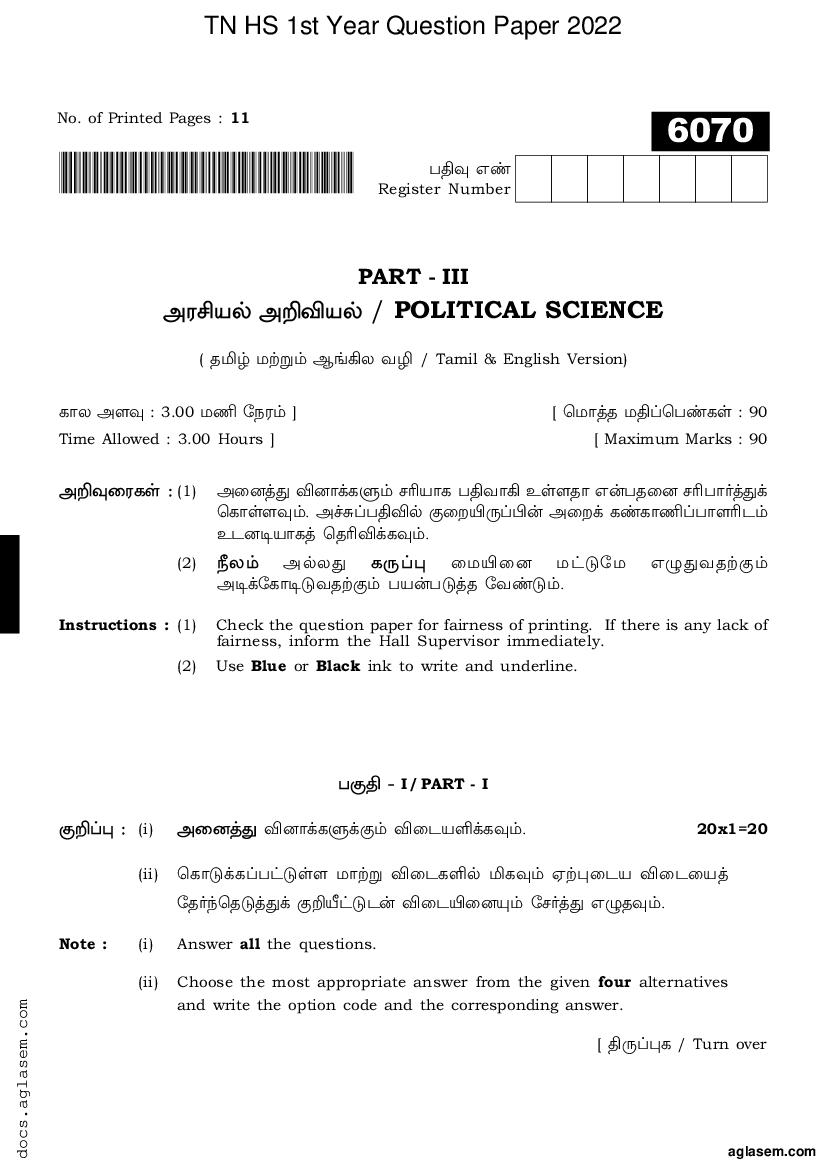
6070
!6070IstYearPoliticalScience! £vÄ Gs
Register Number
PART - III
Aµ]¯À AÔ¯À / POLITICAL SCIENCE
( uªÌ ©ØÖ® B[Q» ÁÈ / Tamil & English Version)
Põ» AÍÄ : 3.00 ©o ÷|µ® ] [ ö©õzu ©v¨ö£sPÒ : 90
Time Allowed : 3.00 Hours ] [ Maximum Marks : 90
AÔÄøµPÒ : (1) AøÚzx ÂÚõUPЮ \›¯õP £vÁõQ EÒÍuõ GߣuøÚ \›£õºzxU
öPõÒÍÄ®. Aa_¨£vÂÀ SøÓ°¸¨¤ß AøÓU PsPõo¨£õÍ›h®
EhÚi¯õPz öu›ÂUPÄ®.
(2) }»® AÀ»x P¸¨¦ ø©°øÚ ©mk÷© GÊxÁuØS®
AiU÷PõikÁuØS® £¯ß£kzu ÷Ásk®.
Instructions : (1) Check the question paper for fairness of printing. If there is any lack of
fairness, inform the Hall Supervisor immediately.
(2) Use Blue or Black ink to write and underline.
£Sv & I / PART - I
SÔ¨¦ : (i) AøÚzx ÂÚõUPÐUS® Âøh¯ÎUPÄ®. 20x1=20
(ii) öPõkUP¨£mkÒÍ ©õØÖ ÂøhPÎÀ ªPÄ® Hئøh¯ Âøhø¯z
÷uº¢öukzxU SÔ±mkhß Âøh°øÚ²® ÷\ºzx GÊuÄ®.
Note : (i) Answer all the questions.
(ii) Choose the most appropriate answer from the given four alternatives
and write the option code and the corresponding answer.
Page 2
1. ""ö£õ¼ì'' GßÓ ö\õÀ __________ Ehß ö|¸[Q¯ öuõhº¦øh¯x.
(A) \mh® (B) |Pµ Aµ_ (C) PõÁÀxøÓ (D) }v©ßÓ®
The word “Polis” is closely related to :
(a) law (b) city-state (c) police (d) court
2. Aö©›UP Aµ]¯À AÔ¯À PÇP® G¢u Bsk ÷uõØÖÂUP¨£mhx ?
(A) 1919 (B) 1907 (C) 1920 (D) 1903
In which year the American Political Science Association was founded ?
(a) 1919 (b) 1907 (c) 1920 (d) 1903
3. Aµ_ GßÓ ö\õÀø» •uß•u¼À £¯ß£kzv¯ Aµ]¯À ]¢uøÚ¯õͺ :
(A) ©õUQ¯ÂÀ¼ (B) »õU
(C) íõ¨ì (D) ¹÷\õ
The political thinker who first used the word “state” :
(a) Machiavelli (b) Locke
(c) Hobbes (d) Rousseau
4. ¤÷Ím÷hõÂß P¸zx¨£i J¸ C»m]¯ Aµ]ß ©UPÒ öuõøP __________.
(A) 5000 (B) 10000 (C) 5040 (D) 12000
According to Plato, the ideal state population is :
(a) 5000 (b) 10000 (c) 5040 (d) 12000
Page 3
5. CøÓ¯õsø© Gߣx __________ GßÓ C»zwß Áõºzøu°À C¸¢x ÷uõßÔ¯x.
(A) ö£õ¼ì (B) _¨£µõÚì
(C) i&L£õU÷hõ (D) ì÷hmhì
The term “Sovereignty” has been derived from the Latin word :
(a) Polis (b) Superanus
(c) De-facto (d) Status
6. ""CøÓ¯õsø©°ß u¢øu'' GÚ AøÇUP¨£k£Áº ¯õº ?
(A) ¤÷Ím÷hõ (B) ÷£õiß
(C) A›ìhõmiÀ (D) Bìiß
Who is known to be ‘the father of Sovereignty’ ?
(a) Plato (b) Bodin
(c) Aristotle (d) Austin
7. ""\mh® Gߣx CøÓ¯õsø©°ß PmhøÍ'' GßÖ TÔ¯Áº ¯õº ?
(A) ¹÷\õ (B) \À©õsk
(C) áõß Bìiß (D) áõß »õU
Who said, “Law is command of the Sovereign” ?
(a) Rousseau (b) Salmond
(c) John Austin (d) John Locke
8. C[Q»õ¢vß ©Põ\õ\Ú® __________ B® Bsk öÁΰh¨£mhx.
(A) 1215 (B) 1689 (C) 1903 (D) 1776
The English Bill of Rights “Magna Carta” was published in the year :
(a) 1215 (b) 1689 (c) 1903 (d) 1776
Page 4
9. ©UPÍõm] Gߣuß ö£õ¸Ò :
(A) ¦µm] (B) Aµ\õ[P®
(C) ©UPÍõÀ Bͨ£k® Bm] (D) Aµ_
The term ‘democracy’ means :
(a) Revolution (b) Government
(c) Ruled by people (d) State
10. wµ •ß÷ÚØÓÁõu ©UPÍõm]ø¯ •ßö©õÈ¢u •ß÷Úõi Aµ]¯À
]¢uøÚ¯õͺ :
(A) Põ¢v (B) G®.Gß. µõ´ (C) A®÷£zPõº (D) ÷|¸
The leading Indian Political Thinker who proposed Radical Democracy ?
(a) Gandhi (b) M.N. Roy (c) Ambedkar (d) Nehru
11. Aö©›UP IUQ¯ |õkPξÒÍ Aµ\õ[P •øÓ :
(A) Si¯µ_zuø»Áº •øÓ (B) |õhõЩßÓ •øÓ
(C) Áøµ¯ÖUP¨£mh •i¯õm] (D) •Êø©¯õÚ •i¯õm]
USA has the ___________ form of Government.
(a) Presidential (b) Parliamentary
(c) Limited monarchy (d) Absolute monarchy
12. Si¯µ_ GßÓ ¡ø» GÊv¯Áº :
(A) ¤Íõm÷hõ (B) ¹÷\õ (C) ©õUQ¯ÂÀ¼ (D) »õU
The philosopher who wrote the book “The Republic” ?
(a) Plato (b) Rousseau (c) Machiavelli (d) Locke
13. ""]ÂÀ Aµ\õ[Pzvß Cµsk J¨£¢u[PÒ'' GßÓ ¡ø» GÊv¯Áº :
(A) A›ìhõmiÀ (B) ¹÷\õ
(C) áõß »õU (D) íõ¨ì
Who authored the book “Two Treaties of Civil Government” ?
(a) Aristotle (b) Rousseau
(c) John Locke (d) Hobbes
Page 5
14. ¤ß |ÃÚzxÁzvß u¢øu ¯õº ?
(A) ¤µm›U }m÷\ (B) áõß öh›hõ
(C) PõµÀ ©õUì (D) Cµõ£ºm i. ¦mÚ®
Who is called ‘the father of Post Modernism’ ?
(a) Fredrick Nietzsche (b) John Derrida
(c) Karl Marx (d) Robert D. Putnam
15. J¸ Pm] Aø©¨¦ •øÓø¯ öPõsh |õk :
(A) Aö©›UPõ (B) ^Úõ (C) ¤µõß_ (D) C[Q»õ¢x
The country which has single party system ?
(a) America (b) China (c) France (d) England
16. ÷uºu¼¯À Gߣx __________ £ØÔ¯ PÀ¯õS®.
(A) ÷uºuÀPÒ (B) Aµ\ø©¨¦
(C) Ai¨£øh E›ø©PÒ (D) Aµ_
Psephology is the study of :
(a) Elections (b) Constitution
(c) Fundamental Rights (d) State
17. •u»õ® £µõ¢uPa ÷\õÇÛß __________ EÒÍõm] Aµ\õ[Pzøu¨ £ØÔ
ÂÍUSQßÓÚ.
(A) Skª¯õß ©ø» PÀöÁmkPÒ
(B) ugø\ PÀöÁmkPÒ
(C) Ezvµ÷©¹º PÀöÁmkPÒ
(D) ©xøµ PÀöÁmkPÒ
The Inscription of Paranthaka Chola-I from _________ was discussed about the
local self Government.
(a) Kudumiyan malai
(b) Tanjavour
(c) Utthiramerur
(d) Madurai
Page 6
18. _u¢vµ C¢v¯õÂß •uÀ ¤Ø£kzu¨£m÷hõº Bøn¯® Aø©UP¨£mh Bsk :
(A) 1972 (B) 1967 (C) 1960 (D) 1953
The first commission for backward community was established in India in the
year :
(a) 1972 (b) 1967 (c) 1960 (d) 1953
19. G¢u Bsk ö\ßøÚ ©õPõn® ""uªÌ|õk'' GÚ¨ ö£¯º ©õØÓ¨£mhx ?
(A) 1950 (B) 1969 (C) 1965 (D) 1975
In which year the Madras state was renamed as “Tamil Nadu” ?
(a) 1950 (b) 1969 (c) 1965 (d) 1975
20. £õµv¯õº ¤Ó¢u Ch® :
(A) ö\ßøÚ (B) v¸a] (C) Gmøh¯¦µ® (D) ¦xa÷\›
Bharathiyar was born in _________.
(a) Chennai (b) Trichy (c) Ettayapuram (d) Puducherry
£Sv & II / PART - II
SÔ¨¦ : H÷uÝ® HÊ ÂÚõUPÐUS Âøh¯ÎUPÄ®. ÂÚõ Gs 30 &US
Pmhõ¯©õP Âøh¯ÎUPÄ®. 7x2=14
Note : Answer any seven questions. Question No. 30 is compulsory.
21. |hzøu°¯À £ØÔ ]Ö SÔ¨¦ GÊxP.
Write a short note on “Behaviouralism”.
22. Aµ]ß •UQ¯ TÖPÒ ¯õøÁ ?
What are the essential elements of a state ?
Page 7
23. CøÓ¯õsø©°ß C¸ A®\[PÒ ¯õøÁ ?
Name the two aspects of Sovereignty.
24. C¯ØøP Si²›ø© – SÔ¨¦ u¸P.
Give a note on natural citizenship.
25. ©UPÍõm] £ØÔ SÔ¨¦ ÁøµP.
Write a short note on Democracy.
26. Aµ\õ[P® – Áøµ¯ÖUPÄ®.
Define Government.
27. SÇ¢øuPÒ Áͺ¨ø£¨ £ØÔ ¤Íõm÷hõÂß P¸zxUPÒ ¯õøÁ ?
What was the opinion of Plato regarding ‘Bringing up of Children’ ?
28. ö£õ¸m£õ¼À GzuøÚ £SvPÒ EÒÍÚ ? AøÁ ¯õøÁ ?
How many parts are there in Porutpal ? Name them.
29. Pm]z uõÁÀ uøha \mh® GßÓõÀ GßÚ ?
What is Anti-Defection Law ?
30. wµ ö£so¯® £ØÔ GÊxP.
Write about radical feminism.
Page 8
£Sv & III / PART - III
SÔ¨¦ : GøÁ÷¯Ý® HÊ ÂÚõUPÐUS Âøh¯ÎUPÄ®. ÂÚõ Gs 40 &US
Pmhõ¯® Âøh¯ÎUPÄ®. 7x3=21
Note : Answer any seven questions. Question No. 40 is compulsory.
31. Aµ]¯À AÔ¯¼ß ußø©ø¯ ÂÍUSP.
Explain the Nature of Political Science.
32. \•uõ¯zvß £s¦PøÍU TÖP.
State the Characteristics of Society.
33. \mhzvß Bm] – SÔ¨¦ u¸P.
Write about “Rule of Law”.
34. \mhzvß ÁøPPÒ ¯õøÁ ?
Write about classification of laws.
35. Aµ]¯À ©UPÍõm] £ØÔ ]Ö SÔ¨¦ u¸P.
Write a note on Political Democracy.
36. vµõÂh C¯UPzvß ÷uõØÓ® £ØÔ SÔ¨¦ u¸P.
Write a short note on Emergence of Dravidian Movement.
Page 9
37. ]¨÷Põ C¯UP® – SÔ¨¦ u¸P.
Write a short note on Chipko Movement.
38. Pm] •øÓPÎß ÁøPPøÍ ÂÍUSP.
Describe the types of Party System.
39. EÒÍõm] Aø©¨¦PÎß ÁøPPÒ ¯õøÁ ?
What are the classifications of Local Government Institutions ?
40. Gvº©øÓ uõµõÍÁõuzvÀ Aµ]ß £oPÒ ¯õøÁ ?
What are the functions of the state in Negative liberalism ?
£Sv & IV / PART - IV
SÔ¨¦ : AøÚzx ÂÚõUPÐUS® Âøh¯ÎUPÄ®. 7x5=35
Note : Answer all the questions.
41. (A) Aµ]¯À AÔ¯¼ß £µ¨¦ GÀø»PÒ £ØÔ Pmkøµ u¸P.
AÀ»x
(B) ©UPÒ |» Aµ_ £ØÔ ÂÁ›UPÄ®.
(a) Write an essay on the ‘Scope of Political Science’.
OR
(b) Describe the ideas of welfare state.
42. (A) Ai¨£øh E›ø©PÒ £ØÔ ÂÍUSP.
AÀ»x
(B) ö£›¯õº J¸ \‰P ^ºv¸zuÁõv – ÂÍUSP.
(a) Explain the fundamental rights in Indian Constitution.
OR
(b) Write in detail about the Periyar is the foremost reformist - Explain.
Page 10
43. (A) Aµ]¯À uÍzvÀ C¢v¯ ©UPÍõm]°ß \õuøÚPÒ SÔzx ÂÁ›UPÄ®.
AÀ»x
(B) Tmhõm] ©ØÖ® JØøÓ¯õm] Aµ\õ[P[PÐUQøh÷¯¯õÚ ÷ÁÖ£õkPøÍ
ÂÍUSP.
(a) Write an essay on achievement of Indian democracy in the Political front.
OR
(b) Distinguish between Unitary and Federal forms of Government.
44. (A) C¢v¯ ÷u]¯Áõu ÷uõØÓzvØPõÚ PõµoPøͨ £mi¯¼kP.
AÀ»x
(B) Aø©v¨ £ÒÍzuõUS £õxPõ¨¦ C¯UP® £ØÔ ÂÍUSP.
(a) Enumerate the causative factors of Indian Nationalism.
OR
(b) Explain about ‘save silent valley movement’.
45. (A) ©UPÍõm]°À Aµ]¯À Pm]PÎß £oPøÍ ÂÍUSP.
AÀ»x
(B) _u¢vµ©õÚ ©ØÖ® ÷|ºø©¯õÚ ÷uºuÀPÎß ÷uøÁPøÍ ÂÍUSP.
(a) Explain the functions of political parties in democracy.
OR
(b) Explain the need for free and fair elections.
Page 11
46. (A) 73 &Áx \mhzv¸zuzvØS ¤ß C¢v¯ EÒÍõm] Aø©¨¤ß Áͺa]ø¯U
PshÔP.
AÀ»x
(B) ö£õ¸Íõuõµ \©zxÁ® £ØÔ ÂÍUP® u¸P.
(a) Trace the development in local governments in India after passing of the
73rd constitutional amendment.
OR
(b) Discuss about Economic equality in India.
47. (A) _¯ ©›¯õøu C¯UP® £ØÔ Pmkøµ u¸P.
AÀ»x
(B) \mhzvß ‰» Buõµ[PÒ £ØÔ ÂÍUSP.
(a) Write an essay about self respect movement.
OR
(b) Explain the sources of Law.
-o0o-
Document Details
| Board / Org | Tamil Nadu Board |
| Exam | Class 11 |
| Type | Question Paper |
| Pages | 11 |
| Updated | 30 Apr 2026 |