aglasem.com
Schools Admission Mock Test Playground
ClassChoose class
StateSelect state

UPSC IFS 2017 Question Paper for Botany Paper-II
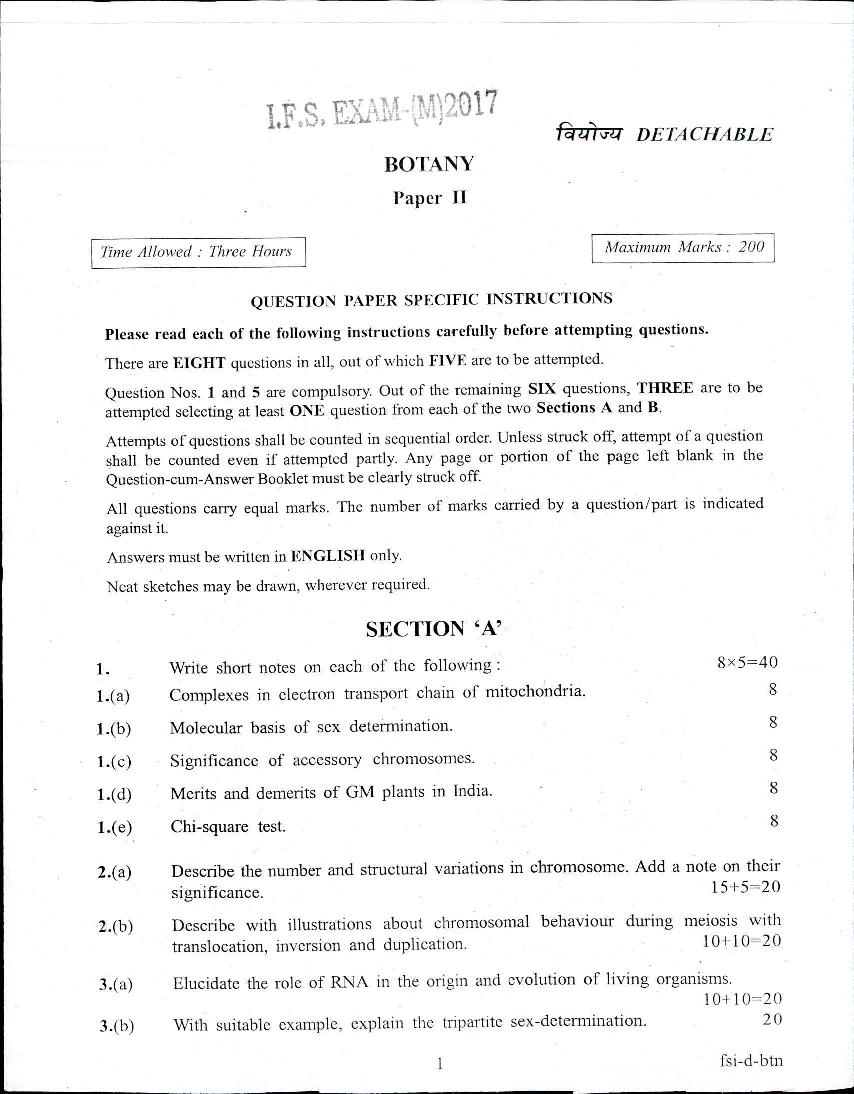
Here we are providing UPSC IFS Exam Question Paper for Botany Paper-II for year 2017 for the candidates so that they can prepare themselves for the upcoming IFS Examination.
UPSC IFS 2017 Question Paper for Botany Paper-II - Page 1 of 2

Finished viewing? Save it for later —

Download UPSC IFS 2017 Question Paper for Botany Paper-II (PDF · 2 pages)
Downloaded 3 times

About UPSC IFS 2017 Question Paper for Botany Paper-II

UPSC IFS 2017 Question Paper for Botany Paper-II is available here for free download. Published by UPSC for IFS, this question paper can be viewed online or downloaded as a PDF (2 pages). Candidates preparing for IFS can use UPSC IFS 2017 Question Paper for Botany Paper-II to understand the exam pattern, the type of questions asked, and the overall difficulty level.

Frequently Asked Questions

How can I download UPSC IFS 2017 Question Paper for Botany Paper-II?

Open this page and click the Download button to save UPSC IFS 2017 Question Paper for Botany Paper-II as a PDF. It is completely free on AglaSem Docs.

Is UPSC IFS 2017 Question Paper for Botany Paper-II free to download?

Yes. UPSC IFS 2017 Question Paper for Botany Paper-II can be viewed online and downloaded as a PDF free of cost on AglaSem Docs.

How many pages does UPSC IFS 2017 Question Paper for Botany Paper-II have?

UPSC IFS 2017 Question Paper for Botany Paper-II contains 2 pages, which you can read online or download together as a single PDF.

Where can I find more IFS study material?

You can find more IFS question papers, sample papers, syllabus, and answer keys on AglaSem Docs.

UPSC IFS 2017 Question Paper for Botany Paper-II – Text

Read the full text of this question paper below — useful to quickly search, copy and reference the content online without downloading the PDF.

📄 View text version (2 pages)

Page 1

q FIVAIM-AM\ 2017 I ase? aq ,rt4 DETACHABLE BOTANY Paper II Time Allowed : Three Hours Maximum Marks: 200 QUESTION PAPER SPECIFIC INSTRUCTIONS Please read each of the following instructions carefully before attempting questions. There are EIGHT questions in all, out of which FIVE are to be attempted. Question Nos. 1 and 5 are compulsory. Out of the remaining SIX questions, THREE are to be attempted selecting at least ONE question from each of the two Sections A and B. Attempts of questions shall be counted in sequential order. Unless struck off, attempt of a question shall be counted even if attempted partly. Any page or portion of the page left blank in the Question-cum-Answer Booklet must be clearly struck off All questions carry equal marks. The number of marks carried by a question/part is indicated against it. Answers must be written in ENGLISH only. Neat sketches may be drawn, wherever required. SECTION 'A' 1. Write short notes on each of the following: 8x5=40 Complexes in electron transport chain of mitochondria. 8 Molecular basis of sex determination. 8 Significance of accessory chromosomes. 8 Merits and demerits of GM plants in India. 8 1.(e). Chi-square test. 8 Describe the number and structural variations in chromosome. Add a note on their significance. 15+5=20 Describe with illustrations about chromosomal behaviour during meiosis with translocation, inversion and duplication. 10+10=20 Elucidate the role of RNA in the origin and evolution of living organisms. 10+10=20 With suitable example, explain the tripartite sex-determination. 20 1 fsi-d-btn

Page 2

Explain the bio-chemical and molecular basis of mutations. 10+10=20 Narrate briefly the various methods of gene transfer in plants. 20 SECTION 'B' 5. Write brief notes on each of the following: 8x5=40 Allelopathy 8 Intellectual property rights 8 Molecular markers in plant breeding 8 $.(d) Role of carotenoids in plants 8 5.(e) Evidences of organic evolution 8 "Calvin cycle is said to be autocatalytic" — Justify the statement. Compare the mode of CO2 assimilation in C3 and C4 plants. How does C4 pathway differ from C3 pathway in terms of efficiency? 5+10+5=20 Describe the role of phytohormones in agri-horticulture. 20 With illustration describe the structure of phytochrome. Explain the role of phytochrome in flower development process. 8+12=20 Describe the methods of breaking seed dormancy. Trace the physiological changes involved during seed germination. 8+12=20 Phytoremediation is not an ultimate solution to all the maladies of air and water. Explain in detail with specific examples. 20 Describe the various phytogeographical zones met within India and add their salient features. In an ideal situation, there will be a high temperature and rainfall with restricted snowfall plus Rhododendron, Oaks, Orchids and Ferns — what is your inference? 15+5=20 fsi-d-btn 2

Document Details

Board / OrgUPSC
ExamIFS
TypeQuestion Paper
Pages2
Updated30 Apr 2026